
When Grief Splits a Couple: How My Husky's Bed Became Our Bridge Back Together
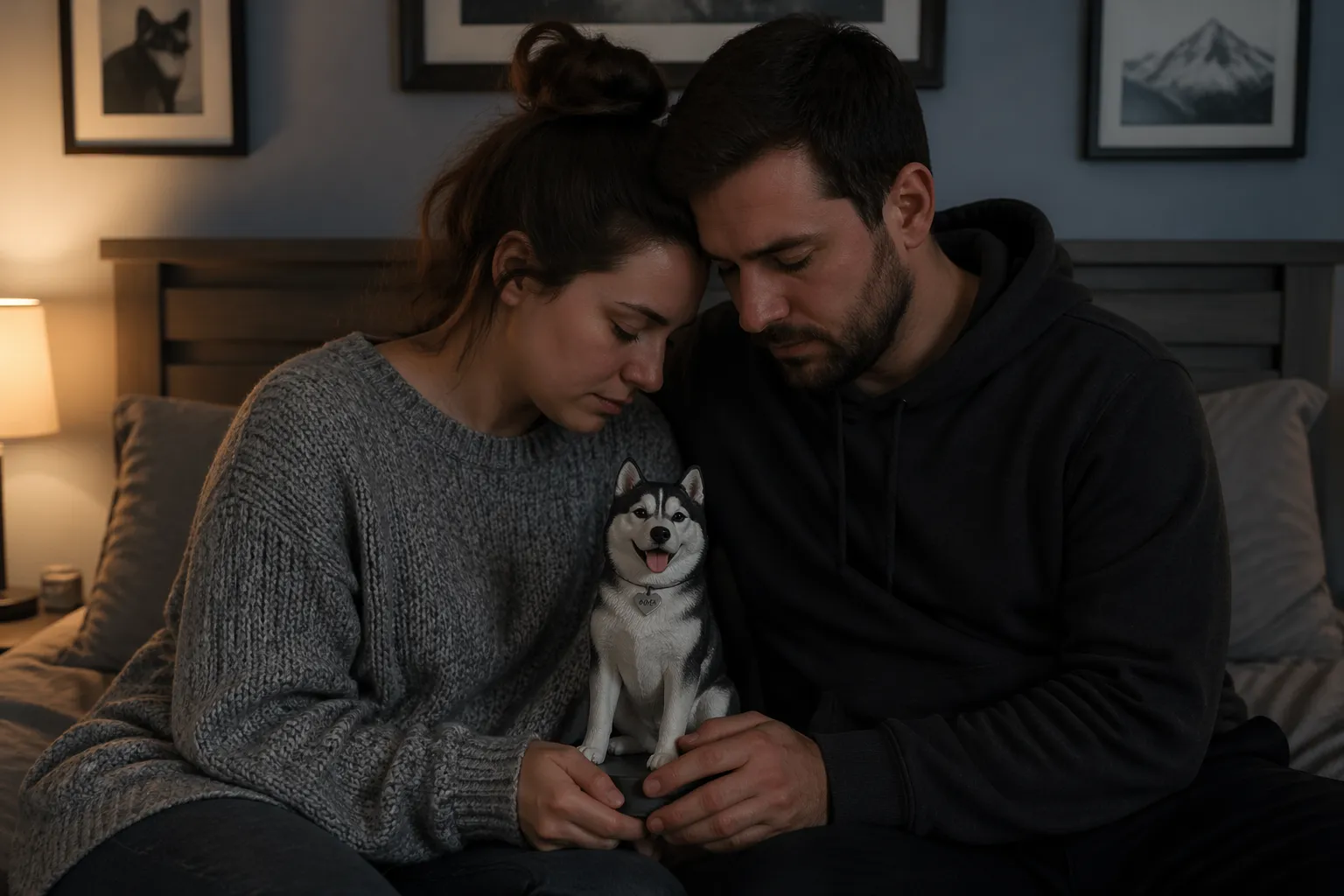
Three winters ago, pet loss grief looked like a gray husky bed shoved behind paint cans in the garage; this morning, the same bed sat by the workbench under a strip of cold light, and neither of us could decide whether touching it would help or wreck the day.
Quick Takeaways
- Name the mismatch early — one partner talking and one organizing is still grief.
- Use objects as bridges — choose one shared item to discuss for 10 minutes.
- Delay major memorial decisions — the first 72 hours can distort what feels right.
- If words keep failing, explore tangible memorial keepsakes that give grief a place to land.
Why couple grief after accident loss often turns into conflict
Most articles about couple grief assume the problem is communication. Often, it isn't. The real problem is timing.
After an accident loss, two people can love the same dog deeply and still grieve on different clocks. One person needs to talk on day one. The other starts cleaning the house, canceling appointments, washing bowls, answering texts. From the outside, that looks like one person is avoiding and the other is “feeling more.” But that reading is usually wrong.
What we’ve seen, over and over, is this: grief styles get mistaken for character flaws. The partner who starts organizing gets labeled cold. The partner who keeps replaying the accident gets labeled overwhelming. Then the second loss begins—not the dog this time, but the sense that you're on the same team.
That’s the missed angle most page-one articles skip. Grief between partners often doesn’t split a couple because they care differently. It splits them because their nervous systems choose different jobs.
One family we worked with lost a husky after a sudden road accident. By that evening, one spouse was scrubbing mud from the leash and collar because the smell of wet pavement made their chest tighten. The other was furious that the leash had been touched at all. Neither was being irrational. Both were trying to regain control.
And honestly, this is where the neuroscience of grief matters—not to sound clinical, but to stop blame from growing.
When the brain registers attachment loss, it doesn't process it like a neat, finished event. It keeps scanning for the missing being. That’s why you hear tags that aren’t there, reach for the food scoop at 6:00 p.m., or glance at the porch when rain hits the wood and smells like the evenings your dog used to wait by the door. The brain is running a prediction loop: husky should be here. When reality breaks that loop, stress rises fast.
Now add a partner. Two brains. Two prediction systems. Two protection strategies.
Usually, one of four patterns shows up in the first two weeks:
| Pattern | What it looks like | What it usually means | What helps |
|---|---|---|---|
| The Organizer | Washes bedding, handles calls, makes lists | Regaining control through tasks | Give one task, then schedule one memory talk |
| The Replayer | Repeats the accident details, asks “what if” | Brain searching for causality | Set a 15-minute replay limit, then ground in facts |
| The Preserver | Won’t move bowls, bed, collar | Protecting attachment cues | Keep one area unchanged temporarily |
| The Avoider | Changes subject, works late, scrolls constantly | Overloaded nervous system | Use short check-ins instead of deep talks |
None of these patterns automatically mean denial, selfishness, or a weak relationship.
The mistake most people make is trying to force matching behavior. “Talk more.” “Cry together.” “Clean it up.” “Move on.” That tends to backfire, because forced sameness feels like pressure, not comfort.
What actually helps more is role translation. In plain English: say what your behavior means before your partner has to guess.
Try sentences like:
- “I’m washing his blanket because I’m panicking, not because I’m done grieving.”
- “I keep telling the story because my brain thinks it can still change the ending.”
- “I don’t want the bed moved today—not forever, just not today.”
- “If I look distracted, I’m overloaded, not uncaring.”
That one shift can lower the temperature in the room fast.
"Different grief speeds can still move in the same direction."
The neuroscience of grief: why your husky’s bed can feel like a live wire
Let’s get practical. Why does a dog bed in the garage feel more dangerous than a hundred photos on your phone?
Because objects carry multi-sensory memory. A photo mostly hits sight. A bed carries shape, habit, and especially smell—that faint warm-dust scent of undercoat, the clean-laundry note from the blanket you washed two weeks before, maybe even the damp outdoor smell from snowmelt or rain on the porch. Smell has a direct line to memory and emotion centers in the brain. It bypasses your usual neat explanations.
So if you and your partner had a blowup over a bed, collar, or blanket, that doesn’t mean the object is trivial. It means the object is doing heavy neurological work.
Research on attachment and bereavement suggests that grief is not simply “letting go.” It’s updating a bond. Your brain has to learn: the relationship is still real, but the routines are different now. That update is slow. And physical cues can either support it or overwhelm it depending on how they’re handled.
Here’s the counterintuitive part: putting everything away immediately can prolong distress for some couples. Not because you need to build a shrine, but because sudden total removal can feel like a second shock to the brain.
For many households, a better plan is a staged transition.
A 3-step object plan for the first 14 days
- Choose one visible object to keep
- Move the rest into a “not final” box
- Review together after 7 to 14 days
We’re not vets or therapists, so if either of you is dealing with panic, inability to function, or self-harm thoughts, bring in professional support. But for many couples, this object plan lowers conflict because it removes the all-or-nothing trap.
A customer once told us the hardest part wasn't the urn or the paperwork. It was the smell trapped in a fleece throw that had ridden in the backseat for months. Her husband wanted it washed because he couldn't sleep. She wanted it untouched because she was terrified that one spin cycle would erase him. They finally cut the blanket in two. One half got washed. One half went into a memory box. That was the first compromise they’d managed in days.
There’s a larger lesson there: shared grief often improves when you stop trying to share the same exact method.
If you want a deeper overview of pet bereavement support options, the Association for Pet Loss and Bereavement is a genuinely useful resource. Not flashy. Just grounded help.
Why accident loss hits differently
An accident loss adds one brutal ingredient: unfinished prediction.
With illness, the brain sometimes gets partial rehearsal. Medications, vet visits, changes in appetite—none of that makes the goodbye easy, but it can create a rough timeline. With an accident, the brain gets no runway. It goes from ordinary routine to emergency in minutes. That abrupt switch often creates:
- Intrusive replay of the event
- Guilt loops about tiny decisions
- Anger at yourself, a driver, weather, timing, fate—take your pick
- A stronger need to assign blame because chaos feels unbearable
That’s why couples after accident loss often fight over facts. The route taken. The gate left open. The text not answered. The leash clip. The vet call. It can sound like problem-solving, but emotionally it’s often a search for a world where this could have been prevented.
And here’s the hard truth: sometimes there was no clean prevention. Tragedy doesn't always offer a satisfying cause-and-effect chain, even though grieving brains demand one.
"When couples argue over details, they’re often arguing with powerlessness."
— The PawSculpt Team
The emotional nuance nobody says out loud: relief, guilt, and the fear of forgetting
Let’s talk about the feelings people hide because they sound disloyal.
If your husky died after an emergency, a hard recovery attempt, or a frightening final day, you may have felt a split-second wave of relief mixed with grief. Relief that the chaos stopped. Relief that they weren’t gasping, pacing, hurting, or confused anymore. Then the guilt hit right behind it.
That reaction is more common than people admit.
It doesn’t mean you loved your dog less. It means your body had been bracing for distress and then, suddenly, the distress ended. The nervous system exhaled before your heart caught up. That gap can feel awful if you don’t understand it.
We’ve also heard from pet owners who carry regret about decisions in a very specific way: not “Did I love them enough?” but “Did I miss the exact right minute?” This shows up often around emergency euthanasia or fast medical decline. And yes, second-guessing euthanasia timing is normal. It’s one of grief’s meanest math problems because it asks for certainty where certainty didn’t exist.
Here’s a practical framework that helps some couples:
The Decision Reality Check
Ask these three questions together and write the answers down.
- What information did we have at the time?
- What suffering were we trying to prevent or end?
- Would we judge another loving family harshly for the same decision?
If your answer to number three is no—and it usually is—notice the double standard. Many grieving people extend mercy outward and punishment inward.
One evening routine from a customer still sticks with us. She would come into the kitchen at 7:10, still half expecting the click of nails on tile. Her partner would open the pantry, pause at the bag of treats, then shut it again. Neither spoke for the first few nights. Then they started leaving one note on the counter before bed: one memory, one regret, one thing they did right. It took under three minutes, and it gave their grief somewhere to go besides each other.
That kind of small structure matters because fear of forgetting can make couples rigid.
One partner wants to talk constantly so the details don’t fade—the wet fur smell after snow, the way the ears tipped forward at the garage door, the circle he made before dropping onto the bed. The other wants less talking because the details are too sharp. Both are trying to protect memory. Again, same goal. Different route.
If fear of forgetting is driving tension, build a memory capture system before memory capture turns into memory warfare.
A simple memory capture system that works
Use one shared note, document, or notebook with four categories:
- Looks — eye color, tail curl, white patch shape, nose freckles
- Habits — where they waited, how they asked for dinner, morning routine
- Sounds — the “woo,” the tag jingle, the heavy exhale onto the floor
- Smells — blanket, paws after rain, sun-warmed fur, car-seat smell
The category most people skip is smell. That’s a mistake. Smell memory fades fast in language, even when it lingers in your body. Write it down while you can still name it.
Here’s a table you can use to tell the difference between common grief reactions and signals that extra support may help.
| Experience | Common in early pet loss grief | Usually worth extra support if... | What to do next |
|---|---|---|---|
| Replaying the accident | Yes, especially first 2 weeks | It disrupts sleep/function beyond several weeks | Contact a grief counselor or trauma-informed therapist |
| Fighting about objects | Very common | Every discussion becomes hostile or avoidant | Use a written object plan, then involve a mediator/therapist |
| Guilt about relief | Common after suffering or emergencies | It becomes self-punishing or obsessive | Use the Decision Reality Check; discuss with a counselor |
| Fear of forgetting | Very common | It leads to isolation or compulsive reviewing | Build a memory archive with time limits |
| Shame about grief intensity | Common, especially if others minimize pet loss | You stop talking to supportive people | Join a pet loss support group like APLB |
And yes, feeling judged by others is real. Some people understand pet loss immediately. Others say clumsy things—“Are you getting another one?” or “At least it wasn’t a person.” That can make a grieving couple retreat into their own bubble and then turn on each other when the pressure builds.
A useful line to keep ready is: “We’re not looking for solutions right now. We’re honoring a bond.”
Short. Clear. Hard to argue with.
How to use a husky memorial as a bridge, not a battleground
A husky memorial can help a relationship—or strain it. The difference is whether the memorial becomes a test.
If it turns into “Do you love him enough to want this?” or “If you choose that, you’re erasing him,” the memorial stops being a tribute and starts acting like a courtroom exhibit.
We’re not huge fans of rushing this part.
Within the first 48 to 72 hours, couples are often making choices with stress chemistry still running high. That’s not the best time for permanent decisions unless logistics force them. For most memorial items, a short pause leads to better choices.
The memorial rule we recommend
Choose one memorial for function and one memorial for meaning.
That split prevents a lot of conflict.
- Function memorial: something that organizes grief in daily life Example: a framed photo by the entryway, a memory box, a shelf for collar and tag.
- Meaning memorial: something that captures identity Example: a custom figurine, a paw print display, a planted tree, a written tribute.
Why this works: couples often disagree because one person wants usefulness and the other wants symbolism. You may need both.
One order that stuck with us came from a couple who had barely agreed on anything since their dog’s accident. He wanted the garage cleared because every glance at the old bed derailed his workday. She wanted a visible reminder because she feared that once the objects were gone, daily life would swallow the memory whole. Their solution was smart: store the bed, keep one photo in the kitchen, and commission a figurine for the bookshelf where they both passed every morning. Not a shrine. Not avoidance. A middle path.
That’s one reason some families choose custom pet figurines. A figurine can hold detail without holding decay. No trapped odor, no fragile fabric, no pressure to preserve an object exactly as it was. Just a stable form of recognition.
And for households split between “put everything away” and “leave everything out,” that matters more than people realize.
Why figurines can help when photos don’t
Photos are powerful, but they’re also slippery. They live in phones, get buried in camera rolls, and often capture a single angle or mood. A well-made figurine does something different: it gives grief location.
With PawSculpt, the process is digitally modeled by experienced 3D artists, then precision 3D printed in full-color resin. The color is part of the material itself, not added on top afterward. A protective clear coat is applied for sheen and durability, but the markings—the white chest patch, darker saddle, soft facial mask—are printed directly into the resin through advanced full-color 3D printing technology.
That’s useful for memorials because markings matter. Husky people know this instinctively. One asymmetrical eyebrow marking can be the whole dog.
We’ll be real: a figurine is not for everyone. If any visual reminder feels too activating in the first week, wait. A memorial should support your nervous system, not flood it.
But if you’re looking for a tangible bridge—something more present than a photo and less raw than an unwashed bed—it can be the right fit. You can explore the options at PawSculpt’s pet memorial page when you’re ready, not before.
Memorial options by relationship need
This table helps couples choose based on what they actually need, not just what sounds nice.
| Memorial type | Best for | Emotional strength | Possible downside | Good couple compromise? |
|---|---|---|---|---|
| Photo book | Storytelling partner | High memory detail | Can trigger long scrolling sessions | Yes |
| Memory box | Organizer partner | Contained and flexible | Easy to avoid indefinitely | Yes |
| Garden stone/tree | Outdoor ritual | Seasonal comfort | Weather and maintenance | Sometimes |
| Custom figurine | Shared visible remembrance | Strong identity capture | May feel intense too soon for some | Often |
| Collar on hook/shelf | Simple daily cue | Low effort, steady presence | Less detailed than other options | Yes |
The commonly overlooked point: the best memorial is not always the most emotional one. It’s the one your relationship can actually live with.
"A memorial works best when both people can look at it without bracing."
A day-in-the-life routine for couples moving through pet loss grief
Big emotional conversations are overrated when a couple is raw. Helpful structure usually beats emotional ambition.
Here’s a realistic morning routine for the first month—especially if one of you is functioning and the other feels wrecked.
At 6:40 a.m., one partner starts coffee and opens the back door out of habit. The air smells like wet concrete and old leaves, and for one second both bodies still expect the husky to trot through. Instead of pretending that didn’t happen, one of you says, “There it is—the morning hit.” Then you put a hand on the counter, stand still for ten seconds, and continue with breakfast.
That tiny script does two things. It names the trigger. And it prevents the trigger from becoming a silent wedge.
The 10-minute bridge ritual
Try this once a day for 10 minutes, preferably at the same time.
- Minute 1-2: State your grief weather
- Minute 3-5: Share one object, memory, or trigger
- Minute 6-8: Ask one concrete question
- Minute 9-10: End with one plan
This structure sounds plain because it is plain. That’s the point.
The mistake most couples make is waiting until one of them breaks open in the middle of the kitchen, then trying to solve everything in one conversation. Short, repeated contact works better because it respects the nervous system’s bandwidth.
Three phrases that lower defensiveness fast
Use these exactly if you need to:
- “I’m not asking you to grieve like me. I’m asking you to translate what you’re doing.”
- “Can we make this decision temporary instead of forever?”
- “I want us on the same side of the loss, not opposite sides of the room.”
That last one has saved more than a few hard evenings.
What not to do in the first two weeks
Skip these if you can:
- Don’t make “Should we get another dog?” a pressure-filled conversation Anxiety about getting another pet is common. Early urgency is often a pain-management strategy, not clarity.
- Don’t throw away all pet items during a fight That decision is almost always regretted.
- Don’t use outsiders as judges Friends and relatives can support, but they shouldn’t become the jury for whose grief is “right.”
- Don’t demand tears as proof Some people cry immediately. Others become strangely competent for a while, then crash at week three.
If surviving pets are part of your household, keep an eye on them too. The AVMA’s pet loss resources are a solid place to start, especially for routines and family support.
If your arguments keep circling the accident
Then stop debating memory and switch to documenting fact.
Make a page with two columns:
| Facts we know | Questions we can’t answer |
|---|---|
| Time of accident | Why this happened on this exact day |
| What the vet told us | Whether one tiny change would have altered everything |
| What actions we took | What our dog “would have wanted” in abstract terms |
| Who was present | Whether blame will actually reduce pain |
This is a deceptively powerful exercise. It separates solvable uncertainty from unsolvable uncertainty.
And grief gets much more manageable when you stop assigning yourself homework you cannot complete.
Building a shared memory system that supports healing, not pressure
By week two or three, many couples hit a strange phase. The emergency is over. The casseroles and texts slow down. Work resumes. Laundry resumes. The garage still smells faintly like cedar shavings, motor oil, and dog fur. That’s often when the real divide shows up.
One person thinks, “We need a system before memory starts fading.” The other thinks, “If we systematize this, it becomes real.” Both reactions make sense.
What helps here is a shared memory system with boundaries.
Not constant grieving. Not forced closure. A container.
The 4-part shared memory system
1. The archive
This is where everything goes before decisions are made.
Include:
- photos
- videos
- voice notes
- vet notes if you want a factual record
- scanned sympathy cards
- written memories from friends
Create one digital folder and one physical box. That’s enough.
2. The display
Choose one small visible place in the home.
Not five places. One.
It might be:
- a shelf near the kitchen
- a corner table
- a frame and figurine on a bookcase
- a hook with collar and one photo
This protects against two extremes: turning the whole house into a trigger field, or erasing every sign the dog lived there.
3. The ritual
Keep it simple and repeatable.
Examples:
- every Sunday evening, add one memory to a notebook
- on the adoption anniversary, make the dog’s favorite trail walk
- light a candle once a month during dinner
- say the dog’s name out loud when the first snowfall comes
Ritual matters because the brain likes predictable containers for emotion. Not because ritual is magic, but because repetition lowers chaos.
4. The future marker
This is the part people miss.
Ask: How will we know our memorial is helping, not freezing us?
Possible answers:
- We can look at it without immediate argument.
- We feel more connected after interacting with it.
- It invites memory without derailing the whole day.
- It reminds us of personality, not only the final event.
That last one is crucial after accident loss. The final hour can hijack the full story unless you intentionally rebalance the memory field.
Why a custom figurine can be especially useful after sudden loss
After sudden death, many photos become contaminated by timeline. You know which pictures were taken a week before. You know which toy was still in the car. You know what happened afterward. A physical memorial that represents the pet in a stable, healthy posture can interrupt that chain.
That’s one reason families come to us for 3D pet sculptures and memorial figurines. The goal isn’t to create something “perfect.” In fact, a little visible print grain or texture can make the piece feel more honest—real material, real presence, not an airbrushed fantasy. PawSculpt’s full-color resin process captures markings directly in the material, then a clear protective coat adds durability and sheen. No painted-on layer to chip away from the memory itself.
A family we worked with after a husky loss told us the figurine became the first object they could both approach without conflict. The bed was too loaded. The leash felt accusatory. Phone photos kept leading back to the day of the accident. But the figurine on the shelf simply said: he was here, and he looked like himself.
That distinction can be healing.
If one partner wants a memorial and the other doesn’t
Don’t force a yes-or-no vote. Use this three-option framework instead:
- Visible shared memorial
- Private individual memorial
- Delayed decision with review date
Set a review date within 2 to 6 weeks. Open-ended delays turn into resentment. Short-term delays create breathing room.
Here’s a practical comparison:
| Approach | Best when | Benefit | Risk | How to make it work |
|---|---|---|---|---|
| Shared memorial now | Both want a visible tribute | Creates joint meaning | Can feel rushed | Start small and revisable |
| Private memorials | Grief styles differ sharply | Lowers conflict | Can feel emotionally separate | Explain the meaning to each other |
| Delay and review | Emotions are too raw | Prevents regret | Avoidance can stretch on | Put the review date on the calendar |
And if you’re the partner who worries a memorial means you’ll never “move forward,” here’s the overlooked truth: some people move forward better because memory has a designated home. Uncontained grief leaks everywhere. Contained grief can coexist with ordinary life.
What healing together actually looks like after pet loss grief
It usually doesn’t look dramatic.
It looks like less flinching.
Less fighting over whether the dog bed stays in the garage another week. Less scanning your partner for evidence that they care enough. Less need to defend your grief style like a court case.
Healing together often starts with a small agreement: we are not going to use love as the thing we measure here.
Because that’s what couples do by accident. One person cries more, so they seem to hurt more. One person handles the practical tasks, so they seem to care less. That math is false. It just feels convincing when everyone is exhausted.
In our years working with pet families, the couples who reconnect best tend to do three things:
1. They separate grief from blame
This is huge after an accident.
If there was genuine negligence, that’s a separate conversation and may need serious support. But many couples are stuck in pseudo-blame—tiny hypotheticals, impossible replays, moralizing ordinary mistakes because random loss feels unbearable.
If you keep returning to the same question and no new information appears, you are probably not solving a problem anymore. You are feeding a wound.
2. They create a shared language
Not therapy language. House language.
Maybe it’s:
- “morning hit”
- “garage wave”
- “porch smell day”
- “I’m in replay mode”
- “I can do tasks, not talking”
Shared language reduces explanation. And in grief, reduced explanation can be mercy.
3. They build one future action that includes the dog’s memory
Not replacing. Including.
Examples:
- volunteer at a sled dog rescue once a year
- donate old supplies after choosing one keepsake
- create a shelf with a figurine and adoption photo
- take the familiar trail on the dog’s birthday
The point is not to stay sad forever. The point is to stop treating memory and ordinary life as enemies.
One small but important caution: if conflict becomes relentless, if one partner is using contempt, or if grief is exposing deeper relationship fractures that were already there, outside help matters. Couples counseling can be deeply useful here, especially with someone who respects the human-animal bond instead of minimizing it.
And if you’re worried your response is “too much,” you’re not alone. Shame about grief intensity is common in pet loss, especially when the wider world treats it like a footnote. But attachment doesn’t care about social rankings. It cares about daily life, body memory, and who was there at the door, on the floor, in the car, by the bed.
That’s why a husky bed in a garage can hold more charge than a whole week of sympathetic texts.
Closing the distance without erasing the dog
The dog bed in the garage may never become neutral. That’s okay. Neutral isn’t the goal.
The goal is that one day you both see it—or the shelf, the figurine, the old blanket, the empty hook—and instead of bracing against each other, you recognize the same thing at the same time: this mattered, and it still does.
Start small. Pick one object this week. Give it a job. Maybe it stays where it is for seven more days. Maybe it goes into a labeled box. Maybe it becomes the starting point for a shared husky memorial that remembers your dog’s face, stance, and markings instead of only the worst day of your life.
If words have turned slippery between you, use structure. Ten minutes. One memory. One decision. No courtroom. No scoring system.
That’s how many couples begin to come back together—not by solving grief, but by building a bridge sturdy enough to carry it.
Frequently Asked Questions
Is it normal for couples to grieve a pet differently?
Yes. Very normal.
One partner may need to talk in detail, while the other becomes highly task-focused or emotionally quiet. That difference can look personal, but it usually reflects different nervous-system responses to the same loss. The goal is not identical grief. It’s understandable grief.
Why does accident loss cause more conflict between partners?
Because sudden loss creates a brutal scramble for explanation.
The brain wants a cause-and-effect chain it can trust, so couples often start revisiting details, timelines, and tiny decisions. That doesn’t always mean the relationship is failing. Often, it means both people are trying to push back against helplessness in the only way they know.
How soon should we make pet memorial decisions?
If logistics allow it, wait at least 48 to 72 hours before making permanent memorial choices.
That short buffer helps reduce “panic decisions.” In the meantime, keep one comfort object visible, place the rest in a decide-later box, and revisit options together after a week or two. That simple pause can lower regret and reduce couple conflict.
Is relief after a pet dies normal?
Yes—and many people feel ashamed admitting it.
If your dog had been suffering, struggling, or in crisis, your body may have felt relief the moment that distress ended. That response does not mean you wanted them gone. It means your nervous system registered the end of emergency before your heart could process the loss.
Can a custom figurine help with pet loss grief?
For many families, yes.
A figurine can give grief a physical place to land, especially when photos feel too digital and belongings feel too raw. PawSculpt creates pieces that are digitally sculpted by experienced 3D artists, then precision 3D printed in full-color resin, which can be especially meaningful when a family wants to preserve distinctive markings and expression in a stable form.
What photos work best for a husky memorial figurine?
Clear, well-lit photos from multiple angles are best—front, both sides, and a favorite expression if you have it.
Try to include pictures that show coat pattern, eye color, facial markings, and body shape. If you’re considering a figurine, gathering those images can also be a healthy memory exercise for couples because it shifts the conversation from the final day to the full life.
Ready to Celebrate Your Pet?
Every pet has a story worth preserving. Whether you're honoring a beloved companion who's crossed the rainbow bridge or celebrating your furry friend's unique personality, a custom PawSculpt figurine captures those details that make your pet one-of-a-kind. For families navigating pet loss grief, a tangible tribute can become more than décor—it can be a steady place for memory, love, and connection.
Visit pawsculpt.com to learn more about our process and guarantees