
Five Years Later: How My Siamese Cat's Last Video Became My Spiritual Anchor
The rubber grip of an old phone case stuck to my palm in the garage, and the screen lit up with my pet loss grief anchor: a 14-second video of a Siamese tail flicking once against a cold concrete floor.
Quick Takeaways
- Use one short video as a ritual — replay the same clip weekly instead of doom-scrolling.
- Touch matters more than storage — choose keepsakes you can hold, not just files you save.
- Mixed emotions after pet loss five years later are normal — especially guilt, relief, and fear of forgetting.
- If you need a tangible memorial, explore custom pet figurines that preserve markings, posture, and presence.
- Create a sacred space with limits — ten intentional minutes helps more than all-day rumination.
Why one last video can matter more than 10,000 photos in a grief journey
Most memorial advice starts with volume. Make the album. Print the collage. Back up every image.
We disagree.
In our years working with pet families, the standout pattern is this: one repeatable sensory artifact often helps more than a giant archive. Not because the archive lacks meaning. Because grief rarely needs more content. It needs an anchor.
A phone gallery can become a digital attic. Heavy. Dusty. Full of emotional splinters. You open it looking for comfort and leave wrecked because there are 4,000 thumbnails, six accidental screenshots, three medication photos, and then suddenly the final week.
A single video works differently.
It creates a ritual loop. Same sound. Same movement. Same length. Same return. Your nervous system starts to recognize it as a doorway, not an ambush.
That’s the unique part many articles miss. The goal is not maximum documentation. The goal is predictable contact with memory.
We’ve seen this with cat families especially. A Siamese cat memorial often carries an extra charge because Siamese cats are so physically expressive—those sharp blue eyes, the elegant neck, the weightless way they perch, the insistent voice that seems to come from another room and another realm at once. Photos capture beauty. But a short video captures presence.
And presence is what grief hunts for.
The overlooked problem with “save everything”
One customer told us she spent two years avoiding all her cat photos because every time she opened her camera roll, she hit the final vet visit by accident. That’s common. Not dramatic. Common.
The mistake most people make is assuming more access equals more healing.
Usually, more access equals more unpredictability.
A better approach:
- Choose one video under 30 seconds
- Rename it with a comforting title, not a date
- Move it into its own album
- Watch it at a chosen time, not whenever panic strikes
- Stop after one or two viewings
Why does this matter? Because grief responds to rhythm. A chosen ritual calms the body in a way random exposure doesn’t.
If your video includes background sounds—a garage door hum, your shoes on concrete, a collar tag tapping against a bowl—don’t edit those out too fast. Those details can become sacred. They carry texture. They prove the bond happened in the ordinary world, not just in idealized memory.
"Grief needs rhythm more than it needs endless replay."
A micro-story we’ve heard more than once
A family we worked with kept returning to the same 11-second clip: their Siamese cat stepping over a coiled extension cord in the garage, pausing, then looking back toward the camera with that unmistakable “Are you coming?” expression. They had hundreds of better-lit photos. But this was the clip.
Why? Because it held the cat’s attitude. Not just the face. The spirit.
That’s worth noting. For spiritual healing, the energetic signature of a pet often lives in motion and stance, not just still imagery.
Why touch and texture change the grief equation
This article’s title points to video, but here’s the counterintuitive insight: the clip often helps most when it leads you back into the physical world.
Grief can become too screen-based. Too flat. Your pet was warm. Fur had drag and direction. Ears felt like velvet or silk. Paw pads were dry, rough, slightly cool after a nap. Whiskers brushed your wrist like wire.
A phone can trigger memory. But touch completes it.
That’s why the memorials that endure tend to have texture:
- a blanket edge worn thin
- a collar with softened leather
- a smooth ceramic dish
- a figurine with real weight in the hand
- a blanket box you open slowly, not compulsively
If you’re five years into a grief journey and still feel unsteady, the issue may not be “not enough time.” It may be not enough embodied ritual.
We’re not therapists, and for severe or prolonged impairment it’s wise to seek professional grief support. The Association for Pet Loss and Bereavement is a genuinely useful place to start. But in day-to-day living, one of the best shifts is simple: move memory out of the cloud and into your hands.

Pet loss five years later: what changes, what doesn’t, and what surprises people
Five years is long enough for other people to stop asking.
It is not always long enough for your body to stop expecting the old pattern.
That’s one of the hardest truths in pet loss five years later. The sharpness usually changes. The bond doesn’t.
We’ve heard versions of the same moment from cat owners over and over: you step into the garage with groceries and instinctively angle your foot to avoid a cat who isn’t there. You hear a small thud and think, for half a beat, “What did she knock over now?” You feel the edge of a fleece throw and your hand pauses because that texture belonged to lap-time.
These are not failures to move on. They are body memories.
The emotions people rarely say out loud
Here’s the one we want to name directly: fear of forgetting.
Not forgetting the name. Not forgetting the obvious facts. Forgetting the exact shade of cream against seal-point fur in winter light. Forgetting how heavy she felt when she leaned bonelessly into your forearm. Forgetting the tiny pause before she jumped onto the workbench. Forgetting the sound she made when she wanted you to follow her.
This fear is more common than people admit.
And it can make you do strange things. Keep broken objects because she touched them. Refuse to move a food mat for years. Avoid adopting again because a new routine might overwrite the old one. Replay the final days too often because your brain confuses painful memory with faithful memory.
That last part matters. A lot.
Pain is not proof of devotion. Rehearsing the worst moment does not protect the best ones.
What actually helps more is building a memory hierarchy:
- Core memory: one video, one photo, one physical object
- Supporting memories: five to ten additional images or stories
- Archive: everything else, stored safely but not constantly viewed
This structure reduces panic. You know where the essence lives.
Relief mixed with grief is not betrayal
Another emotional nuance we want to say plainly: many pet owners feel relief mixed with sadness after a difficult illness or a hard euthanasia decision. Then guilt slams in right behind it.
That relief does not make you cold.
It often means your nervous system had been braced for weeks or months—medication schedules, appetite checks, litter box monitoring, late-night breathing worries, emergency vet math, constant scanning. When suffering ends, your body unclenches before your mind gives permission.
One of our customers described it this way: she cried in the parking lot, then slept six straight hours for the first time in months, and woke up ashamed. She thought rest meant she had failed her cat.
No. It meant the vigil was over.
If you’re second-guessing euthanasia timing even years later, focus on patterns, not one isolated hour. Was your cat withdrawing? Hiding? Eating less? Struggling with mobility or comfort? A veterinarian is the right voice for medical clarity, and the AVMA’s resources on end-of-life care can help frame those decisions compassionately. But emotionally, here’s the truth: people who worry they acted too soon are usually the same people who waited out of love as long as they responsibly could.
"The relief you felt when suffering ended was love, not disloyalty."
A practical timeline that respects real grief
Most grief articles flatten the timeline into neat stages. Real life is messier. Still, a broad map helps.
Here’s our best editorial version—the one that actually matches what pet families tell us.
| Timeframe | What often happens | What helps most | What to avoid |
|---|---|---|---|
| First 72 hours | Shock, logistical haze, compulsive checking | Simple rituals, hydration, one trusted person | Making big memorial decisions fast |
| Weeks 2-6 | Routine disruption hits hard | Structured remembrance, sleep support, short walks | Endless photo scrolling at night |
| Months 2-6 | Social support fades; isolation spikes | Scheduled memory practices, grief groups | Assuming you should be “done” |
| Year 1 | Anniversaries and seasons sting | Marker rituals, storytelling, tangible keepsakes | Comparing your timeline to others |
| Years 2-5+ | Sharp triggers become more specific | One anchor object/video, legacy practices | Erasing reminders to “prove” healing |
The standout here is the last row. Years later, grief often gets more precise, not less meaningful. Fewer all-day breakdowns. More specific ambushes. The garage. The winter sun spot. The sound of dry food in a metal scoop.
That precision is why a siamese cat memorial works best when it captures exactness, not generic cuteness.
Building a siamese cat memorial that feels like a sacred space, not a shrine you avoid
Some memorials comfort you. Others intimidate you.
We’re not huge fans of memorial setups that feel so precious you stop interacting with them. A memorial should invite contact. Not freeze the room.
The better model is a sacred space with circulation. Alive. Touched. Revisited. Adjusted as your relationship with grief changes.
Our top picks for memorial anchors
After seeing thousands of pet families create remembrance rituals, a few memorial forms consistently stand out. Not because they’re trendy. Because they invite return.
1. A single-video ritual station
Who it’s for: people overwhelmed by digital clutter or startled by random photo triggers.
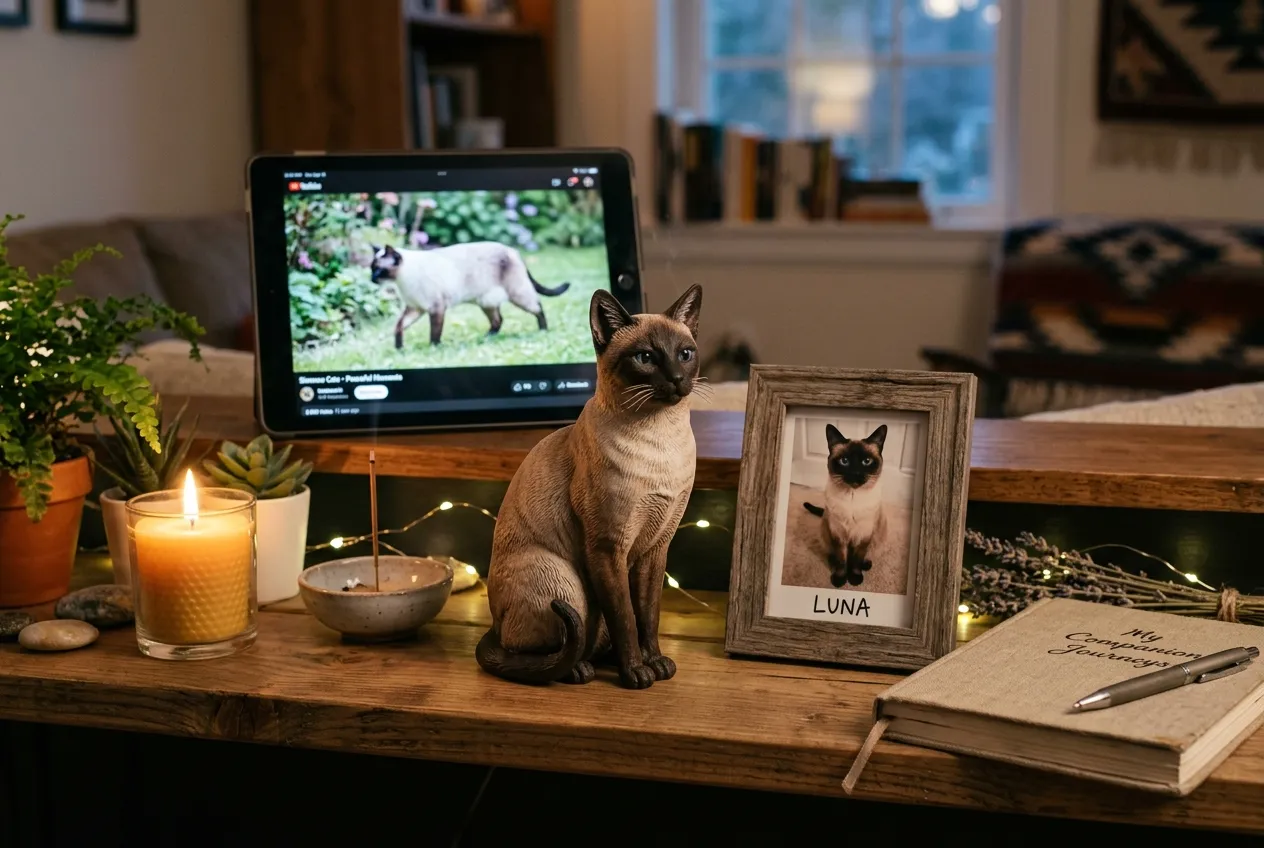
Set one phone stand, one candle, one small object on a shelf, dresser, or garage ledge you already use. Once a week, press play on the same clip. Sit for 60 to 120 seconds. Stop.
Why it stands out: It gives grief boundaries. You are not waiting to be ambushed by memory; you are meeting memory. That shift restores agency.
Pro tip: Don’t pick the “best” video. Pick the one that contains personality.
2. A texture box
Who it’s for: people whose grief is deeply tactile.
Use a small box with three to five touch-based objects:
- collar
- favorite blanket corner
- toy mouse
- brush
- a note describing fur texture in your own words
Why it stands out: Touch pulls memory into the body quickly. Faster than reading. Faster than scrolling.
Pro tip: Keep the box accessible, not buried in storage.
3. A custom figurine with real physical presence
Who it’s for: people afraid visual memory is fading.
This is where a carefully made 3D pet sculpture can be powerful. PawSculpt, for example, creates museum-quality custom pet figurines that are digitally sculpted by master 3D artists, then precision 3D printed in full color. The markings aren’t added as surface paint—the color is printed directly into full-color resin, then protected with a clear coat. That matters because the result feels stable, specific, and true to the pet’s patterning.
Why it stands out: A figurine gives memory weight. You can feel the cool surface warm in your hand. You notice the curve of the spine, the set of the ears, the way the body occupies space. For many grieving cat owners, that physicality does more than another framed photo.
Pro tip: Choose reference photos that show posture, not just the face.
4. A living ritual object
Who it’s for: people who need grief to move, not sit still.
This might be a plant near the window your cat loved, a folded throw on a bench, or a lamp that turns on at dusk in their honor.
Why it stands out: It keeps the bond integrated with life instead of sealing it off.
Pro tip: The ritual should take under two minutes or you won’t keep doing it.
What a sacred memorial space should feel like
Think less “display” and more energetic landing place.
A good memorial area usually has:
- One visual focal point
- One tactile element
- One small ritual action
- A limit, so it doesn’t become a grief trap
That last point is worth underlining. If you create a beautiful memorial corner but then sit there spiraling every night for 90 minutes, the space stops serving you.
Try the 10-minute rule:
- 2 minutes to arrive
- 3 minutes to watch or hold an object
- 3 minutes to say one memory out loud
- 2 minutes to close the ritual
Yes, close it. That matters spiritually. Open. Witness. Close. It tells your mind and body that the bond continues without requiring total emotional collapse.
Memorial options at a glance
If you’re deciding what kind of anchor fits your grief style, this table makes the tradeoffs clearer.
| Memorial option | Best for | Texture / touch factor | Emotional intensity | Effort to maintain |
|---|---|---|---|---|
| Single video ritual | Strong memory, low clutter | Low | High at first, steadier over time | Low |
| Photo album | Storytelling families | Low | Variable | Medium |
| Texture box | Tactile grievers | High | Deep but grounding | Low |
| Custom figurine | Fear of forgetting details | High | Strong, often stabilizing | Low |
| Memorial garden | Outdoor ritual lovers | Medium | Seasonal waves | Medium |
No one option wins for everyone. But for spiritual healing, our favorite combinations are one visual anchor plus one tactile anchor. Screen plus object. Memory plus matter.
"A memorial works best when it lets love land somewhere."
— The PawSculpt Team
Spiritual healing after pet loss: the part most advice skips
A lot of grief content gets shy around the spiritual dimension. We won’t.
Not because everyone believes the same thing. They don’t. But because many grieving pet owners experience the bond as more than biography. It feels like ongoing presence.
The cat who always appeared at your feet during your worst nights. The gaze that changed the emotional weather of a room. The odd sense, years later, that some corners of the house still hold charge.
You don’t need to force that into doctrine.
You can simply treat it as relationship.
The spiritual contract idea
One way to understand a long grief journey is this: some animals arrive as companions; others arrive as soul mirrors. Siamese cats, in particular, often get described this way by their people. They are socially intense, almost oracular. They don’t just share space. They participate in your inner life.
So when they die, the rupture isn’t only practical. It’s metaphysical.
That’s why “just remember the good times” can feel so thin. You’re not only missing events. You’re missing a witness.
A spiritual approach asks a different question: How does the relationship continue in changed form?
Not fantasy. Practice.
Three rituals we actually think are worth doing
We’ve seen plenty of ritual ideas. Some are lovely. Some are elaborate enough that they collapse after a week. These three tend to last.
Name the continuing role
Write one sentence that describes who your cat still is in your life.
Examples:
- Guardian of stillness
- Keeper of my evening rituals
- The spirit who taught me gentleness
- My threshold companion
Why this works: grief often gets stuck when identity has no new place to go. A continuing role gives the bond structure.
Create a threshold touch ritual
Thresholds matter spiritually. Doorways. Garages. Stair landings. Places between states.
Choose one threshold your cat used often. Each time you pass, touch the frame, your chest, or a memorial object and say a short phrase:
- Walk with me
- Still here
- Thank you for this day
This is not about pretending they are physically present. It’s about training your attention toward continuity.
Use the last video as invocation, not evidence
This one surprised even us.
Many people replay the last video like evidence in a trial. Proof they existed. Proof they were loved. Proof the final days happened the way they remember.
That can become compulsive.
Try a different frame: before pressing play, say, “I’m here to visit, not investigate.”
That sentence changes the energy immediately. You stop scanning for what you missed and start receiving what remains.
A story from one family that stayed with us
A customer sent photos of a small memorial shelf in the garage workshop where her Siamese cat used to supervise every project. There was a folded work rag, a smooth stone, and a figurine beside an old phone stand. No clutter. No dramatic signage.
She told us she watched the same clip every Sunday before tidying the bench. “It’s not a grief session anymore,” she wrote. “It’s more like checking in with a wise, bossy spirit.”
That line stuck with us because it captures the shift so well. The relationship moved from acute absence to active legacy.
That’s the real destination of spiritual healing after pet loss. Not amnesia. Not replacement. Re-patterning.
If signs comfort you, use them carefully
We’ll be real: many people report “signs” after pet loss. A shadow near the food area. A familiar weight at the bed’s edge. A sudden memory arriving with unusual force.
We’re not here to validate or dismiss every experience.
But we do think this matters: if a sign leaves you more grounded, more loving, more able to function, it may be serving a healthy role. If it keeps you from living in the present, narrows your world, or escalates anxiety, take a step back.
The line is simple. Comfort should widen your life, not shrink it.
And if your grief starts affecting sleep, work, eating, or relationships in a prolonged way, professional support is wise. That’s not a spiritual failure. It’s care.
Counter-Point: don’t turn a memorial into a substitute for living
Here’s where we want to challenge our own advice.
Tangible memorials can help tremendously. Ritual can help. A figurine can anchor memory. A video can steady the week.
But.
There is a version of memorializing that becomes avoidance in beautiful packaging.
We’ve seen it. Someone spends months perfecting the shelf, arranging candles, commissioning multiple objects, editing videos, rewriting tribute captions... and never actually sits with the simplest truth: the relationship changed, and life must change with it.
A memorial is not meant to preserve your home as a museum of before.
It’s meant to support your movement through after.
Signs your memorial practice may be tipping into avoidance
- You spend more time organizing memorial items than engaging with people
- You feel panic if an object is moved by an inch
- You refuse to clean, rotate, or touch the setup
- Every visit to the space ends in a multi-hour emotional crash
- You use ritual to avoid decisions about work, health, or relationships
If that’s you, no shame. Honestly, it happens.
- Remove one nonessential item
- Shorten the ritual by half
- Add one outward-facing action after the ritual—text a friend, water a plant, take a walk, feed a living pet
This “outward step” is crucial. It tells your nervous system that remembrance and participation can coexist.
What if you’re worried a figurine or keepsake will feel too intense?
Valid concern.
For some people, the most helpful memorial in the first month is not visual at all. It’s a scent-free blanket, a written letter, or a donation in the pet’s name. A physical likeness may feel too direct too soon.
For others, the opposite is true—they need something concrete immediately because the lack of form is what hurts most.
There’s no purity test here. Our editorial take is simple:
- If seeing your pet’s likeness stabilizes you, lean in
- If it dysregulates you, wait
- If you’re unsure, start with photos and one ritual object first
That’s also why we appreciate memorial products that begin with photo-based design previews and a collaborative process rather than forcing a rushed emotional purchase. If you’re exploring memorial keepsakes for cats, take your time with the images you choose. Posture, ear set, and expression matter more than fancy backgrounds.
How to choose a keepsake that preserves presence, not just appearance
This is where editorial judgment matters. Not all keepsakes do the same job.
A framed print preserves image. A paw print preserves proof. A blanket preserves scent and texture for a while. A figurine—when done well—preserves spatial memory.
That phrase is worth your attention.
Spatial memory is your body’s memory of how your pet occupied space: the curve on the shelf, the chest lifted before a meow, the tucked paws, the alert neck, the slight lean into you. It’s why some people cry harder at a silhouette than at a close-up.
The standout criteria for a keepsake that actually helps
If you’re evaluating memorial options, these are the filters we’d use.
1. Does it capture posture?
For a Siamese cat memorial, posture is huge. Siamese cats often communicate through line and angle—elegant spine, lifted chin, draped forelegs, that unmistakable seated authority.
A keepsake that only gets color right but misses posture may feel oddly empty.
2. Can you touch it without anxiety?
Some memorials are so fragile, expensive-looking, or sacred-seeming that owners stop handling them. That defeats the point for tactile grief.
Ask yourself: Will I actually hold this?
3. Does it invite a ritual?
The best memorial objects aren’t just accurate. They’re usable within a rhythm. Shelf by the chair. Desk companion. Bedside object. Garage workbench witness.
4. Is it visually specific?
This is where quality matters. Fine facial contrast, ear coloration, body markings, eye placement—these details are not decorative. They are recognition triggers.
A generic “cat statue” won’t do the same work as something that truly reflects your cat.
What to expect from a custom figurine process
For families considering a custom memorial, here’s the broad process that tends to matter most.
| Stage | What matters most | Your best move |
|---|---|---|
| Photo selection | Clear markings, posture, eye shape | Pick 5-10 sharp images in natural light |
| Design interpretation | Capturing personality, not just anatomy | Prioritize “most like them” over “most polished” |
| Production | Material realism and color fidelity | Ask how color is reproduced in the material |
| Arrival | Emotional impact of first contact | Open it when you have space, not mid-chaos |
| Placement | Daily visibility without overload | Put it where you already pause naturally |
One note readers appreciate: with PawSculpt, the color is part of the full-color resin 3D print itself, produced through advanced printing technology rather than added later with surface paint. The final protective clear coat gives durability and sheen, but the markings are built into the object. That’s part of why the details can feel so integrated.
And yes, you may notice a natural fine print texture. We actually think that honesty is part of the beauty. It doesn’t pretend to be machine-perfect in the sterile sense. It reads as dimensional, material, real.
The photos that usually work best
If your goal is a true likeness, our top picks are:
- Eye-level shots that show expression
- Three-quarter angles that reveal face shape and muzzle
- Full-body side views for posture and proportion
- Natural daylight photos where cream, seal, blue, or chocolate tones read accurately
- One image in a familiar pose, even if it’s not your highest-resolution shot
What’s often overlooked? Reference consistency.
If half your photos are kitten-era and half are senior-year, or if one batch is warm indoor light and another is blue outdoor light, your memory may be blending multiple versions of your cat. Decide which era you want the keepsake to honor.
That choice alone reduces a lot of emotional static.
One order we still think about
A family sent us dozens of glamorous close-ups of their Siamese cat. Beautiful photos. Crystal eyes. Perfect lighting.
But the image that ended up guiding their favorite memorial piece was simpler: the cat standing on a garage shelf with one front paw slightly forward, shoulders squared, looking like she owned the mortgage.
That was the cat.
And that’s the point. The best keepsake preserves the stance where the spirit becomes visible.
"The most healing memorials capture attitude, not just anatomy."
The practical rituals that keep memory alive without keeping you stuck
By year five, you don’t need more inspiration. You need practices you’ll actually keep.
Here are the ones we think earn their place.
The weekly two-minute return
Set a recurring day and time. Same place. Same object or video. Two minutes only.
This works because consistency beats intensity. You’re teaching your brain that connection is available, not scarce.
The spoken detail practice
Once a week, say one physical detail out loud:
- Her fur felt cooler along the back than the belly
- His paws were heavier than people expected
- She always tucked one paw under before falling asleep
Why it works: language preserves sensory memory. If fear of forgetting haunts you, this is one of the best antidotes.
The legacy transfer
Choose one trait your pet taught you and pass it on deliberately.
Examples:
- Give patient attention to a shy rescue
- Build a slow evening routine
- Leave space for rest
- Speak more gently in your home
This is the spiritual move many people miss. A bond continues most powerfully when it becomes behavior.
The anniversary edit
Every year on the adoption date, passing date, or another meaningful day, review your memorial setup and remove one thing that no longer serves.
Not because you love less.
Because the relationship has matured.
That act can be profoundly relieving, especially if you’ve felt guilt about “moving on.” Many people do. They worry that changing the memorial means weakening the bond.
Usually, the opposite is true. It means the bond is sturdy enough to breathe.
If there are other pets in the home
Worth noting: grief ripples through the household. Other pets may show changes in appetite, sleep, clinginess, or searching behavior after a loss. The ASPCA’s guidance on grieving pets is a solid starting point if you’re noticing changes.
Here’s our practical view:
- Keep routines stable for 2-3 weeks
- Don’t force interaction with memorial spaces
- Offer extra floor-level presence, not constant stimulation
- Watch for sustained behavior changes that merit a veterinary check
And if a new pet eventually enters your life, anxiety about that is normal too. Many grieving owners fear betrayal, comparison, or emotional replacement.
A new pet does not erase a spiritual contract. It creates a different one.
Closing the loop: why that garage video still matters
Five years later, the garage may still hold the charge. The cold floor. The old phone case. The tiny body moving through ordinary light like it was arranging the room’s energy on purpose.
That doesn’t mean you’re stuck.
It may mean you’ve finally identified the true shape of your grief journey: not a countdown to being “over it,” but a practice of returning with less panic and more reverence.
If you do one thing after reading this, make it small and specific. Choose one anchor this week. One short video. One tactile object. One sentence about your cat’s continuing role in your life. Then give that memory a home—a shelf, a drawer, a workbench corner, a sacred space you can approach without bracing.
If you want a tangible memorial, choose one that preserves posture, markings, and physical presence rather than a generic symbol. Some families use albums. Some keep a texture box. Some create full-color custom pet figurines that make memory feel holdable again. All can work if they help love land somewhere real.
The goal is not to keep grief loud.
It’s to let devotion become quiet, steady, and touchable.
Frequently Asked Questions
Is it normal to still grieve a pet five years later?
Yes. Pet loss grief often changes shape rather than disappearing on schedule. By year five, the pain is usually less constant but more specific—tied to places, textures, routines, and anniversaries. That kind of enduring bond is common, especially with deeply attached companion animals.
Why does one short video feel more powerful than hundreds of photos?
Because a short clip captures movement, timing, and presence. You’re not just seeing your cat; you’re encountering their mannerisms again—the head turn, the pause, the tail flick, the sound in the room. For many people, that makes one video a more effective spiritual anchor than a massive photo archive.
Is it normal to feel relief after a pet dies?
It is. Relief often shows up after long caregiving, repeated medical stress, or watching a pet decline. That relief can sit right beside sadness and guilt, and it doesn’t cancel your love. It usually means your body recognized the end of suffering before your heart could make sense of it.
What makes a good Siamese cat memorial?
Our top pick is anything that captures specificity—posture, markings, expression, and the elegant physical presence Siamese cats are known for. Generic cat decor rarely helps in the same way. A meaningful memorial might be one video, a tactile keepsake box, or a custom figurine that reflects your cat’s actual shape and coloring.
How do I choose photos for a custom pet figurine?
Use images with clear natural light, visible facial markings, and at least one full-body angle. Include a familiar pose if you have it—even if it’s not your sharpest photo—because posture carries personality. If you’re exploring a figurine through PawSculpt, their process is designed around translating those visual cues into a full-color 3D form; visit the site for current service details.
Ready to Celebrate Your Pet?
Every pet has a story worth preserving. Whether you're honoring a beloved companion who's crossed the rainbow bridge or celebrating your furry friend's unique personality, a custom PawSculpt figurine captures those details that make your pet one-of-a-kind.
Visit pawsculpt.com to learn more about our process and guarantees