
Stop Scrolling Old Photos: Why Your Husky Needs a 3D Physical Anchor
Does the stillness of the walking trail feel heavier than the noise ever did? You reach for the spot where that thick, double coat used to brush against your leg, only to grasp at empty air. For a Husky owner, the silence isn't just quiet—it’s a physical weight that presses against your chest where a leash used to pull.
Quick Takeaways
- The digital trap — Scrolling through photos on a screen often triggers dopamine loops that delay deep healing.
- Touch creates presence — Haptic memory (touch) soothes the nervous system faster than visual memory alone.
- Anchoring the spirit — A physical object creates a "sacred space" for ritual connection and conversation.
- Preserving unique details — Custom pet figurines capture the specific markings that a generic urn cannot.
The Digital Ghost: Why Your Phone Screen Isn't Enough
We live in an era where we attempt to cure spiritual wounds with digital band-aids. When the grief wave hits—that sudden, breathless moment at 2:00 PM when you realize no one needs a walk—the modern reflex is to unlock the phone. You scroll. You zoom in on the blue eyes. You watch the video of the "woo-woo" howling for the hundredth time.
But here is the counterintuitive truth that few will tell you: The screen is a barrier, not a bridge.
When you stare at a pixelated image, your brain recognizes the form, but your spirit recognizes the absence. The screen is cold, flat, and emits an artificial light that keeps your nervous system in a state of seeking, rather than finding. You are feeding the "wanting" center of your brain without ever satisfying the "having" center.
This digital loop creates a sense of frantic disconnection. You have thousands of photos, yet you feel further away from your companion than ever. The spirit of a Husky—a creature of immense kinetic energy and physical presence—cannot be contained in a cloud server. It requires a vessel. It needs a physical anchor in the room with you.
The Unique Energy of the Husky Bond
Every dog leaves a void, but a Husky leaves a crater.
We have worked with thousands of pet families, and we see a distinct pattern with Northern breed guardians. Your bond wasn't just about companionship; it was a negotiation of wills, a partnership of chaotic energy, and a deep, primal understanding.
Huskies are tactile creatures. They lean. They shed mountains of fur that weave into your carpets and clothes. They are vocal. Their presence is a "loud" energy, even when they are asleep. When that energy is suddenly unplugged, the house doesn't just feel empty; it feels spiritually static.
"Grief isn't a problem to be solved. It's a love story that continues after the last chapter."
To heal from the loss of such a physical force, you need something that occupies space. You need an object that casts a shadow, catches the light, and demands to be acknowledged. This is why we see so many Husky owners moving away from hidden photo albums and toward custom 3D memorials that sit on the mantle, watching over the room just as the dog once did.
The Physics of Grief and Touch
| Sensory Input | Brain Response | Emotional Outcome |
|---|---|---|
| Digital Photo | Activates visual cortex & dopamine seeking | "I want them back" (Longing/Anxiety) |
| Physical Object | Activates somatosensory cortex | "They are still here" (Grounding/Peace) |
| Video/Audio | Triggers auditory memory loops | "I miss the sound" (Acute sadness) |
| Ritual Touch | Lowers cortisol, releases oxytocin | "I am honoring them" (Acceptance) |
The Relief You Are Afraid to Admit
Let’s speak to the shadow in the room—the feeling you might be hiding from your friends, your family, or even yourself.
Relief.
Huskies are high-maintenance souls. They require miles of running, constant grooming, and vigilant management. When they pass, alongside the crushing sorrow, there is often a tiny, quiet exhale. You can sleep past 6:00 AM. You don't have to worry about the gate being latched.
And then, immediately following that relief, comes the guilt.
This guilt is a liar. It tells you that because you feel relief, you didn't love them enough. From a spiritual perspective, this is false. You can be relieved that the suffering (yours and theirs) has ended while simultaneously being heartbroken that their spirit has moved on.
A physical anchor helps reconcile this duality. It allows you to transition your role from "caretaker of the body" to "guardian of the memory." You are no longer responsible for the walks and the feeding; you are now responsible for the legacy. Placing a figurine in a sunbeam isn't a chore—it’s a ritual of pure love, unburdened by the stress of caretaking.
Creating a Sacred Space: The Anchor Point
A photograph is a window you look through. A sculpture is an object you exist with.
To truly process the loss of a Husky, we recommend creating a "sacred space" or an altar in your home. This isn't just decoration; it is a focal point for your energy.
- Choose the Location: Pick a spot where your dog loved to be. A window sill, a spot near the fireplace, or the corner of the desk where they nudged your elbow.
- The Anchor: Place a tangible representation of them there. This is where the difference between a generic statue and a custom piece becomes vital. A generic "wolf" statue doesn't hold the specific energy of your friend.
- The Ritual: Every morning, or every evening, touch the anchor. Say their name. Acknowledge their presence.
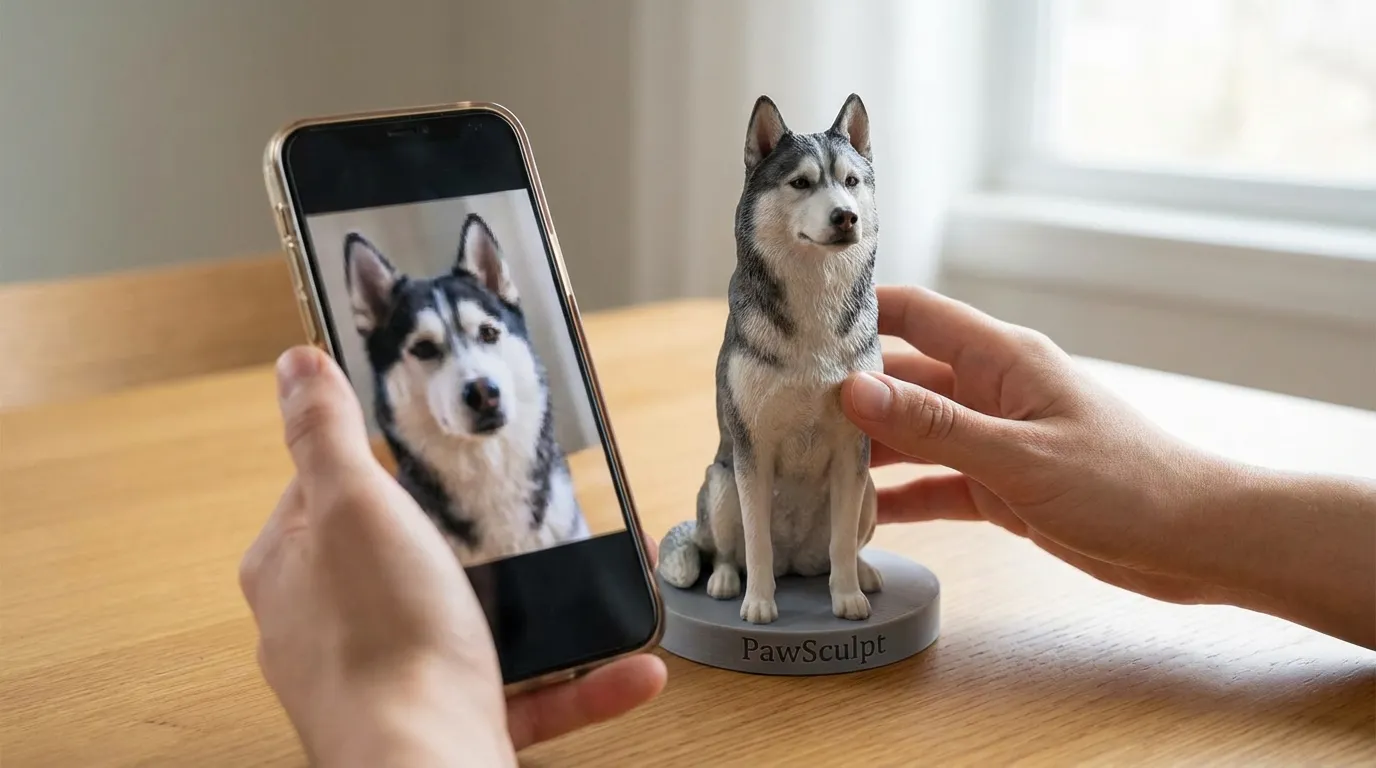
This is where the technology of full-color 3D printing becomes a spiritual tool. At PawSculpt, we don't just make "models." We use advanced resin printing technology that builds the image of your dog layer by microscopic layer. The color isn't painted on top; it is fused into the material itself.
Why does this matter? Because a Husky's markings—the specific mask pattern, the heterochromia (different colored eyes), the splash of white on the chest—are their spiritual signature. Our 3D artists digitally sculpt these details, and the printer births them into full-color reality. It captures the asymmetry, the unique tilt of the ear, the specific way they held their tail.
"We've seen families heal by holding something tangible. Grief needs an anchor, not just a memory."
— The PawSculpt Team
The Fear of the Fading Image
Perhaps the deepest fear in grief is not the pain, but the fading of the pain. We hold onto the hurt because we are terrified that if we let go, we will forget the details. We fear that the memory of their face will blur.
This is the "Second Death"—when the memory becomes generic.
A 3D physical anchor acts as a firewall against this forgetting. It freezes the physical form in time. You don't have to rely on your tired, grieving mind to reconstruct the curve of their snout or the color of their paw pads. The object holds that data for you.
By outsourcing the "remembering of details" to the figurine, you free your mind to focus on the "remembering of the love." You stop struggling to recall what they looked like and start simply feeling their energy.
Moving From Grief to Legacy
The bond with a Husky is often described by owners as "ancient." It feels older than one lifetime. When that physical cord is cut, it must be re-tied in a different way.
We encourage you to put down the phone. Stop doom-scrolling through the last weeks of their life when they were sick and tired. Those pixels are not them.
Instead, create a physical legacy. Whether it's planting a tree, keeping their collar in a shadow box, or commissioning a lifelike replica, choose something that has weight. Choose something that occupies the three-dimensional world, just as they did.
Your Husky took up space. Their memory deserves to take up space, too.
Frequently Asked Questions
Does having a realistic figurine make the grief worse?
Initially, seeing a realistic likeness can be emotional, but for the vast majority of pet owners, this quickly turns into deep comfort. It provides a "place" for the grief to go. Instead of the eyes scanning the whole room and finding nothing, they land on the figurine, which calms the nervous system's search response.How accurate can a 3D printed figurine really be?
The accuracy is often startling. Because we use full-color 3D printing technology rather than hand-painting, we can replicate complex fur patterns, ticking, and gradients that are nearly impossible to achieve with a brush. The result is a resin piece that captures the specific "soul" of the dog, not just the breed standard.Is it normal to talk to a pet memorial object?
Absolutely. In fact, psychologists often suggest "continuing bonds" therapy, where you maintain a relationship with the deceased rather than trying to detach completely. Speaking to a memorial object allows you to externalize your feelings and maintain that sacred conversation.What if I don't have perfect photos of my Husky?
You don't need studio portraits. Our team of digital artists has years of experience understanding dog anatomy. We can take a photo of the face from one angle, the body from another, and the tail from a third, and synthesize them into a cohesive, accurate sculpture. We know Huskies, and we know how to fill in the gaps.Ready to Celebrate Your Pet?
Every pet has a story worth preserving. Whether you're honoring a beloved companion who's crossed the rainbow bridge or celebrating your furry friend's unique personality, a custom PawSculpt figurine captures those details that make your pet one-of-a-kind.
Free instant AI preview • 3D artist preview within 7 days • 5 free revisions