The 'Memory Palace' Technique: Using a Pug Figurine to Retain Specific Sensory Details
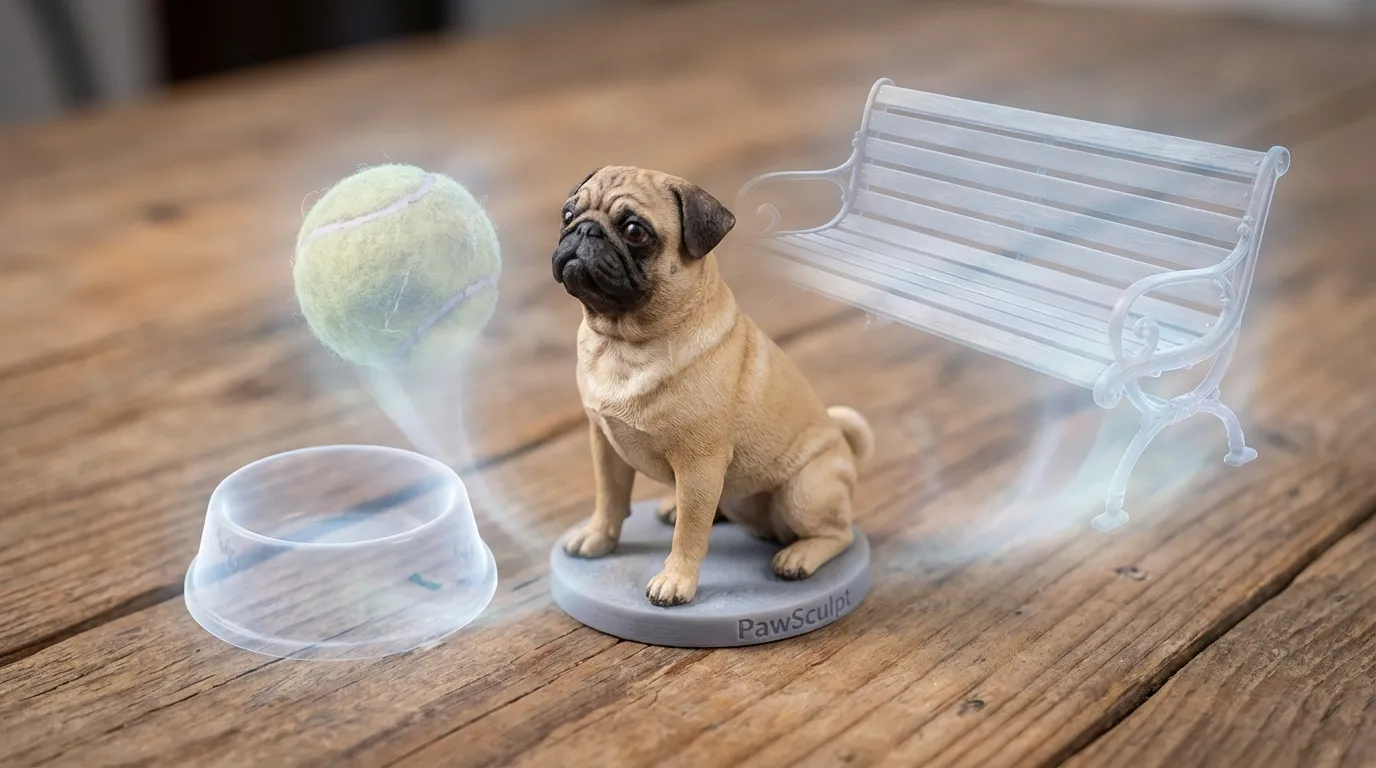
The hallway still echoes with the phantom rhythm of that distinctive, snuffling breath—a sound that used to signal you were never truly alone. You find yourself stepping carefully over the spot where they used to sprawl, a "pug rug" blocking your path, only to realize with a fresh pang of heartache that the floor is empty.
Quick Takeaways
- The "Memory Palace" — A cognitive technique linking specific physical locations on a figurine to vivid sensory memories.
- Tactile grounding — Holding a 3D object engages "haptic memory," which photos cannot trigger.
- Sensory mapping — Assigning the smell of "corn chip paws" to the figurine’s feet helps retain olfactory memory.
- Custom accuracy matters — Generic statues fail to trigger deep recall; custom pet figurines capture the specific mask and markings necessary for this technique.
The Fear of Forgetting: It’s Not Just About the Face
Here is the brutal truth that most pet owners are terrified to admit: we are afraid we will forget.
It’s not that you’ll forget their name or what they looked like. You have thousands of photos on your phone for that. The fear is subtler and sharper. It’s the fear of losing the sensory details. The specific density of their body when they sat on your foot. The exact texture of the velvet fur behind their ears. The way their tail curled—one loop or two?
We often hear from the PawSculpt community that the panic sets in about three months after the loss. The photos are still there, but the feeling of the dog is slipping away.
This is where the Memory Palace technique comes in. Originally a mnemonic device used by ancient Greek orators to memorize long speeches by visualizing a walk through a building, we can adapt this for grief. Instead of a building, your "palace" is a physical object—a custom pug figurine. And instead of speeches, you are encoding sensory data into the physical form of the keepsake.
"Grief isn't a problem to be solved. It's a love story that continues after the last chapter."
Why Pugs Are a Unique Sensory Experience
To understand why this technique is so effective for Pugs specifically, we have to acknowledge that Pugs are an intensely physical breed. If you owned a Pug, you didn't just look at them; you experienced them.
They are tactile creatures. They demand to be touching you at all times. They are auditory events—snorting, wheezing, screaming, grumbling. They have a distinct smell (yeasty, musky, comforting).
A photograph is flat. It captures light, but it fails to capture mass. Pugs are famous for the Latin phrase multum in parvo ("much in little"). They are heavy for their size. When you hold a photo, your brain recognizes the image, but your hands feel a piece of paper or a cold phone screen. There is a sensory disconnect that can actually make the grief feel worse, a phenomenon known as "cognitive dissonance" in bereavement.
By using a three-dimensional object, specifically one that replicates the unique color patterns and posture of your specific dog, you bridge that gap.
The Science of Haptic Memory
We often prioritize visual memory, but haptic (touch) memory is one of the most durable forms of recall we have.
Research into object-based coping suggests that handling a physical representation of a lost loved one can lower cortisol levels more effectively than looking at pictures. When your fingers trace the familiar wrinkles on a figurine’s forehead, your brain fires the same neural pathways it used when you were petting your living dog.
This isn't magic; it's neuroscience. Your hands are "remembering" the dog.
But for this to work, the "anchor" object needs to be accurate. A generic pug statue from a garden store usually won't work because your brain instantly categorizes it as "decoration." It lacks the specific asymmetry of your dog's mask or the unique way their lip got stuck on their teeth. This is why we utilize high-fidelity full-color 3D printing. We aren't painting a generic model; we are digitally sculpting the specific animal and printing the color into the resin, capturing the organic gradients of fawn or black coats that trigger recognition.
How to Build Your Pug Memory Palace
This is an active technique. It requires you to sit with your figurine and consciously link memories to physical touchpoints. Here is the process we recommend to families:
1. The Velvet Spot (The Ears)
Pug ears are arguably the softest substance on earth.- Action: Rub the ear of the figurine between your thumb and forefinger.
The Encode: Close your eyes and vividly recall the texture of their ears. But go deeper—recall the temperature*. Pugs often have warm ears when they are sleepy and cool ears when they are alert. Link that tactile memory to this specific spot on the sculpture.
2. The Corn Chip Zone (The Paws)
- Action: Press your thumb against the paw pads of the figurine.
- The Encode: Summon the smell. You know the one—that Fritos/popcorn scent that is distinct to dog feet. Don't just think "they smelled like chips." Try to physically hallucinate the scent while touching the paws.
3. The Weight Anchor ( The Chest)
- Action: Cup the figurine in your hand, feeling its solidity.
- The Encode: Remember the feeling of them sitting on your chest or lap. Pugs are dense. Recall that "anchoring" weight that used to keep you pinned to the couch.
4. The Wrinkle Ritual (The Forehead)
- Action: Trace the "prince mark" (the diamond shape wrinkles) on the forehead.
- The Encode: Remember the maintenance. The damp cotton pads, the squirming, the treats afterwards. This might seem like a chore you wouldn't want to remember, but these caretaking rituals are often what we miss the most because they were moments of pure intimacy.
| Memory Anchor | Sensory Trigger | The "Forgettable" Detail to Encode |
|---|---|---|
| The Tail Curl | Visual/Tactile | Was it a tight double curl or a loose loop? Did it uncurl when they slept? |
| The Eyes | Visual | The specific "whale eye" look when they wanted food. |
| The Neck Rolls | Tactile | The feeling of burying your face in the loose skin. |
| The Mouth | Auditory | The sound of the "pug scream" or the heavy breathing. |
Addressing the Guilt of "Moving On"
There is a heavy, complicated emotion that often sits alongside the sadness: Guilt.
Many of the pet parents we work with confess that they feel guilty for wanting a figurine. They worry that getting a "replacement" is disrespectful, or conversely, that having a memorial means they are stuck in the past.
Here is the counterintuitive insight: Externalizing your memory allows you to live in the present.
When you carry the burden of trying to "never forget" solely in your mind, it takes up immense cognitive energy. You are constantly scanning your brain, terrified a detail has slipped. By encoding these memories into a custom figurine, you are outsourcing the storage. You can look at the figurine on your desk and know, "Okay, the memory of his tail is safe there. The memory of his mask is safe there."
This doesn't mean you stop missing them. It means you stop panicking about forgetting them. It frees you to grieve the loss without the anxiety of memory degradation.
"We've seen families heal by holding something tangible. Grief needs an anchor."
— The PawSculpt Team
The Importance of Color Accuracy in Memory
We need to talk about color, because for Pugs, color is texture.
In the world of mass-produced memorials, you usually get a flat beige for a Fawn Pug or a flat black for a Black Pug. But real Pugs aren't monochrome. A Fawn Pug has apricot undertones, a trace of a dorsal stripe (the "trace"), and a mask that fades from charcoal to black.
If the color is wrong, the Memory Palace technique fails. Your brain rejects the object.
This is why we avoid hand-painting. Paint sits on top of a surface, often obscuring the fine texture of the fur. Our full-color 3D printing technology builds the color voxel-by-voxel (a voxel is a 3D pixel). The color is intrinsic to the material. This allows us to capture the "ticking" on the coat—the darker hairs intermingled with the lighter ones—which is a crucial visual trigger for memory.
When you look at the figurine and see that specific gradient on the ears that matches your dog, it triggers a "recognition spark" in the brain that a generic object cannot achieves.
Advanced Technique: The "Daily Greeting"
Once you have established your Memory Palace, you can use it to maintain a connection without letting grief consume your whole day.
We recommend the "Daily Greeting." Keep the figurine in a high-traffic area, like the hallway or near your coffee maker. (Avoid the bedroom initially if waking up to it is too painful).
When you pass it, give it a quick touch—just a tap on the head or a brush of the tail. This micro-interaction acknowledges their presence in your life story. It says, “I see you, I remember you, I love you,” without requiring you to stop and fall apart. It integrates their memory into your daily routine, transforming grief from a tidal wave into a gentle, constant stream.
When You Feel "Crazy" for Talking to It
Let’s be real: you’re going to talk to the figurine. And then you’re going to feel silly.
Please don't.
Anthropomorphism—attributing human traits or consciousness to objects—is a healthy psychological coping mechanism. It’s not a delusion; it’s a bridge. Talking to your Pug’s figurine ("Good morning, buddy," "You'd love this bacon") keeps the linguistic pathways of your relationship open.
You spent years talking to your dog. They (probably) didn't understand the complex syntax of your day, but they understood the tone. Continuing that dialogue helps process the silence in the house. It is far better to externalize those thoughts than to bottle them up.
Frequently Asked Questions
Does having a lifelike figurine make the grief worse?
For the vast majority of our community, the answer is no—it actually helps. The anticipation of opening the box can be nerve-wracking, and the first moment of seeing it often brings tears. But after that initial release, the figurine becomes a source of comfort. It fills the visual void. Instead of looking at an empty dog bed and feeling pain, you look at the figurine and feel a sense of preservation.How accurate can a 3D printed figurine really be?
We strive for hyper-accuracy. Because we don't use molds, we aren't limited to "standard pug pose." If your Pug had a snaggletooth, a specific scar, or one ear that flopped differently than the other, our digital artists model that from your photos. The full-color printing then locks those details in.What photos do I need for a custom Pug figurine?
Since Pugs are so distinct, the more angles, the better. We typically ask for:- Face: Eye level, good lighting.
- Profile: Both left and right sides (markings are often asymmetrical).
- The "Loaf": A view from above to see the shape of the body and tail curl.
- Details: Close-ups of any unique markings (like a white chest patch or specific mask shape).
My Pug had a unique sitting posture. Can you capture that?
Absolutely. Pugs are famous for the "lazy sit"—rolling onto one hip with a leg kicked out. Generic statues almost always show dogs sitting squarely. We believe capturing the posture is just as important as capturing the face. If your dog sat like a little gremlin, we want to sculpt a little gremlin.Ready to Celebrate Your Pet?
Every pet has a story worth preserving. Whether you're honoring a beloved companion who's crossed the rainbow bridge or celebrating your furry friend's unique personality, a custom PawSculpt figurine captures those details that make your pet one-of-a-kind.
Free instant AI preview • 3D artist preview within 7 days • 5 free revisions
A Final Thought on "Memory Palaces"
The hallway doesn't have to stay empty.
By building a Memory Palace around a tangible object, you are doing something profound. You are taking the invisible love you have for your Pug and giving it a visible form. You are ensuring that the smell of corn chips, the velvet of the ears, and the weight of their love remain vivid, accessible, and safe.
You aren't moving on. You're moving forward, bringing the best parts of them with you.
Further Reading
- The Association for Pet Loss and Bereavement (APLB) – Support resources for grieving pet owners.
- American Kennel Club: Pug Breed Information – Understanding the unique traits of the breed.