
Why Traditional Urns Fail the 'Hygge' Test for Your German Shepherd's Memorial
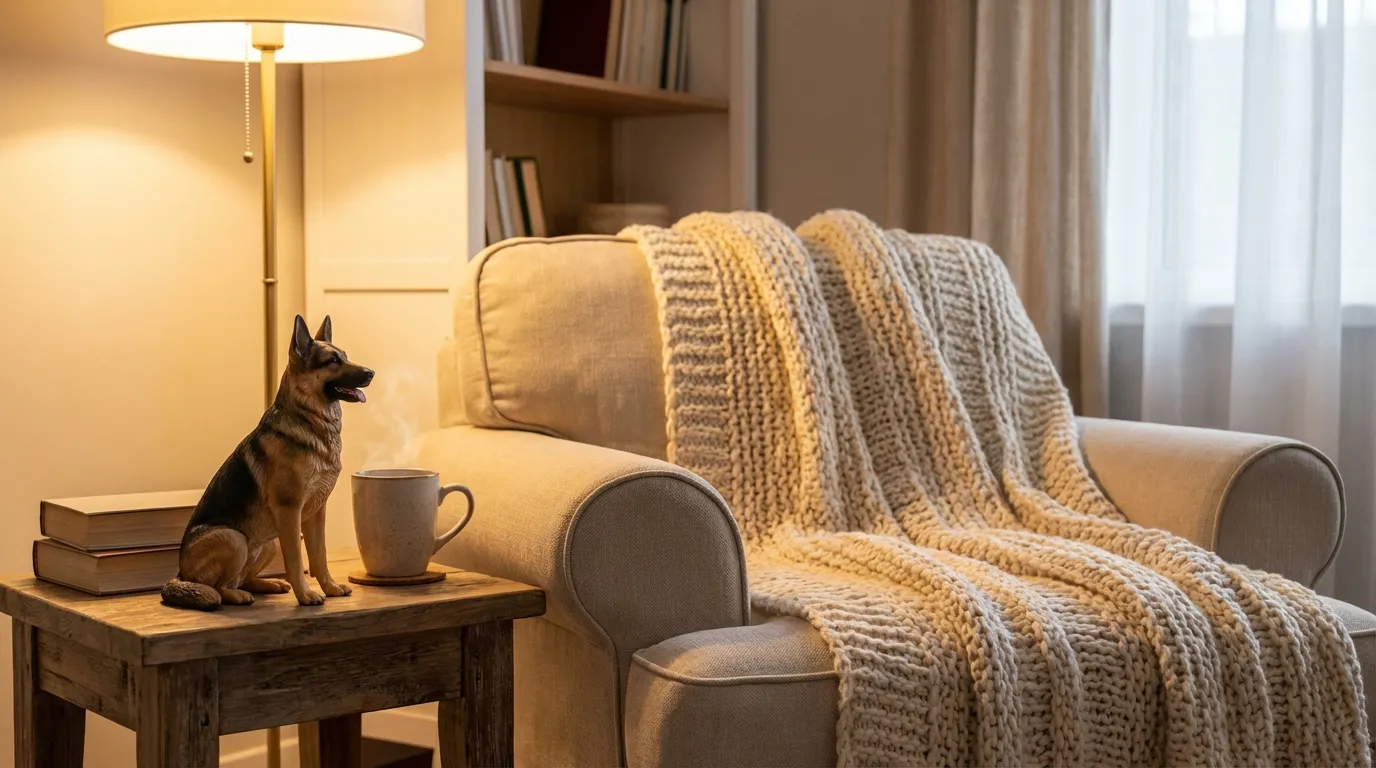
Three months ago, the space beside your nightstand was a chaotic tangle of orthopedic foam, stray fur, and the rhythmic, heavy breathing of a ninety-pound guardian. Today, the morning light hits that same spot on the rug, illuminating nothing but dust motes dancing in the empty air and a pristine, undisturbed flatness that feels louder than any bark ever was.
Quick Takeaways
- Cognitive Dissonance in Grief — Traditional urns often prolong pain by creating a visual mismatch between the "warm" memory of your dog and the "cold" reality of a box.
- The Biology of Hygge — Creating a cozy memorial space isn't just aesthetic; it lowers cortisol and signals safety to your limbic system.
- German Shepherd Specifics — For a "velcro dog" breed, abstract memorials often fail to trigger the necessary comforting neural pathways that a custom visual likeness can provide.
- The "Relief" Factor — Acknowledging the biological relief of ending a GSD's suffering (especially with mobility issues) is crucial for healing.
The Psychology of the "Cold" Urn: Why It Feels Wrong
We need to talk about the disconnect. You walk into a veterinary office or a funeral home, and you are presented with a catalog of vessels: brass vases, wooden boxes, maybe a ceramic jar. They are dignified. They are respectful. But for many German Shepherd owners, they fail the fundamental psychological test of grief recovery.
The problem isn't the object; it's the association.
In psychology, we look at attachment theory. Your German Shepherd wasn't just a pet; they were likely your "secure base." This is the psychological term for an attachment figure that provides a sense of safety and security. When you lose a secure base, your brain enters a state of panic and disorientation.
When you place a cold, sealed box on your mantle, you are introducing a symbol of finality and separation. While this acknowledges the reality of death, it often bypasses the need for continuing bonds—a modern grief framework that suggests we heal not by detaching, but by redefining our relationship with the deceased.
A sealed urn is a barrier. It hides the remains. It is often cold to the touch. For a breed defined by its physical presence—the lean against your leg, the heavy head on your lap—replacing that warmth with a cold, abstract geometric shape creates cognitive dissonance. Your brain, craving the familiar comfort of your protector, is met with an object that signals "do not touch" and "gone forever."
"Grief isn't a problem to be solved. It's a love story that continues after the last chapter."
Defining 'Hygge' for the Grieving Heart
You’ve likely seen the word "Hygge" (pronounced hoo-ga) plastered on candles and oversized sweaters. But in the context of Scandinavian psychology and living, Hygge is far more profound. It is the art of creating sanctuary. It is the conscious feeling of safety, warmth, and togetherness.
Why does this matter for your German Shepherd's memorial?
Grief is a high-stress state. Your body is flooded with cortisol and adrenaline. You are in fight-or-flight mode because your primary protector is gone. A "Hygge" memorial is designed to counteract this. It aims to stimulate the parasympathetic nervous system—the "rest and digest" mode.
A traditional urn often fails the Hygge test because it is formal and sterile. A Hygge memorial, by contrast, incorporates:
- Texture: Things you can touch (softness, warmth).
- Light: Warm, low-kelvin lighting (mimicking firelight).
- Narrative: Objects that tell a story, not just mark an end.
If we look at the neurobiology of comfort, we know that harsh lines and cold materials (metal, polished stone) can increase cognitive load. Soft textures, warm colors, and organic shapes lower it. Your German Shepherd was a source of organic, chaotic, warm comfort. Your memorial should reflect that energy, not sterilize it.
The German Shepherd Paradox: Strength vs. Vulnerability
German Shepherds present a unique grief profile. We've worked with thousands of families, and the GSD owners often struggle the hardest. Why? Because of the role reversal.
For years, this dog was the strong one. The police dog, the guard dog, the one who barked at the delivery driver. But in their final months—often due to Degenerative Myelopathy (DM) or hip dysplasia—they became incredibly vulnerable. You became the physical support system for a dog that used to be yours.
This creates a complicated grief landscape.
You are mourning two dogs: the powerful protector of their prime, and the sweet, dependent soul of their final days. A standard urn captures neither. It is too small to represent their power, and too hard to represent their vulnerability.
The "Velcro" Factor
German Shepherds are notoriously "velcro dogs." They don't just exist in your house; they exist within a three-foot radius of your body at all times. They monitor the bathroom door. They sleep across the threshold.When you remove a "velcro" presence, the void is physically palpable. Your brain's spatial awareness is constantly pinging for them and getting no return signal. This is why a German Shepherd urn alternative needs to have presence. It needs to occupy space in a way that acknowledges that "shadow" behavior.
The Emotional Nuance: The Guilt of Relief
We need to pause here and address something uncomfortable. Something you might be feeling but haven't said out loud because you're afraid it makes you a bad owner.
The relief.
If your Shepherd battled DM or severe arthritis, the last months were likely a grueling regimen of lifting harnesses, carpet runners, incontinence management, and sleepless nights listening for signs of distress.
When the end finally comes, there is a distinct biological response: decompression. The caregiver burnout snaps. Suddenly, you can sleep. You don't have to rush home.
Then, immediately following that relief, comes the shame.
"The guilt that follows relief is grief's cruelest trick. It doesn't mean you loved them less; it means you loved them enough to carry their pain until it broke you."
From a psychological perspective, please understand: Relief is not the opposite of love. Relief is the body's reaction to the cessation of chronic stress. It is entirely possible—and normal—to be heartbroken that they are gone and simultaneously relieved that the suffering (theirs and yours) has ended.
A sterile urn can sometimes exacerbate this guilt. It sits there, looking serious and judgmental. A Hygge-inspired memorial, one that focuses on warmth and happy memories, helps you forgive yourself for being human. It shifts the focus from the trauma of the end to the warmth of the life.
Why Visuals Matter: The Fusiform Face Area
Why do we keep photos? It's not just habit. It's biology. The human brain has a specialized region called the Fusiform Face Area (FFA) dedicated entirely to recognizing faces.
When you look at a photo or a realistic figurine of your dog, this area lights up. It triggers the release of dopamine and oxytocin—the bonding hormones.
A brass box does not trigger the FFA.
When you look at a traditional urn, your brain has to perform a complex cognitive step: Object A (Box) = Concept B (Dog). This is an intellectual process, not an emotional reflex.
When you look at a full-color 3D printed figurine that captures the specific way your Shepherd's left ear flopped or the graying pattern on their muzzle, the recognition is instant. The FFA activates. The brain says, "Oh, there you are."
This is why many GSD owners are moving away from abstract vessels toward hyper-realistic representations. It bridges the gap between memory and reality.
The Problem with "Artistic Interpretation"
In the past, if you wanted a likeness, you commissioned a painting or a clay sculpture. The risk there is the "Uncanny Valley." If the artist gets the eyes wrong, or the snout is too short, it looks like a dog, but not your dog. That can be more jarring than a box.This is where modern technology shifts the paradigm. At PawSculpt, we don't rely on "artistic interpretation" of a generic breed. We use digital sculpting based on your specific photos, followed by full-color 3D printing.
The color isn't painted on with a brush; it is intrinsic to the resin material, voxel by voxel. This captures the "salt and pepper" transition on a Shepherd's saddle that a paintbrush often muddies. It captures the depth in the amber eyes. It provides a touchstone that feels authentic, triggering that recognition pathway in the brain without the "uncanny" distortion.
Creating Your 'Hygge' Memorial Sanctuary
So, how do you build a memorial that passes the Hygge test? You need to move away from the "shrine of sadness" and toward a "corner of comfort."
1. The Anchor Piece
You need a focal point. This replaces the urn (or hides it).- Option A: A high-quality framed photo (ensure it is matte, not glossy, to reduce cold reflections).
- Option B: A custom figurine. This adds the third dimension, which is critical for spatial memory. Placing a custom figurine nestled among plants or books integrates the memory into daily life rather than setting it apart.
- Option C: A living plant. For Shepherds, a sturdy, upright plant like a Snake Plant or a Fiddle Leaf Fig represents their standing guard.
2. The Tactile Element
Hygge is about touch. Grief leaves your hands feeling empty.- Incorporate their favorite collar.
- Keep a small swatch of their favorite blanket.
- Use materials like untreated wood, felt, or wool in the display.
3. The Lighting
Never use harsh overhead light for a memorial. It feels clinical.- Use a small lamp with a warm bulb (2700K).
- Candles are the quintessential Hygge element. The flicker of a flame mimics the heartbeat—dynamic, warm, alive.
4. Integration, Not Isolation
Don't put the memorial in a room you rarely use. That is avoidance coping. Put it where they lived. If your Shepherd slept in the living room corner, that's where the Hygge memorial belongs. It reclaims the space. Instead of an empty rug that triggers sadness, you have a warm, lit corner that triggers gratitude.Comparative Analysis: Traditional vs. Hygge Memorials
To help you visualize the difference in how these approaches affect your processing of grief, we've broken down the sensory inputs.
| Feature | Traditional Urn | Hygge Memorial Strategy | Psychological Impact |
|---|---|---|---|
| Visual | Static, geometric, metallic/wood | Organic, personal, warm lighting | Urn: Signals "end/death." Hygge: Signals "continued bond." |
| Tactile | Hard, cold, smooth, polished | Soft, textured (fur, felt, resin) | Urn: Increases sensory dissonance. Hygge: Soothes somatosensory cortex. |
| Location | Often high up (mantle), out of reach | Integrated into living space | Urn: Creates distance. Hygge: Normalizes presence. |
| Emotional | Formal, respectful, distant | Intimate, cozy, safe | Urn: Validates loss. Hygge: Validates life. |
The "German Shedder" Legacy: A Note on Fur
Here is a counterintuitive insight: Don't clean everything immediately.
Standard grief advice often says to "pack away" the reminders to avoid triggers. We disagree. For a German Shepherd owner, the tumbleweeds of undercoat are a part of the environment.
Sanitizing your home too quickly can lead to a shock response. It erases the evidence of their existence. In a Hygge memorial, we often encourage keeping a small glass vial of their fur, or incorporating a "felted" ball of their undercoat.
It sounds strange to non-dog people. But to you? It’s texture. It’s scent. It’s reality. It is softer and warmer than any brass urn could ever be.
Moving Forward: The "New Normal"
There is a concept in neuroplasticity regarding habit formation. It takes roughly 66 days to form a new habit, or in this case, to un-learn the habit of expecting your dog to be at the door.
During this window, your environment is your primary therapist. If your environment screams "loss," your cortisol stays high. If your environment whispers "love and safety," you heal faster.
This doesn't mean you forget. It means the memory moves from the amygdala (the panic/fear center) to the hippocampus (the long-term memory center).
A Hygge memorial facilitates this transfer. It allows you to sit in that corner, drink a cup of coffee, look at the likeness of your brave friend, and feel warmth instead of the icy grip of absence.
"We've seen families heal by holding something tangible. Grief needs an anchor, and sometimes a photo just isn't enough to ground you."
— The PawSculpt Team
Frequently Asked Questions
Is it disrespectful to not use a traditional urn?
Absolutely not. Respect is defined by the love you hold, not the container you choose. Many behaviorists and grief counselors agree that if an object brings you pain, it isn't serving its purpose. A memorial should comfort the living while honoring the dead. Whether that's a biodegradable planting pod, a custom sculpture, or a simple wooden box, the "right" choice is the one that brings you peace.How do I deal with the guilt of getting a new dog?
This is often called the "loyalty bind." You feel that loving a new dog betrays the memory of the old one. However, try to reframe it: Your German Shepherd's job was to teach you how to be a guardian. By bringing a new dog into your home, you aren't replacing them; you are honoring the skills and love they taught you. Hearts expand; they don't divide.What if I don't have perfect photos for a figurine?
This is a common worry. You don't need studio-quality portraits. In fact, the "imperfect" photos—the ones showing them muddy at the park, or sleeping upside down—often capture the personality best. Our team of digital artists specializes in synthesizing a 3D model from multiple angles and casual phone snaps. We look for the "spark," not just the geometry.Why does losing a dog hurt as much as losing a human?
Research supports that this is valid. The relationship with a pet is often "unambivalent." Human relationships are complicated by arguments, baggage, and complex dynamics. Your relationship with your Shepherd was likely pure, unconditional positive regard. Losing that source of uncomplicated love disrupts your emotional regulation systems in a unique and profound way.Ready to Celebrate Your Pet?
Every pet has a story worth preserving. Whether you're honoring a beloved companion who's crossed the rainbow bridge or celebrating your furry friend's unique personality, a custom PawSculpt figurine captures those details that make your pet one-of-a-kind.
Free instant AI preview • 3D artist preview within 7 days • 5 free revisions