
The Impermanence Paradox: Why Your Maine Coon's Ashes Deserve a Permanent Home
The antiseptic sting of rubbing alcohol hit your nose before you even sat down, and somewhere behind the exam room door, a dog was crying in short, hitching breaths that sounded almost human. You were holding your Maine Coon's carrier on your lap—sixteen pounds of warmth, suddenly so light—and already thinking about what comes next. About the maine coon memorial you hadn't planned for, because who plans for this.
Quick Takeaways
- Impermanence philosophy doesn't mean letting go of everything — it means choosing what endures with more intention
- Maine Coon ashes need a permanent home sooner than you think — environmental and emotional factors degrade temporary containers within months
- Buddhist-inspired pet grief isn't about detachment — it's a framework for sitting with pain without being consumed by it
- A physical memorial anchors memory against the fear of forgetting — consider custom pet figurines from PawSculpt as a tangible, lasting tribute
- The guilt you feel about relief is grief's cruelest trick — and naming it is the first step toward healing
The Angle Everyone Misses: Impermanence as a Reason to Preserve, Not Release
Here's what you'll find if you Google "pet ash memorial" or "buddhist pet grief" right now: a dozen articles telling you to let go. To accept impermanence. To find peace in the cycle of life and death. And look—they're not wrong, exactly. But they're skipping the most interesting part of the conversation.
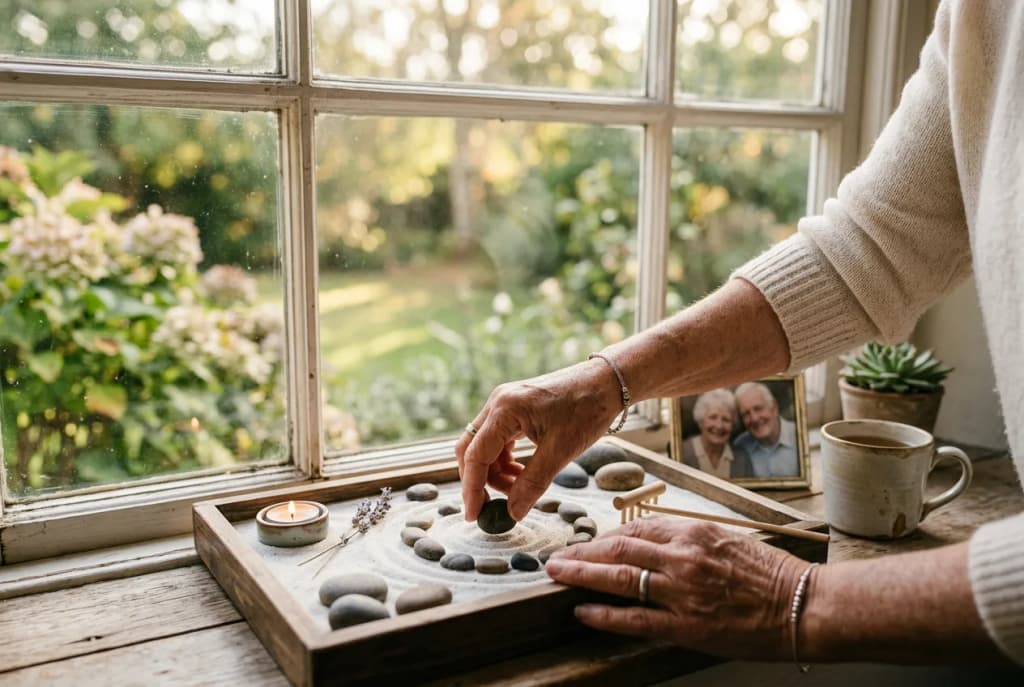
The actual Buddhist concept of impermanence (anicca) doesn't instruct you to avoid attachment to physical objects. It asks you to understand the nature of that attachment. There's a massive difference. Monks build sand mandalas for weeks, pouring extraordinary care into something they know they'll destroy. The point isn't that the mandala doesn't matter. The point is that the making of it matters. The intention behind it matters.
So here's the counterintuitive insight that most grief guides completely miss: understanding that everything is temporary is precisely the reason to create something permanent. Not despite impermanence—because of it. You're not clinging. You're choosing, with clear eyes, to honor what was real.
Your Maine Coon's seventeen-pound frame draped across your keyboard. The bizarre chirping trill they made instead of a normal meow. The way their tail puffed up like a bottlebrush during thunderstorms. Those details are already fading. That's impermanence doing its thing. And a permanent pet memorial isn't a denial of that process—it's a deliberate act of love that says, I see you disappearing, and I'm going to anchor some part of you here.
We've worked with thousands of pet families at PawSculpt, and the ones who come to us months or years after a loss almost always say the same thing: "I wish I'd done this sooner, before I started forgetting the little things."
"Memory isn't permanent. That's not a reason to surrender it—it's a reason to give it a home."
Why Maine Coons Demand a Different Kind of Memorial
Not all pet loss hits the same way. We'll be real about that. And Maine Coon grief has a particular character to it that's worth naming, because if you're in it right now, you probably feel like you lost something closer to a roommate than a cat.
The Gentle Giant Gap
Maine Coons aren't cats in the way most people think of cats. They're 15-to-25-pound conversationalists who follow you from room to room, headbutt your hand when you stop petting them, and—this is the part that wrecks people—they talk back. That signature chirp-and-trill vocalization means your house had a soundtrack. And now it doesn't.
The absence of sound is what gets most Maine Coon owners. Not the empty bed, not the missing food bowl. It's the quiet where the chirping used to be. The lack of that heavy thud when they jumped off the counter. The missing rumble of a purr that you could feel through the couch cushion.
One family we worked with told us they kept hearing phantom purring for weeks. Another said they couldn't use their home office because that's where their Maine Coon would sit on the desk and "supervise" their work, chattering at birds through the window. The room felt wrong without the noise.
What Makes Maine Coon Memorials Unique
| Feature | Why It Matters for Maine Coons | Memorial Implication |
|---|---|---|
| Size | Largest domestic cat breed; physical presence is a core trait | Small, generic memorials feel inadequate for the scale of the animal |
| Distinctive ear tufts & ruff | Lynx-like ear tips and lion-like chest ruff are breed signatures | Any memorial worth having must capture these specific features |
| Coat patterns | Complex tabby patterns, bi-color, smoke, and solid variations | Color accuracy in a memorial is non-negotiable |
| Expressive faces | Wide-set eyes, strong chin, almost human expressions | Generic cat silhouettes miss the personality entirely |
| Individual personality | Known for dog-like loyalty, playfulness into old age | The memorial should feel like your cat, not a cat |
This is exactly why a generic paw-print ornament or a mass-produced "cat angel" figurine from a big-box store falls flat for Maine Coon owners. The breed is too specific, too individual, too large in every sense. The memorial needs to match.
The Ash Problem Nobody Talks About
Okay, let's get practical for a minute, because this is the part that most grief articles skip entirely—probably because it feels clinical. But you need to hear it.
Temporary Containers Are Exactly That
When you pick up your Maine Coon's cremated remains from the vet or crematory, they typically come in one of three things: a plastic bag inside a tin, a basic wooden box, or a cardboard container. These are temporary vessels. They're not designed for long-term storage, and here's what happens when they become the permanent solution by default:
- Tin containers can corrode over time, especially in humid environments (basements, garages, anywhere near a coast)
- Wooden boxes are porous and can absorb moisture, warp, or develop mildew
- Plastic bags inside any container can degrade, and if the seal fails, you've got a real problem
- Cardboard is... cardboard. It was never meant to last.
The crematory gives you these containers expecting you to transfer the ashes into something permanent. But here's the thing—most people never do. The temporary container sits on a shelf or in a closet, and inertia takes over. Grief makes you tired. Decision-making feels impossible. And so your Maine Coon's remains end up in what is essentially packaging.
We're not saying this to make you feel bad. Honestly, this is one of the most common things we hear from families who reach out to us months or years later. "The ashes are still in the box from the vet, and I feel terrible about it." You shouldn't feel terrible. But you should know that finding a permanent pet memorial solution—whatever form that takes—is a kindness to yourself as much as to their memory.
The Decision Paralysis Is Real
Here's why this happens, and it's not laziness: choosing a permanent home for your pet's ashes requires you to fully accept the loss. As long as the remains are in a temporary container, some part of your brain can treat the situation as temporary too. It's an unconscious negotiation with grief.
We've seen families keep ashes in a closet for five years, not because they forgot, but because making the permanent choice felt like a second goodbye. If that's you, that's okay. But know what you're doing and why.
"Choosing where their ashes belong isn't a second goodbye. It's the first real hello to their memory."
Buddhist-Inspired Pet Grief: What It Actually Means (and Doesn't)
Let's clear something up, because buddhist pet grief as a concept gets badly mangled online. You'll find articles suggesting that Buddhist philosophy means you should simply "accept" your cat's death and move on with serene detachment. That's a misreading so severe it's almost the opposite of the truth.
The Middle Way Isn't the Numb Way
The Buddha's Middle Way is about avoiding extremes. Applied to grief, that means:
- Not suppressing your pain (extreme denial)
- Not drowning in it indefinitely (extreme attachment to suffering)
- Instead, sitting with the pain, observing it, letting it move through you
This is wildly different from "just let go." It's more like: feel everything, but don't build a house there. And crucially—creating memorials, rituals, and physical tributes isn't inconsistent with this approach. In fact, many Buddhist traditions incorporate memorial objects, altars, and ceremonies for the deceased. The point is intention. Are you creating a memorial to avoid feeling the loss? Or are you creating it to honor what was?
The Four Foundations, Applied to Pet Loss
Here's a framework that borrows loosely from Buddhist mindfulness practice, adapted for pet grief. We're not monks or meditation teachers—we're a team that works with grieving pet families every day—but we've seen these principles help people move through the hardest weeks.
| Foundation | Traditional Concept | Applied to Pet Loss | Practical Action |
|---|---|---|---|
| Mindfulness of Body | Awareness of physical sensations | Notice where grief lives in your body—chest tightness, throat ache, heavy limbs | Body scan meditation, 5 minutes daily; acknowledge physical grief symptoms to your doctor |
| Mindfulness of Feelings | Observing emotional tones without judgment | Name your feelings precisely: not "sad" but "guilty-sad" or "angry-sad" or "relieved-sad" | Journal specific emotions daily for 2 weeks; use the compound-emotion naming technique |
| Mindfulness of Mind | Noticing thought patterns | Catch the rumination loops: "I should have noticed sooner," "What if I'd tried one more treatment" | When you catch a loop, say out loud: "That's a grief thought. I'm noticing it." |
| Mindfulness of Phenomena | Understanding impermanence of all things | Recognize that grief itself is impermanent—it will change shape, even if it never fully disappears | Create one permanent memorial object as an anchor; let the grief waves move around it |
That last row is where the impermanence paradox lives. Grief changes. Memory changes. Your relationship to the loss changes. But a physical memorial stays constant, giving all that shifting emotion a fixed point of reference.
The Counterintuitive Power of a Physical Anchor
Here's something that might surprise you: according to the Association for Pet Loss and Bereavement, one of the most common sources of anxiety in pet grief isn't the sadness itself—it's the fear of forgetting. People are terrified that the details will slip away. The exact shade of their cat's eyes. The specific pattern on their chest. The way one ear was slightly more tufted than the other.
This fear is so common among Maine Coon owners specifically because the breed has such individual physical characteristics. No two Maine Coon coats are alike. The patterns, the ruff shape, the ear furnishings—they're like fingerprints. And your brain knows it can't hold all those details forever.
A pet ash memorial doesn't solve grief. Nothing does. But a physical object—whether it's an urn, a piece of jewelry, a garden stone, or a custom figurine—gives your fading memory something concrete to lean against. It's not about replacing the cat. It's about giving your love somewhere to land.
The Emotions Nobody Warns You About
This is the section most pet grief articles skip or gloss over with a gentle "everyone grieves differently." We're going to be more specific than that, because vague comfort isn't comfort at all.
Guilt That Comes Dressed as Relief
Your Maine Coon was sick for months. Maybe years. The subcutaneous fluids, the medication schedules, the 2 AM checks to make sure they were still breathing. You were exhausted. And when they finally passed—or when you made the call to help them go—part of you felt lighter.
And then the guilt hit like a truck.
That wave of relief mixed with grief doesn't make you a monster. It makes you someone whose nervous system was running on crisis mode for months and finally got permission to stop. The relief isn't about being glad they're gone. It's your body recognizing that the vigil is over. But grief has a way of twisting that relief into evidence that you didn't love them enough.
You did. The exhaustion was the love. The fact that you're reading a 5,000-word article about how to properly memorialize them? That's the love too.
Second-Guessing the Unthinkable
If euthanasia was part of your Maine Coon's story, you almost certainly replay the decision. Was it too soon? Could they have had one more good week? Did I give up? Or the other version: Did I wait too long? Were they suffering while I was being selfish?
Here's what we've learned from working with thousands of families: the timing is almost never perfect, and it doesn't need to be. The fact that you agonized over the decision means you took it seriously. The fact that you're still agonizing means you loved them. There is no version of this where you get to feel good about the timing, because there is no good time to lose someone you love.
What helps, oddly, isn't reassurance. It's permission. So here it is: you are allowed to have made that choice. You are allowed to wonder if it was right. Both of those things can exist in the same body at the same time.
The Shame of Grieving "Too Much"
Maybe someone at work said, "It was just a cat." Maybe a family member implied you should be over it by now. Maybe you caught yourself crying in the car three weeks later and thought, what is wrong with me?
Nothing. Nothing is wrong with you.
The American Veterinary Medical Association recognizes that pet loss can trigger grief responses equivalent to losing a human family member. This isn't a fringe opinion. It's the professional consensus of the veterinary community.
But knowing that intellectually doesn't always help when your coworker is rolling their eyes. So here's a practical strategy: you don't owe anyone an explanation for the depth of your grief. You don't need to justify why a seventeen-pound cat who slept on your pillow every night for fourteen years left a hole in your life. That's self-evident to anyone who's paying attention.
"We've noticed that the families who grieve hardest are the ones who loved most specifically—not just the animal, but every weird, particular detail of who that animal was."
— The PawSculpt Team
Building a Permanent Memorial: Your Actual Options, Ranked
Alright. Let's get into the practical side. You've decided—or you're deciding—that your Maine Coon's ashes deserve more than a temporary container on a shelf. Here's what we've seen work, what we've seen fall short, and where each option shines.
Option 1: Dedicated Urn (The Classic)
Best for: Families who want a traditional, dignified resting place.
Urns range from basic wooden boxes (a step up from the crematory packaging, but not by much) to ceramic, metal, or stone vessels that can be genuinely beautiful. The standout move here is commissioning a custom urn from a ceramicist or woodworker—something made specifically for your Maine Coon, possibly incorporating their name, dates, or a design element that references their personality.
The catch: An urn holds ashes. That's it. It doesn't capture what your cat looked like, sounded like, or felt like. For some families, that's enough. For many Maine Coon owners—whose cats were so visually distinctive—it's not.
Option 2: Memorial Jewelry (Wearable Grief)
Best for: People who want to carry a piece of their cat with them daily.
Ash-infusion jewelry—pendants, rings, or bracelets that incorporate a tiny amount of cremated remains into glass or resin—has gotten genuinely good in recent years. The best pieces are subtle enough to wear to work without inviting questions you don't want to answer.
The catch: Jewelry is personal and private. It doesn't give other family members (or visitors) a way to connect with the memorial. And it's small—which is inherently at odds with memorializing a breed known for being enormous.
Option 3: Memorial Garden or Burial
Best for: Families with stable, long-term homes and outdoor space.
Burying ashes under a memorial garden, alongside a stone or marker, creates a living tribute. Some families plant catnip or cat grass as part of the garden. It's a lovely idea.
The catch: If you move, the memorial stays. This is a bigger deal than people realize when they're deep in grief and not thinking about the five-year plan. We've heard from families who were devastated to leave a memorial garden behind after a job relocation.
Option 4: Custom Figurine (The Visual Memorial)
Best for: Families who want to see their specific cat—not a generic representation—every day.
This is where companies like PawSculpt come in, and we'll be transparent about the bias here since it's literally what we do. But here's why we believe in it: a custom 3D-printed figurine captures the visual details that make your Maine Coon yours. The specific tabby pattern. The ear tufts. The way their ruff fell. The exact green-gold of their eyes.
Our process uses full-color 3D printing technology—the color is printed directly into the resin, voxel by voxel, so your cat's coat pattern is reproduced with the kind of accuracy that a generic product can't touch. The only manual step is applying a protective clear coat for durability and sheen. What you get is a museum-quality piece that looks like a tiny, frozen moment of your cat being exactly who they were.
The catch: It doesn't hold ashes (pair it with an urn if that matters to you), and it requires good reference photos. The better your photos, the better the result. Visit pawsculpt.com for details on the process, photo guidelines, and what to expect.
Option 5: Combination Approach (Our Top Pick)
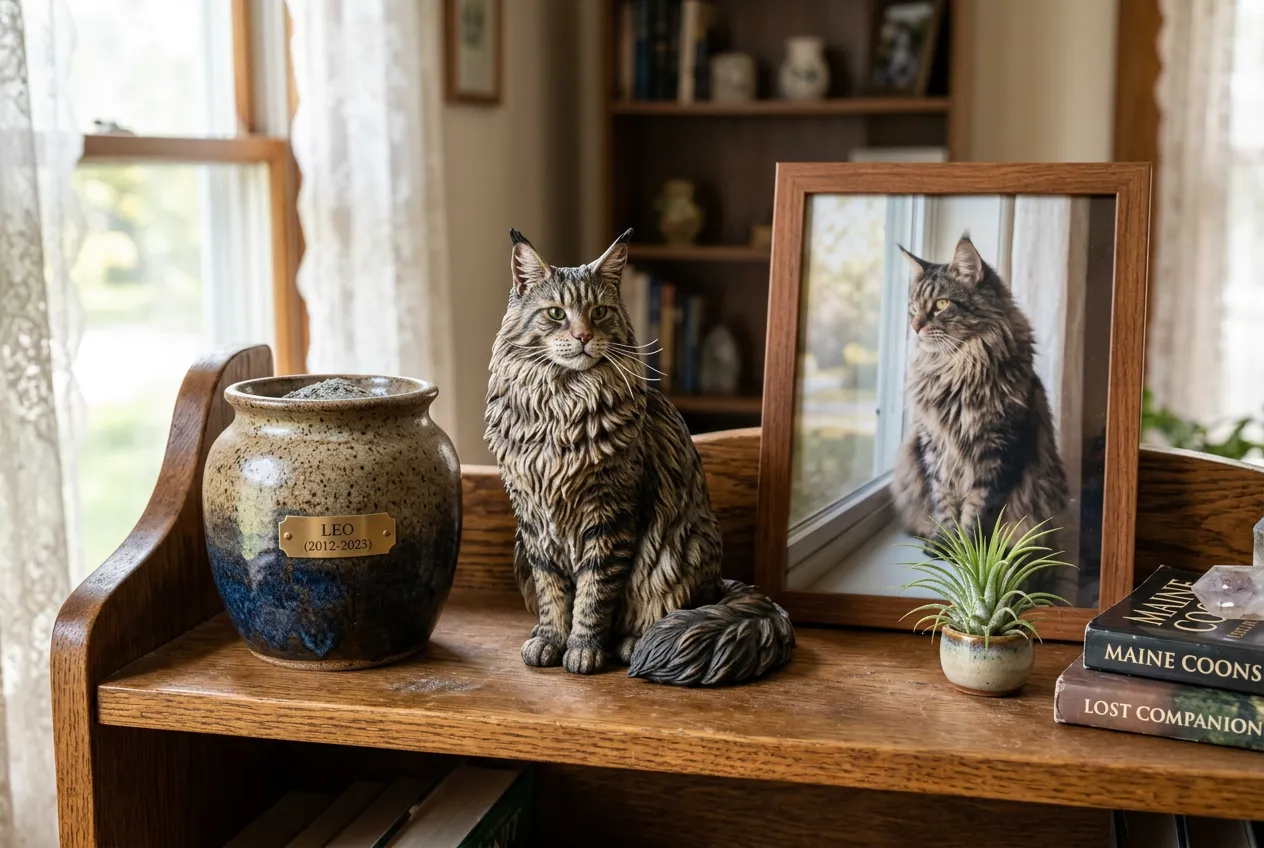
Honestly? The families who seem most at peace are the ones who don't pick just one option. They create a small memorial space: an urn on a shelf, a figurine beside it, maybe a framed photo and a candle. It becomes a spot in the home that holds the memory in multiple dimensions—visual, physical, and emotional.
The figurine gives you the look. The urn gives you the presence. The photo gives you the moment. Together, they're more than the sum of their parts.
| Memorial Option | Cost Range | Captures Appearance? | Holds Ashes? | Portable? | Longevity |
|---|---|---|---|---|---|
| Basic Urn | $ | No | Yes | Somewhat | Varies by material |
| Custom Urn | $$-$$$ | Minimally (engravings) | Yes | Somewhat | High |
| Memorial Jewelry | $$-$$$ | No | Trace amount | Yes | Moderate-High |
| Garden/Burial | $-$$ | No | Yes (buried) | No | Location-dependent |
| Custom Figurine | $$-$$$ | Yes—highly detailed | No | Yes | Very High (UV-resistant resin) |
| Combination | $$$+ | Yes | Yes | Mixed | Highest |
Counter-Point: When a Memorial Isn't What You Need
We'd be doing you a disservice if we didn't say this: not everyone needs a physical memorial, and that's completely valid.
Some people process grief through action—volunteering at a shelter, fostering a Maine Coon in need, donating to feline health research. Some people process it through creativity—writing about their cat, painting, making music. Some people process it internally and don't need an external anchor at all.
If the idea of a memorial urn or figurine feels like pressure rather than comfort, ignore everything in the previous section. Seriously. The worst thing you can do is create a memorial out of obligation rather than desire, because then every time you look at it, you'll feel the weight of should instead of the warmth of want.
The impermanence paradox works both ways. Yes, creating something permanent can honor what was temporary. But so can letting the temporary be temporary. Holding your cat's memory only in your mind and heart—without any physical object—is a legitimate, beautiful choice.
The question isn't whether you should memorialize. It's whether doing so would bring you comfort or add to your burden. Only you know the answer.
A Timeline for Grief (That Isn't Really a Timeline)
We hesitate to put grief on a schedule because everyone's path is different—but we also know that having some framework helps when you're in the thick of it and can't see the edges. So here's a rough map, based on what we've observed across thousands of families. Take it loosely.
The First 48 Hours
Everything is sharp. The sounds are wrong—or rather, the right sounds are missing. You might catch yourself pouring food into a bowl that shouldn't be there anymore. You might hear a thud in another room and think, for one electric second, that they're still here.
What helps now: Don't make any permanent decisions. Not about memorials, not about ashes, not about "what's next." Just let the first wave crash.
Days 3-14
The numbness starts to crack, and the weird, specific grief sneaks in. It's not the big moments that get you—it's the tiny ones. The empty windowsill. The lint roller you no longer need. The way your lap feels wrong without weight on it.
What helps now: Start a "details" list. Write down every physical detail you can remember about your Maine Coon—the exact color of their nose leather, the direction their chest fur swirled, which paw they led with. This list becomes invaluable later if you decide to create a visual memorial.
Weeks 2-8
This is when pet ash memorial decisions typically start to feel possible. The acute pain has shifted into something duller but more pervasive—a background hum of absence. You can function. You can think about options without falling apart.
What helps now: Research your memorial options. Visit websites, read reviews, look at examples. If you're considering a custom figurine, this is the ideal time to gather your best photos and start the process, while the details are still fresh.
Months 2-6
Grief becomes weather—some days sunny, some days storms you didn't see coming. Triggers are unpredictable. A stranger's cat photo online. The sound of a can opener. A Maine Coon at the vet's office when you're there with another pet.
What helps now: If you haven't created a memorial yet, this is when the fear of forgetting typically peaks. Don't wait until the details are gone. Act on whatever memorial feels right, even if the grief isn't "resolved." (Spoiler: it won't be.)
Beyond Six Months
The grief doesn't end. It just gets quieter. It lives in a different room of your emotional house—still there, but not blocking every doorway. You can talk about your Maine Coon and smile before the ache hits. Sometimes you can even laugh about the ridiculous things they did.
What helps now: Revisit your memorial. Add to it. Light a candle on their anniversary. Tell their stories to people who never met them. Let the memorial be a living thing, not a closed chapter.
The Fear of Forgetting (And What to Do About It)
This is the emotion that drives most families to our door at PawSculpt, and it's the one that deserves the most honest attention.
You will forget things. That's not a failure—it's biology. Memory is impermanent. The exact pitch of your Maine Coon's chirp will fade. The precise pattern of the tabby stripes on their left flank will blur. The weight of them on your chest at 6 AM will become approximate rather than precise.
This terrifies people, and the terror is justified. Because if you forget the details, what's left? The idea of a cat, rather than your cat. And that feels like a second loss.
Here's what actually works against the forgetting:
- Photograph everything now. Not just cute photos—detail photos. Close-ups of paw pads, ear tufts, nose freckles, the pattern on their belly. These become reference material for any visual memorial and serve as their own form of preservation.
- Record their sounds. If your Maine Coon is still alive but aging or ill, open your phone's voice memo app and just... record. Capture the purr, the chirp, the demanding yowl at dinner time. You'll be grateful later in ways you can't imagine right now.
- Write their biography. Not a Facebook post. A real document. Where you got them, their first day home, their quirks, their favorite spots, the dumb thing they did that one time. Include dates. Include details that seem too small to matter.
- Create a physical visual memorial. Whether it's a 3D pet sculpture printed in full-color resin that captures their exact markings, or a commissioned painting, or a detailed drawing—give yourself something to look at when your memory starts to soften the edges.
The point isn't to freeze time. That's not possible. The point is to give your future self enough anchors that when the memory starts to drift, there's always a line back to shore.
How to Photograph Your Maine Coon for a Memorial (Even After Loss)
Whether your Maine Coon is still with you (and you're planning ahead—smart) or you're working from existing photos, here's what matters for any visual memorial:
If They're Still Here
- Natural light, always. Window light or outdoor shade. Flash distorts colors.
- Multiple angles. Front face, both profiles, three-quarter view, full body from the side, and top-down.
- Capture the details. Zoom in on ear tufts, paw pads, whisker patterns, and any unique markings.
- Include scale reference. Maine Coons are massive. Include your hand or a common object in at least one photo so artists understand the proportions.
- Catch their personality. One photo of them doing their thing—whatever made them uniquely them.
If You're Working from Existing Photos
- Gather everything. Check your phone, cloud storage, social media, old texts to friends and family.
- Prioritize clarity over cuteness. A well-lit, slightly boring photo is more useful for a memorial than a hilarious but blurry action shot.
- Color accuracy matters. If you have a photo where the lighting makes them look orange when they were actually brown, note that.
- Send multiples. Any reputable memorial artist or service—PawSculpt included—would rather have fifteen reference photos than three.
Closing: The Sound That Stays
Here's what we keep coming back to, after years of working with families who've lost Maine Coons, Persians, tabbies, mutts, and every other beloved creature that shares our homes: the paradox holds.
Everything is impermanent. Your cat's life was impermanent. Your grief will shift and change and eventually become something softer. Even your memories will evolve, some details sharpening while others fade. That's the nature of things, and there's a strange peace in accepting it.
But accepting impermanence doesn't mean surrendering to it. You can hold two truths at once—that nothing lasts forever, and that some things deserve to be made permanent anyway. A maine coon memorial isn't a denial of loss. It's an affirmation of what the loss meant. It says: this cat mattered. This chirping, thundering, pillow-stealing, sixteen-pound force of nature mattered. And I'm not going to let the universe just... take that.
The vet office where it ended—or where the hard conversations happened—smelled like rubbing alcohol and sadness. But your home doesn't have to smell like that forever. It can smell like the candle you light on their shelf, next to their urn, next to the figurine that looks so much like them it makes you catch your breath. That shelf isn't a shrine to death. It's a shelf that says: love was here.
And somewhere in the quiet of your house, if you listen closely, you can almost hear the chirp.
Frequently Asked Questions
How long does pet grief last after losing a Maine Coon?
There's no expiration date on grief, and anyone who gives you a specific number is oversimplifying. What we've observed is that the acute, can't-function phase typically eases within two to eight weeks. But grief waves—those sudden ambushes triggered by a sound, a spot of sunlight, or a can opener—can roll in for years. The grief doesn't disappear; it becomes less frequent and less sharp. Think of it as a tide that eventually stops flooding the whole house but still reaches the porch sometimes.
Is it normal to feel relief after a pet dies?
Absolutely, and it's one of the most undertalked-about emotions in pet loss. If your Maine Coon was ill, you were essentially running a home hospice. The relief you feel when that vigil ends is your body's response to the cessation of a prolonged stress state. It doesn't compete with your love—it coexists with it. The guilt that follows the relief is common too, and equally undeserved.
What should I do with my cat's ashes?
The short answer: whatever brings you comfort. The practical answer: move them out of the temporary crematory container sooner rather than later, because those containers aren't designed for long-term storage. Popular permanent options include custom urns, memorial jewelry, garden burial, or creating a memorial shelf that pairs the ashes with a visual tribute like a custom figurine or framed photo. Many families find that a combination approach feels most complete.
How does Buddhist philosophy help with pet grief?
Buddhist-inspired grief work isn't about detaching from your feelings—it's about observing them without being consumed. The concept of impermanence (anicca) teaches that all things change, including grief itself. Practically, this means sitting with your pain rather than fighting it, naming your specific emotions, and understanding that creating a permanent memorial can be an intentional act of honor rather than a form of clinging.
What photos work best for a custom pet memorial figurine?
Natural light is non-negotiable—window light or shaded outdoor light preserves color accuracy. You'll want multiple angles: front-facing, both profiles, three-quarter view, and a full-body side shot. For Maine Coons especially, close-ups of ear tufts, chest ruff, and any distinctive markings are essential. Prioritize clarity and accurate color over artistic composition. More reference photos are always better than fewer.
Is it normal to feel guilty about euthanasia timing?
It's not just normal—it's nearly universal. Whether you feel you acted too early or waited too long, the second-guessing is a hallmark of love, not failure. The decision to euthanize is made with the information you had at the time, under the worst emotional conditions imaginable. No timing would have felt right, because there is no right time to say goodbye to someone who mattered this much.
Ready to Honor Your Maine Coon's Memory?
Your Maine Coon was one of a kind—from the lynx-tipped ears to the ridiculous chirp to the way they took up the entire bed and somehow made it feel like a privilege. A custom PawSculpt figurine captures those exact details in full-color resin, giving you a permanent pet memorial that looks like your cat, not a generic silhouette. It's a maine coon memorial built to last.
Visit pawsculpt.com to see examples, learn about the process, and explore your options