
When You Live Alone and Your Persian Cat Was the Only Witness to Your Life

Two years ago, the walking trail behind your apartment complex was something you did together—her flat face pressed against the mesh of the carrier, your fingers curled around the handle, the weight of her shifting as she leaned into turns. Now you walk it alone, and losing a cat when you live alone means the trail hasn't changed, but the weight in your hand is gone.
Quick Takeaways
- Single-person pet loss is neurologically distinct — your brain loses its only co-regulator, not just a companion
- The "witness grief" is real — mourning someone who saw your unfiltered life hits differently than other losses
- Guilt about relief is grief's cruelest trick — feeling both at once doesn't make you a bad person
- Physical anchors help rewire grief patterns — tangible memorials like custom pet figurines give your hands something to hold when the absence feels unbearable
- Returning to routine isn't betrayal — your nervous system needs structure even when your heart resists it
The Science of Why This Grief Feels Different Than Anyone Expects
Here's something most persian cat death grief articles won't tell you: what you're experiencing isn't just emotional. It's neurological.
When you live alone with a cat—especially a Persian, a breed whose entire evolutionary trajectory has been shaped toward human companionship and proximity—your nervous system literally calibrates to their presence. Attachment theory, originally developed by John Bowlby to describe infant-caregiver bonds, applies here with uncomfortable precision. Your cat wasn't just a pet. They were what psychologists call a co-regulating partner. Their purr (which vibrates at 25-50 Hz, a frequency range associated with tissue healing and stress reduction) was doing real physiological work on your body every single day.
So when people say "it was just a cat," what they're actually saying—without knowing it—is "your primary attachment figure, your nervous system's co-regulator, and the only living witness to your unedited life has disappeared, and I don't understand why that matters."
It matters.
The ASPCA's research on human-animal bonds confirms what you already feel in your body: pet loss triggers the same neurochemical cascade as losing a human loved one. Cortisol spikes. Oxytocin plummets. Your brain's threat-detection system—the amygdala—goes on high alert because the presence that signaled "safe" is no longer there.
And for single-person households? The effect compounds. There's no other human in the apartment to partially absorb that regulatory role. You go from co-regulated to completely unregulated in the span of a single terrible afternoon.
The "Witness" You Lost
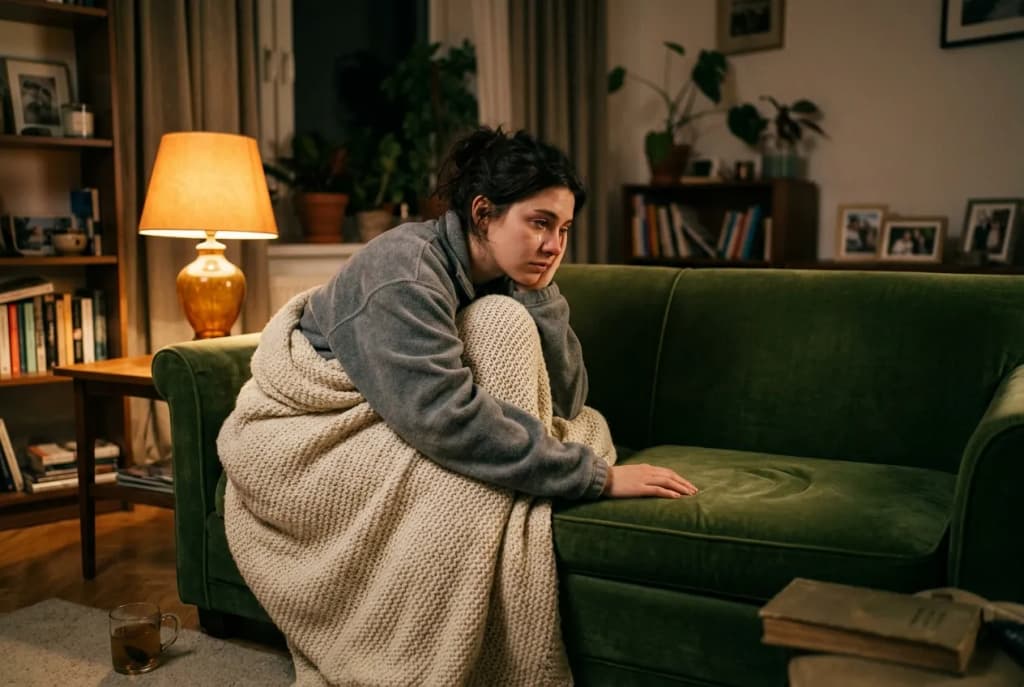
Here's the angle nobody talks about, the one you won't find in any of the top Google results for single person pet loss: you didn't just lose a companion. You lost your witness.
Think about it. Your Persian cat watched you cry on the bathroom floor at 2 AM. They sat on the counter while you stress-cooked pasta you didn't eat. They were there when you got the promotion, when you got the rejection, when you danced alone in the kitchen to a song that made you feel briefly, stupidly alive.
No one else saw those moments. No one.
There's a concept in existential psychology called "being seen"—the idea that we need another consciousness to reflect our existence back to us. It's why solitary confinement is classified as torture. Your cat provided that mirror. Not with words, not with judgment, but with presence. The slow blink across the room. The weight settling onto your lap during the worst evenings. The way they'd track your movement from doorway to kitchen to couch, a quiet confirmation that yes, you are here, you are real, your life is happening and someone is paying attention.
That's gone now. And the grief you're feeling isn't just "I miss my cat." It's "the only creature who witnessed my private life no longer exists, and those moments feel less real without them."
"Grief isn't about losing someone who loved you. It's about losing the version of yourself that only they knew."
What Nobody Warns You About: The Guilt That Comes With Relief
We need to talk about something uncomfortable. Something you might not have admitted to anyone, maybe not even to yourself.
That wave of relief you felt when their suffering ended? When the vet said it was done, or when you found them still and finally peaceful after weeks of watching them decline—and somewhere beneath the devastation, there was this tiny exhale. This microsecond of "it's over."
And then the guilt hit like a freight train.
Many pet owners feel guilty about this relief, and if you're living alone, the guilt is worse because there's no one to normalize it for you. No partner to say "I felt it too." No roommate to witness that you also sobbed for three hours afterward. Just you, alone with the relief and the shame and the terrible suspicion that maybe you didn't love them enough.
Let's be precise about what's happening in your brain. This is cognitive dissonance—the psychological discomfort of holding two contradictory truths simultaneously. Truth one: you loved your Persian cat with everything you had. Truth two: you are relieved they are no longer suffering (and, honestly, that you are no longer watching them suffer). Both are true. Both are love. The guilt is your brain's clumsy attempt to resolve the contradiction, and it resolves it by blaming you.
It's wrong. The guilt is wrong.
Relief in the face of suffering's end is one of the most ancient, most human responses we have. It doesn't cancel out love. It's actually a product of love—you can only feel relieved that suffering ended if you were paying close enough attention to feel that suffering in the first place.
The Specific Guilt of the Euthanasia Decision
And then there's this: if you made the decision to euthanize, you made it alone. No one co-signed it. No one helped you carry it.
Second-guessing euthanasia timing is so common among single pet owners that it probably deserves its own clinical term. Was it too soon? Could you have tried one more medication? Did you give up? Or—and this one cuts deeper—did you wait too long because you couldn't bear to be alone?
Both directions of the guilt are normal. Both are your love talking. And both are, frankly, unanswerable—which is what makes them so persistent. The brain hates unanswerable questions. It will circle them for months, years, looking for resolution that doesn't exist.
What helps (and we'll get into this more) isn't answering the question. It's learning to sit with the not-knowing. To hold the decision you made and say: "I did this with the information and the love I had at the time. That is enough."
| Guilt Pattern | What Your Brain Says | What's Actually True |
|---|---|---|
| Relief after death | "If you loved them, you'd only feel sad" | Relief that suffering ended IS love |
| Euthanasia timing | "You did it too early / too late" | You made the best decision with available information |
| Not noticing symptoms sooner | "You should have caught it" | Cats—especially Persians—mask illness instinctively |
| Feeling okay on a good day | "You're already forgetting them" | Grief isn't linear; good moments aren't betrayal |
| Wanting another pet | "You're replacing them" | New love doesn't erase old love |
The Apartment After: When Every Surface Holds a Ghost
The texture of Persian cat fur is unlike anything else. Dense, impossibly soft, slightly cool at the tips and warm underneath where it meets skin. You know this because your hands remember it even when your conscious mind is trying to move on. You reach for the arm of the couch and expect resistance—that slight give of a body that was always, always there.
The empty apartment is the hardest part of single person pet loss, and almost nobody writes about it honestly.
It's not just the absence. It's the acoustic change. A Persian cat doesn't make much noise—they're not yowlers—but they make presence noise. The soft thud of jumping down from the bed. The barely-audible grinding of kibble. The rhythmic breathing you didn't know you were tracking until it stopped. Your apartment is now acoustically dead in a way that your nervous system reads as wrong, wrong, wrong.
Here's what's happening: your brain built a predictive model of your environment that included your cat. Neuroscientists call this your "internal model" or "predictive processing framework." Every time you walk through the door, your brain expects certain sensory inputs—the sound of paws on hardwood, the visual of a flat face appearing around the corner, the tactile anticipation of fur against your ankle. When those predictions aren't met, your brain generates a prediction error signal. That signal feels like a jolt. A wrongness. A tiny grief-shock, dozens of times a day.
This is why the first two weeks are so physically exhausting. Your brain is literally rewriting its model of home, and every failed prediction costs metabolic energy.
Practical Things That Actually Help (Not the Usual Advice)
Most grief guides will tell you to "be gentle with yourself" and "allow the feelings." That's fine. It's also vague to the point of uselessness. Here's what actually helps, based on what we've seen working with thousands of grieving pet families:
- Rearrange one piece of furniture within 72 hours. Not the whole apartment. Just one thing. Move the couch six inches. Swap two chairs. This gives your brain a legitimate reason for the prediction errors, which reduces the jolt-per-encounter rate significantly.
- Put their food bowl away, but leave one item out. The blanket they slept on. The spot on the windowsill. Total erasure triggers panic in the grieving brain. Total preservation creates a shrine that freezes you. One item is an anchor, not a trap.
- Change the soundscape. If you lived in near-silence with your cat, the acoustic void will be brutal. A white noise machine, a low podcast, even a ticking clock—anything that gives your auditory cortex something to track besides absence.
- Touch something with texture every day. This sounds strange, but your hands are grieving too. They're missing the specific tactile input of fur. A weighted blanket, a textured throw pillow, even a smooth stone you keep in your pocket—give your somatosensory cortex something.
"We've worked with families who tell us the hardest part isn't the big moments—it's reaching down to pet a cat who isn't there anymore. Grief lives in the hands."
— The PawSculpt Team
The Counter-Point: When Memorializing Becomes Avoiding
Okay, here's where we challenge our own advice. Because intellectual honesty matters more than a clean narrative.
There's a line between healthy memorialization and grief avoidance, and it's thinner than most memorial companies (including us, honestly) want to admit.
Healthy memorialization gives grief a container. It says: "This love existed. Here is proof. I can touch it, look at it, and then continue living." It's an anchor point you visit and leave.
Grief avoidance disguised as memorialization looks different. It's spending six hours a day editing photos for a memorial project instead of eating. It's ordering five different keepsakes not because each one serves a purpose, but because the act of ordering creates a brief dopamine hit that temporarily numbs the pain. It's building an elaborate shrine and then being unable to leave the apartment because leaving means leaving them.
The psychological term is complicated grief or prolonged grief disorder, and it affects roughly 10-15% of bereaved individuals. For single-person households who've lost their only companion animal, the risk is higher because there are fewer external structures (work obligations to a partner, children's needs, social commitments) pulling you back into life.
So how do you know the difference?
Healthy grief moves, even when it moves slowly. You have terrible days and slightly less terrible days. You can, eventually, talk about your cat without your throat closing. The memorial items bring a bittersweet comfort—emphasis on the sweet part growing over time.
Complicated grief stays stuck. The intensity at month four feels identical to week one. You've organized your entire life around the loss. The memorial items bring only pain, but you can't stop engaging with them.
If you recognize yourself in the second description, that's not a moral failing. It's a signal that your nervous system needs more support than self-help can provide. The Association for Pet Loss and Bereavement offers resources specifically for this, and honestly, a therapist who understands attachment theory can be transformative.
| Sign | Healthy Grieving | May Need Additional Support |
|---|---|---|
| Timeline | Intensity gradually softens over weeks/months | Intensity unchanged after 3-6 months |
| Daily function | Difficult but possible; you eat, sleep, work | Basic functions consistently disrupted |
| Memorials | Bring bittersweet comfort | Bring only acute pain or compulsive behavior |
| Social life | Reduced but not eliminated | Complete withdrawal |
| Thoughts of pet | Frequent, sometimes warm | Intrusive, exclusively painful, ruminative |
| Future orientation | Can imagine (even reluctantly) life continuing | Cannot conceive of any future without the pet |
The Fear Nobody Talks About: Forgetting
Here's the counterintuitive insight that might reframe everything for you: the fear of forgetting is more painful than the forgetting itself—because the forgetting never actually happens the way you think it will.
You're terrified right now that you'll forget the exact shade of their fur. The specific weight of them on your chest. The way their breathing sounded when they were deeply asleep. And yes, the high-resolution sensory details will soften over time. That's not a bug in human memory—it's a feature. It's your brain's way of making the loss survivable.
But here's what doesn't fade: the relational memory. The felt sense of who you were with them. The emotional texture of your life together. Cognitive science calls this implicit memory—it's stored in your body, your reflexes, your emotional responses. It's why, three years from now, you'll hear a specific sound and feel a wash of warmth before you even consciously think of your cat. They're encoded in you at a level deeper than photographs can reach.
That said—and this is where we'll be real—the fear of forgetting is legitimate, and it deserves a response beyond "don't worry, you won't forget."
Concrete actions that preserve what matters:
- Write down three specific micro-moments within the first month. Not "she was sweet." Specific. "She used to press her nose against my wrist when I was typing, and her nose was always slightly cold and damp, and she'd leave a tiny wet mark on my skin." That level of detail. Your future self will thank you.
- Record a voice memo describing their physical presence. The weight, the texture, the temperature of their body. Describe it like you're explaining it to someone who's never touched a cat. This captures sensory details that photos can't.
- Save one item that holds their scent. Scent is processed by the olfactory bulb, which connects directly to the hippocampus (memory) and amygdala (emotion). It's the most powerful memory trigger we have. A blanket, a bed, even a collar—seal it in a ziplock bag. The scent will fade eventually, but it'll last longer than you'd expect.
- Consider a physical memorial that captures their specific appearance. This is where something like a custom 3D-printed figurine genuinely helps—not as a replacement for memory, but as an external anchor for it. When the visual details start to soften in your mind (and they will, around month 4-6), having a three-dimensional object that captures their exact coloring, their specific face shape, the way their fur fell—it gives your memory something to re-calibrate against. PawSculpt's full-color resin process reproduces the actual color patterns directly in the material, so what you're holding isn't a painted approximation. It's a dimensionally accurate record of what your cat looked like, down to the marbling in their coat.
"Memory doesn't live in the mind. It lives in the objects we're brave enough to keep."
Persian Cats Specifically: Why This Breed's Loss Hits a Particular Way
Not all cat grief is identical, and Persian cat grief has specific dimensions worth naming.
Persians are low-energy, high-presence cats. They don't fetch. They don't do parkour off your bookshelves. What they do is be there—consistently, quietly, heavily. A Persian's love language is proximity. They follow you from room to room not to play but to exist near you. They're the feline equivalent of a person who doesn't need to talk to make you feel less alone.
This means the loss pattern is different from losing, say, a Bengal or a Siamese. You're not missing activity. You're missing weight. The literal, physical weight of a 10-pound cat on your lap. The gravitational pull of another body in the room. The thermal presence—Persians run warm under all that fur, and your body got used to that heat source.
There's also the grooming dimension. If you had a long-haired Persian, you spent significant daily time in physical contact with them—brushing, detangling, checking their eyes and face folds. That ritual wasn't just maintenance. It was a structured bonding activity that gave your day rhythm and your hands purpose. Losing the cat means losing the ritual, and losing the ritual means losing a chunk of your daily structure.
For single people especially, that structure mattered more than you probably realized while it was happening.
What Persian Owners Specifically Need to Hear
Your cat's medical needs were probably significant. Persians are prone to polycystic kidney disease, respiratory issues, dental problems. You likely spent more time, money, and emotional energy on veterinary care than owners of hardier breeds.
Which means you might be carrying a specific flavor of guilt: "Did I do enough?" Or its inverse: "Did I do too much—did I prolong their suffering because I couldn't let go?"
Both questions are unanswerable. Both are love. And both are made worse by the fact that you navigated every vet appointment, every medication schedule, every difficult conversation alone. There was no one to turn to in the exam room and ask, "What do you think?" The weight of every decision sat on one set of shoulders.
Yours.
That's not a small thing. Acknowledge it. You carried something heavy, by yourself, for a long time. The exhaustion you feel now isn't just grief. It's the accumulated weight of solo caregiving finally being set down.
Coming Back to Life (Without Feeling Like a Traitor)
Let's talk about the anxiety that comes next—because it will come, and it'll probably surprise you.
Guilt about moving on is almost universal in pet loss, but for single-person households, it takes a specific shape: "If I start enjoying my evenings again, does that mean they didn't matter? If I rearrange the apartment, am I erasing them? If I—god—get another cat someday, am I replacing them?"
The answer to all three is no. But knowing that intellectually and feeling it are different countries entirely.
Here's the neuroscience that might help: your brain doesn't have a fixed amount of love that gets redistributed when someone dies. Love isn't a zero-sum resource. Neuroplasticity—your brain's ability to form new connections—means that new bonds form in new neural territory. They don't overwrite the old ones. Your Persian cat's place in your neural architecture is permanent. It will be accessed less frequently over time, but it won't be demolished to make room for something new.
Getting another cat someday isn't replacement. It's expansion.
But—and this is important—don't rush it. The internet is full of well-meaning people who'll tell you "the best way to heal is to rescue another cat." Sometimes that's true. Sometimes it's a way to avoid processing the loss, and you end up resenting the new cat for not being the old one. Give yourself at least three months before making any decisions. Let the prediction errors in your brain settle. Let your apartment become yours again—not yours-and-theirs, not yours-and-empty, just yours.
Then, when you're ready (and you'll know—it'll feel less like desperation and more like openness), you can choose what comes next.
Small Steps That Don't Feel Like Betrayal
- Week 1-2: Survive. That's it. Eat something. Sleep when you can. Cancel plans without guilt.
- Week 3-4: Begin one new micro-routine that has nothing to do with your cat. A morning walk. A different coffee shop. Something that builds a neural pathway not connected to them.
- Month 2-3: Reconnect with one person you've been avoiding. Grief in single-person households tends toward isolation, and isolation feeds complicated grief. One coffee date. One phone call. That's enough.
- Month 3-6: Consider what you want your home to feel like going forward. Not "how do I fill the void" but "what do I want this space to be?" That's a fundamentally different question, and it puts you in the driver's seat.
Holding On and Letting Go at the Same Time
There's a paradox at the center of grief that nobody resolves for you, because it can't be resolved. It can only be lived.
You need to hold on. And you need to let go. And you need to do both at the same time, which sounds impossible until you realize you've been doing impossible things for a while now—loving something you knew you'd outlive, building a life around a creature with a 15-year lifespan, giving your whole heart to a being who couldn't promise to stay.
The Japanese have a concept called mono no aware—the bittersweet awareness of impermanence. The beauty of cherry blossoms isn't despite their brief bloom. It's because of it. Your Persian cat's life was like that. Finite, and therefore precious. Bounded, and therefore complete.
The walking trail behind your apartment is still there. The carrier is in the closet, or maybe you've already donated it—either choice is fine, neither is wrong. What matters is that you walked that trail together, and the trail remembers even if no one else does.
You were witnessed. That doesn't end because the witness is gone.
Your hands will find new things to hold. A coffee mug on a cold morning. A book that makes you feel something. Maybe, eventually, a memorial figurine that captures the exact flat-faced, wide-eyed, impossibly soft presence that shared your apartment and your life—full-color resin holding the specific copper and cream of their coat, the precise way their fur parted across their chest. Something with weight in your palm. Something that says: this was real.
And it was. All of it. Every silent evening, every 2 AM bathroom vigil, every slow blink across the room that meant I see you, I'm here, you're not alone.
You weren't alone. And the love that made this grief so heavy? It's still yours. It goes where you go. It doesn't need a body to survive in. It just needs you to keep walking.
Frequently Asked Questions
How long does grief last after losing a cat when you live alone?
There's no universal timeline, but acute grief—the phase where it's hard to function normally—typically runs 2-3 months, with gradual softening over 6-12 months. For single-person households, the timeline can stretch longer because you've lost your only co-regulating presence. If the intensity feels completely unchanged after six months, consider reaching out to a grief counselor or the Association for Pet Loss and Bereavement.
Is it normal to feel relief after my Persian cat died?
Completely normal, and far more common than people admit. Relief that suffering ended is a direct product of love—you can only feel relieved about the end of pain you were intimately attuned to. The guilt that chases the relief is your brain's attempt to resolve cognitive dissonance, not evidence that you loved them less.
Why does losing a pet feel worse when you live alone?
Your cat was likely your primary attachment figure and nervous system co-regulator. Without another human in the home to partially absorb that role, the neurological impact is more intense. Your brain's entire predictive model of "home" included your cat, and every failed prediction generates a small grief-shock throughout the day.
How do I memorialize my Persian cat in a meaningful way?
Focus on preserving specific sensory details: write down three micro-moments within the first month, save a scent item in a sealed bag, and record a voice memo describing their physical presence. For a lasting visual memorial, a custom figurine created through full-color 3D printing can capture their exact coat patterns and features in resin—something your memory can re-calibrate against as visual details naturally soften over time.
When is it okay to get another cat after losing one?
Give yourself at least three months. The right time feels like openness rather than desperation. Neuroscience confirms that new bonds form in new neural territory—they don't overwrite existing ones. Your Persian's place in your brain is permanent. A new cat isn't a replacement; it's an expansion.
Is it normal to feel guilty about the euthanasia decision?
Extremely normal, and especially intense for single pet owners who carried that decision alone. Whether you worry it was too soon or too late, both directions of guilt are common. The decision can't be retroactively optimized. You made it with the information and love available to you in that moment, and that is enough.
Ready to Honor Your Persian Cat's Memory?
Some losses leave a shape in your life that words can't quite fill. When you're ready—not rushed, not pressured, but ready—a tangible memorial can give your grief an anchor and your love a home. PawSculpt's custom figurines are digitally sculpted by master 3D artists and precision-printed in full-color resin, capturing the exact coat patterns, face shape, and presence of the Persian cat who witnessed your life.
For those navigating losing a cat when you live alone, holding something with weight and dimension and color can be the difference between a memory that fades and one that stays vivid.
Visit pawsculpt.com to explore the full process, preview options, and service details