
Writing a Letter to Your Pug at the Rainbow Bridge: Why Psychologists Say It Actually Works
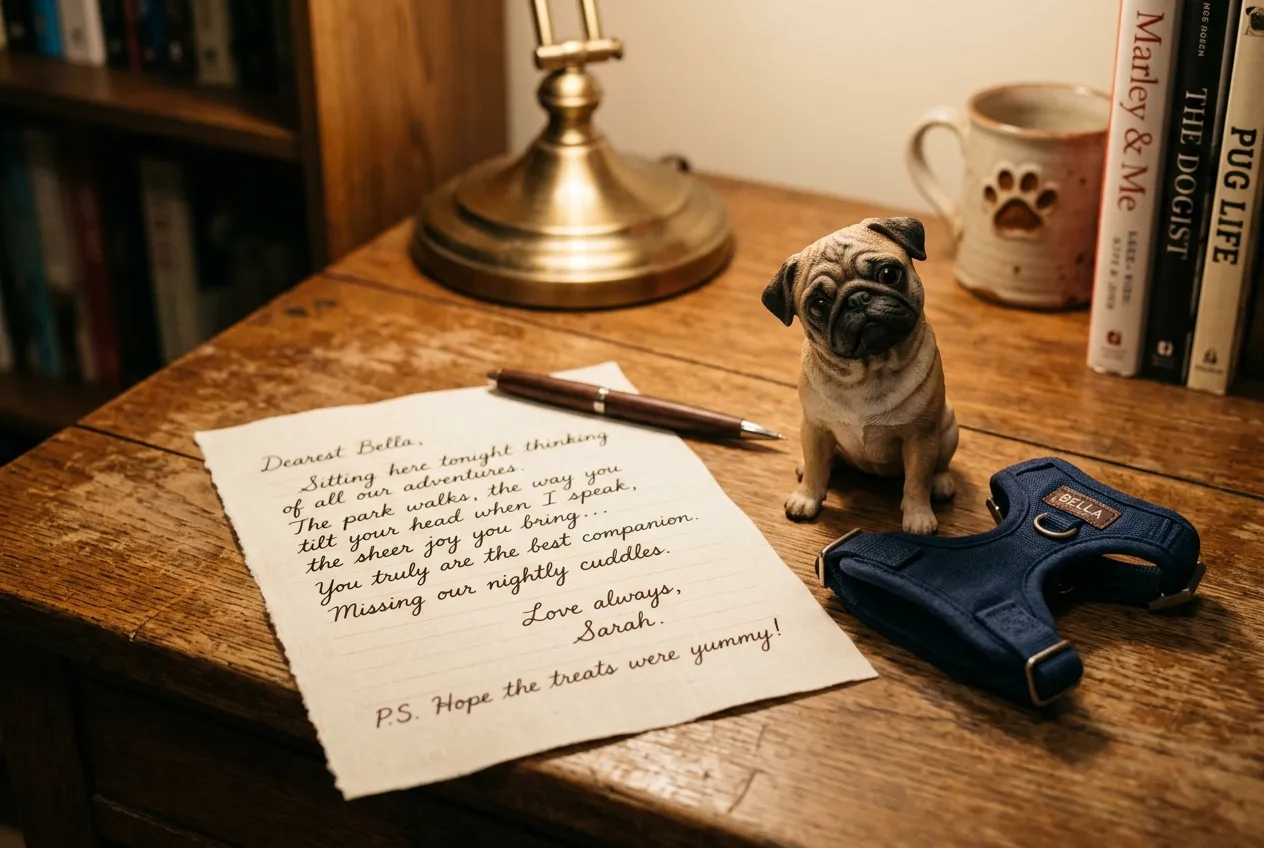
"The risk of love is loss, and the price of loss is grief — but the pain of grief is only a shadow of the love itself." — Hilary Stanton Zunin
A rainbow bridge letter to your pet isn't poetry for poetry's sake. It's a clinical tool dressed in sentiment — and for pug owners sitting in a living room that still smells faintly of corn chips and warm fur, staring at a leash hanging by the door, it might be the most effective grief intervention you've never considered.
Quick Takeaways
- Writing a letter to your deceased pug activates measurable grief-processing pathways — it's therapy, not just sentimentality
- The specific structure of your letter matters more than eloquence — psychologists recommend a particular framework we break down below
- Pug owners face unique grief complications — their breed's expressiveness creates an unusually deep communication bond that intensifies loss
- Physical anchors like custom memorial figurines paired with letter-writing create a dual-channel grief ritual that research suggests accelerates healing
- You don't need to be a writer — the worst letter you send to the rainbow bridge is the one you never write
Why Psychologists Actually Recommend Writing to a Deceased Pet (And Why Most People Misunderstand the Reason)
Here's what most articles about rainbow bridge letters get wrong: they frame the exercise as a sentimental goodbye. Something soft. A Hallmark moment.
It's not.
Expressive writing therapy — the clinical term for structured emotional writing — has been studied since the 1980s, when psychologist James Pennebaker at the University of Texas discovered that writing about traumatic experiences for just 15 to 20 minutes over three to four consecutive days produced measurable improvements in immune function, reduced doctor visits, and lowered cortisol levels. The mechanism isn't mystical. When you translate chaotic emotional experience into linear narrative — subject, verb, object, sequence — you force your brain to organize what feels unorganizable.
Grief, especially pet grief, tends to live in the body as a kind of ambient static. You can't quite name it. You walk into the kitchen and your chest tightens. You hear a snort from a stranger's dog at the park and your vision blurs. Writing a letter to your pug at the rainbow bridge doesn't just honor their memory. It gives your prefrontal cortex a job to do with material that's been trapped in your amygdala.
The counterintuitive insight most grief counselors won't lead with: the letter isn't really for your pet. It's a neurological intervention for you. And it works whether you believe in the rainbow bridge, an afterlife, or nothing at all.
The Pug-Specific Grief Problem Nobody Talks About
We've worked with thousands of pet families over the years, and pug owners grieve differently. We don't say that lightly or to flatter — it's an observation backed by the breed's unique characteristics.
Pugs are, by temperament and physiology, some of the most communicative dogs alive. Those enormous, liquid-dark eyes. The head tilts. The full-body wiggles. The way they follow you from room to room not out of anxiety but out of genuine, almost philosophical interest in what you're doing. The American Kennel Club describes pugs as "charming, mischievous, and loving," but anyone who's lived with one knows the description undersells it. Pugs don't just coexist with you. They commentate on your life.
That level of perceived communication creates what animal behaviorists call a high-reciprocity bond — the sense that your pet genuinely understood you, responded to your moods, and participated in emotional exchange. When that bond breaks, the grief isn't just about missing a companion. It's about losing what felt like a conversation partner.
Which is exactly why writing a letter works so powerfully for pug owners specifically. You're not starting a new form of communication. You're continuing one that already felt verbal.
"Grief doesn't need an audience. Sometimes it just needs a page."

The Letter Framework That Actually Works: A Psychologist-Backed Structure
Most rainbow bridge poem and letter guides online offer vague encouragement: "Write from the heart." "Say what you need to say." "Let the tears flow."
We'll be real — that advice is nearly useless when you're sitting at a table with a blank page and a lump in your throat the size of a fist. Structure helps. Here's a framework adapted from expressive writing therapy protocols, tailored specifically for writing a letter to a deceased dog.
Step 1: The Sensory Anchor (Opening Your Letter)
Don't start with "Dear [name]." Start with a single, hyper-specific sensory memory. Not "I miss our walks" but "I miss the way your nails clicked on the kitchen tile at exactly 6:47 every morning, three minutes before my alarm."
Why this works: sensory details activate the hippocampus (memory center) rather than the abstract language centers. You're not thinking about grief. You're re-entering a moment. The emotion follows naturally, and it's the real emotion — not the performed version.
| Letter Section | Purpose | Example Prompt | Time to Spend |
|---|---|---|---|
| Sensory Anchor | Activate specific memory | "The sound/smell/sight I remember most is..." | 3-5 minutes |
| The Unsaid | Release unexpressed thoughts | "I never told you, but..." | 5-7 minutes |
| The Difficult Truth | Process complicated feelings | "The hardest part I haven't admitted is..." | 5-7 minutes |
| The Gratitude Shift | Redirect neural pathways | "You taught me _____ without trying" | 3-5 minutes |
| The Release | Create psychological closure | "What I want you to know going forward..." | 3-5 minutes |
Step 2: The Unsaid
This is where the therapeutic weight lives. Write the things you never said out loud — not because they're dramatic, but because they were too ordinary to seem worth saying.
"I loved the way you snored so loud it drowned out the TV."
"I'm sorry I got frustrated when you wouldn't stop begging for my sandwich."
"You were the only one in the house who was always happy to see me. Every single time."
The "unsaid" section often surprises people. It tends to surface not the grand declarations but the tiny, unglamorous truths of daily life together. And those, it turns out, are the ones that hurt the most — because they're the ones most tied to routine, and routine is what grief disrupts most violently.
Step 3: The Difficult Truth
This is the section most rainbow bridge letter guides skip entirely, and it's the one that matters most.
Many pug owners carry a specific guilt that they rarely voice: pugs are a brachycephalic breed, prone to breathing difficulties, spinal issues, and eye problems. If your pug suffered health complications, you may be carrying a quiet, corrosive question — Did I cause this by choosing this breed? Should I have done more? Did I wait too long, or not long enough?
That wave of relief you felt when their labored breathing finally stopped? It doesn't make you a bad person. It makes you someone who loved them enough to prioritize their comfort over your own desperate need to keep them close. The guilt that follows that relief is one of grief's cruelest tricks — it takes your most compassionate moment and reframes it as betrayal.
Write it down. Name it. "I felt relieved, and then I felt guilty for feeling relieved, and I haven't told anyone because I'm afraid they'd think I didn't love you enough."
The act of writing that sentence — seeing it exist outside your head, in ink or pixels — begins to defuse it. Pennebaker's research consistently shows that the emotional experiences we avoid articulating are the ones that cause the most physiological stress. The difficult truth section isn't optional. It's the engine of the entire exercise.
"We've seen families heal by holding something tangible. Grief needs an anchor — something you can see, touch, and place in the spot where they used to sleep."
— The PawSculpt Team
Step 4: The Gratitude Shift
After the difficult truth, pivot. Not away from the pain — through it.
Write three to five specific things your pug taught you that you didn't realize you were learning at the time. Not "unconditional love" (too abstract). Try:
- "You taught me that 10 p.m. is a perfectly reasonable bedtime."
- "You taught me that enthusiasm about dinner is not something to be embarrassed about."
- "You taught me that sitting next to someone in complete quiet is its own kind of conversation."
This section leverages what psychologists call benefit-finding — the cognitive process of identifying growth or meaning within loss. It doesn't minimize the grief. It adds a second channel of processing alongside it.
Step 5: The Release
End your letter not with goodbye (that word carries too much finality for most people in acute grief) but with a forward-facing statement. Something like:
"I'm going to keep your bed in the corner for a while. Not because I'm stuck, but because I'm not ready to change the shape of the room yet. And that's okay."
Or: "I don't know if you can hear this. I don't need to know. Writing it was enough."
Personal Aside: Our team debated whether to include the "release" step at all. Some of us felt it pressured people toward closure they might not be ready for. We kept it because the framing matters — it's not "move on." It's "here's where I am right now." That distinction is everything.
The Timing Question: When Should You Write Your Rainbow Bridge Letter?
This is where we diverge from most advice you'll find online. The standard recommendation is to write when you "feel ready." Respectfully, that's not helpful. Grief doesn't send a calendar invite.
Here's what the research actually suggests:
| Timing | Effectiveness | Who It's Best For | Caution |
|---|---|---|---|
| Within 48 hours | High emotional intensity, strong cathartic effect | People who process through action | May feel overwhelming; have support nearby |
| 1-2 weeks after loss | Balanced — acute shock has faded, memories still vivid | Most people | Sweet spot for first letter |
| 1-3 months after | Good for processing complicated emotions (guilt, anger) | Those experiencing "stuck" grief | Don't wait this long if you're struggling daily |
| Anniversary/birthday | Powerful for ritual-based grieving | People who find comfort in ceremony | Can re-trigger acute grief; plan self-care around it |
| Multiple letters over time | Most effective long-term strategy | Everyone, honestly | Each letter will feel different — that's the point |
The standout insight here: you don't write one letter. The most therapeutically effective approach, according to Pennebaker's protocol, involves writing multiple times. Your first letter, written in the raw early days, will look nothing like a letter written six months later. And that contrast — visible on the page — becomes its own evidence of healing. You can literally see yourself moving through grief when you compare the two documents.
We recommend writing your first letter within the first two weeks. Keep it. Then write another one at the one-month mark. And another on their birthday or adoption anniversary. The letters become a grief journal with a recipient, which is psychologically distinct from (and often more effective than) a standard journal.
What to Do With the Letter After You Write It
This is the part most guides skip entirely, and it matters more than you'd think. The physical disposition of the letter creates what psychologists call a ritual action — a concrete behavior that signals to your brain that a psychological process has been completed.
Options, ranked by our editorial judgment:
Keep It in a Memory Box
Pair the letter with physical mementos — a collar, a favorite toy, a tuft of fur if you saved one. The box becomes a contained space for grief, which is psychologically different from grief that permeates every corner of your home. You can open it when you want to. You can close it when you need to. That sense of agency over your grief experience is profoundly healing.
Some families place a custom 3D-printed pet figurine on top of the box — a full-color resin piece that captures their pug's exact markings, the particular tilt of their head, the way their tongue poked out just slightly to the left. The figurine becomes a visual anchor for the memory box, something you see every day without having to open the lid. The color is printed directly into the resin material (not applied afterward), which means the warm fawn tones or silver-black shading of your pug's coat won't fade or chip over time.
Read It Aloud at a Memorial
This sounds intense, and it is. But reading your letter aloud — even alone, even to an empty room — activates different neural pathways than silent reading. You hear your own voice saying the words. You feel them in your throat and chest. For many people, this is the moment the grief shifts from something they're carrying to something they're expressing. There's a difference.
Burn It or Bury It (Ritual Release)
Not for everyone, but powerful for some. The act of watching the paper curl and darken, or of placing it in the earth near a planted tree, creates a physical metaphor for release that your brain processes as real. You're not destroying the memory. You're giving it a place to live that isn't inside your body.
Send It Digitally to Yourself in the Future
Several email scheduling services let you compose an email and set it to deliver months or years later. Write your rainbow bridge letter as an email to your future self. When it arrives in your inbox six months from now, you'll read it with different eyes. The distance between who you were when you wrote it and who you are when you receive it becomes tangible proof that grief moves, even when it doesn't feel like it's moving.
"A letter doesn't need a mailbox. It just needs to leave your hands."
The Emotions Nobody Warns You About (And How the Letter Helps With Each)
We need to talk about the feelings that don't make it into the rainbow bridge poems. The ones you scroll past on social media because they don't fit the narrative of "beautiful, bittersweet loss."
The Jealousy
You see someone at the dog park with a pug puppy — wrinkled forehead, curly tail, that absurd little waddle — and instead of feeling happy for them, you feel a hot, sharp jealousy that shocks you. Why do they get to have that? Why was mine taken?
This is more common than you might think. It doesn't mean you're a bad person. It means your brain is registering an inequity — you had something precious, it was taken, and someone else still has theirs. That's a normal human response to loss. In your letter, you might write: "I saw a pug puppy today and I hated that it wasn't you. I know that's not fair to them. But I'm not feeling fair right now."
The Fear of Forgetting
This one creeps in around the three-to-six-month mark, and it's terrifying. You realize you can't quite remember the exact sound of their snore. Or the precise weight of them on your lap. The details are softening at the edges, going from high-definition to watercolor, and it feels like a second loss.
This is exactly why tangible memorials matter so much. A photograph helps, but it's flat — it captures light, not dimension. A written letter captures language and emotion. A physical object — a figurine, a paw print casting, a piece of jewelry — captures form and presence. The most effective memorial strategies use multiple channels: visual, verbal, and tactile.
The letter addresses the fear directly. When you write "You used to press your cold nose against my ankle when you wanted breakfast," you've preserved that detail outside your fallible memory. It exists now. It won't soften. The page holds what the mind eventually releases.
The Shame About Grief Intensity
"It was just a dog."
If anyone has said this to you — or if you've said it to yourself — we want to be direct: the bond between a pug and their person is not lesser because it's interspecies. Functional MRI studies have shown that the same brain regions activate when a person looks at their dog as when a parent looks at their child. The neurological architecture of love doesn't check species at the door.
Your grief is proportional to your love. If the grief feels enormous, it's because the love was enormous. Writing the letter gives you a private space where the intensity of that grief is appropriate — where you don't have to perform being "okay" or minimize what you're feeling because someone might judge you.
In your letter: "People keep telling me I can get another dog. They don't understand that I don't want another dog. I want you. Specifically you. The one who knew that my left hand gives better scratches than my right."
Pug Rainbow Bridge Poems vs. Letters: Which Is More Effective?
A quick editorial note, because this comes up constantly in our research.
The classic pug rainbow bridge poem — and there are dozens of beautiful ones circulating online — serves a different psychological function than a letter. Poems are received. Letters are created. The therapeutic benefit of expressive writing comes specifically from the act of generating language about your experience, not from reading someone else's language about a generalized experience.
That said, poems aren't useless. They can serve as a gateway — reading a rainbow bridge poem that resonates can unlock the emotional state needed to write your own letter. Think of the poem as the key that opens the door. The letter is what you do once you walk through it.
| Format | Therapeutic Mechanism | Best Used When | Limitation |
|---|---|---|---|
| Rainbow Bridge Poem (reading) | Emotional validation, feeling "seen" | Early grief, when you can't find your own words | Passive; doesn't activate expressive processing |
| Personal Letter (writing) | Active cognitive processing, narrative construction | Any stage, especially 1-4 weeks post-loss | Requires emotional energy to begin |
| Structured Journal | Ongoing processing, tracking grief trajectory | Long-term grief work, months 2-12 | Less focused than a letter; can become ruminative |
| Verbal Storytelling | Social bonding, shared grief processing | When you have a supportive listener | Dependent on audience; can feel performative |
Our recommendation: read a poem first, then write your letter. The poem primes the emotional pump. The letter does the work.
Combining Your Letter With Physical Memorials: The Dual-Channel Approach
Here's something we've observed working with grieving pet families that we haven't seen discussed elsewhere: the most effective grief rituals combine a verbal/written element with a physical/tangible one. Neither alone is as powerful as both together.
The letter processes the internal experience — the emotions, the memories, the unsaid things. But grief also lives in the body and in physical space. The empty spot on the couch. The absence of weight on your feet at night. The visual gap where a small, snoring body used to be.
Physical memorials address the spatial dimension of grief. They fill — not replace, but acknowledge — the physical absence. A framed photo. A garden stone. A memorial pet figurine that captures the specific way your pug sat with one back leg kicked out to the side (pug owners know exactly what we're talking about).
The combination works because it engages multiple memory systems simultaneously. Your letter activates semantic memory (language, narrative, meaning). A physical memorial activates perceptual memory (visual recognition, spatial awareness, tactile experience). Together, they create what grief researchers call a continuing bond — an ongoing, healthy relationship with the deceased that doesn't require denial or detachment.
Personal Aside: One order that stuck with our team involved a woman who wrote a letter to her pug, folded it into a small square, and placed it beneath a custom figurine on her mantel. She told us the figurine "guards the letter." We think about that a lot. The figurine was printed in full-color resin — every wrinkle in the face, the exact champagne-fawn of the coat, the dark mask around the eyes rendered voxel by voxel in the print. She said it was the first time she'd smiled in weeks. Not because the grief was gone, but because it finally had a shape she could look at.
Practical Tips for the Actual Writing Process
Enough theory. Here's the tactical advice.
Choose your medium deliberately. Handwriting activates different motor and cognitive pathways than typing. Research from the Norwegian University of Science and Technology suggests handwriting produces stronger memory encoding. But if your hands shake or your handwriting feels like a barrier, type. The best medium is the one you'll actually use.
Set a timer for 20 minutes. Not 10 (too short to get past surface emotions), not 60 (too long; you'll exhaust yourself). Twenty minutes is the Pennebaker sweet spot. When the timer goes off, stop — even mid-sentence. You can come back tomorrow.
Don't edit. This is not a document for anyone else. Spelling doesn't matter. Grammar doesn't matter. Crossed-out words and tear-stained pages are features, not bugs. The therapeutic mechanism requires uncensored expression. The moment you start editing, you shift from emotional processing to performance, and the benefit drops.
Write to your pug, not about your pug. "You" is more powerful than "he" or "she." Direct address maintains the relational frame that makes the exercise work. You're not writing an obituary. You're continuing a conversation.
Include at least one moment of humor. This might feel wrong. It's not. Your pug was funny — that flat face pressed against the glass door, the dramatic sighs, the way they'd steal your spot the second you stood up. Laughter and grief aren't opposites. They're neighbors. Including a funny memory in your letter gives your brain permission to hold both simultaneously, which is closer to the truth of your relationship than pure sadness ever could be.
When a Letter Isn't Enough: Recognizing Complicated Grief
We want to be honest about the limits of this approach. Writing a rainbow bridge letter to your pet is a powerful tool, but it's not a replacement for professional support when grief becomes clinical.
Complicated grief (sometimes called prolonged grief disorder) affects an estimated 10-20% of bereaved pet owners, according to research published through the Human Animal Bond Research Institute. Signs include:
- Inability to function in daily life beyond 6 months post-loss
- Persistent, intrusive thoughts that don't diminish over time
- Complete avoidance of anything associated with your pet
- Feeling that life has no meaning or purpose without them
- Significant changes in eating, sleeping, or self-care
If this describes your experience, the letter can be a complement to therapy — not a substitute for it. Several therapists now specialize in pet bereavement, and the Association for Pet Loss and Bereavement maintains a directory of resources.
We're not therapists. We're a team that works with pet families every day and has seen the full spectrum of grief. What we can tell you is this: seeking help isn't a sign that your grief is "too much." It's a sign that your love was significant enough to warrant real support.
A Note on Writing for Children Who've Lost a Pug
If your child is grieving a family pug, the letter-writing exercise adapts beautifully — but with modifications.
For children under 7, drawing a picture to their pug at the rainbow bridge activates the same expressive processing pathways. They can dictate words for you to write alongside the drawing. The combination of visual art and narrated language is developmentally appropriate and surprisingly effective.
For children 7-12, a structured prompt works better than a blank page:
- "Draw or describe your favorite place you and [pug's name] used to go together."
- "What's the funniest thing they ever did?"
- "If they could talk, what do you think they'd say to you right now?"
- "What do you want them to know?"
For teenagers, offer the framework from the adult section but don't require them to share it. Privacy is critical for adolescent emotional processing. Let them know the letter exists for them alone.
The Letter You Write Today Will Mean Something Different in a Year
This is perhaps the most important thing we can leave you with, and it's the insight that separates this approach from a one-time grief exercise.
The letter you write today, in the thick of loss — when the living room still has that indent in the couch cushion and the food bowl is still on the kitchen floor — that letter is a snapshot of acute grief. It's raw. It's messy. It's probably not eloquent. It's perfect.
The letter you write in six months will be different. The sharp edges will have softened slightly. You might notice gratitude appearing where there was only pain before. You might find yourself writing about new things — a dream you had, a moment where you laughed unexpectedly, the complicated feelings about whether you're ready to love another dog.
And the letter you write on the one-year anniversary will be different still. Not because you've "moved on" (a phrase that deserves to be retired permanently from the grief vocabulary) but because you've moved with. Your pug is still part of your story. The story just has more chapters now.
Keep every letter. Date them. Store them together. Over time, they become the most honest record of love and loss you'll ever create — more truthful than memory, more dimensional than photographs, more yours than any poem someone else wrote.
The leash is still hanging by the door. Maybe it stays there for a while. Maybe it goes into the memory box eventually, folded next to a letter and beneath a small figurine that looks so much like them it makes your breath catch every time you walk past the mantel.
That catch in your breath? That's not a problem to solve. That's love, still alive, still finding you in the living room at unexpected moments. Write it down. Your pug would want to hear about it.
Frequently Asked Questions
Does writing a letter to my deceased pet actually help with grief?
It does — and not just anecdotally. Expressive writing therapy has been studied for over four decades, with consistent findings that writing about emotional experiences for 15-20 minutes over several consecutive days reduces cortisol levels, improves immune markers, and helps the brain convert chaotic emotional material into organized narrative. The letter format adds a relational dimension that standard journaling doesn't provide, because you're writing to someone rather than about something.
What should I include in a rainbow bridge letter to my pug?
The most effective letters follow a five-part structure: a specific sensory memory (not a general statement), things you never said aloud, a difficult truth you've been avoiding (guilt, relief, anger), specific lessons they taught you, and a forward-facing statement about where you are now. The key is specificity — "I miss the way you snored" is more therapeutic than "I miss you."
When is the best time to write a letter to my deceased dog?
The research-backed sweet spot for a first letter is one to two weeks after loss — early enough that memories are vivid, but past the initial shock. The most effective approach involves writing multiple letters over time: one in the first weeks, another at the one-month mark, and additional letters on meaningful dates. Each letter captures a different stage of grief, and comparing them over time provides visible evidence of healing.
Is it normal to feel guilty after putting my pug to sleep?
This is one of the most common experiences in pet grief, and one of the least discussed. The relief-guilt cycle — feeling relieved that their suffering ended, then feeling guilty about that relief — affects a significant number of pet owners who chose euthanasia. It's not a sign of insufficient love. It's a sign that you made an impossibly hard decision rooted in compassion. Writing about this specific feeling in your letter is one of the most effective ways to begin processing it.
What's the difference between a rainbow bridge poem and a personal letter?
Rainbow bridge poems provide emotional validation — the comfort of feeling understood by someone else's words. Personal letters provide active cognitive processing — the therapeutic benefit of generating your own language about your experience. Poems are passive; letters are active. Both have value, but the clinical evidence for grief processing specifically supports the act of writing, not reading. Our recommendation: read a poem to unlock the emotional state, then write your letter to do the processing work.
How do I help my child write a rainbow bridge letter to our family pug?
Adapt the exercise to their developmental stage. Children under seven benefit most from drawing a picture to their pet with words you write alongside as they dictate. Children seven to twelve respond well to structured prompts ("What's the funniest thing they ever did?" "What would they say to you if they could talk?"). Teenagers should be offered the adult framework but given complete privacy — don't require them to share what they write.
Ready to Honor Your Pug's Memory?
Some letters need a place to live — not folded in a drawer, but anchored beside something that looks back at you with those familiar dark eyes and that unmistakable wrinkled expression. A custom PawSculpt figurine captures your pug exactly as they were: the specific tilt of the head, the curl of the tail, the coat color printed directly into full-color resin so every detail endures. Paired with your rainbow bridge letter to your pet, it becomes a memorial that holds both the words and the shape of the love you shared.
Visit pawsculpt.com to see how the process works and explore your options