
What Happens When You Live Alone and Your Maine Coon Was Your Whole World
When did you last sit in a veterinary waiting room, your Maine Coon's carrier heavy on your lap, and realize that not a single person in your phone contacts would understand the weight of what was about to happen?
That specific loneliness—living alone pet loss at its rawest—is what we need to talk about.
Quick Takeaways
- Single-person grief after losing a cat is structurally different — your daily routines collapse entirely, not partially
- The sounds disappearing from your home matter more than people realize — silence becomes the loudest symptom of loss
- Guilt about "the decision" is nearly universal — and it doesn't mean you got it wrong
- Tangible anchors like custom memorial figurines help ground grief — giving your hands something to hold when your home feels empty
- Re-entering a quiet apartment is the hardest part nobody warns you about — but there are concrete strategies to survive that first night
The Grief Nobody Designed a Playbook For
Most grief resources assume there's someone else in the house. A partner who also cried. A roommate who noticed the empty food bowl. A kid who drew a crayon rainbow over the bridge.
But when it was just you and a twenty-pound Maine Coon who'd been sleeping against your ribs for twelve years? The architecture of your entire life just lost its load-bearing wall.
We've processed thousands of memorial orders at PawSculpt, and here's a pattern that stopped us in our tracks: roughly forty percent of the most detailed, most emotionally specific orders come from people who live alone. They remember every whisker direction. Every ear tilt. The exact gradient where the silver tabby faded into white on the chest. These aren't casual pet owners. These are people whose cat was their primary relationship—and they are not embarrassed about that, nor should they be.
Yet somehow, the internet treats single person pet grief as a footnote. A subsection under "general pet loss." That's wrong. It's a fundamentally different experience, and it deserves its own honest conversation.
"The depth of someone's grief has nothing to do with how many people share the house. It has everything to do with how much space that animal filled."
— The PawSculpt Team

Why Maine Coon Loss Hits Different—And It's Not Just About Size
Let's get specific, because Maine Coon loss grief carries textures that owners of other breeds don't always encounter.
Maine Coons are absurdly present. You know this. They follow you room to room. They "talk" in that chirpy trill that sounds nothing like a standard meow. They headbutt your laptop closed when you've been working too long. They weigh enough that when they jumped off the bed at 3 a.m., the thud registered in your half-sleeping brain like a second heartbeat in the apartment.
The Sound Profile That Vanishes
Here's the angle most articles miss: it's the acoustic footprint that devastates people who live alone.
With a Maine Coon, your home had a specific soundtrack:
| Sound | When It Happened | What It Meant |
|---|---|---|
| Low-frequency purr against your chest | Evenings on the couch | You were not alone tonight |
| Chirping trill from the kitchen | Mornings, near the food bowl | Someone needed you |
| Heavy paw-thuds on hardwood | Throughout the day | Life was moving through the rooms |
| Scratching on the post (or the couch arm) | Afternoons | The house was alive |
| That specific meow at the door when you came home | Every single return | You were expected. You were wanted. |
When a Maine Coon dies, your apartment doesn't just get emptier. It gets quieter in a way that feels aggressive. The refrigerator hum becomes deafening. The street noise outside sounds foreign, like it belongs to someone else's life. You turn on the TV not because you want to watch anything but because you cannot stand the silence where the trill used to be.
One customer told us she started leaving a white noise machine running on a "rain and purring" setting for three straight months. She wasn't embarrassed about it. She shouldn't have been. It was a smart, self-aware coping mechanism—filling the frequency gap her cat left behind.
They Were Your Cohabitant, Not Your "Pet"
This distinction matters enormously for solo dwellers. A Maine Coon in a single-person household isn't playing the role of "family pet." They're playing the role of:
- Roommate (whose schedule you organized your day around)
- Alarm clock (that paw on your face at 6:14 a.m., unfailingly)
- Dinner companion (eating when you ate, hovering nearby)
- Social buffer (someone to talk to out loud without feeling strange)
- Security system (that alert ear-swivel toward the front door)
Losing all five of those roles simultaneously is not a single loss. It's a cascade. And the outside world often fails to recognize the magnitude because they see one cat, not five functions.
The Emotions You're Feeling That You Haven't Told Anyone
Here's where we're going to get uncomfortably honest, because surface-level comfort doesn't help.
The Relief—And the Guilt That Eats It Alive
If your Maine Coon was older (and many are when they pass, given the breed's predisposition to hypertrophic cardiomyopathy), the last months may have been brutal. Subcutaneous fluids. Medication schedules that rivaled a nursing protocol. Watching that massive, majestic frame shrink.
That wave of relief you felt when their suffering ended? It doesn't make you a monster. It makes you someone who was running a one-person ICU in a studio apartment with no backup.
The guilt that follows that relief is one of grief's cruelest tricks. It whispers: If you really loved them, you wouldn't feel lighter. But the lightness isn't joy. It's the sudden absence of hypervigilance. Your nervous system spent months on high alert—monitoring breathing, checking gums, listening for distress sounds in the night. When that stops, your body exhales. That's physiology, not betrayal.
Second-Guessing the Timing
We'll be real: this is the most common confession we hear from solo pet owners. Not from couples. Not from families. From people who made the decision alone.
Was it too soon? Could I have tried the other medication? Did I give up? Did I wait too long and let them suffer because I couldn't face it?
When you live alone, there's no one to turn to in that vet office and ask, "Are we doing the right thing?" You carry the full moral weight on one set of shoulders. And afterward, without someone to co-process with at the kitchen table, those doubts don't get aired—they get buried. They calcify into something that feels like regret about decisions you made under impossible conditions.
Here's what a veterinarian once told one of our customers, and we think about it constantly: "The fact that you're agonizing over the timing means you were paying closer attention than most. People who don't care don't second-guess."
"Grief isn't proof that you did something wrong. It's proof that you showed up completely."
The Shame About How Hard This Is
You lost a cat. Not a spouse. Not a parent. A cat.
That's the voice, right? Maybe it's your own internal critic. Maybe it's a coworker who said "So are you getting another one?" forty-eight hours later. Maybe it's a family member who went quiet on the phone when you started crying—not out of cruelty, but out of genuine confusion about why you're this upset.
Feeling judged by others for the intensity of your grief is so common among single pet owners that it almost functions as a secondary loss—the loss of feeling understood. The Association for Pet Loss and Bereavement has noted that disenfranchised grief (grief that society doesn't fully validate) is one of the most isolating forms of mourning.
You are not overreacting. You are reacting proportionally to what you lost. And what you lost was your daily life's co-author.
Personal Aside: Our team has a running observation—and this isn't data, just years of pattern recognition—that the customers who apologize most ("I'm sorry, I know it's just a cat") tend to write the most extraordinarily detailed descriptions of their pet. As if the apology is a shield they hold up before letting themselves be fully vulnerable. You don't need the shield here.
The First Night Alone in a Truly Empty Home
Nobody talks about this enough. The drive home from the vet. Or the moment the in-home euthanasia team leaves and the front door clicks shut and you are standing in a room that still smells like your cat but no longer contains them.
What Actually Happens
Your brain does a strange thing in the first 24-48 hours: it keeps running the old programs. You'll hear phantom sounds—the thud of a jump, the click of claws. You'll glance at their spot on the couch. You might catch yourself about to say their name out loud. One customer told us she poured kibble into the bowl on autopilot the next morning and then stood there staring at it for fifteen minutes.
These aren't signs of losing your mind. They're signs of a nervous system that hasn't yet updated its map of reality. Your home was shared space for years. Your brain needs time to rewrite the spatial code.
Concrete Things to Do That First Night
Most guides say "be gentle with yourself." That's true but useless when you're standing alone in a quiet kitchen at 11 p.m. So here's what has actually helped people we've worked with:
- Change one sensory element in the room where your cat spent the most time. Move a piece of furniture. Light a candle with a scent you don't normally use. This gives your brain a signal that "this is a different chapter now" without erasing the old one.
- Call someone—anyone—not to talk about the cat, but just to hear a voice. Order food and chat with the delivery person for an extra beat. The goal isn't grief processing. It's breaking the acoustic isolation.
- Don't wash their blanket yet. This is counterintuitive. Some people rush to clean everything, thinking it'll help them "move forward." It usually backfires. You'll want that scent later. Maybe in two days. Maybe in two weeks. Let it exist on your timeline.
- Put their collar or a toy in a specific place—not hidden away, but intentionally placed. A shelf. A windowsill. This converts a random absence into a deliberate memorial. Small difference in action, enormous difference psychologically.
- Write down three things your cat did today or yesterday. Not their whole life story. Just three small, specific things. This fights the fear of forgetting that often surfaces aggressively in the first 72 hours.
| Time After Loss | Common Experience | What Helps |
|---|---|---|
| First 24 hours | Phantom sounds, autopilot habits, shock | Sensory anchors, not being alone with total silence |
| 48-72 hours | Waves of acute crying, anger, guilt spirals | Writing specific memories, talking to someone who "gets it" |
| 1-2 weeks | The "secondary losses" emerge (routine collapse, purposelessness) | Rebuilding one small daily ritual not tied to the cat |
| 1-3 months | Intermittent grief ambushes, loneliness intensifies | Tangible memorials, considering (not rushing into) support groups |
| 3-6 months | Identity questions ("Who am I without a cat to care for?") | Exploring what caregiving meant to you, possibly volunteering |
The Collapse of Daily Structure (And Why It Matters More Than Sadness)
Here's the counterintuitive insight that most losing cat when alone articles completely miss: the most destabilizing part of single-person pet loss isn't the sadness. It's the evaporation of structure.
When you live with another person and a pet dies, your human routines remain. You still cook for two. You still have someone's schedule to orbit. The pet-shaped hole is real, but the scaffolding of daily life holds.
When you live alone, the cat was the scaffolding.
Think about it:
- Your morning alarm was partly biological (the cat waking you), which set the tone for your entire morning
- Your evening had a rhythm: feed the cat, clean the box, settle in with the cat on the couch
- Your weekends were structured around being home because someone needed you
- Your grocery trips included their food, their treats—you had a reason at the store beyond yourself
- Your bedtime was influenced by when the cat settled, when the purring started
When the cat dies, you don't just lose a companion. You lose the invisible operating system that ran your home.
This is why so many solo grievers describe not just sadness but a strange, floating purposelessness. A feeling of: I don't know what to do with my hands. I don't know what to do with my evening. I don't know why I'm setting an alarm.
And here's the part that stings: people who haven't experienced this specific configuration—alone plus pet loss—will interpret that purposelessness as depression. They'll say "maybe you should see someone." And maybe you should! But first, recognize that the emptiness you're feeling is structural, not just emotional. Your operating system crashed. It's not a character flaw. It's architecture.
Rebuilding One Brick at a Time
You don't need to rebuild the whole structure at once. One deliberate ritual per week is enough at first:
- A morning anchor. Not the cat feeding—something new. A specific coffee ritual. A five-minute walk outside before looking at your phone. Something that says "this is how the day starts now."
- An evening marker. The hardest gap to fill, because evenings were their time with you. A podcast. A sketchbook. A call with someone. Not a replacement—a placeholder until you figure out what this new version of evening looks like.
- A weekly "leaving the house" commitment. Grief plus living alone plus working from home (which many single pet owners do) is a recipe for complete withdrawal. One non-negotiable outing per week. A bookstore. A coffee shop. Anywhere with ambient human sound.
Making Grief Tangible When There's No One to Share It With
Here's what we've learned from years in this space: grief that lives only in your head becomes recursive. It loops. It distorts. It feeds on itself because there's no external reality check.
This is why tangible memorials matter more for solo grievers than almost anyone else. Not because of sentimentality—because of psychology.
The Role of Physical Objects
When you hold something that represents your cat—something with dimension, weight, and presence—you're giving your grief an anchor outside your own skull. You can look at it and think that's real, they were real, this happened instead of cycling through the same internal footage.
Some people choose:
- A clay paw print from the vet (good, but often rushed and imperfect)
- A framed photo (accessible but flat—literally one-dimensional)
- A tattoo (permanent and meaningful, but not something you can hold)
- A custom figurine that captures the specific physical reality of your cat
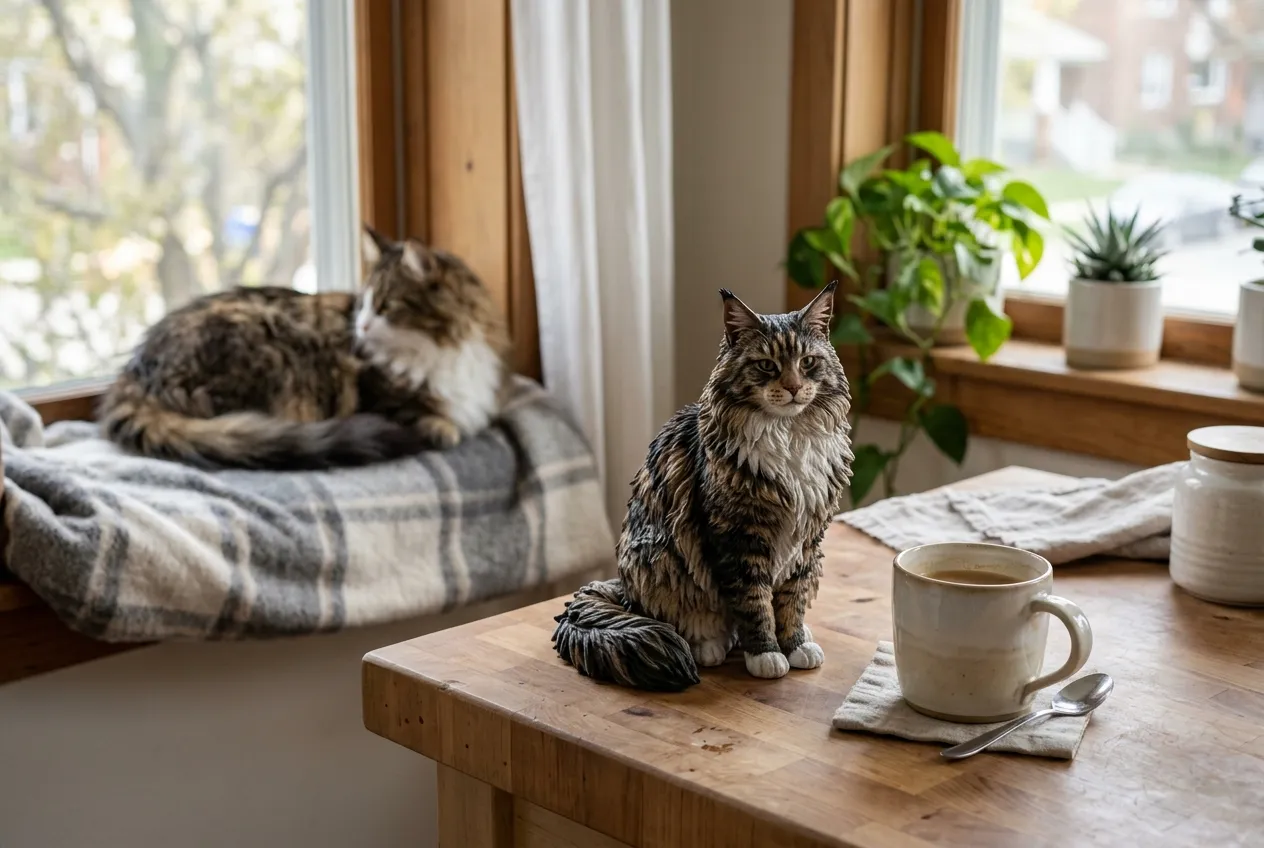
That last one is where PawSculpt fits into this conversation—not as a sales pitch, but as a genuine option we've seen transform the grieving process for solo owners. Our figurines are digitally sculpted by master 3D artists who study your photos obsessively, then precision printed in full-color resin where the color is literally embedded in the material, voxel by voxel. The ticked tabby pattern. The specific copper of the eyes. The ear tufts that made your Maine Coon look like a lynx pretending to be domesticated.
What we hear most from customers who live alone: "I put it on my nightstand and it was the first morning I didn't wake up and feel like the room was lying to me."
That's not marketing. That's someone telling us what a three-dimensional, accurate representation of their cat did for their spatial grief. It didn't replace the cat. Nothing does. But it occupied a physical point in the room that said: this creature existed, and the evidence is right here.
"A figurine doesn't fix the grief. But it gives it an address."
Choosing the Right Memorial for Your Brain
Not every memorial suits every person. Here's what we've observed:
| Memorial Type | Best For | Limitation |
|---|---|---|
| Photo collage/album | Visual processors, people who find comfort in browsing memories | Two-dimensional; doesn't occupy physical space in a room |
| Paw print impression | Immediate comfort, tactile connection | Often taken during a distressed moment; quality varies |
| Jewelry (fur/ash pendant) | People who want to carry the memorial with them | Small, easy to lose; not visible in the home environment |
| Custom figurine (explore options) | Solo grievers needing a room-scale anchor; detail-oriented owners | Requires good reference photos |
| Tattoo | Permanent statement, bodily connection | Can't be held, placed, or repositioned |
| Memorial garden/plant | Ritually satisfying, especially outdoors | Not available to apartment dwellers |
The point isn't that one is better than another. It's that solo grievers benefit most from memorials that change the physical environment of their home, because that's where the absence is loudest.
The Fear of Forgetting (And Why It Starts Immediately)
This one catches people off guard. You'd think the fear of forgetting would be a long-term concern—something that surfaces months or years later. But for people who live alone, it often starts within the first week.
Why? Because there's no one else in the house who remembers.
In a family, memories are distributed. One person remembers the cat's weird obsession with ice cubes. Another remembers the time she got stuck behind the dryer. The collective holds the full portrait.
When you live alone, you are the sole archive. If you forget a detail, it's gone. There's no backup drive. And that knowledge creates a desperate urgency—write it down, photograph everything, don't let any detail escape—that can feel almost manic in the early days.
Here's what we'd suggest, specifically:
- Record a voice memo talking about your cat. Not a polished eulogy. Just ramble. Describe the weird things. The specific chirp-meow hybrid they made when they saw a bird through the window. The way they'd drape themselves across your shoulders like a fur stole. Your voice breaking while you talk about them is not a flaw in the recording. It's part of the record.
- Ask your vet for their file. Seriously. Your cat's medical records contain dates, weights, visit notes—a factual skeleton that can trigger memories you didn't know you were losing. Some vets will print or email the full history if you ask.
- Save their fur. However much you have—from a brush, from a blanket, from the carrier. It sounds strange until you realize that scent is the memory sense most vulnerable to time. A small ziplock bag with their fur, sealed and stored, is a sensory time capsule.
When People Say the Wrong Thing (And They Will)
Let's catalog the greatest hits, because forewarned is forearmed:
- "It was just a cat." (The hall of fame entry. The one that makes you want to leave your body.)
- "At least you can travel now." (Said with genuine helpfulness. Received like a slap.)
- "You should get another one! There are so many cats that need homes." (True. Irrelevant. Badly timed.)
- "I know how you feel—my goldfish died in college." (They mean well. They truly do.)
- "Maybe this is a sign you should try dating." (As if your cat was a placeholder for a human. As if love is interchangeable.)
You will hear at least two of these within the first month. Here's how to survive them:
You don't owe anyone a measured, graceful response. You can say "I appreciate that you're trying" and change the subject. You can say "That's not helpful right now." You can say nothing and let the silence do the talking.
But also—and this is harder—try to hear the intention behind the clumsy words. Most people aren't dismissing your grief. They're drowning in their own discomfort with it. They don't know what to say because our culture has given them zero vocabulary for "my friend's cat died and they lived alone together and this is a real crisis."
The people who will surprise you? Often it's the ones who say almost nothing. Who text "I'm sorry. They were a great cat." Who drop off food without asking if you're okay. Who don't try to fix it.
The Anxiety About Getting Another Cat
This deserves its own section because it's one of the most complex emotional tangles in single person pet grief, and it's almost never discussed honestly.
The anxiety comes in layers:
Layer 1: "It would be a betrayal." As if your Maine Coon is watching from somewhere, tallying your loyalty. This feeling is irrational and completely real, and those two things can coexist.
Layer 2: "I can't survive this twice." This is the one that actually keeps people from adopting again. It's not about the new cat. It's about the preview of future grief. You now know exactly what losing a cat feels like when you're alone, and that knowledge is terrifying.
Layer 3: "What if I'm just filling a hole?" This one has a whiff of shame to it—as if wanting companionship again is a weakness, a neediness you should have outgrown.
Here's our take, after hearing from thousands of customers on both sides of this decision: there is no correct timeline, and there is no wrong reason to love an animal. Some people adopt within weeks and find it healing. Some wait years. Some never get another pet and live full, complete lives. None of these paths represents a failure of character or a failure of grief.
The one thing we'd caution against: adopting in the first two weeks specifically to escape the silence. Not because it won't work—sometimes it does—but because you deserve time to grieve this cat without the distraction of that cat's needs. Your Maine Coon earned their own mourning period. Give it to them.
Practical Matters Nobody Mentions
Quick section on the logistical aftermath, because grief brain makes everything harder and this stuff still needs doing:
- Cancel auto-ship pet food and litter orders immediately. The box arriving on your doorstep two weeks later is a grief ambush you don't need.
- Notify your vet's office. They'll stop sending vaccination reminders. This sounds trivial until you get one eight months later and it levels you.
- If you rent, update your pet deposit or pet rent situation with your landlord. Money is money, especially when you're also paying for cremation or memorial costs.
- Donate unopened food and supplies to a shelter within the first week, if you can. Sitting next to an untouched bag of Royal Canin Maine Coon formula for months doesn't serve your grief. Letting it feed another enormous, ridiculous cat does.
- Keep one thing that smells like them. Everything else can go when you're ready. But keep one thing.
The Long Quiet (Months 2-6)
The first two weeks get all the attention. Cards arrive. People check in. There's a dramatic quality to fresh grief that the world understands.
But the real battle for solo pet owners happens between months two and six—the long quiet—when everyone assumes you've "moved on" and you're standing in your kitchen at 7 p.m. on a Tuesday wondering why you bothered cooking for one.
This is when the identity questions surface. Not "I miss my cat" (though you do) but:
- Who am I when no one needs me?
- What is this apartment without another living thing in it?
- Was I a "cat person" or was I a "their name person"?
These questions don't have quick answers. But naming them is the first step toward living with them. And living with them—rather than solving them—is what the long quiet actually requires.
Personal Aside: One of the orders that stuck with our team was from a woman who waited eleven months to commission a figurine of her Maine Coon. She said she wasn't ready before that—she needed to stop crying when she looked at his photos before she could send them to strangers. When the figurine arrived, she told us she sat with it on the couch in "his spot" and watched a movie. "It was the first normal evening I'd had in almost a year," she wrote. That stopped all of us.
Finding Your People
The isolation of losing a cat when alone is real, but it's not inevitable. Communities exist—and they're not all cheesy or performative.
- The Association for Pet Loss and Bereavement runs a chat support forum and can connect you with pet loss counselors who specialize in exactly this kind of grief.
- Reddit's r/petloss community is raw, unfiltered, and surprisingly kind. The anonymity helps. People post things there they'd never say out loud.
- Your veterinary clinic may offer or know of local pet bereavement groups. Ask them. They field these questions more than you'd think.
- Online Maine Coon communities can be especially healing because the members understand the specific bond. They know what it means to lose a cat who weighed as much as a small dog, talked back to you, and followed you into the bathroom like a feline shadow.
You don't have to grieve in public. But you shouldn't have to grieve in total isolation either.
A Note on What Endures
Your Maine Coon is not reducible to their absence.
They were the sound of heavy paws on the hallway floor at 2 a.m. The specific pressure of a fifteen-pound body leaning into your side. That absurd, lion-like ruff of fur around the neck that made every photograph look vaguely regal. The way they'd sit in the bathroom sink like it was a custom-fitted throne.
Those things are not gone. They live in you—the sole archive, yes, but also the sole witness to a life that was shared completely, without dilution, between two beings in a small space.
That's not a lesser love because it was quiet and private. It might be the most undiluted form of love there is.
And if you want to make a piece of it visible—something you can set on a shelf and point to and say that was my cat, look at the ear tufts—that option exists. Companies like PawSculpt build full-color 3D-printed memorial figurines that carry your cat's exact markings in the resin itself, not as a surface layer but as part of the material's structure. It's one way—not the only way, but a meaningful one—to give the invisible something solid to stand on.
The sound of your Maine Coon is gone from the apartment. But the shape of the life you shared doesn't have to be.
You were someone's whole world too. Don't let anyone—including yourself—minimize that.
Frequently Asked Questions
How long does grief last after losing a cat when you live alone?
There's no expiration date on grief, and anyone who gives you a fixed number is guessing. That said, the acute phase—where it's hard to function, where the crying hits without warning—tends to run two to six weeks for most people. The structural adjustment (rebuilding routines, adapting to a quiet home) often takes three to six months. And occasional grief ambushes? Those can surface years later, triggered by a sound, a season, or a bag of treats you find in the back of a cabinet. All of that is normal.
Is it normal to feel guilty after choosing euthanasia for my cat?
Overwhelmingly normal. This is perhaps the single most common emotion we hear about from solo pet owners—even more than sadness. The guilt is amplified when you bore the decision alone. But the agonizing itself is evidence of how seriously you took their wellbeing. You didn't make that choice lightly. That matters.
How do I cope with the silence of living alone after my Maine Coon dies?
Start with the acoustic gap—it's the most immediately destabilizing part. Background sound (podcasts, ambient noise apps, even leaving a window cracked for street sounds) helps more than people expect. Beyond that, rebuild one daily ritual per week, reach out to pet loss communities online or through your vet, and consider a tangible memorial that gives the empty space something meaningful to hold.
When is it okay to get another cat after losing one?
Whenever it feels right to you—not when someone else suggests it. Our only caution is to avoid the first two weeks as a reactive decision to escape the quiet. After that, there's no betrayal in loving again. Some people find it healing quickly. Others need years. Both are valid.
Why does single-person pet loss feel so much more intense?
Because the cat wasn't one part of your household ecosystem—they were the ecosystem. Your morning alarm, your evening companion, your reason to come home at a certain time, your audible proof that the apartment contained life. When they die, every single one of those functions disappears simultaneously with no remaining structure to absorb the impact.
How can I create a meaningful memorial for my Maine Coon?
Match the memorial to your specific needs. If you crave something physical that occupies space in your home, a custom figurine (like those from PawSculpt) or a shadow box can serve as a daily anchor. If you process through language, a written tribute or voice memo works beautifully. If you want something on your body, a tattoo carries permanent meaning. The best memorial is the one you'll actually interact with, not the one that sounds most impressive.
Ready to Honor Your Maine Coon's Memory?
The bond between a single person and their cat doesn't disappear—it transforms. If you're looking for a way to make that bond visible, a custom PawSculpt figurine captures every tuft, every marking, every detail that made your Maine Coon irreplaceable. Full-color resin. Your cat's exact likeness. Something real to hold in a home that feels too quiet.
Visit pawsculpt.com to see how the process works and explore your options