
Two Years On: What Your Maine Coon's Last Video Taught Me About Impermanence
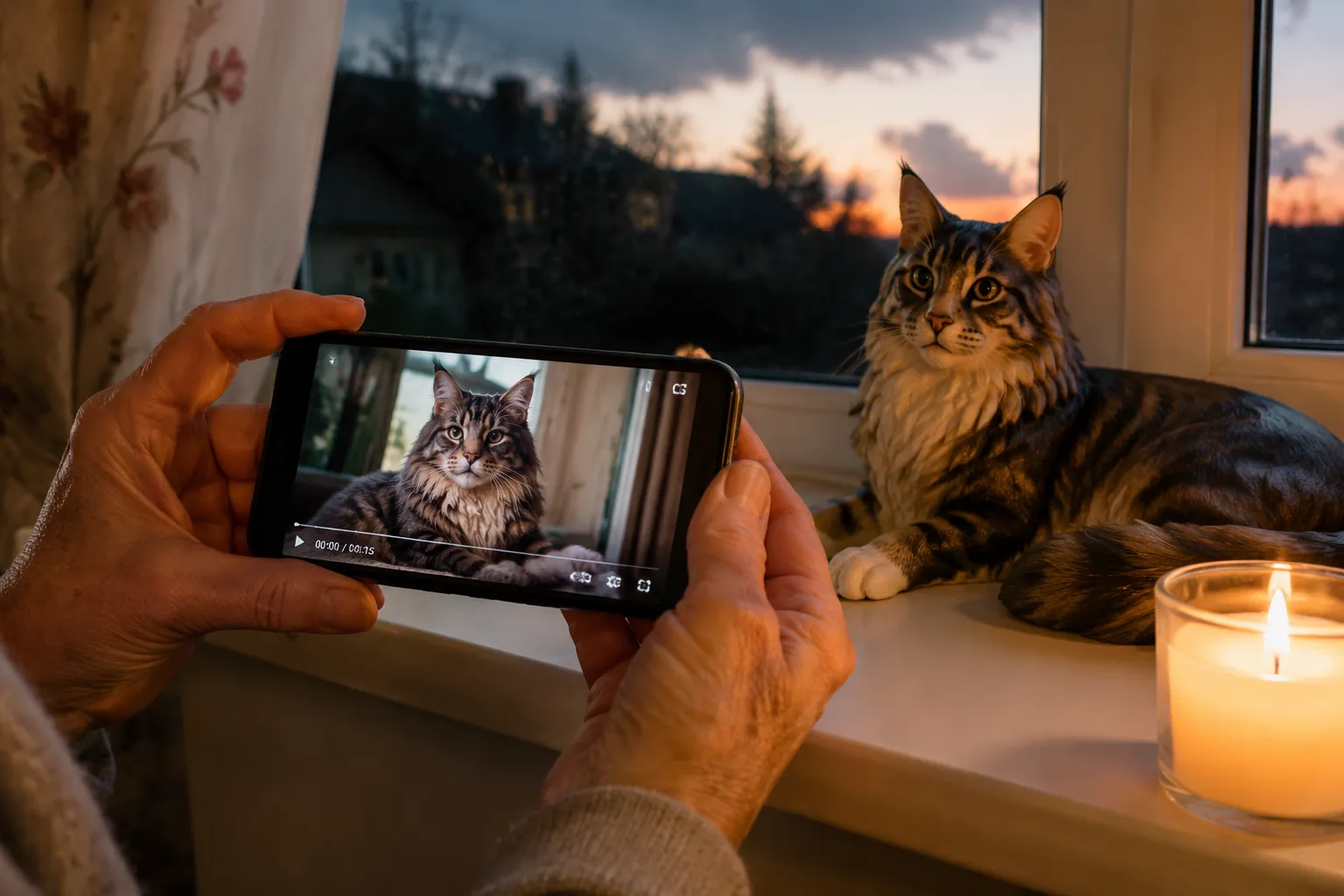
Your phone buffers, then plays: fourteen seconds of a Maine Coon batting a bottle cap across kitchen tile, tail flicking, sun catching the ginger tips of that ridiculous mane. When you're building a maine coon memorial, this is the footage you return to. Not the posed shots. This one.
Quick Takeaways
- The second year of grief hits differently — expect quieter, sneakier waves, not fewer ones.
- Your pet's last video is precious because it's ordinary — the mundane is what memory actually clings to.
- Fear of forgetting their exact movement is normal — capture texture now, not just faces.
- Tangible keepsakes anchor memory better than screens — some families choose custom pet figurines that hold a favorite pose in three dimensions.
- Impermanence isn't the enemy — it's the reason the small moments glowed in the first place.
Why Nobody Warns You About the Second Year
Everyone braces for year one. The empty bed. The first holiday. The vet's reminder card that arrives three weeks too late.
But grief second year pet loss is the chapter nobody hands you a pamphlet for. And honestly, it's the one that catches the most people off guard.
Here's the thing we've noticed after working with thousands of grieving pet families: the second year isn't gentler. It's just quieter. The casseroles stopped coming. Friends assume you've "moved on." And you, too, assumed you would.
Then a bottle cap skitters across your floor. And you're gutted all over again.
"Year one is a storm you see coming. Year two is weather that shows up on a clear day."
The first year, grief is loud and socially permitted. You're allowed to cry. People expect it. By year two, the world has moved its attention elsewhere, and the mismatch between how you feel and how you're "supposed" to feel becomes its own small ache.
That mismatch has a name in the research: disenfranchised grief. The kind of loss others don't fully recognize as loss. The Association for Pet Loss and Bereavement has spent decades validating exactly this—that mourning an animal is real grief, not a lesser version of it.
So if you're two years out and still feel the floor drop when a specific video autoplays, you are not stuck. You are not dramatic. You are someone who loved a large, opinionated cat with a mane like a lion's understudy. That doesn't expire on a calendar.
The counterintuitive part
Most grief guides tell you the pain should be shrinking by now.
We'd gently push back. In our experience, year two isn't about the volume of pain decreasing. It's about the pain changing shape—from a wall you hit to a thread that runs quietly through ordinary days. That's not failure to heal. That's integration.
What a Fourteen-Second Video Actually Teaches
Let's talk about that video. The last video of pet impermanence file sitting in your camera roll, the one you're afraid to watch and afraid to lose.
Most people assume the last video matters because it's the last. The final proof of aliveness.
We'd argue it matters for the opposite reason. It matters because it's utterly unremarkable.
Nobody films their pet knowing it's the last time. So the footage you have isn't a curated goodbye. It's a Tuesday. It's your Maine Coon knocking a pen off the desk with the calm confidence of an animal who has never once been held accountable. It's the tail. The head-tilt. The specific weight of them landing.
"We don't miss the milestones. We miss the muscle memory of the ordinary."
And that's the aha. Grief lives in motion, not in stills. You can look at a photo and feel warmth. But it's the fourteen seconds of movement—the exact rhythm of their walk, the way light slid over their fur as they turned—that undoes you. Because that's the part a still can never hold.
The visual grammar of memory
Here's something our 3D artists talk about a lot. Memory is intensely visual, but it's specific visual.
You don't remember "orange fur." You remember the way afternoon light turned the undercoat almost apricot near the belly, and how the guard hairs went nearly translucent at the edges. You remember the shadow their mane threw across the floorboards.
That precision is why grief feels so physical. Your brain stored the light.
Personal Aside: We'll be real—the videos our customers share during the intake process wreck us sometimes. One family sent a clip of their Maine Coon "supervising" laundry from inside the basket. Twelve seconds. We watched it six times. That's the thing about this work; you become a quiet witness to a thousand small, ordinary loves.
The Fear You Don't Say Out Loud
Let's name it, because almost nobody does.
You're afraid you'll forget.
Not their name. Not the big stuff. You're afraid you'll forget the exact pitch of their chirp. The specific way they flopped against you. The weight of them on your chest at 6 a.m.
This fear—the fear of forgetting—is one of grief's most common and least-discussed torments. And it's more common than you might think. We hear it constantly: "I watched the video today and panicked because I couldn't remember if that's actually how she sounded, or if I'm just remembering the video now."
That's real. And it's normal. Memory and recording start to blur, and the fear that the recording is replacing the real thing can feel like a second, smaller loss.
Here's what actually helps more than rewatching on loop:
- Write the sensory details down within the first weeks — the smell of their fur after sun, the sound of their specific meow, described in words. Words decay slower than confidence in your own memory.
- Choose one anchor object over a hundred digital files — a scattered camera roll fragments memory. A single tangible thing consolidates it.
- Give yourself permission to not watch daily — the video isn't going anywhere. Rationing it can protect its emotional charge.
"The fear isn't that you'll forget them. It's that forgetting would feel like a betrayal. It won't be."
The truth we've watched play out again and again: you don't forget the ones who shaped your days. The memory changes texture, softens at the edges like a photograph left in sun. But it stays. What fades is your anxiety about it fading—and that's a mercy, not a loss.
Guilt, Relief, and the Feelings You're Not Supposed to Have
Time for the honest part. Because year two often surfaces emotions year one was too loud to let through.
Guilt about moving on
You laughed last week. Really laughed. And then a cold hand gripped your stomach.
Guilt about moving on is nearly universal, and it operates on a cruel logic: some part of you believes that staying sad is a way of staying loyal. That joy is a kind of forgetting.
It isn't. Let's be direct about this. Your capacity to feel happy again is not a measure of how little you loved them. It's evidence that they taught you how to feel deeply in the first place. Moving forward is not moving away.
Second-guessing the timing
For those who faced euthanasia, year two can reopen the question you thought you'd closed. Did I wait too long? Did I not wait long enough?
Second-guessing euthanasia timing is one of the heaviest stones people carry, often in silence. Here's the reframe we offer, and we stand by it: there is no perfect day. There was never a clean moment where the "right" choice glowed obviously. You made a decision inside love and uncertainty, with the information you had. That is the most any of us can do.
The comparison table below reflects patterns we've observed across many families—not a clinical timeline, just honest terrain.
| Emotion | Common in Year One | Resurfaces in Year Two | What Helps |
|---|---|---|---|
| Acute sadness | Constant, loud | Situational, triggered | Let the wave pass without fighting it |
| Guilt about decisions | Overwhelming | Quieter but sharper | Write a letter to your pet; say what you needed to |
| Fear of forgetting | Emerging | Intensifies | Anchor memory in one tangible object |
| Guilt about joy | Rare (too soon) | Very common | Reframe joy as their legacy, not a betrayal |
| Peace | Fleeting | Slowly steadier | Notice it without rushing it |
None of these are problems to fix. They're the emotional weather of loving something that couldn't stay.
"We've seen families heal not by letting go, but by holding something real. Grief needs an anchor, not an eraser."
— The PawSculpt Team
Turning Motion Into Something You Can Hold
So what do you do with a video you can't stop watching and can't bear to lose?
You give the memory a body.
This is where a lot of families reach a quiet crossroads in year two. The digital files feel fragile—one dead phone, one failed cloud sync away from gone. And a screen keeps memory flat. Two-dimensional. Trapped behind glass.
There's real comfort in moving a favorite moment off the screen and into your hands. A memorial garden does this. A shadow box does this. And increasingly, families choose three-dimensional pet sculptures that lift a specific pose out of the footage and make it something you can actually pick up.
How the pose from a video becomes an object
People are often surprised by the process, so here's the honest version. At PawSculpt, your pet is digitally sculpted by master 3D artists, then precision 3D printed in full color. The color isn't a coating brushed on top—it's printed into the resin itself, voxel by voxel, so your Maine Coon's exact markings live inside the material.
The only manual step is a clear protective coat for sheen and durability. What you get is vibrant, true-to-life color with a natural fine 3D-print grain—authentic texture, not glossy plastic perfection.
Why does that matter for a memorial? Because that subtle grain catches light the way real things do. It reads as present, not as a toy.
Here's a quick look at how tangible keepsakes compare, based on what families tell us over time:
| Keepsake Type | Holds Motion/Pose | Durability | Best For |
|---|---|---|---|
| Digital video file | Yes, but flat & fragile | Depends on backups | Daily revisiting |
| Framed photo | No | High | A single favorite still |
| Memorial garden stone | No | Very high | Outdoor ritual space |
| Full-color 3D figurine | Yes—captures a pose in 3D | High, UV-resistant resin | Anchoring a specific memory |
| Paw print casting | No, but tactile | High | Physical touch memory |
None of these is "the best." The best one is the one that matches how you remember. If you remember through touch, a casting or figurine speaks louder. If you remember through ritual, a garden might. We'd rather you choose honestly than expensively.
What photos and video work best
If you do go the figurine route, our team's practical advice:
- Send multiple angles — front, both sides, and a top-down if you can. Sculptors build in 3D, so they need to see around your pet.
- Prioritize good, even light — natural daylight beats flash. Avoid harsh shadows that hide markings.
- Include a clear shot of the markings you love most — that white chest blaze, the ringed tail, whatever makes you say that's them.
- Video helps more than people expect — a short clip lets artists understand posture and proportion in a way a single frame can't.
For the specifics on turnaround, revisions, and guarantees, those details shift, so it's best to check them directly at pawsculpt.com rather than trust a number in a blog post.
The Reframe: Impermanence Was the Point
Here's the idea we keep circling back to, and it's the heart of this whole thing.
The reason that fourteen-second video glows isn't in spite of impermanence. It's because of it.
The bottle cap skittering across the tile mattered precisely because that afternoon would never repeat. The light hitting the mane was beautiful because light moves on. Nothing that stays forever ever feels that vivid.
"Impermanence isn't what stole them from you. It's what made every ordinary Tuesday worth filming."
We're not vets, and we're certainly not grief counselors—if year two brings grief that feels immobilizing, please reach out to a professional, and resources like the ASPCA's pet loss support exist for exactly this. But as people who spend our days translating fleeting moments into things you can hold, we've learned one thing for sure.
The goal was never to hold on so tightly that nothing could change. The goal is to let the memory keep changing shape—softer, warmer, more yours—while keeping something real in your hands to steady it.
You loved a creature who couldn't stay. That's not a tragedy to solve. It's the most human thing there is.
Frequently Asked Questions
Is it normal to grieve a pet more intensely in the second year?
Yes, and it surprises almost everyone. Year one grief is loud and socially supported. By year two, the outside world has moved on while your triggers—like an autoplaying video—haven't. That mismatch can make the pain feel sharper, not because you're regressing, but because you're grieving more privately.
Why does my pet's last video hit harder than photos?
Because memory lives in motion. A still image holds a face, but a video holds the walk, the tail flick, the exact rhythm of how they moved. Your brain stored those details deeply, so seeing them play again reactivates the full physical sense of your pet's presence.
How do I stop being afraid that I'll forget my Maine Coon?
Capture the sensory details in writing early on—the sound of their chirp, the smell of their fur. Ration how often you rewatch videos so they keep their emotional charge. And consider anchoring the memory in one tangible object rather than scattered files. The deep memory stays; it's the anxiety about forgetting that eventually fades.
Is it normal to feel guilty for being happy again?
Completely normal. Many people equate staying sad with staying loyal. But your ability to laugh again isn't forgetting—it's the legacy of an animal who taught you to feel deeply. Moving forward is not moving away from them.
What photos work best for a custom pet memorial figurine?
Send several angles (front, both sides, and ideally top-down) in soft natural light, plus a clear shot of the markings you love most. A short video is a bonus, since it helps 3D artists understand posture and proportion. For process specifics, check pawsculpt.com.
Ready to Celebrate Your Pet?
Every pet has a story worth preserving. Whether you're two years into a maine coon memorial or celebrating a companion still curled up beside you, a custom PawSculpt figurine lifts a favorite pose out of a fragile video file and into something you can actually hold—full-color resin that captures the exact markings you're afraid of forgetting.
Visit pawsculpt.com to learn more about our process, preview turnaround, revisions, and quality guarantee.