
Cooking Their Favorite Greens: The Neuroscience of Grieving a Guinea Pig's Empty Corner
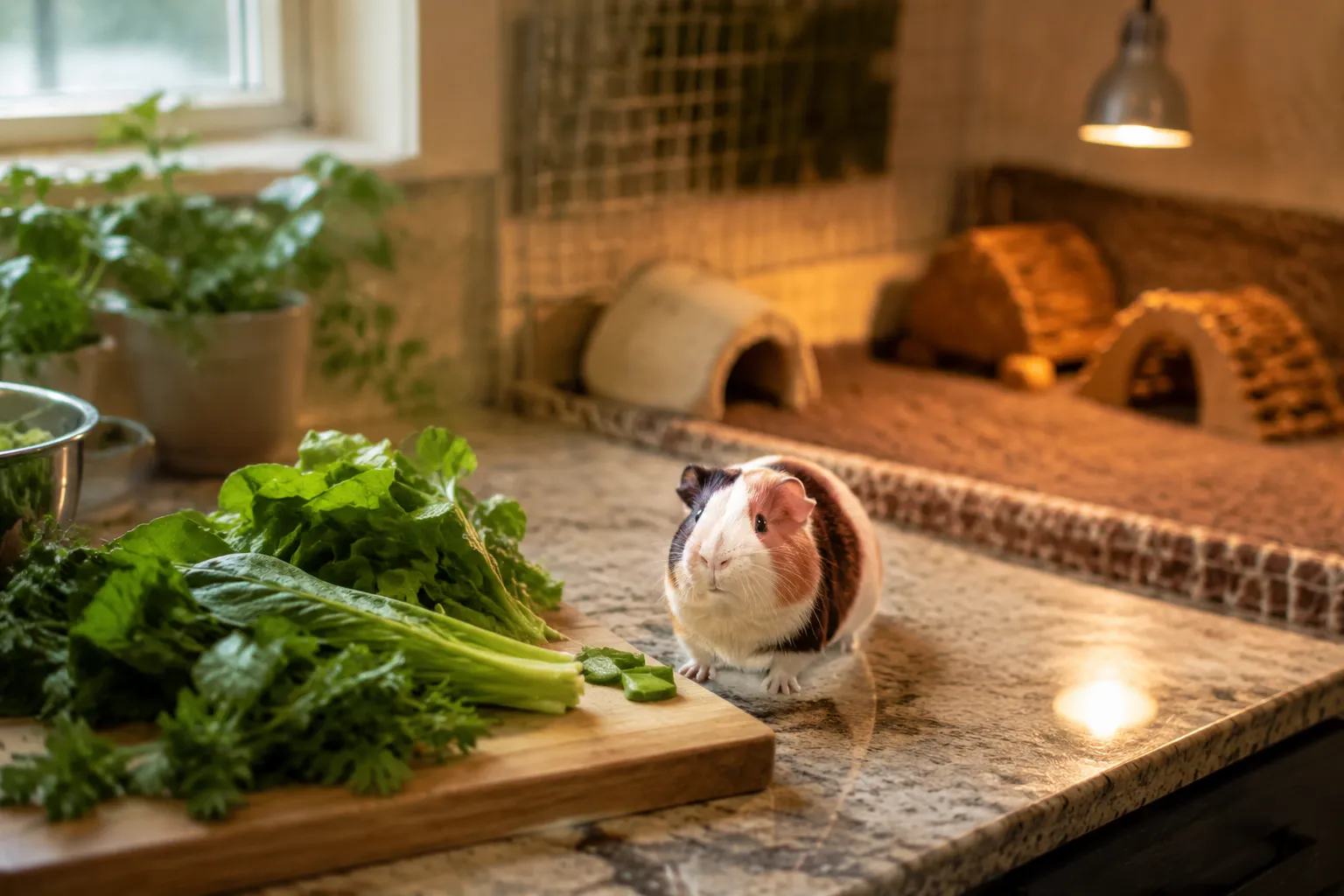
You reach for the crisper drawer, pull out a fistful of romaine, and start tearing it into ribbons before your hands catch up with the truth. The corner where the hay pile used to sit is holding the afternoon light now, and nothing is squeaking at the sound of the fridge. Guinea pig loss grief lives right here, in the muscle memory that keeps cooking for someone who isn't in the room anymore.
Quick Takeaways
- Your brain keeps "predicting" your guinea pig — the wheek-response habit loop takes weeks to fade, and that's normal.
- Anticipatory grief starts before they're gone — small-pet owners rarely get told this, so they blame themselves for feeling it.
- Guilt and second-guessing are neurological, not moral — your brain is running error signals, not delivering verdicts.
- A sacred space works better than "moving on" — ritual gives grief an anchor, and tangible keepsakes like custom pet figurines can hold that presence.
- Feeding behaviors fade last — the greens ritual is grief's slowest habit to release, and there's a reason for that.
Why a Guinea Pig's Empty Corner Hits Your Brain So Hard
Here's something people almost never say out loud: losing a guinea pig can level you in a way that surprises even you. You brace yourself for the ache of losing a dog you walked for twelve years. You don't brace for a two-pound animal who lived in a corner of the living room. And then it hits harder than you expected, and now you're grieving the pet and quietly judging yourself for the size of the grief.
We've watched this play out across thousands of memorial orders at our studio, and the small-pet families carry a very particular kind of ache. It's not smaller. It's just less witnessed.
The reason isn't sentimental. It's structural. Your brain built a model of your daily life that included this animal, and that model doesn't delete itself the moment the cage goes quiet.
The Habit Loop That Keeps Cooking
Think about what your evenings actually looked like. The fridge opens. A guinea pig, somewhere across the room, hears that specific seal-crack of the door and launches into the wheek — that high, insistent, full-body demand for vegetables. You tear the greens. They vibrate. You deliver. Everyone is satisfied.
That's a habit loop (cue, routine, reward), and it ran hundreds of times. Maybe thousands.
Neuroscientists talk about these loops living in the basal ganglia (a deep brain structure that automates repeated behavior so your conscious mind doesn't have to). The whole point of that system is efficiency — it lets you do things without deciding to do them. Which is beautiful when you're learning to drive.
It's brutal when the reward at the end of the loop has died.
"The hands remember longer than the heart accepts. That's not weakness. That's a body that loved on schedule."
So you keep reaching for the romaine. Your prefrontal cortex — the thinking, updating part of your brain — knows. But the automated loop fires first, because that's literally its job. This is why so many owners tell us the food ritual is the moment that breaks them. Not the empty cage. The half-torn lettuce in their hand.
One family we worked with told us she couldn't buy bell peppers for a month. She'd get to that section of the produce aisle and her chest would go tight, because bell peppers were his. That's not fragility. That's a habit loop with nowhere left to go.
Prediction Error and the Brain's Slow Update
There's a second mechanism, and it's the one that explains why grief keeps ambushing you from the side.
Your brain is a prediction machine. It constantly forecasts what's about to happen — a sound, a movement, a squeak — and then checks reality against the forecast. When reality matches, you barely notice. When reality violates the prediction, your brain fires what researchers call a prediction error (a neural signal that says: update your model, something is wrong).
For weeks after a loss, your model still contains your guinea pig. So every time the fridge opens and no wheek comes, that's a prediction error. Every time you glance at the corner expecting a small warm shape and see empty bedding, that's a prediction error. The absence of a sound becomes its own kind of sound.
This is the neuroscience of pet grief in one sentence: you are not sad on a schedule, you are sad every time reality contradicts a forecast your brain hasn't finished rewriting.
And small pets create incredibly dense forecast maps. Guinea pigs are creatures of habit — they popcorn at the same times, wheek at the same cues, occupy the same three square feet. That predictability, which made them so comforting, is exactly what makes their absence so loud. Your brain had a very high-resolution model of them, so there's a lot of model to grieve.

The Anticipatory Grief Nobody Warns Small-Pet Owners About
Let's talk about something the pet-loss world skips almost entirely.
Guinea pigs live, on average, five to seven years. Their decline can be fast — respiratory issues, dental problems, the sudden fragility that comes with prey-animal biology (prey animals hide illness until they can't). If you've been paying attention, you probably felt grief before your guinea pig was gone. That's anticipatory grief, and for small pets, almost nobody names it for you.
"Anticipatory grief is love doing math it wishes it didn't have to."
Anticipatory grief is the mourning that begins while your pet is still alive but you can see the road narrowing. You start noticing the greying muzzle, the slower popcorning, the way they sleep more. And you begin, without meaning to, saying goodbye in small daily installments.
Here's what makes small-pet anticipatory grief uniquely isolating: you often can't tell anyone. Say "I've been crying because my dog is getting old" and people nod. Say it about a guinea pig and you brace for the flicker of it's just a guinea pig across their face. So you grieve privately, in advance, and alone. That's a lot to carry.
The counterintuitive part? Anticipatory grief is not a bonus round of suffering. Research on the human-animal bond suggests that this pre-mourning can actually be protective — it lets you complete unfinished business, savor the remaining time deliberately, and begin building meaning before the loss arrives. Families who let themselves feel it often describe the final weeks as sacred rather than only frightening.
If you're in that window right now — your guinea pig is still here but slowing — this is your permission to treat the time as precious rather than pretending the ending isn't coming. Photograph them in good light. Cook the favorite greens on purpose, mindfully, as a ritual instead of a chore. You're not being morbid. You're being present.
Below is how anticipatory grief tends to move for small-pet owners, based on what families have shared with us. Every timeline is personal — this is a map, not a rulebook.
| Phase | What It Feels Like | What Actually Helps |
|---|---|---|
| Early awareness | Noticing decline, denial, "reading" every behavior | Vet clarity on prognosis; permission to feel it |
| Deep anticipatory grief | Preemptive crying, guilt, hypervigilance | Deliberate presence; documenting good moments |
| The final window | Exhaustion, dread, tenderness | Comfort-focused care; saying the goodbyes out loud |
| Acute loss | The empty corner, broken habit loops | Ritual, structure, not rushing "normal" |
| Integration | Grief softens into legacy | Memorial keepsakes; telling their story |
The Feelings You Haven't Said Out Loud
Now the hard part. The feelings that live under the socially acceptable sadness — the ones you might not have admitted even to the person you share a bed with.
The Guilt That Isn't Yours to Carry
Guinea pig owners carry a specific strain of guilt, and it usually sounds like a question. Did I catch it too late? Prey animals mask symptoms so well that by the time a guinea pig looks sick, they've often been sick for a while. So owners replay the timeline. The day they seemed a little quiet. The pellet they didn't finish. The signs that were invisible on purpose.
Let's be clear about this: guilt after a guinea pig's death is almost always a story your brain tells to regain a sense of control. If you could have done something, then the loss was preventable, then the universe makes sense. Guilt is easier than randomness. But easier isn't the same as true.
You loved an animal built by evolution to hide its suffering. You are not a diagnostician. You are a person who noticed something was wrong and acted on the information you had. That's what love looks like in real time — imperfect, retroactive, doing its best with incomplete data.
Second-Guessing the Timing
If you made the euthanasia decision, you may be trapped in a loop that goes: too soon one hour and too late the next. This is one of the cruelest features of the grieving brain, and we hear it constantly.
Here's the reframe that has helped families in our experience: the fact that you're agonizing over the timing is proof you were paying attention. People who don't care don't lie awake recalculating. The American Veterinary Medical Association offers guidance on quality-of-life assessment that many owners find grounding, precisely because it moves the decision from "did I feel ready" to "was my pet still comfortable." That distinction matters, because your readiness was never the right metric. Their comfort was.
"You didn't end their life. You ended their suffering. Those are not the same sentence."
The Fear of Forgetting
This one sneaks up months later, and it's the fear almost nobody admits: what if I forget the exact sound? The specific pitch of the wheek. The weight of them in your palm. The way they'd close their eyes when you scratched the right spot behind the ear.
Memory is reconstructive, not a recording — every time you recall a moment, your brain rebuilds it and can subtly overwrite it. So the fear is grounded in something real. Details do soften. And for a lot of owners, forgetting feels like a second loss, or even a betrayal.
This is exactly why so many people reach for something tangible — a photo they print, a voice memo they save, a small object that holds the shape of the animal. It's not clinging. It's giving your reconstructive memory an anchor to rebuild around.
Building a Sacred Space Around the Empty Corner
Okay. So what do you actually do with the corner?
The instinct is to erase it fast — pack the cage away, deep-clean the spot, remove the evidence, because the sight of it stings. And sometimes that's right. But often, rushing to clear the space just relocates the grief without resolving it. What we've seen work better is transforming the space rather than erasing it.
Grief needs somewhere to go. Anthropologists have long noted that humans across every culture build ritual around loss — not because ritual changes the outcome, but because it gives the survivors something to do with a love that has nowhere left to land. Your guinea pig's corner can become that place. A small sacred space.
This isn't about a shrine that makes visitors uncomfortable. It can be quiet and beautiful. A framed photo where the water bottle used to hang. A little bowl. A candle lit on certain evenings. The point is intention — you're converting an accidental emptiness into a chosen presence.
Here's how different memorial approaches tend to compare, in terms of effort, cost, and the kind of comfort they offer:
| Memorial Option | Effort | Emotional Weight | Best For |
|---|---|---|---|
| Photo display / printed album | Low | Warm, immediate | Everyone; a gentle first step |
| Memorial garden or plant | Medium | Living, seasonal | Those who find comfort outdoors |
| Written tribute / their story | Low–Medium | Deeply processing | People who grieve through words |
| Paw-print or fur keepsake | Low | Tactile, intimate | Those who fear forgetting textures |
| Custom full-color figurine | Low (you send photos) | Enduring, present | Reclaiming the empty corner with a form |
That last row is where a lot of our families land, and it's worth explaining honestly rather than as a pitch. A guinea pig's whole charm lives in the specifics — the rosette swirl of the fur, the particular patch of white over one eye, the pose they held when they were content. Those details are what fade first in memory and what a keepsake can hold.
At PawSculpt, we digitally sculpt your guinea pig from your photos and then bring them to life through full-color 3D printing, where the color is printed directly into the resin rather than added on top. It captures the actual markings and rosettes — the visual fingerprint that made your guinea pig yours. For families terrified of forgetting the exact look of their pet, having a small, accurate form to place in that corner can transform the space from a wound into a presence. You can see how the process works over at pawsculpt.com.
"We've learned that grief doesn't want to be talked out of the room. It wants something to hold. A tangible form gives love a place to rest."
— The PawSculpt Team
A Simple Corner Ritual (Actually Specific)
Vague advice helps no one, so here's a concrete practice families have found grounding in the first few weeks:
- Pick a time, ideally the old feeding time — the moment the habit loop still fires hardest.
- Light one small candle in the corner for the length of what used to be the greens ritual, maybe five minutes.
- Say one thing out loud to them. A memory, a thank-you, an apology if you need it. Speaking engages different neural pathways than silent thought.
- Blow it out and let the evening continue.
Why this works: you're not suppressing the habit loop, which backfires. You're giving it a new, complete routine — a cue, an action, a closure. Over three to six weeks, most people find the automatic reach for the fridge softens, because the loop finally has an ending again.
Counter-Point: When Rituals Become a Cage
We'd be doing you a disservice if we sold ritual as a cure-all, so here's the honest nuance.
There's a point where a sacred space stops healing and starts trapping. If the corner becomes a place you visit compulsively, if you find yourself unable to move an object even slightly, if the ritual is generating fresh anxiety rather than settling it — the tool has become the problem.
Psychologists distinguish between grief (a normal, if painful, adaptive process) and complicated grief (prolonged, disabling grief that doesn't move over time). For most people, the corner ritual is firmly in the healthy zone. But if months pass and the intensity hasn't shifted at all — if you're structuring your life around the memorial rather than living around it — that's worth taking to a therapist or a pet-loss support line, and there's no shame in it.
And honestly? Some people don't need a corner at all. Some grieve best by clearing the space, going for a long walk, and carrying their guinea pig internally rather than in a spot on the floor. If ritual feels forced or performative to you, skip it. The goal was never the candle. The goal was giving your particular brain and heart a workable way through. Yours might not look like anyone else's, and that's completely legitimate.
The metaphysical read on this, if it resonates: the bond you shared doesn't live in the corner. It never did. The corner was just where the bond showed up. If the space becomes heavy, the presence isn't gone — it's just asking to be carried differently.
What Actually Helps in the First Six Weeks
Let's get practical, because grief loves to leave you standing in a room with no idea what to do with your hands.
Don't clean the cage the same day. Unless the sight is unbearable, give yourself 48 hours before dismantling it. Snap decisions made inside acute grief are often the ones people regret. There's no rush.
Keep the feeding time occupied. The old greens ritual leaves a hole precisely at that hour. Fill it deliberately — a walk, a phone call, the candle ritual above. An unstructured empty slot is where the habit loop screams loudest.
Write down the sensory specifics now. Not the story, the details. The exact pitch. The weight. The smell of the hay. The favorite green. Your reconstructive memory will thank you in a year, and this is the cheapest possible insurance against the fear of forgetting.
Tell one person the real size of your grief. Isolation is grief's amplifier. You don't need a crowd. One person who won't say "it's just a guinea pig" is enough to make the loss witnessed, and being witnessed is neurologically calming.
Let the good days feel like betrayals — then let that go. The first day you laugh and forget for an hour, you may feel a stab of guilt for "moving on." That guilt is the brain misreading joy as disloyalty. It isn't. Healing is not forgetting. It's the love changing shape.
"Healing isn't the moment you stop missing them. It's the moment missing them stops being all you feel."
Here's the reframe we come back to with families again and again. The greens you keep almost-cooking, the corner you keep glancing at, the wheek you keep half-hearing — none of that is malfunction. It's the residue of a relationship that ran on love and routine for years. Your brain is grieving the way it loved: on schedule, in the body, in the specifics.
That doesn't get erased. It gets integrated. The prediction error fades, the habit loop finds a new ending, and the sharp corner slowly becomes a soft one. The love doesn't leave. It just stops requiring lettuce.
If part of your healing is holding onto their exact form — the rosettes, the pose, the small specific shape of them — a keepsake like a memorial pet figurine can sit in that corner as a quiet presence rather than an absence. Not because you need proof they existed, but because your memory deserves an anchor.
Frequently Asked Questions
Is it normal to grieve a guinea pig this intensely?
Completely. Grief scales with the strength of the bond and the density of your shared routines, not with the animal's body weight. Guinea pigs weave themselves into dozens of daily habits — feeding times, greeting sounds, that fixed corner of the room — so their absence triggers frequent, small waves of grief. The intensity is a measure of the love, not a malfunction.
Why do I keep reaching for their greens out of habit?
Because feeding your guinea pig was an automated behavior stored deep in your brain, in the basal ganglia, designed to run without conscious effort. That loop fired hundreds of times, so it keeps firing even after the reward is gone. Most people find the automatic reach softens over three to six weeks, especially if they build a new, complete routine at that same time of day.
Is it normal to feel guilty after my guinea pig died?
Yes, and it's one of the most common feelings we hear about. Guinea pigs are prey animals who instinctively hide illness, so by the time symptoms show, they've often been unwell a while. Owners replay the timeline searching for the moment they "should have known." That guilt is usually your brain seeking a sense of control over something random — not proof you did anything wrong.
What is anticipatory grief, and why didn't anyone warn me?
Anticipatory grief is the mourning that begins while your pet is still alive but clearly declining. Small-pet owners rarely get told it exists, so they often feel confused or ashamed about crying "too early." It's normal, and research suggests it can actually be protective — giving you time to be present, complete goodbyes, and begin finding meaning before the loss arrives.
How long does guinea pig loss grief usually last?
There's no fixed schedule, but acute grief often begins easing over several weeks to a few months, then integrates into something softer and more livable. Everyone's timeline differs. If the intensity hasn't shifted at all after many months, or it's disrupting daily functioning, it's worth reaching out to a pet-loss support line or a therapist.
Should I get another guinea pig right away?
There's no universal answer. Some people heal by welcoming a new companion soon; others need space first, and feel anxiety or guilt at the idea of "replacing" their pet. Neither is wrong. A good rule: make the decision from a place of readiness for a new relationship, not from a rush to fill the empty corner.
Ready to Celebrate Your Pet?
Every pet has a story worth preserving, and a guinea pig's story lives in the smallest details — the rosette swirls, the particular pose, the way they filled one specific corner of your home. Whether you're navigating guinea pig loss grief right now or you want to honor a companion still popcorning across the floor, a custom PawSculpt figurine captures the markings and personality that made your pet impossible to replace.
Visit pawsculpt.com to explore our full-color 3D printing process, flexible revisions, and quality guarantee.