
After the Accident: Turning Your Boxer's Paw Print Into a Quiet Anchor for Healing
Six weeks ago this park path rang with the jingle of tags and the drum of boxer paws hitting packed dirt. Now, after the accident, your pocket still carries a leash you keep forgetting to leave home. Pet loss from an accident steals the goodbye you never got the chance to plan.
Quick Takeaways
- Accident grief hits differently — the shock and missing goodbye need their own kind of processing
- Guilt and anger are normal — replaying "what if" isn't weakness, it's love with nowhere to go
- A physical anchor helps hands that keep reaching — something to hold steadies a scattered mind
- Turn a paw print into ritual, not just decoration — placement and intention matter more than the object itself
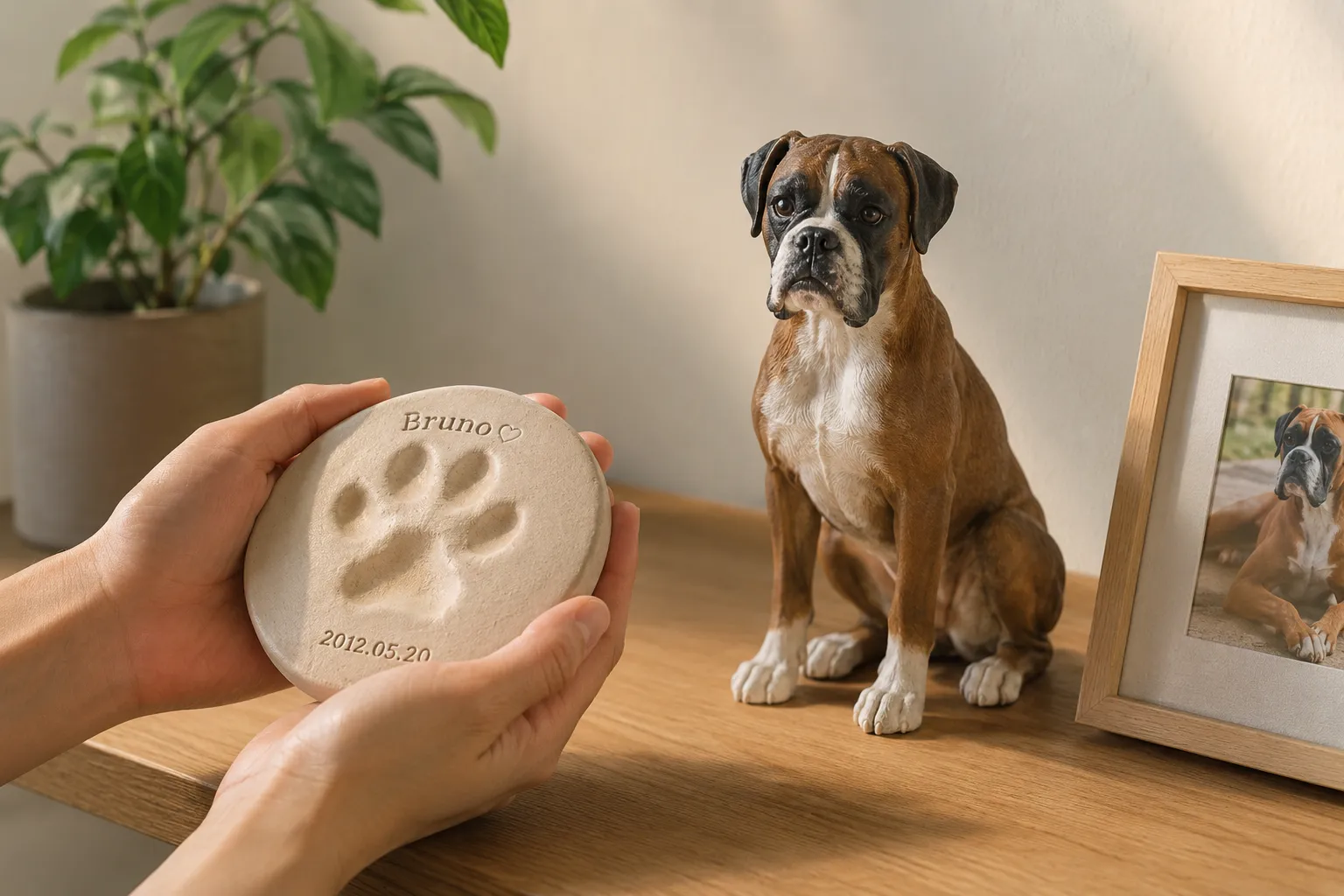
- Consider a tangible keepsake — many families find comfort in custom pet figurines that hold a pet's exact markings
When There Was No Goodbye: The Specific Weight of Accidental Loss
Here's what nobody tells you about losing a pet to an accident.
It's not just grief. It's grief tangled up with shock, and the two of them don't play nice together. Your body was braced for an ordinary Tuesday. A walk. A treat. The click of nails across the kitchen floor at dinnertime. And then, in the space of a breath, that entire future got erased without a single warning bell.
That's the part that guts you. Not only that they're gone, but that you had no time to memorize them one last time.
When a pet declines slowly, families often get a strange, painful gift: the chance to say things out loud. To sit on the floor. To whisper into a graying muzzle. Accidental loss steals that ritual of goodbye, and the theft leaves a wound with jagged edges instead of a clean line.
So if you feel like you're grieving wrong — too shocked to cry, or crying at the wrong moments, or numb when you think you should be sobbing — you're not. You're grieving a rupture, not a fade. Different injury, different healing.
"Accidental loss doesn't take a chapter of the story. It rips the page out mid-sentence."
The soundtrack that disappears overnight
Grief after an accident is loud in a very particular way. Not with noise. With the absence of it.
You notice the sounds first, honestly. The specific arrhythmia of boxer breathing — that soft snore they do, half-snort, half-sigh — gone from the foot of the bed. No tags clinking against the water bowl at 6 a.m. No nails ticking down the hallway when you get up to make coffee. The house doesn't just feel empty. It sounds empty, and your ears keep straining for a frequency that's no longer broadcasting.
One family we worked with described it perfectly. They said the worst moment wasn't the vet's office. It was walking in the front door three days later and realizing nobody was going to lose their mind with joy at the sound of the key in the lock.
That silence is where a lot of this article lives. Because the tools that help most aren't the ones that fill the quiet with distraction. They're the ones that give the quiet somewhere to rest.
The Feelings You're Not Supposed to Say Out Loud
Let's talk about the ugly stuff. The feelings that make you think something's broken in you.
They're not signs of a problem. They're standard equipment for a heart that loved hard and lost fast.
The guilt that won't let go
If your pet died in an accident, there's a very good chance you've spent hours — maybe entire nights — inside one relentless loop. If I'd shut the gate. If I'd used the other leash. If I'd left five minutes later. If I hadn't looked away.
We need to name this directly, because you've probably been carrying it in silence: that guilt is grief wearing a disguise.
Your brain, desperate to make sense of something senseless, reaches for control. If you can find the mistake, then the world still has rules. Then it wasn't random. Then, in some awful way, you had power over it. Guilt feels terrible, but it's often preferable to the alternative — accepting that sometimes love isn't enough to keep the ones we adore safe.
Here's the counterintuitive truth. The guiltiest grievers are frequently the most devoted ones. You're not being punished by your conscience because you failed. You're being ambushed by it because you cared enormously and the outcome was outside your hands anyway.
You did not choose this. An accident, by its very definition, is the thing you didn't choose.
The anger you didn't expect
Then there's the rage. Nobody puts this on the sympathy cards.
Maybe you're furious at the driver. At the other dog. At yourself. At the vet who couldn't fix it, or at the universe for the timing, or at a friend who says "at least it was quick" like that's supposed to help.
Some people even feel a flash of anger at the pet. Why did you run? Why didn't you stop? And then they hate themselves for thinking it.
If that's you — breathe. Anger is one of grief's most honest expressions. It shows up because loss this sudden feels like an injustice, and injustice demands a target. You don't have to act on it. You don't have to be proud of it. You just have to let it move through instead of damming it up until it turns into something harder.
Second-guessing every decision
For families whose pet survived the accident briefly — hours, or a day, or a week in critical care — a different torment sets in. The endless audit of choices. Did we do enough? Did we do too much? Should we have let go sooner? Should we have fought harder?
If you made an end-of-life decision under emergency pressure, with a vet talking fast and your hands shaking, know this: you made the most loving choice available with the information you had in the room. Hindsight has perfect vision and zero mercy. The version of you standing in that fluorescent hallway didn't have a crystal ball. That version of you had love, and love did the best it could.
"You didn't fail them by not knowing the future. You loved them inside the only moment you were given."
Feeling judged, feeling alone
And then the world keeps spinning like nothing happened.
Your coworker asks if you're "over it yet." Someone suggests you "just get another one." A family member reminds you it was "only a dog." Suddenly you're not just grieving — you're grieving and defending your right to grieve, which is its own exhausting job.
This is the isolation that catches so many pet owners off guard. The disenfranchised grief, as pet loss counselors call it. Your loss is real, but the culture around you often doesn't rank it as real. So you learn to grieve in private, to save the tears for the car, to keep the mourning small enough that it doesn't inconvenience anyone.
You don't have to do that here. Organizations like the Association for Pet Loss and Bereavement exist precisely because this grief deserves witnesses, not minimizers. Reaching out to a community that gets it isn't weakness. It's finding the people who won't ask if you're over it yet.
Why Your Hands Keep Reaching (and Why an Anchor Helps)
Notice what your body does when it forgets.
You buy the wrong food at the store and it's already in the cart before you remember. You step over the spot where the bed used to be. You reach down at a red light to rest your hand on a head that isn't in the passenger seat anymore. Your muscles kept the memory even after your mind got the news.
This is the strange physical reality of loss. Grief lives in the body, not just the mind. And a body that spent years reaching for a warm, breathing presence doesn't stop reaching just because you understand, intellectually, that there's nothing there.
Which is exactly why so many grieving pet owners find unexpected relief in something tangible to hold.
The psychology of the anchor object
Think about why humans keep lockets. Why we press flowers. Why a grandmother's ring can undo you in the checkout line. Physical objects give abstract, overwhelming emotion a place to land. They convert a feeling too big for your body into something the size of your palm.
For pet loss specifically, this matters more than most people realize. Your bond with your pet was profoundly physical — fur under your fingers, weight against your legs, the warm press of a head on your knee. When that physical relationship ends abruptly through an accident, the sudden absence of touch can be as painful as the absence of presence.
A paw print keepsake works because it speaks the language your grief already knows. Touch. Weight. A shape your hands recognize.
"Grief needs somewhere to go. A keepsake gives your hands a home when your heart has none."
A day-in-the-life: how an anchor actually works
Picture a Tuesday evening, about two months in. You get home, and the door opens onto that too-quiet apartment. Instead of standing frozen in the entryway the way you have for weeks, you go to the shelf by the window where you've placed a small figurine that carries your boxer's exact brindle markings. You rest two fingers on it for a moment, the way you used to rest them on his head. You breathe. Then you make dinner.
That's it. That's the whole ritual. Thirty seconds.
But those thirty seconds do something powerful. They give your reaching hands a destination. They turn a moment of ambush into a moment of choice. And over weeks, that tiny act of contact rewires the homecoming from an assault into an acknowledgment.
Turning a Paw Print Into a Quiet Anchor: Practical Steps
Alright. Let's get concrete, because "make a memorial" is useless advice without the how.
Not every keepsake becomes an anchor. A framed photo shoved in a drawer doesn't heal anyone. What transforms an object into something that genuinely steadies you is intention plus placement plus ritual. Here's how we've seen it work.
1. Capture what's authentic, not what's perfect
If you have a physical paw print — ink, clay, a mold from the vet — protect it now. These are fragile, and in the fog of early grief, things get lost.
If you don't have one, don't despair. This is where a lot of families feel a fresh stab of panic. I didn't get a print. I didn't get a paw casting. I have nothing. You have more than you think. You have photos. You have that video where he's losing his mind over a tennis ball. Those hold the markings, the proportions, the specific crooked ear that made him him.
The mistake most people make is chasing a perfect, posed, studio-quality image for a memorial. What actually captures a soul is the candid shot. The mid-yawn. The goofy sit. The photo where his tongue is out and his eyes are half-closed in pure boxer bliss.
2. Choose a form that invites touch
Here's an insight most memorial guides skip entirely: the best memorial objects are the ones you're allowed to touch.
We're culturally trained to treat memorials as sacred-and-therefore-untouchable. Glass cases. Do-not-disturb shrines. But for grief that lives in the body, an object you can only look at is only doing half its job.
This is part of why three-dimensional keepsakes resonate so deeply. A flat print honors the memory. A form you can pick up, turn over, and hold against your chest at 2 a.m. — that participates in your healing.
Below is a quick comparison of common memorial forms and what each one actually does for a grieving person.
| Memorial Form | Sensory Engagement | Best For | Emotional Function |
|---|---|---|---|
| Framed photo | Visual only | Shared spaces, walls | Remembering and honoring |
| Ink/clay paw print | Visual + light touch | A single anchor spot | Preserving a physical trace |
| Memorial garden stone | Visual + outdoor ritual | Backyard, quiet visits | Creating a place to "go" |
| Full-color 3D figurine | Visual + full touch + weight | Bedside, desk, daily contact | Restoring physical presence |
| Photo book | Visual + narrative flow | Anniversary revisiting | Telling the whole story |
3. Build a sacred space, however small
You don't need an altar. You need a spot.
A corner of a bookshelf. A windowsill where morning light lands. The nightstand. What makes a space sacred isn't its size or its decoration — it's that you've designated it as the place where this relationship still gets to exist. Where the bond has an address.
Put the keepsake there. Maybe add one small thing that holds sound-memory: the collar with its tags, so that when you pick it up, you hear that faint jingle one more time. That sound was the soundtrack of your shared life. Preserving it deliberately means you get to summon it on purpose, instead of being ambushed by its absence.
4. Attach a ritual to an existing routine
Rituals stick when they're anchored to something you already do.
Morning coffee. The evening lock-up of the house. The moment you set your keys down. Pick one, and let it carry a five-second act of contact with your anchor object. You're not adding a chore to your day. You're threading remembrance into the fabric of a moment that's already there.
Why this matters: grief that's scheduled is grief that's contained. When you have a designated time and place to feel it, it's less likely to detonate at random in the cereal aisle. You're not avoiding the pain. You're giving it a room of its own.
"We've learned that healing rarely comes from forgetting. It comes from giving the memory a place to live."
— The PawSculpt Team
From Rupture to Growth: What Healing Actually Looks Like
There's a term that gets thrown around a lot and understood almost never: post-traumatic growth. Grief researchers use it to describe something real — the way people who survive profound loss sometimes emerge, over time, with a changed and deepened relationship to life.
Let's be clear about what post-traumatic growth is not. It is not "everything happens for a reason." It is not silver linings. It is not being grateful for the accident. Anyone who tells you to find the gift in your pet's death has never held that kind of loss in their own hands.
Post-traumatic growth in grief is subtler and more honest than that. It's the discovery that you can carry something unbearable and keep walking. It's a widened capacity for compassion — the way grievers so often become the friend who actually shows up for other grievers. It's a reordering of what matters, so that the small warm moments you overlooked start to shine.
And critically: growth and grief are not opposites. They live in the same house. You can be shattered and expanding at the same time. Both things are true.
The timeline nobody gives you (because it doesn't exist)
People desperately want a schedule. When will this stop hurting? We wish we could hand you a date. We can't, and anyone who does is selling something.
What we can offer is a loose map of what many families move through, so you can recognize where you are without judging yourself for being there. This isn't prescriptive. Skip stages, repeat stages, do them out of order — grief doesn't read the instructions.
| Rough Phase | Common Timeframe | What It Often Feels Like | What Tends to Help |
|---|---|---|---|
| Shock & numbness | First 1–2 weeks | Unreal, robotic, foggy | Basic care: food, water, sleep, gentle people |
| Acute grief | Weeks 2–8 | Sharp waves, ambush moments | Anchor objects, permission to feel, routine |
| Reorganizing | Months 2–6 | Adjusting to the new normal | Ritual, memorial creation, community |
| Integration | 6 months onward | Love without constant pain | Remembering with warmth, honoring anniversaries |
Notice that last row. Integration doesn't mean the love shrinks. It means the pain and the love stop being the same size. The love stays enormous. The pain becomes something you visit rather than something you live inside.
A counterintuitive move: don't rush to "stay busy"
The most common advice grieving people get is to keep busy. Fill the calendar. Distract yourself.
We'd push back on that, gently.
Distraction has its place in the first raw days, sure. But used long-term, busyness is just grief avoidance in a productive costume. The families who seem to find their footing fastest aren't the ones who outran the pain. They're the ones who built a small, deliberate practice of turning toward it — through ritual, through their anchor object, through letting the sadness have its scheduled seat at the table.
Turning toward your grief in measured doses is scary. It's also, in our experience across thousands of pet families, the shorter road. The pain you allow yourself to feel is the pain that eventually moves. The pain you run from just waits for you at the next quiet moment.
Where a Custom Figurine Fits In (One Option Among Many)
We want to be straight with you here, because trust matters more than a sale.
A figurine is not the answer to grief. Nothing is. Some families heal beautifully with a garden and a stone. Others need a tattoo, a donation to a shelter in their pet's name, a photo book they page through every year. There's no hierarchy of memorials, and the "right" one is simply the one that speaks your particular grief's language.
But if you're someone whose bond was deeply physical — if your hands keep reaching, if you find yourself missing the weight and the touch more than anything — a three-dimensional keepsake can do something a photo can't.
This is where our work at PawSculpt lives. We create full-color resin figurines through advanced 3D printing technology, digitally sculpted by our modeling artists from your photos, then precision-printed so your pet's actual markings — that specific brindle, the white blaze, the exact set of the ears — come through in the material itself. The color isn't a coating that can chip. It's printed into the resin, voxel by voxel, then sealed with a protective clear coat for a natural, authentic finish that carries the fine texture of a real 3D print rather than a slick, factory-plastic look.
For a boxer especially, that fidelity matters. The breed's markings are so individual that a generic figurine feels like a stranger. What families tell us moves them is opening the box and seeing their dog — the crooked ear, the particular mask across the face — not a boxer-shaped approximation.
If a tangible anchor sounds like what your hands are asking for, you can explore how the process works and see examples of full-color memorial keepsakes on our site. And if it's not right for you, that's completely okay too. The goal was never the object. It was always giving your love somewhere to land.
What to expect if you go this route
We won't quote you prices or timeframes here, because those things shift and we'd rather you get the current details straight from the source. But the general shape of the process looks like this:
- You share your photos. Candid, well-lit shots from a few angles work best — remember, personality beats studio polish.
- Our 3D artists digitally model your pet, focusing on the details that make them recognizably them.
- You review a preview and request adjustments so the likeness feels true.
- The figurine is 3D printed in full-color resin and finished with a protective clear coat.
For the specifics — turnaround, revision options, the guarantee — head to pawsculpt.com where the current details live. What we'll say with confidence is that fidelity to your pet, not a generic mold, is the entire point of the craft.
Helping the Others Who Are Grieving Too
One piece that accident-loss families frequently overlook: the other animals in the house are grieving the sudden absence, too.
When a pet vanishes without the slow decline that sometimes lets surviving pets "understand," the confusion can be acute. A surviving dog may pace, wait by the door, sniff the empty bed, or go quiet and off their food. They lost their companion mid-sentence just like you did, and they have even less framework for it.
Watch for a few things over the first several weeks:
- Appetite changes that persist beyond a few days
- Vocalizing or searching — waiting at doors, pacing familiar routes
- Lethargy or clinginess that's out of character
- Disrupted sleep or restlessness at the times they used to interact
Keeping their routine steady helps enormously — same walk times, same feeding schedule, the reassuring rhythm of an ordinary day. If changes persist or worry you, loop in your vet, because we're a keepsake company, not a veterinary one, and some symptoms deserve professional eyes. The American Kennel Club offers solid general guidance on supporting a grieving companion animal, too.
Here's the quietly beautiful part. When you tend to a surviving pet's grief, you're often tending your own. The extra floor-time, the maintained routine, the shared waiting-out of the silence — it anchors both of you.
Anxiety About What Comes Next
At some point, someone will ask if you'll get another dog. And the question might land like a slap.
If the thought of another pet fills you with anxiety — or worse, guilt, as if even considering it betrays the one you lost — you are having a completely normal reaction. The fear isn't about being disloyal. It's about being that vulnerable again, especially after loss taught you in the cruelest way that the ones you love can be taken without warning.
There's no timeline on this, and there's no correct answer. Some families find that opening their home to another animal is how they honor the love their lost pet taught them to give. Others need years. Some never do it again, and that's a valid, whole way to have loved.
Whenever and whatever you decide, know that welcoming a new pet is not replacing the one you lost. Love doesn't work on a substitution model. A new bond doesn't overwrite the old one — it's built on the foundation the old one laid. Your boxer taught you how to love a dog. That lesson doesn't expire.
"A new love doesn't erase the old one. It's proof the old one taught you well."
The Spirit That Stays
Let's end this part where grief so often circles back to: the question of where they went.
We're not here to sell you a belief system. But we've listened to thousands of pet families, and across every faith and none, one theme repeats. The bond doesn't feel finished. People report the sensation of presence — a weight on the bed, a shape in the peripheral vision, a certainty in a quiet moment that they're not entirely alone.
Whatever you make of that, here's what we'd offer. The relationship you had was never only physical, even though it felt so physical. It was an exchange of trust and devotion that existed in a space no measuring tape can find. That part of the bond isn't subject to accidents. It doesn't live in the body that was lost. It lives in you now — in the way you love more carefully, notice more gratefully, show up for others more fully.
That's the legacy. Not the collar on the shelf, though that matters. The real inheritance is who you became by loving them. And that, no accident can touch.
Circling Back to the Park Path
Return, for a moment, to that trail. The one that used to ring with tags and paws on dirt.
Here's what changes, and it's not that the silence goes away. It's that eventually you can walk that path and the quiet stops feeling like an absence and starts feeling like a presence. Same trail. Same silence. Different relationship to it.
That's the whole work of grief, really. Not erasing the empty space, but coming to feel your pet inside it rather than missing from it.
So here's your one specific next step. This week, choose your anchor — a paw print, a collar, a figurine that carries their real markings, whatever your hands are reaching for — and give it a home in a spot you pass every day. Attach it to a moment you already have. Five seconds of contact, threaded into your ordinary Tuesday.
You'll still reach for them. That never fully stops, and honestly, you may not want it to. But now, when your hand moves before your brain catches up, it will have somewhere to land.
That's not the end of loving them. That's just love, learning to live in a new form.
Frequently Asked Questions
Is it normal to feel guilty after losing a pet in an accident?
Completely normal, and more common than almost anyone admits. When a loss is sudden and senseless, the mind reaches for control by hunting down a mistake — because a world with rules feels safer than a random one. That guilt usually reflects how deeply you loved, not any real failure on your part. An accident is, by definition, the thing you didn't choose.
How long does grief last after losing a pet suddenly?
There's no set clock, and be wary of anyone who gives you one. Many families find the sharpest waves ease somewhere between two and six months, but grief doesn't move in a straight line. Even after you've integrated the loss, an anniversary or a familiar sound can bring it rushing back. That's not backsliding — it's love, still active.
What is a paw print keepsake, and does it actually help?
It's any physical memorial that preserves your pet's paw shape or overall likeness — an ink print, a clay casting, or a three-dimensional figurine. It helps because grief lives in the body, not just the mind. When your hands keep reaching for a presence that's gone, having a touchable anchor gives that reflex somewhere to land, especially in the quiet moments.
What is post-traumatic growth in pet grief?
It's the gradual, real change that can follow profound loss — deepened compassion, a reordered sense of what matters, and the discovery that you can carry something unbearable and keep walking. Importantly, it's never about being glad the accident happened or finding a silver lining. Growth and grief live in the same house at the same time.
What photos work best for a custom pet figurine?
Candid, well-lit shots taken from a few different angles capture the most. Skip the pressure of a perfect studio pose — the images that translate best are the ones full of personality, where you can clearly see markings, proportions, and the little quirks that made your pet unmistakably themselves. A mid-yawn or goofy sit often works better than a formal portrait.
Is it wrong to feel relief after an accidental loss?
No. If your pet was suffering after the accident and their pain ended, the relief you feel doesn't make you cold — it means you loved them enough to want their suffering over, even at your own cost. The guilt that shadows that relief is one of grief's cruelest tricks, and you don't have to earn your way out of it.
Ready to Celebrate Your Pet?
Every pet has a story worth preserving. Whether you're navigating a pet loss accident that left you without a goodbye, or simply want to hold onto the details that made your companion one-of-a-kind, a custom PawSculpt figurine captures your pet's exact markings in full-color resin — a boxer memorial that gives your reaching hands somewhere to land.
Visit pawsculpt.com to learn more about our full-color 3D printing process, preview and revision options, and quality guarantee.