
Stuffed Animal Replica vs. Resin Figurine: The Material Science Behind Eco-Friendly Bengal Cat Memorials
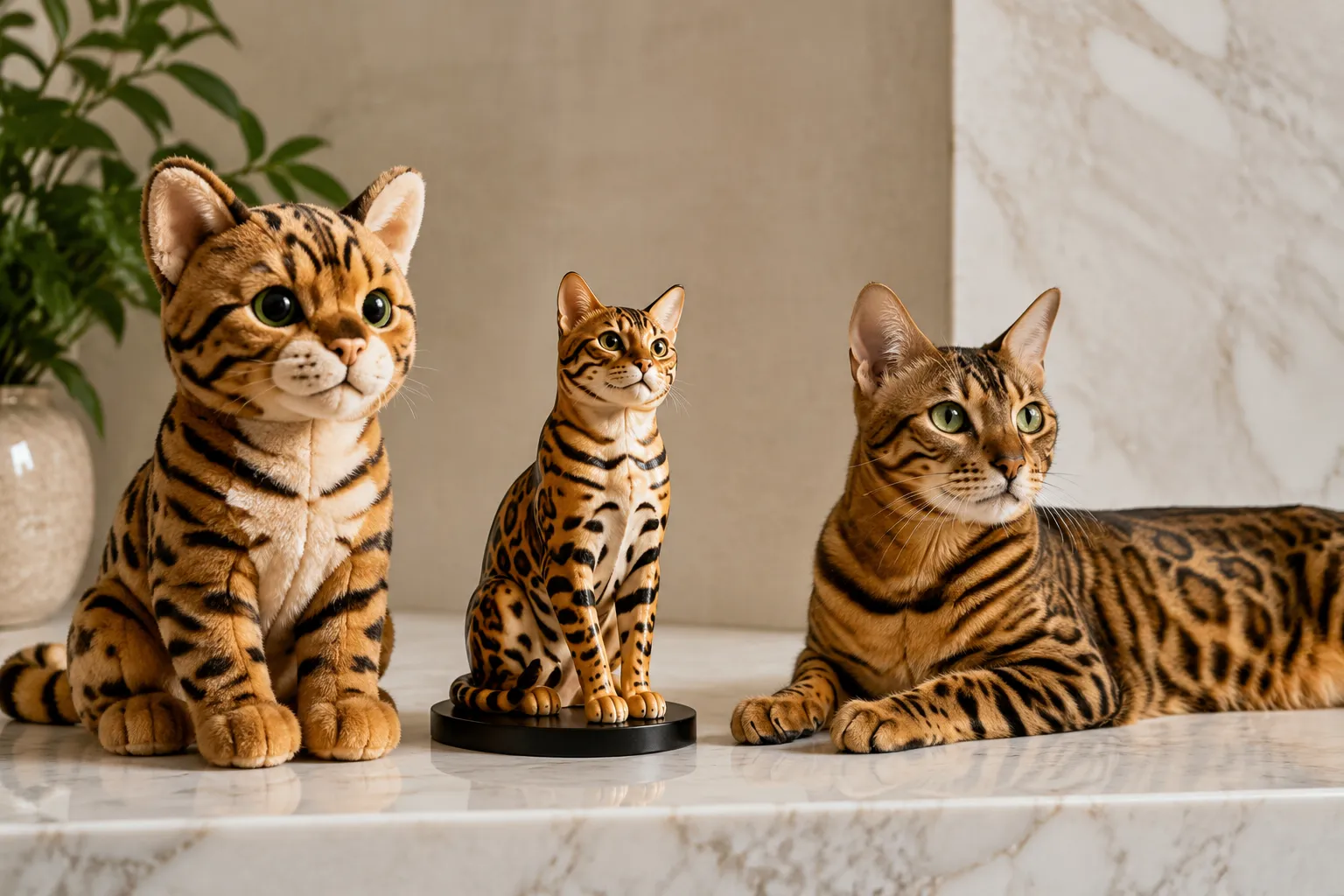
You're sitting in the vet's waiting room, your Bengal's carrier on your lap, and your thumb is scrolling through memorial options on your phone—stuffed animal replica vs figurine—because some part of you already knows what the doctor is going to say.
Quick Takeaways
- Resin figurines and plush replicas serve fundamentally different grief needs — one anchors memory in permanence, the other offers tactile comfort
- Eco-friendliness in pet memorials isn't straightforward — material origin, longevity, and end-of-life disposal all factor in
- Bengal cat markings present unique memorial challenges — rosettes, glitter coats, and marbling require specific reproduction technologies
- Full-color 3D-printed resin offers the lowest long-term environmental cost — explore options like PawSculpt's custom figurines that embed color directly into the material
- The "greenest" memorial is the one you never replace — durability is the most overlooked sustainability metric
The Spiritual Weight of Choosing a Material
Here's what nobody talks about when you're comparing a stuffed animal replica to a resin figurine for your Bengal cat memorial: you're not choosing a product. You're choosing a vessel A container for something that doesn't have a body anymore.
That distinction matters more than any spec sheet.
We've worked with thousands of pet families at PawSculpt, and the question we hear most isn't "what's it made of?" It's "will it feel like them?" The material science matters—and we'll get deep into it—but the spiritual contract you're making with a memorial object is this: I am choosing what will hold the space my cat left behind.
A plush replica fills the empty corner of the couch. A resin figurine claims the mantel. Both are valid. Both are sacred. But they occupy different rooms in your grief, literally and metaphorically.
"A memorial isn't decoration. It's a lighthouse—something fixed that you can orient yourself toward when the loss feels shapeless."
Let's talk about what these materials actually are, what they cost planet, and which one serves a Bengal cat's legacy best.
Material Science Breakdown: What You're Actually Bringing Into Your Home
Stuffed Animal Replicas — The Anatomy
Most custom stuffed animal replicas use a combination of polyester fiberfill (the stuffing), synthetic plush fabric (typically polyester or acrylic), and sometimes weighted pelets (polypropylene or glass beads) for that satisfying heft.
The higher-end versions—companies like Cudle Clones or Petsies—use longer-pile fabrics and airbrushed details to approximate your pet's markings. The construction involves:
- Pattern cutting from reference photos
- Machine sewing of the shell
- Hand-stuffing and shaping
- Surface detailing (rbrushing, embroidery for eyes)
The result is soft, huggable, and roughly life-sized. It occupies physical space the way your cat did. You can hold it. That matters.
But here's the counterintuitive truth: softness degrades. Polyester fibers compress over time. Colors from airbrushing fade with UV exposure and handling. The average plush memorial has a functional lifespan of 5-15 years before it looks noticeably different from the day it arrived.
Resin Figurines — The Anatomy
Resin figurines fall into two broad categories, and most people don't realize how different they are:
Traditional cast resin involves pouring liquid polymer (usually polyurethane or epoxy) into a mold, curing it, then painting the surface. The color sits on top of the material. Chip it, and you see white or gray underneath.
Full-color 3D-printed resin is a fundamentally different technology. The color is deposited voxel-by-voxel during printing—meaning the pigment is part of the material structure, not a coating. Think of it like the difference between painting a wall versus building the wall out of colored bricks.
This distinction matters enormously for longevity and environmental impact. We'll get there.
| Feature | Stuffed Replica | Cast Resin Figurine | Full-Color 3D-Printed Resin |
|---|---|---|---|
| Primary Material | Polyester fabric + fiberfill | Polyurethane/epoxy resin | Photopolymer resin |
| Color Method | Airbrushed surface | Acrylic paint layers | Integrated pigment (voxel-level) |
| Typical Size | Life-size or near | 3-8 inches | 3-8 inches |
| Tactile Quality | Soft, huggable | Smooth, cool solid | Smooth with fine texture, solid |
| Lifespan | 5-15 years | 10-30 years (paint chips) | 30-50+ years (color is structural) |
| UV Resistance | Low (fading) | Medium (clear coat dependent) | High (UV-resistant materials) |
The Bengal Problem
Bengal cats are, frankly, a nightmare to memorialize accurately. And I mean that with deep respect for the breed.
Their coats feature rosettes (two-toned spots with darker outlines), marbling (swirled taby patterns), and in some cases, a glitter gene that makes individual hair shafts reflect light. The color palette shifts from warm gold to cool silver depending on the individual. Their musculature is visible beneath short, tight fur.
A stuffed replica struggles here. Airbrushing can approximate rosettes, but the three-dimensionality of a Bengal's coat pattern—the way light catches different layers—gets flattened into surface decoration. You're looking at a plush cat with Bengal-colored paint on it.
A full-color 3D-printed figurine handles this differently. Because color is deposited at the material level, the subtle gradients within each rosette—the warm center fading to a darker ring—can be reproduced with photographic precision. The digital sculpting process captures the muscular definition beneath the coat. The result is smaller, yes. But it's accurate in a way that soft materials can't achieve.
The Eco-Friendly Bengal Cat Memorial: A Sustainability Deep Dive
This is where most comparison articles fail you. They'll say "resin is plastic, therefore bad" or "plush is fabric, therefore softer on the earth." Both statements are oversimplifications that border on wrong.
Sustainability in memorials isn't about the material alone. It's about the full lifecycle:
- Raw material extraction and processing
- Manufacturing energy consumption
- Shipping weight and distance
- Functional lifespan before replacement
- End-of-life disposal or decomposition
Let's run both options through this framework honestly.
Raw Materials
Stuffed replicas: Polyester is petroleum-derived. The fabric, the stuffing, the thread—all fossil fuel products. A typical custom plush uses 200-400 grams of synthetic material. Some companies offer "eco" versions using recycled polyester (rPET from plastic bottles), which reduces virgin petroleum use by roughly 60%.
Resin figurines: Also petroleum-derived at the base level. Photopolymer resins are acrylic-based compounds. A typical 5-inch figurine uses 80-150 grams of material. Some newer resins incorporate bio-based components (plant-derived acrylates), though fully biodegradable options don't yet exist at production quality.
Here's the thing most people miss: weight matters enormously. A stuffed replica uses 2-4x more raw material than a figurine of equivalent memorial significance. Less material in, less material out.
Manufacturing Energy
Stuffed replicas require multiple manufacturing steps across potentially different facilities: fabric production, cutting, sewing, stuffing, airbrushing. Each step has its own energy footprint and often its own geographic location (fabric milled in one country, assembled in another).
Full-color 3D printing consolidates the entire creation into a single machine process. One build, one location, one energy draw. The AVMA's environmental resources note that consolidating manufacturing steps is one of the most effective ways to reduce a product's carbon footprint—a principle that applies here.
The Longevity Factor (The Insight Everyone Mises)
Here's the counterintuitive truth that changes the entire calculation:
The most eco-friendly memorial is the one you never have to replace.
A stuffed replica that degrades in 10 years and gets replaced means double the material, double the shipping, double the manufacturing energy. A resin figurine that lasts 50 years without meaningful degradation represents a one-time environmental cost.
When you factor in replacement cycles, a durable resin figurine's per-year environmental impact drops to roughly one-fifth that of a plush replica over a 50-year memorial period.
"The greenest choice isn't always the softest one. Sometimes permanence is the most radical act of sustainability."
This doesn't mean plush is wrong. It means the framing of "eco-friendly" needs to account for time, not just materials.
| Sustainability Factor | Stuffed Replica | Full-Color Resin Figurine |
|---|---|---|
| Material Weight | 200-400g | 80-150g |
| Manufacturing Steps | 5-7 (multi-location) | 1-2 (single location) |
| Functional Lifespan | 5-15 years | 30-50+ years |
| Replacement Likelihood | High (degradation) | Very low |
| 50-Year Material Cost | 600-1600g (replacements) | 80-150g (one-time) |
| Recyclability | Low (mixed materials) | Low (but rarely needed) |
| Biodegradability | Partial (centuries for polyester) | No (but inert, non-toxic) |
Myth vs. Reality: What Most People Get Wrong
Myth 1: "Natural materials are always more eco-friendly than synthetic resin"
Reality: A wool-stuffed, cotton-shelled plush sounds grener. But conventional cotton farming uses enormous water resources (10,000 liters per kilogram), and wool production generates methane. Meanwhile, a small resin figurine's total material footprint is a fraction of the weight. The "natural = better" equation colapses when you account for agricultural impact versus a one-time 100-gram industrial print.
Myth 2: "Resin figurines are just plastic junk that ends up in landfills"
Reality: Cured photopolymer resin is chemically inert—it doesn't leach microplastics or off-gas volatile compounds the way uncured resins do. More importantly, memorial figurines aren't disposable consumer goods. They're kept for decades, often passed between family members. The "landfill" argument assumes disposal behavior that simply doesn't apply to objects of deep sentimental value. Nobody throws away their mother's ashes urn. Nobody throws away a memorial figurine.
Myth 3: "A stuffed replica is more emotionally comforting, so it's always the better memorial choice"
Reality: Comfort and memorial serve different psychological functions. Grief researchers distinguish between continuing bonds (maintaining a sense of connection with the deceased) and comfort-seeking (soothing acute distress). A plush serves comfort-seeking beautifully in the first weeks. But for long-term continuing bonds—the kind that last years—a permanent, unchanging object often serves better. It doesn't wear down. It doesn't change. It stays exactly as your cat was, frozen in their best moment. Both have their place. The mistake is thinking one replaces the other.
The Resin Figurine Environmental Impact: Going Deeper
Let's get specific about what happens during and after the creation of a full-color resin figurine, because "resin figurine environmental impact" is a search term that deserves a real answer, not marketing spin.
During Production
Full-color 3D printing uses UV-curable photopolymer resins. During the printing process:
- Energy consumption: A typical print run for a 5-inch figurine uses roughly 0.5-1.5 kWh of electricity. For context, that's less than running your dishwasher once.
- Material waste: Modern printers achieve 85-95% material efficiency. Support structures (necessary for overhanging features like tails or ears) account for most waste, and some facilities recycle uncured support material.
- VOC emissions: Minimal during printing (enclosed systems), with brief off-gassing during UV curing that dissipates within hours.
Post-Production
The only manual step for a quality full-color print is applying a clear protective coat—a thin layer of UV-resistant varnish that shields the surface from light degradation and adds a subtle sheen. This uses approximately 5-10ml of coating material per figurine.
No paint. No solvents. No brush-cleaning chemicals going down the drain.
Long-Term Stability
Cured photopolymer resin is remarkably stable:
- UV resistance: Modern formulations include UV stabilizers that prevent yellowing for decades
- Chemical inertness: Won't react with household chemicals, humidity, or temperature fluctuations within normal indoor ranges
- Structural integrity: No moving parts, no joints to weaken, no fabric to thin
This stability is precisely why the environmental argument favors resin for memorials. An object that never needs replacing never generates replacement waste.
"We think of permanence as the ultimate act of love. When something is built to last unchanged for fifty years, it's a promise—not just to the pet you lost, but to your future self who'll still need that anchor."
— The PawSculpt Team
Choosing Based on Your Grief Landscape
Here's where we leave pure material science and enter the territory that actually determines which memorial you'll reach for at2 AM when the loss hits fresh again.
The Spatial Question
Think about where your Bengal existed in your home. Not abstractly—specifically.
Did they claim the back of the couch? The windowsill where afternoon light pooled? The foot of your bed? The top of the refrigerator (because Bengals are absurd like that)?
A stuffed replica occupies that space physically. It fills the void with approximate volume. For some people, this is exactly right—the empty spot on the couch is unbearable, and something soft and cat-shaped makes the room feel less hollow.
A figurine doesn't fill space the same way. It marks space. It says: this spot on the bookshelf is sacred now. This corner of my desk belongs to them. It's a shrine rather than a substitute.
Neither approach is more valid. But they serve different spiritual needs.
The Touch Question
Bengals have that distinctive short, dense, almost pelt-like coat. Silky and cool to the touch. If your grief lives in your hands—if you keep reaching for fur that isn't there—a plush replica addresses that specificache.
But here's what we've observed working with grieving families: the tactile comfort of a plush often peaks in the first 3-6 months, then gradually becomes less central to the grief ritual. The figurine, by contrast, often grows in significance over time. It becomes the fixed point. The lighthouse.
Many families we've worked with end up choosing both—a plush for the acute grief period, and a custom 3D-printed figurine for the permanent memorial. They serve different chapters of the same story.
The Accuracy Question
This is where Bengals specifically tip the scales.
A Bengal's identity is inseparable from their markings. Those rosettes are as individual as fingerprints. The specific pattern of marbling across their flanks, the exact shade of their background coat, the way their spots align (or don't) across their shoulders—this is what made your Bengal yours.
Stuffed replicas approximate. They get the general color palette right, the rough distribution of spots. But the precision required to reproduce a specific Bengal's coat pattern pushes the limits of what airbrushing on fabric can achieve.
Full-color 3D printing works from photographs at the pixel level. The digital sculpting process maps your cat's actual markings onto the 3D model, and the printer reproduces them with the same fidelity as a high-resolution photograph—because it's essentially printing a photograph in three dimensions.
For breeds with simpler coat patterns (solid-color cats, for instance), this advantage matters less. For Bengals, Savannahs, Ocicats, and other dramatically patterned breeds, it's often the deciding factor.
The Sustainable Pet Memorial Comparison: A Decision Framework
Rather than telling you what to choose, here's a framework for making the decision that aligns with both your values and your grief:
Choose a stuffed replica if:
- Your grief is primarily tactile (you need to hold something)
- You want to fill a specific physical space your cat occupied
- You're in the acute phase (first 1-6 months) and need comfort objects
- Accuracy of markings is less important than the feeling of presence
- You plan to supplement with a permanent memorial later
Choose a resin figurine if:
- Your grief is primarily visual (you need to see them)
- You want a permanent, unchanging anchor for your memory
- Accuracy of your Bengal's specific markings matters deeply
- Long-term environmental impact is a priority
- You want something that can be passed to family members across generations
Choose both if:
- You recognize that grief has phases, and different phases need different tools
- Budget allows (check PawSculpt's current offerings for figurine details)
- You want immediate comfort AND long-term permanence
What Bengal Owners Specifically Need to Know
We've created figurines for hundreds of Bengal cats, and there are patterns (no pun intended) in what works and what doesn't.
Photo Requirements for Bengals
Because their coats are so complex, Bengal memorials require more reference material than simpler breeds:
- Minimum 5-7 clear photos from different angles
- At least one photo in natural light showing true coat color (indoor lighting often shifts Bengals toward yellow)
- Close-up of rosette pattern on flanks—this is the "fingerprint"
- Full body profile showing muscular structure
- Face straight-on capturing the distinctive "M" forehead marking
For stuffed replicas, companies typically need similar reference photos but focus more on overall color distribution than individual spot placement.
The Glitter Gene Challenge
Some Bengals carry the glitter gene—individual hair shafts that are hollow or translucent, creating a sparkling effect in sunlight. This is nearly impossible to reproduce in any memorial medium.
Stuffed replicas can't replicate it at all. Resin figurines can approximate it through the clear coat application—a high-gloss finish catches light in a way that suggests (though doesn't perfectly replicate) that characteristic shimer.
It's worth knowing this limitation upfront. No memorial will perfectly capture a glitter-coat Bengal in motion under sunlight. But a well-executed figurine with a quality clear coat comes closer than you might expect.
Color Accuracy Across Seasons
Bengal coats shift subtly with seasons—slightly warmer in winter, cooler in summer. When choosing reference photos for any memorial, pick images from the season you most associate with your cat. The version of them that lives strongest in your memory.
This is a spiritual choice as much as a practical one. You're choosing which version of your cat to immortalize. There's no wrong answer, but it's worth being intentional about it.
The Environmental Bottom Line
Let's bring this full circle with hard numbers, because "eco-friendly Bengal cat memorial" deserves concrete answers:
| Environmental Metric | Stuffed Replica (Lifetime) | Resin Figurine (Lifetime) |
|---|---|---|
| Total material used (50-year period) | 600-1600g (with replacements) | 80-150g (one-time) |
| Carbon footprint (manufacturing) | Higher (multi-step, multi-location) | Lower (single consolidated process) |
| Shipping weight | 400-800g per unit | 150-300g per unit |
| Chemical exposure during production | Moderate (dyes, adhesives, airbrush paints) | Low (enclosed printing, minimal post-processing) |
| End-of-life impact | Mixed waste (hard to recycle) | Inert solid (non-toxic, non-leaching) |
| Microplastic shedding during use | Yes (polyester fiber release) | No (solid, non-shedding) |
That last row surprises people. Polyester fabrics shed microfibers with every touch, every compression, every time they're moved. Over years of handling a stuffed memorial, microscopic plastic fibers release into your home environment. A solid resin figurine doesn't shed. Period.
This isn't an argument against stuffed replicas—the microfiber release from a single plush is negligible compared to, say, your synthetic clothing in the washing machine. But for people who specifically seek eco-friendly memorials, it's a data point worth knowing.
The Ritual of Choosing
We want to leave you with something that goes beyond material science, because choosing a memorial for your Bengal isn't really a consumer decision. It's a ritual.
The act of selecting photos. Of describing their personality to a sculptor or craftsperson. Of waiting for the preview. Of unwrapping the finished piece and placing it somewhere specific in your home. Each step is a ceremony of remembrance.
The material you choose shapes the ritual differently.
With a stuffed replica, the ritual is one of receiving comfort. You open the box, and something soft and cat-shaped is there. You hold it. The ritual is immediate and visceral.
With a figurine, the ritual is one of witnessing accuracy. You open the box, and your cat's face looks back at you—frozen in their most characteristic expression, their specific markings rendered in permanent color. The ritual is recognition There you are.
Both are sacred. Both are real. Both honor the spiritual contract between you and the animal who chose to share their life with yours.
The planet prefers the one that lasts. Your grief might need the one that's soft. Only you know which room in your heart needs filling first.
And maybe—probably—you'll eventually need both.
That carrier on your lap in the vet's waiting room. The weight of it. The warmth still radiating through the mesh. Whatever you choose to memorialize your Bengal, let it carry that same weight. That same warmth. Let it be worthy of what it represents.
A sustainable pet memorial comparison isn't really about materials at all. It's about finding the vessel strong enough to hold a love that outlasts a body.
Frequently Asked Questions
Is a stuffed animal replica or resin figurine better for a Bengal cat memorial?
It depends on what your grief needs most. Resin figurines—especially full-color 3D-printed versions—capture Bengal rosette patterns with near-photographic precision, making them ideal for long-term visual memorials. Stuffed replicas offer tactile comfort that's especially valuable in the acute grief period. Many families we've worked with ultimately choose both, using the plush for immediate comfort and the figurine as a permanent anchor.
What is the environmental impact of resin pet figurines?
Full-color resin figurines use 80-150 grams of material in a single consolidated manufacturing process. Because they last 30-50+ years without degradation, their per-year environmental cost is remarkably low. They don't shed microplastics during handling, and cured photopolymer resin is chemically inert—it won't leach toxins. The main environmental consideration is that they aren't biodegradable, but since they're rarely disposed of, this is largely theoretical.
How long do stuffed animal pet replicas last?
Custom stuffed replicas typically maintain their original appearance for 5-15 years, depending on handling frequency, UV exposure, and storage conditions. Airbrushed details fade first, followed by fiber compression that changes the shape over time. Keeping them out of direct sunlight and handling them gently extends their lifespan, but eventual degradation is inherent to soft materials.
Are eco-friendly pet memorials actually sustainable?
The most overlooked sustainability metric is longevity. A memorial you replace three times over 30 years costs the planet three times the materials, manufacturing energy, and shipping. The greenest choice is often the most durable one, regardless of base material. When comparing options, factor in the full lifecycle—not just what it's made of, but how long it'll last and whether you'll need to replace it.
What photos do I need for a Bengal cat memorial figurine?
Bengal cats require more reference photos than simpler breeds due to their complex coat patterns. Plan on providing 5-7 clear images: at least one in natural light (indoor lighting shifts their colors), a close-up of their flank rosettes, a full body profile showing musculature, and a straight-on face shot. Choose photos from the season you most associate with your cat, since Bengal coats shift subtly between warmer and cooler months.
Can pet memorials capture a Bengal cat's glitter coat?
Honestly, no memorial medium perfectly replicates the glitter gene's light-refracting effect. It's caused by hollow or translucent hair shafts—a three-dimensional optical phenomenon that's extremely difficult to reproduce in any static material. That said, a high-gloss clear coat on a resin figurine catches light in ways that suggest the shimer, and full-color 3D printing can reproduce the underlying coat colors and patterns with high fidelity even if the sparkle itself remains elusive.
Ready to Honor Your Bengal's Legacy?
Your Bengal's rosettes were as unique as a fingerprint—a pattern that existed exactly once in the history of the world. Whether you're navigating fresh grief or looking for a permanent way to honor a companion who crossed the rainbow bridge years ago, a memorial that captures those specific markings keeps their spirit present in your daily life. A stuffed animal replica vs figurine decision ultimately comes down to what your heart needs most—but for Bengal owners who want lasting accuracy, full-color 3D-printed resin holds that legacy without fading.
Visit pawsculpt.com to explore the process, see examples, and learn how your photos become a permanent tribute