
Memorial Jewelry vs a 3D-Printed German Shepherd: Which Truly Lasts a Lifetime?
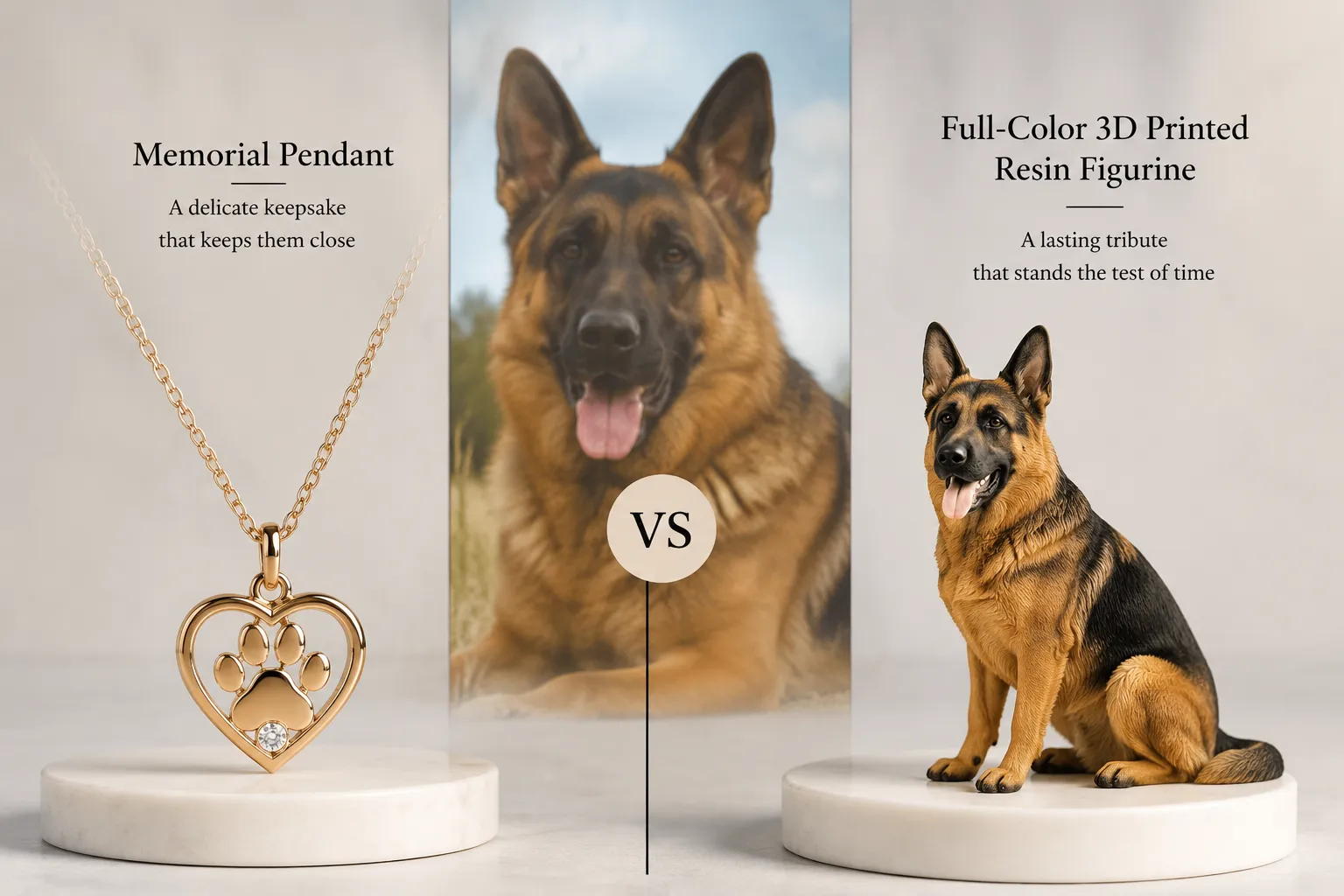
Which would you reach for at 2 a.m.—the memorial jewelry resting on your nightstand, or the figurine sitting in the corner across the room? When you weigh memorial jewelry vs figurine for a pet you've lost, that one midnight reach tells you more than any product spec ever could.
Quick Takeaways
- Durability isn't the real question — what matters is which keepsake you actually touch, hold, and live near
- Memorial jewelry travels with you; a figurine holds the room — pick based on where your grief lives
- German Shepherd owners face a unique challenge — generic charms rarely capture that breed's distinct presence and markings
- For a keepsake your grandkids will still "read" without explanation, explore full-color 3D printed pet sculptures that preserve real markings
- The longest-lasting keepsake is the one that becomes part of a ritual — not the one with the best material warranty
We've helped thousands of families decide between these two, and here's the honest truth up front: there's no universal winner. There's only the right answer for your house, your hands, and the specific shape of the hole your pet left behind. So let's actually do the work of figuring out which one lasts a lifetime for you—not in a marketing sense, but in the way that matters when the lights are off and the house is too quiet.
The Question Everyone Asks Wrong: "Which One Lasts Longer?"
Let's get something out of the way, because it's the first thing people search and it's the wrong frame.
When folks type "durable pet keepsake" into Google, they're picturing a materials test. Drop it, scratch it, leave it in a hot car—what survives? And sure, we'll cover that, because it matters a little. But here's the thing almost every comparison article misses entirely.
A keepsake's real lifespan isn't measured in years. It's measured in attention.
We had a customer—we'll call her Marisol—who reached out about her German Shepherd, Atlas. Big dog, the kind who'd lean his whole eighty-five pounds against your leg like he was trying to merge with you. After he passed, she bought a beautiful silver pendant with his pawprint and a tiny vial for fur. Gorgeous piece. She wore it for three weeks.
Then it migrated to her jewelry box. Then to a drawer. Honestly? She told us she felt guilty every time she opened that drawer and saw it sitting there, unworn, like she'd let him down twice.
That's the part the durability charts never tell you. The most indestructible object in the world does nothing if it ends up in a drawer.
"The longest-lasting keepsake isn't the one that survives the most years. It's the one that survives your daily attention."
So before we rank anything, sit with this: where does your grief actually live? Is it something you carry out the door every morning, pressed against your sternum? Or is it rooted in a place—a specific corner, a spot by the window, the foot of the bed where a body used to be? That answer matters more than any material spec, and we'll come back to it.
What "lasts a lifetime" really means
There are three different kinds of "lasting," and conflating them is why people end up disappointed.
- Physical longevity — will the object survive decades without degrading?
- Emotional longevity — will you still engage with it in year five, not just week one?
- Generational legibility — will someone who never met your pet still understand what it is?
Most comparisons only measure the first one. The really important answer lives in the second and third. And as you'll see, jewelry and figurines score wildly differently across all three.
Memorial Jewelry: The Keepsake That Travels
Memorial jewelry has a genuine, beautiful superpower, and we'd be doing you a disservice to pretend otherwise. It's with you. On your body. Through meetings, grocery runs, the long drive home where you suddenly lose it at a red light.
For a lot of people, that proximity is everything. Grief doesn't keep office hours. When it hits you in the cereal aisle, being able to close your hand around a pendant—warm from your own skin—is a small, real comfort. That's the spiritual contract of jewelry: you carry their presence the way you'd carry a promise.
The standout case for jewelry
The strongest argument for memorial jewelry is for people whose grief is mobile. If your bond with your pet was built on motion—hikes, road trips, the dog who came everywhere—then a keepsake that moves with you honors that better than something anchored to a shelf.
We're also genuinely fans of jewelry for one underrated reason: discretion. Not everyone wants to explain their grief. A subtle pendant lets you keep your pet close without inviting a conversation you're not ready to have. There's a quiet dignity in that.
Where jewelry quietly fails
But here's the honest tradeoff, and it's a big one.
Jewelry is small, and small things get lost, lose meaning, and lose legibility fast. A pawprint charm is deeply meaningful to you. To your niece in thirty years? It's an abstract metal shape in an estate box. Nobody will know it was Atlas. The story evaporates in a single generation.
And there's the drawer problem we already met. The intensity that makes you wear something daily in month one tends to fade—that's healthy, that's grief doing its job—but the jewelry's whole value was tied to being worn. When you stop, it doesn't transition into anything. It just... waits.
"Jewelry holds your pet against your skin. A figurine holds them in your home. Grief needs both kinds of nearness."
One more thing worth noting from a practical angle: ash and fur-vial jewelry can be surprisingly anxiety-inducing. We've heard from customers terrified of losing the one piece holding their pet's actual remains. A keepsake shouldn't come with that low hum of dread.
The 3D-Printed German Shepherd: The Keepsake That Holds the Room
Now flip it. A figurine doesn't travel. It can't comfort you in the cereal aisle. That's its limitation, full stop.
But it does something jewelry fundamentally cannot. It occupies space. And for grief that's rooted in place, that's the whole ballgame.
Remember Marisol and the drawer? Here's where her story turned. The hardest part of her day wasn't leaving the house—it was the empty corner by the back door. That's where Atlas used to wait, ears up, the second he heard her keys. For months, that corner was just... absence. A vacancy with a shape.
She ended up commissioning a figurine of Atlas, and she put it right there. Not on a mantle. In the corner. In his corner.
She told us the first time she walked in and saw him there—sitting, ears up, exactly how he used to—she cried, but it was a different kind of crying. The corner wasn't a wound anymore. It was a presence again.
That's the thing a figurine does that no pendant can. It refills the specific empty space your pet left in your physical world.
Why German Shepherds especially deserve a figurine
Here's a counterintuitive insight most people don't clock until it's too late: the more distinctive your dog, the worse generic memorials serve them.
A German Shepherd isn't a silhouette. According to the American Kennel Club's German Shepherd breed standard, the breed has a specific noble outline, that signature saddle marking, the alert ear set, the substance and length-to-height proportion that make a Shepherd unmistakably a Shepherd. A heart-shaped charm flattens all of that into nothing.
A figurine, by contrast, can hold the exact tan-and-black saddle pattern, the particular way your Shepherd's ears tipped, the graying muzzle of an old friend. That specificity is the point. You didn't love "a dog." You loved Atlas, with his crooked left ear and the white patch on his chest.
This is where the technology genuinely matters, so let's be precise about it. PawSculpt's figurines are digitally sculpted by master 3D artists, then precision printed in full-color resin, where the color is part of the material itself—printed voxel by voxel, not layered on top. The only manual step is a protective clear coat for sheen and durability. That means your Shepherd's actual saddle markings get reproduced directly in the resin, not approximated. The result has a natural, authentic texture—vibrant and real, not plastic-perfect.
"Every German Shepherd wears markings like a fingerprint. Our job is to make sure the resin remembers them exactly."
— The PawSculpt Team
The generational legibility advantage
This is the figurine's quiet trump card, and almost nobody talks about it.
In fifty years, your great-grandchild finds a full-color sculpture of a German Shepherd on a shelf. They don't need a label. They know instantly: this dog mattered to this family. The figurine tells its own story. It's legible across generations without a single word of explanation.
That same descendant finds a small silver charm in a box? They donate it to Goodwill. The story's gone.
For a comprehensive look at how families process these long arcs of remembrance, the Association for Pet Loss and Bereavement offers genuinely useful, no-charge guidance—worth bookmarking whether you choose jewelry, a figurine, or both.
Head to Head: The Longevity Comparison That Actually Helps
Okay, you came for a longevity comparison, so here's a real one—not just "which scratches less," but the three kinds of lasting we laid out earlier. This is the table we wish existed when we started doing this work.
| Factor | Memorial Jewelry | 3D-Printed Figurine |
|---|---|---|
| Physical lifespan | Decades+ (metal is durable) | Decades+ (UV-resistant resin, clear-coated) |
| Daily emotional engagement | High early, fades when unworn | Steady—it's always in view |
| Captures breed-specific detail | Minimal (abstract shapes) | High (exact markings, posture, ears) |
| Travels with you | Yes—its main strength | No—it's anchored to a place |
| Fills physical absence | No | Yes—refills the empty corner |
| Generational legibility | Low (meaning fades in one gen) | High (self-explanatory across decades) |
| Risk of loss/anxiety | Higher (small, easily misplaced) | Low (it stays put) |
Look at that pattern. They're not competing on the same field. Jewelry wins on mobility and discretion. The figurine wins on presence, specificity, and legacy. Which column matters more is entirely about you.
The mistake most people make
Here's the error we see constantly: people choose based on the first 48 hours of grief instead of the long arc.
In those first raw days, you want your pet on your body. The pull toward jewelry is intense and immediate. So people buy the pendant, and it's right for that moment. But grief isn't a moment—it's a years-long relationship with an absence. And six months in, what most people actually crave is to see their pet again, to have them hold space in the home.
"Buy for the grief you'll have in a year, not just the grief you have tonight."
What actually helps more than rushing the decision is giving yourself a beat. There's no expiration date on a memorial. Sit in the house. Notice where you miss them most. If it's a place—a corner, a windowsill, the foot of the bed—that's your answer pointing at a figurine. If it's a feeling you carry out the door, that's jewelry.
How to Choose: Matching the Keepsake to Your Grief
Grief has a shape, and different shapes want different anchors. After thousands of conversations, we've noticed the choice tends to sort along a few clear lines. Here's a matching guide.
| If your grief feels like... | Your bond was built on... | Lean toward... |
|---|---|---|
| An ache you carry everywhere | Adventure, motion, constant companionship | Memorial jewelry |
| An empty space in a room | Home routines, a favorite spot, presence | A figurine |
| Needing to see them again | Their distinct face, markings, expressions | A figurine (full-color) |
| Wanting them close but private | A quiet, personal bond | Memorial jewelry |
| Building a family legacy | A pet who shaped the whole household | A figurine (heirloom) |
Notice we're not telling you one is better. We're telling you to read your own grief honestly and match accordingly. That's the whole skill here.
The "why not both" reality
Honestly? A lot of our families end up with both, and we think that's the most complete answer when the budget allows.
The pendant handles the mobile, private, carry-it-with-you grief. The figurine handles the place-based, visible, legacy grief. They cover different terrain. One refills your hand; the other refills your room.
If you can only choose one right now, start with whichever maps to where your grief lives most of the time. You can always add the second later—and many people do, on the first anniversary, as a small ritual of moving forward.
A note on rituals (because this is the part that actually heals)
Here's something we've learned that no product page will tell you: the object matters less than the ritual you build around it.
A figurine in a corner that you walk past mindlessly is just décor. But a figurine you greet—a quiet "morning, buddy" as you pass, a habit of resting a hand on it before a hard day—becomes a sacred space. The keepsake is the anchor. You supply the ceremony.
So whatever you choose, give it a place and a moment. Light a candle near it on their birthday. Tell them about your day once in a while. We're not being mystical for its own sake here—this is genuinely how the human mind metabolizes loss. Ritual gives grief somewhere to go.
What to Expect When You Commission a German Shepherd Figurine
If you're leaning toward a figurine, you probably want to know how the process actually works without the mystery. Here's the honest walkthrough—minus the specifics that change over time (for current turnaround, revisions, and guarantees, check the PawSculpt process details directly, since we won't quote numbers that might be outdated).
The photos that actually work
The single biggest factor in a great figurine is your reference photos. After thousands of orders, here's what we've learned makes the difference.
| Photo element | What works best | Why it matters |
|---|---|---|
| Angle | Eye-level, side and front | Captures true body proportion and face |
| Lighting | Natural daylight, no harsh flash | Flash washes out saddle markings |
| Resolution | Sharp, in-focus, well-lit | Detail can't be invented from blur |
| Expression | A few that capture their look | The "them-ness" lives in the expression |
| Markings | Clear shots of distinctive patterns | German Shepherd saddles vary hugely |
Pro tip: Don't just send your single favorite photo. Send a small spread—different angles, that goofy ear, the gray on the muzzle. Our 3D artists assemble the full picture from multiple views, the way you'd describe someone to a sketch artist.
The general creative arc
- You share photos and the details that made them them — that crooked ear, the chest patch, how they sat.
- Master 3D artists digitally sculpt the model — building the form, posture, and markings with care.
- You review a preview — this is where you catch anything that feels off; flexibility here is the point.
- Precision full-color resin 3D printing — the color prints into the material itself, capturing real markings.
- A protective clear coat — the one manual step, adding sheen and guarding against UV and wear.
That clear coat is part of why these hold up for decades. The resin is UV-resistant, so the colors don't fade out the way you might fear with a sunny shelf. It's built to be a true durable pet keepsake, not a souvenir that yellows in two years.
Back to Marisol, one last time
We'll close her thread here, because it's the best illustration we've got.
A year after Atlas passed, Marisol sent us a photo. The corner by the back door—the one that used to gut her—now had the figurine in it, and beside it, hanging on a little hook she'd installed, the silver pendant she could never quite wear.
She'd found the answer wasn't either/or. The figurine gave the corner its presence back. And the pendant finally had a home too, somewhere she'd see it daily instead of burying it in a drawer. Together, they turned a place of absence into a small shrine of a very good dog.
That corner isn't empty anymore. That's what lasting a lifetime actually looks like.
The Honest Downsides (Because We Won't Pretend)
We're not going to hand you a pure sales pitch, so here's the real talk on both options.
Memorial jewelry downsides: It can end up unworn and guilt-inducing. It's losable. Remains-based pieces carry anxiety. And it doesn't preserve what your specific pet looked like.
Figurine downsides: It doesn't travel with you—zero comfort in the car or the cereal aisle. It needs a thoughtful spot in your home, not a junk drawer. And a quality full-color sculpture is an investment of care and consideration, not an impulse buy.
If your grief is overwhelmingly mobile and private, a figurine genuinely may not be your best fit, and we'd rather you know that. Likewise, if it's an empty room breaking your heart, no pendant will fix that corner.
The right keepsake isn't the most popular one. It's the one that meets your grief where it actually lives.
Frequently Asked Questions
Which lasts longer, memorial jewelry or a figurine?
Both can physically last for decades—quality metal and UV-resistant resin are each built to endure. But physical lifespan is only part of the story. The keepsake that "lasts" in the way that matters is the one you keep engaging with, whether that's worn daily or seen daily. Match it to your grief, not just the materials chart.
Why is a figurine better than a charm for a German Shepherd memorial?
German Shepherds have a highly distinctive look—the saddle marking, alert ears, and noble proportions that the AKC breed standard describes. A generic charm can't capture any of that. A full-color figurine preserves your Shepherd's exact markings, posture, and expression, so it stays recognizably them for generations.
Do 3D-printed figurines fade or yellow over time?
Quality full-color resin figurines are printed with UV-resistant material and finished with a protective clear coat, which guards against fading and wear. That's a big part of why they function as a genuine durable pet keepsake rather than a souvenir that degrades. For current material and care specifics, it's worth checking the maker's details directly.
Should I buy a keepsake right after my pet passes, or wait?
There's no deadline on a memorial. In the first 48 hours, the pull is usually toward something to hold. But many people find that months later they crave something to see. Giving yourself a little time to notice where you miss your pet most often leads to a choice you won't second-guess.
Can I get both jewelry and a figurine?
Absolutely, and many families do. They cover different emotional terrain—jewelry handles mobile, private grief, while a figurine refills the empty space in a room. If budget is a factor, start with whichever matches where your grief lives most, then add the second later as a ritual of moving forward.
Are the figurines hand-painted?
No—and this is a common misconception. PawSculpt figurines are digitally sculpted by master 3D artists and then precision printed in full-color resin, where the color is part of the material itself. The only manual step is applying a protective clear coat for sheen and durability.
Ready to Honor Your German Shepherd?
Every German Shepherd leaves a specific shape of absence—an empty corner by the door, a quiet spot at the foot of the bed. When you're weighing memorial jewelry vs a figurine for your german shepherd memorial, remember that the most durable pet keepsake is the one that refills that space and stays legible for generations. A custom PawSculpt figurine preserves your dog's exact markings, posture, and presence in full-color resin built to last.
Visit pawsculpt.com to learn more about our process, preview turnaround, flexible revisions, and quality guarantee.