
Painted Portrait vs Resin Figurine: Which Makes a French Bulldog Mom Gasp?
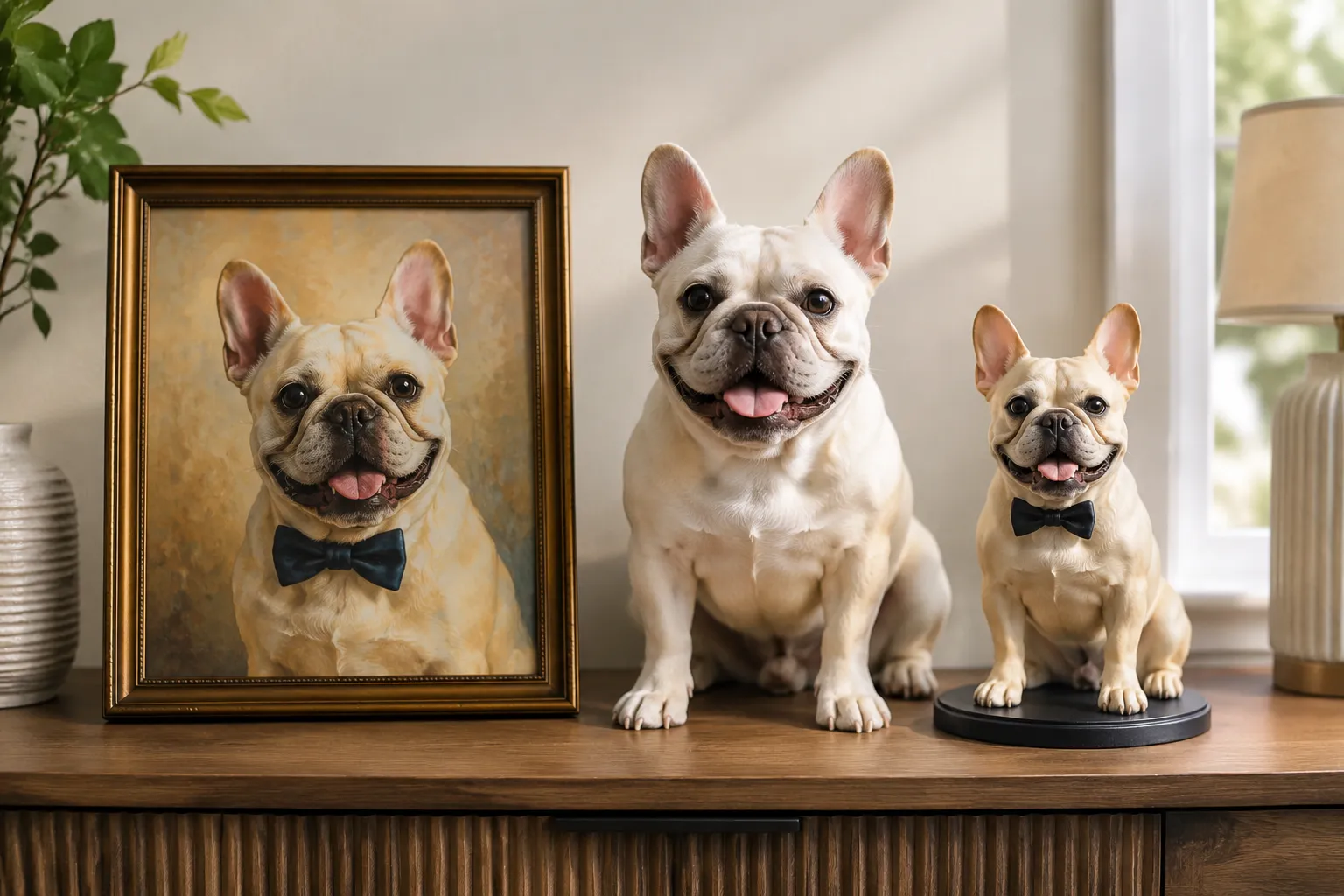
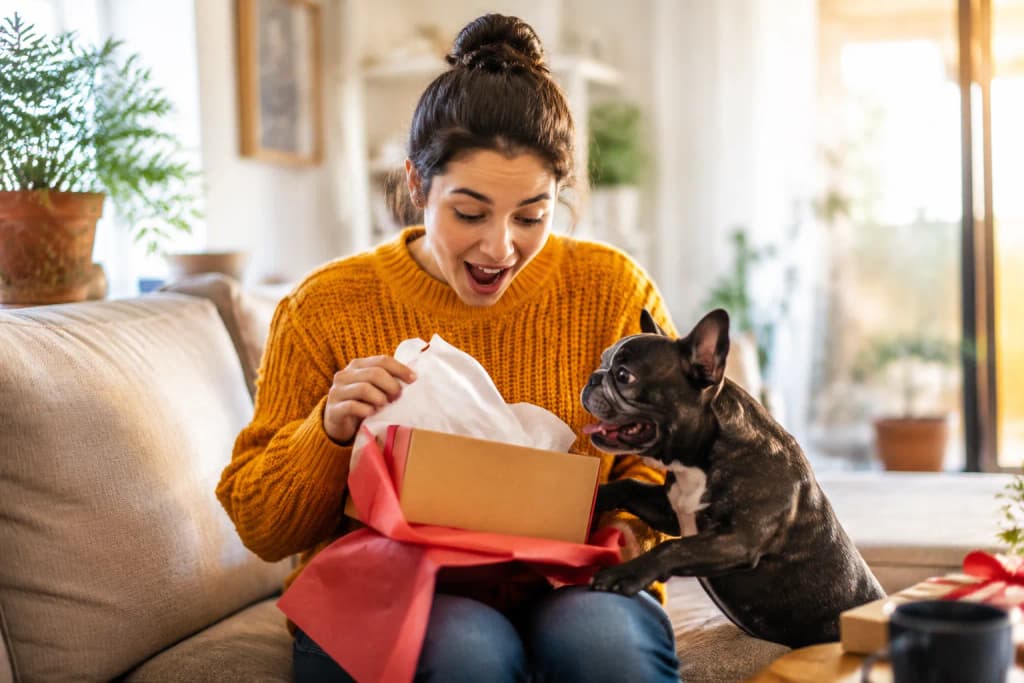
Neuroscientists have found that we recognize a familiar three-dimensional shape faster than a flat picture of the same thing, and our hands twitch toward it before we've consciously decided to reach. That reflex sits at the center of the pet portrait vs figurine question, especially for a French Bulldog mom standing in her kitchen, holding her breath, about to unwrap something.
Quick Takeaways
- Your hands react before your eyes do — 3D objects trigger a reach reflex that flat images never quite do.
- Frenchie features are sculptural, not painterly — wrinkles, ears, and that squish read better in three dimensions.
- The gasp comes from recognition, not realism — capturing personality beats photographic perfection every time.
- A custom keepsake should feel right in the hand — explore how a full-color pet figurine translates a real dog into resin you can hold.
- Portraits and figurines solve different emotional jobs — pick based on the moment, not the price tag.
Why Your Hands Decide Before Your Eyes Do
Here's the thing nobody tells you when you're agonizing over a gift for a serious dog person. You think you're choosing an image. You're actually choosing an experience of touch.
There's a concept in cognitive science called embodied cognition, and the short version is this: your understanding of the world isn't locked inside your skull. It lives in your hands, your skin, the weight you feel when you pick something up. When you hand someone a flat portrait, their brain files it under "look." When you hand them something with mass and depth, their brain files it under "hold." Different drawer. Completely different emotional response.
We've watched this play out more times than we can count. A customer opens a box, and there's this micro-pause. The eyes go wide, sure. But the real tell is the hands. They cup the thing. They turn it over. Their thumb finds the curve of an ear without them even looking.
"The gasp isn't about how it looks. It's about the moment their hands recognize a dog that's gone."
That recognition is older than language. We're a tactile species. Long before we painted on cave walls, we shaped things out of clay and stone because we needed to hold what mattered to us.
The science of the reach reflex
When you see a 3D object you associate with love, your motor cortex lights up in anticipation of grasping it. Researchers studying the human-animal bond through institutions like the NIH have repeatedly found that physical contact with pets lowers cortisol, the stress hormone, and bumps up oxytocin, the bonding one. Your nervous system learned, over years of life with that dog, to associate the physical sensation of touching them with calm.
So when a grieving owner holds a figurine that has the right proportions, the right weight, the right squish of a face, something genuinely physiological happens. The body remembers. Not metaphorically. Literally.
A flat portrait, hung on a wall, asks the eyes to do all the work. Beautiful, yes. But it can't give the hands their job back.
What this means for choosing a gift
The mistake most people make is treating this as a question of which one looks more impressive. That's the wrong axis entirely.
The better question: what do you want this person's body to do with their grief or their love? Do you want them to glance up at the wall and smile? A portrait does that well. Do you want them to pick something up at 11pm when the house is too quiet and just hold it? That's a figurine's whole reason for existing.
Neither is better. They're built for different human needs. And honestly, knowing the difference is what separates a thoughtful gift from a generic one.
The French Bulldog Figurine Problem (And Why It's Actually a Gift)
French Bulldogs are a fascinating test case, because almost everything that makes them adorable is structural.
Think about it. The bat ears that stand straight up like little radar dishes. The deep forehead folds. The flat, pushed-in muzzle. The barrel chest on those stubby legs. The way they sit with their back legs splayed out in that "frog dog" pose. None of that is about color or surface. It's all about shape, depth, and dimension.
This is exactly where the french bulldog figurine has a structural advantage that a flat image struggles to match.
A portrait of a Frenchie has to imply the depth of those wrinkles using shadow and shading. It's a clever illusion, and a skilled artist can pull it off. But it's still flattening a fundamentally three-dimensional animal onto a two-dimensional plane. Some information is always lost in that translation.
A figurine doesn't translate the wrinkles. It has the wrinkles. You can run your thumb along the fold above the nose. The ear casts a real shadow because it's a real raised form. The squish is squishable—well, it's resin, so it's firm—but the geometry is true.
"A Frenchie's charm lives in its folds and angles. Flatten it and you lose the very thing you loved."
Where flat images quietly fail Frenchies
Let me be specific, because vague advice helps nobody.
- The dual-tone face: Many Frenchies have a darker mask fading into a lighter muzzle. On a flat surface, that gradient can look smudgy. On a 3D form, the transition follows the actual contour of the face, so it reads as natural.
- Brindle patterns: That tiger-stripe brindle coat wraps around a rounded body. A portrait shows you one side. A figurine lets the pattern flow around the chest and haunches the way it does in real life.
- The ear set: A Frenchie's ear angle is part of their expression. Slightly forward means curious. Pinned back means "I did something and I'm not sorry." Three dimensions preserve that angle from every viewing direction.
How we actually capture this
We're a 3D printing company, so let's be straight about how this works, because there's a lot of confusion out there.
Our process starts with master 3D artists who digitally sculpt your dog from your photos. They build the geometry—every wrinkle, the ear set, the body proportions—as a digital model first. Then we bring it to life through full-color resin 3D printing, where the color is printed directly into the material, voxel by voxel. The color isn't a coating sitting on top. It's part of the resin itself.
The only manual step afterward is a clear protective coat for durability and a bit of sheen. No brushes, no acrylics, none of that. The machine reproduces your dog's markings, the brindle, the white chest blaze, the pink of the tongue, straight into the printed form.
The result has a real, honest texture—a fine grain you can feel, protected under that clear coat. It doesn't look like a mass-produced plastic toy. It looks like your dog, shrunk down and made holdable.
Pet Portrait vs Figurine: What Each One Actually Does to You
Okay, let's get practical and side by side. Because the emotional stuff matters, but you also need to make a decision.
Here's how the two options compare across the dimensions that actually affect the recipient's experience:
| Factor | Painted Portrait | Resin Figurine |
|---|---|---|
| Primary sense engaged | Sight | Touch and sight |
| Best display spot | Wall, mantel, desk | Anywhere you can pick it up |
| Frenchie features | Implied through shading | Physically present in 3D |
| The "reach" reflex | Rarely triggers it | Triggers it almost every time |
| Daily interaction | Glanced at | Held, turned, moved around |
| Space required | Wall space | A few inches on any surface |
| Survives a move well? | Frames crack, glass breaks | Compact, durable resin |
Notice that neither column is all wins. That's intentional. Anyone who tells you one option is universally superior is selling you something, not helping you.
The portrait's real superpower
A portrait commands a room. It's a statement on the wall that says this dog mattered. For a living room, an entryway, a home office, that visual presence is genuinely powerful. Guests see it. It becomes part of the home's story.
We had a customer once who chose a portrait specifically because she wanted her late Frenchie "watching over the dinner table." That's a beautiful, valid reason. A small figurine on a shelf wouldn't have done that job.
The figurine's real superpower
A figurine goes with you. Nightstand. Office desk. A purse, even, for a tiny one. It's the difference between a monument and a companion.
And here's the counterintuitive part that surprised even us: figurines tend to get touched more as time passes, not less. A portrait becomes wallpaper—you stop seeing it after a few weeks because your brain filters out the constant. But an object you can pick up reactivates the memory every single time your skin meets it. The novelty doesn't fade the same way.
"A picture becomes part of the wall. A figurine stays a companion you can hold."
The Best Pet Gift Reaction Isn't Loud. It's the Pause.
Everybody hunting for the best pet gift reaction pictures the same thing: shrieking, jumping, maybe happy tears posted to Instagram. And sure, that happens.
But after working with thousands of pet families, we'll be real with you—the most profound reactions are quiet.
It's the pause. The person goes still. They stop talking mid-sentence. Their hand comes up to their mouth, or it reaches out slowly like they're not sure they're allowed to touch it. There's a beat of silence that feels like it lasts a year. That's the real gasp. The loud stuff is the surface. The pause is the depth.
Why the quiet reaction matters more
Psychologists talk about emotional flooding—when a feeling arrives faster than the brain can process it. Loud reactions are often the easy emotions: surprise, delight. The quiet reaction is what happens when something hits a deeper register. Recognition. Grief. Love that doesn't have words yet.
When someone goes silent holding a figurine of their dog, what you're witnessing is their nervous system catching up to something their hands already understood.
Micro-story: the desk delivery
One order that stuck with us: a woman bought a figurine of her sister's French Bulldog as a surprise. The dog had passed a few months earlier. She set it on her sister's desk while she was out and just waited.
Her sister came back, saw it, and didn't make a sound for almost a full minute. Then she picked it up, held it against her chest, and said, very quietly, "There you are." That was it. No screaming. No big production. Just there you are.
We think about that one a lot.
Engineering the moment (gently)
If you want to maximize that reaction, a few things genuinely help:
- Don't over-narrate the reveal. Let them discover it. Hand it over, then shut up. The silence is where the magic lives.
- Choose a private moment over a crowded one. Deep emotion needs safety. A room full of people often makes someone perform a reaction instead of feeling it.
- Let them hold it immediately. Don't keep it in a display case behind glass. The whole point is the touch.
- Pick a pose that captures personality, not just a generic sit. The frog-dog splay, the head tilt, whatever was theirs.
That last one matters more than most people realize. The gasp comes from recognition, not from technical perfection. A slightly imperfect figurine that nails your dog's signature pose will outperform a flawless one in a generic posture every time.
"Every wrinkle and ear tilt tells a story. Our job is to capture the ones a family would recognize in the dark."
— The PawSculpt Team
Counter-Point: When the Painted Portrait Actually Wins
Alright. We make figurines, so you'd expect us to wave the figurine flag the whole way through. But that wouldn't be honest, and a one-sided guide is useless to you.
There are real situations where a portrait is the better call. Let's name them.
When wall presence is the goal. If your person has a gallery wall, loves visual art, and wants their dog to be a focal point of a room, a portrait delivers a scale and visual impact that a small figurine can't. Some people are visual, full stop. Honor that.
When the dog had a striking flat profile. Certain breeds and certain photos are just made for 2D. A dramatic silhouette, a stunning eye, a coat color that pops as a graphic image. Frenchies, as we argued, are sculptural creatures—but every dog and every owner is different.
When budget points that direction. Depending on size, medium, and artist, portraits and figurines sit at different price points. We're not going to quote you numbers here because they vary, but the honest truth is that the "right" choice sometimes comes down to what fits the wallet, and there's zero shame in that.
When the recipient is a minimalist. Some people genuinely don't want more objects on their surfaces. For them, something on the wall intrudes less on daily life than a thing that needs dusting.
Here's our honest synthesis: if the relationship was primarily visual and the goal is presence, lean portrait. If the relationship was physical and the goal is comfort you can hold, lean figurine. Most Frenchie people we meet land in the second camp, because Frenchies are such intensely physical, lap-loving, snuggle-demanding little dogs. But you know your person. Trust that.
What to Expect From a Custom Pet Keepsake
If the figurine route is calling to you, let's talk about how to get a good one. Because a custom pet keepsake is only as good as the photos and the process behind it.
The photos make or break it
This is the single biggest lever you control. Garbage in, garbage out—it's true for 3D modeling too. The clearer and more varied your reference photos, the more accurate the sculpt.
Here's what actually works, based on what we see come through:
| Photo Type | Why It Matters | Pro Tip |
|---|---|---|
| Straight-on face | Captures the muzzle and ear set | Get down to their eye level |
| Full side profile | Shows body proportions and posture | Natural standing or sitting pose |
| 3/4 angle | Helps model the transition of features | The most useful single angle |
| Close-up of markings | Nails brindle, blazes, color zones | Good natural light, no flash |
| Their signature pose | This is what triggers recognition | The way they sat or flopped |
A few specifics that matter more than people expect:
- Natural daylight beats flash every time. Flash flattens the very wrinkles and contours you want captured. A window on an overcast day is ideal.
- Avoid heavy filters. That Instagram glow shifts the actual color of your dog's coat, and we want the real markings.
- More angles beat one perfect shot. Three okay photos from different sides help the 3D artist more than one gorgeous front-on portrait.
For breed-specific quirks, the American Kennel Club's French Bulldog breed standard is a surprisingly useful reference for understanding the proportions that make a Frenchie read as a Frenchie—the ratio of head to body, the ear placement, all of it.
The general creative process
Every studio works a little differently, and we won't pretend our exact timeline and revision details are universal—those live on our site and they shift, so check our process and FAQ for the current specifics. But the general arc looks like this:
- You submit photos. More angles, better result.
- A master 3D artist digitally sculpts your dog. This is where the geometry gets built—wrinkles, ears, pose, proportions.
- You review a preview. This is your chance to catch anything that's off. The ear angle, the body shape, whatever.
- Full-color 3D printing brings it into resin. Color printed into the material, not painted on.
- A clear protective coat is applied for durability and a subtle finish.
The preview step is the one we'd tell you not to rush. That's where you make sure the figurine captures your dog and not a generic version of the breed. Speak up if something feels off. A good studio wants that feedback.
Caring for it once it arrives
Full-color resin is durable, and quality pieces use UV-resistant materials so the colors hold up. Still, a little care goes a long way:
- Dust with a soft, dry cloth. A makeup brush works great for getting into the wrinkle detail.
- Keep it out of prolonged direct sunlight if you want maximum color longevity over many years.
- Don't soak it. A barely-damp cloth for stubborn spots is plenty.
- Mind the ears and thin features—they're sturdy, but a hard drop onto tile is a hard drop onto tile.
Treat it like the keepsake it is, and it'll outlast the frame on any portrait.
The Deeper Thing We're All Really Asking
Step back with me for a second, because there's a bigger question hiding under "portrait or figurine."
What we're really doing, when we commission an image or an object of a creature we love, is arguing with time. We know, somewhere in us, that this dog won't be here forever. We know we won't either. And so we make a thing. We've done this as a species for forty thousand years.
The Japanese have that phrase, mono no aware—the gentle ache of knowing that everything passes, and loving it anyway, because it passes. Every Frenchie owner knows this in their body, even if they've never heard the words. It's the feeling you get watching them snore on your chest at 2am, this strange mix of complete contentment and a tiny background grief.
A portrait says: this was real, and I want to see it. A figurine says: this was real, and I want to hold it. Both are acts of love against forgetting. Neither is wrong.
The reason we lean toward the thing you can hold isn't a sales pitch. It's that grief and love both seem to need an anchor in the hands. When the day is hard, you don't reach for the wall. You reach for the thing on the nightstand. You close your fingers around a familiar shape. And for a second, the body remembers what the calendar tried to take.
Bringing It Back to the Kitchen
Remember the French Bulldog mom from the opening, standing in her kitchen, holding her breath?
Whatever you give her, the goal is the same: you want her nervous system to recognize her dog before her conscious mind catches up. You want that pause. That stillness. That quiet there you are.
If she's a visual soul who wants her dog presiding over the room, give her a portrait and let it command the wall. If she's the type who's going to pick the thing up the moment everyone leaves and just hold it against her chest, a figurine is the move.
Either way, here's the actual next step: don't gift the generic. Gift the specific. Find the photo where her dog's personality leaks out of the frame—the head tilt, the splayed legs, the look that says I own this house. That specificity is the whole gift. The medium is just how you deliver it.
And in the pet portrait vs figurine decision, let her hands tell you what her heart already knows.
Frequently Asked Questions
Is a pet portrait or figurine a better gift?
Honestly, neither wins universally. Portraits create visual presence on a wall and work beautifully for people who are visually oriented. Figurines engage touch, which tends to produce a deeper, more lasting emotional response, particularly for memorial gifts. Match the choice to the person and the moment, not to the price tag.
Why do French Bulldogs look better as figurines?
So much of a Frenchie's appeal is structural—the bat ears, the deep forehead wrinkles, the flat muzzle, the barrel body. A figurine physically reproduces those contours in three dimensions, so you can see and feel them from every angle. A flat portrait has to imply that depth with shading, and some of it inevitably gets lost in translation.
What photos work best for a custom pet figurine?
Variety and clarity matter most. Aim for a straight-on face shot, a full side profile, a 3/4 angle, and a close-up of any distinctive markings. Shoot in natural daylight, skip the flash and heavy filters, and get down to your dog's eye level. Three good photos from different angles help a 3D artist far more than one perfect front-facing shot.
Are PawSculpt figurines hand-painted?
No, and this is a common mix-up. We use full-color 3D printing, where the color is printed directly into the resin material itself, not brushed on top. Master 3D artists digitally sculpt your dog first, then we print it in full color. The only manual step is applying a clear protective coat for durability and a subtle sheen.
How do I create the best pet gift reaction?
Keep the reveal quiet and private. Hand the keepsake over and resist the urge to narrate—let them discover it. Make sure they can hold it right away instead of keeping it behind glass. The most powerful reactions are usually the silent ones, that pause when their hands recognize their dog before words arrive.
How long does a custom figurine take to make?
Timelines vary based on the studio, the complexity of the piece, and current demand, so we don't want to quote a number that might be outdated. The general flow is photo submission, digital sculpting, a preview for your approval, full-color printing, and a protective coat. For current turnaround and revision details, check the website directly.
Ready to Celebrate Your Pet?
Every pet has a story worth preserving. Whether you're honoring a beloved French Bulldog who's crossed the rainbow bridge or celebrating a living companion's frog-dog flops and head tilts, a custom PawSculpt figurine captures the specific details that make your dog impossible to mistake for any other. When you're weighing the pet portrait vs figurine question, remember that the gasp comes from recognition you can hold in your hands.
Visit pawsculpt.com to learn more about our process, preview turnaround, flexible revisions, and quality guarantee