
A Memory Box That Breathes: Building a Living Tribute for Your Ragdoll Cat
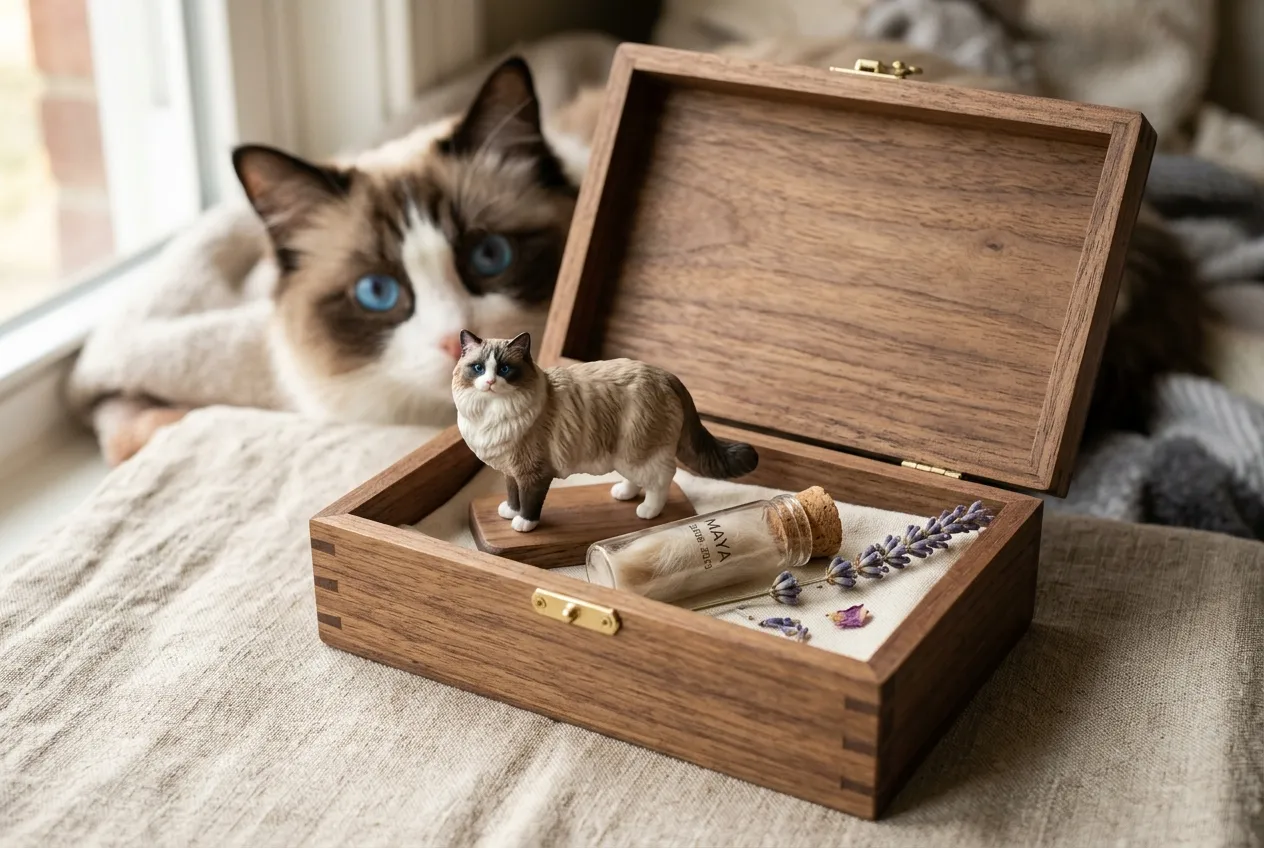
Two summers ago, the garden smelled like warm lavender and cat fur—your Ragdoll stretched across the flagstones, belly up, blue eyes half-closed. Now the lavender's back, but the flagstones are bare, and you're holding a collar with no cat attached, wondering how to build a ragdoll cat memory box that actually means something.
Quick Takeaways
- A living tribute evolves over time — add seasonal items, scent refreshers, and new photos instead of sealing the box shut forever
- Scent preservation matters most in the first 48 hours — bag unwashed items immediately to lock in your Ragdoll's smell
- Physical objects anchor grief better than digital ones — tangible keepsakes like custom pet figurines from PawSculpt give your hands something to hold when they reach for fur that isn't there
- Include "imperfect" items — the chewed corner of a book, a stained blanket, the vet's last receipt all carry more emotional weight than curated mementos
- Your memory box is not a coffin — open it regularly, rearrange it, let it breathe and change as your grief does
Why Most Pet Memorial Keepsakes Fail (And What Actually Works)
Here's something we've learned from working with thousands of grieving pet families: most memorial keepsakes end up in a drawer within six months.
Not because people stop caring. Because the keepsake was designed to be looked at once, cried over, and closed. A shadow box on the wall. A paw print in plaster. A single framed photo. These are fine—genuinely—but they're static. They freeze one moment and ask you to stare at it forever.
A living tribute works differently. It's a collection that grows, shifts, and breathes alongside your grief. Some weeks you add something. Some months you take something out. The box itself becomes a relationship—a continuing conversation with a cat who shaped your daily rhythms in ways you're still discovering.
We'll be real: this approach isn't for everyone. Some people need closure, a sealed container, a period at the end of the sentence. But if you're the kind of person who keeps finding Ragdoll fur on your black sweater three months later and can't decide if it makes you smile or cry (probably both), a living tribute might be your thing.
"A memorial isn't something you finish. It's something you tend, like a garden that blooms in its own time."
The Counterintuitive Truth About Memory Boxes
Most guides tell you to gather your pet's "most precious items" and arrange them beautifully. Sounds right. But here's what we've noticed from families who actually use their memory boxes long-term versus those who don't:
The boxes that get opened again contain ugly things.
The half-destroyed feather toy. The vet bill with your handwriting in the margin ("ask about appetite"). A clump of fur you pulled off the couch. A photo where your Ragdoll looks annoyed, not majestic. These imperfect artifacts carry more emotional charge than the perfect portrait or the pristine collar, because they smell like real life. They feel like Tuesday afternoon, not a memorial service.
| What Most Guides Suggest | What Actually Gets Opened Again |
|---|---|
| Best professional photo | Blurry phone photo from an ordinary day |
| Clean, new collar | The worn collar that still smells like them |
| Formal paw print casting | A sticky note where you wrote their weight |
| Sympathy cards from others | Your own grocery list that says "cat food" |
| Decorative urn or box | The cardboard box they loved sitting in |
That table might sting a little. Good. The point isn't that professional photos are bad—it's that your memory box should contain the mundane alongside the beautiful, because your Ragdoll's life was both.
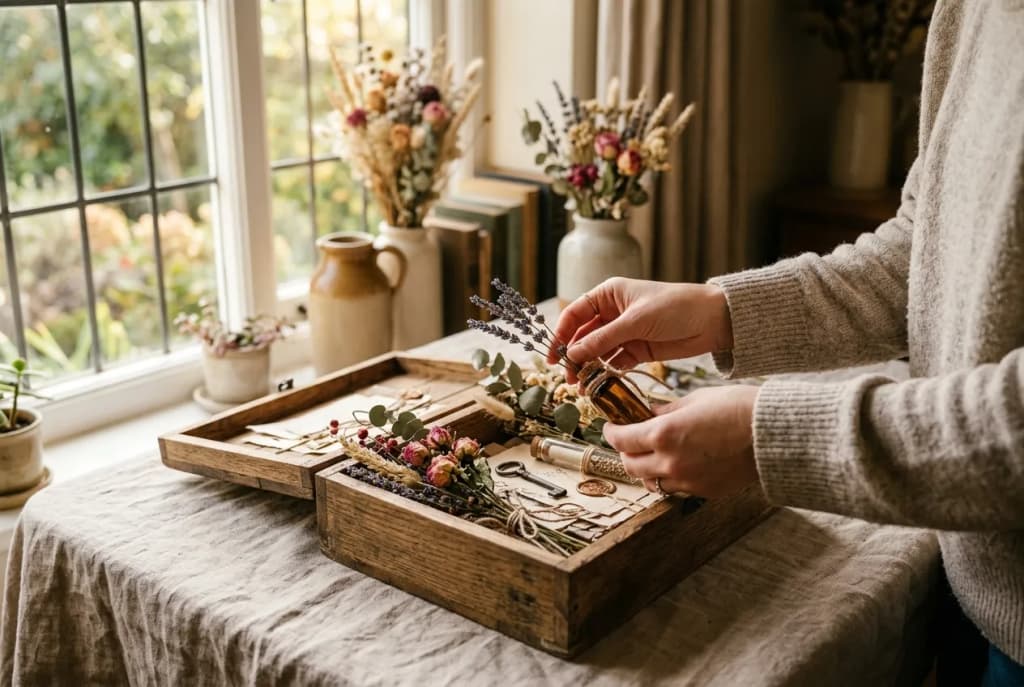
The First 72 Hours: What to Save and How to Save It
This is the practical part, and timing matters. If you're reading this before your Ragdoll has passed—maybe they're aging, maybe you've gotten a diagnosis—you have an advantage. Use it.
Scent Is the First Thing You'll Lose
Here's something nobody talks about enough: scent fades faster than anything else, and scent is the sense most tightly wired to memory. The smell of your Ragdoll's fur—that warm, slightly dusty, biscuit-adjacent smell that every Ragdoll owner knows—will disappear from fabric within weeks if you don't act.
Within the first 48 hours:
- Take their primary sleeping blanket or bed cover and seal it in a ziplock bag. Don't wash it. Don't even fold it neatly—just stuff it in and squeeze the air out.
- If they had a favorite spot on the couch, pull the cushion cover off and bag that too.
- Save any unwashed clothing of yours that they regularly slept on.
- Their collar—bag it separately. The leather or fabric holds scent longer than you'd think.
We worked with a family last year who told us the single most important thing in their cat's memory box was a pillowcase they'd sealed on day one. Eight months later, they could open the bag, press it to their face, and be right back in bed with their Ragdoll purring against their neck. Nothing else—no photo, no figurine, no poem—hit that hard.
Physical Items Worth Keeping
Beyond scent, here's a practical checklist. Not everything will apply to your situation, and that's fine.
- Whiskers: Ragdolls shed whiskers regularly. If you've been finding them on the carpet for years, check your junk drawer—you might already have some. These are tiny, nearly weightless, and irreplaceable.
- Fur clippings: A small bag of brushed fur. Ragdolls produce plenty of it. If you're pre-planning, brush them and save a generous amount.
- Claw sheaths: Those translucent little shells they leave behind. Strange to keep? Maybe. But they're a physical piece of your cat.
- The last toy they played with: Not the newest one. The one they actually chose.
- Vet records: Specifically the handwritten notes, appointment cards, anything with their name on it in someone else's handwriting. These prove they existed in the world beyond your home.
- A piece of their scratching post: Cut a small section. It'll have their scent, their claw marks, their daily routine embedded in it.
Digital Preservation (Do This Now, Organize Later)
Don't curate yet. Just collect.
Go through your phone and airdrop every photo and video of your Ragdoll to a dedicated folder. Every single one. The blurry ones, the duplicates, the ones where they're just a white blob on the bed. You can sort later. Right now, you're just making sure nothing gets lost in a phone upgrade or an accidental deletion.
Record a voice memo describing their daily routine. What time they woke you up. Where they sat during breakfast. The sound they made when they wanted dinner. You think you'll remember these details forever. You won't—not the specifics. Not the exact pitch of that chirpy Ragdoll trill.
Building the Physical Box: Materials, Layout, and the Breathing Room Principle
Choosing the Container
Skip the pre-made "pet memorial box" from the big retailers. Most of them are too small, too decorative, and too final-looking. They signal "this is done" when what you want is "this is ongoing."
What works better:
- A medium wooden box with a hinged lid (unfinished wood absorbs and holds scent)
- A vintage cigar box if you like the aesthetic (cedar holds up well)
- A linen-covered photo box from an art supply store
- A handmade ceramic box with a loose-fitting lid
The key quality: it should be easy to open. No clasps that require two hands. No lids that stick. You want to be able to reach for it on a hard Tuesday evening and have it open in your lap within seconds.
The Breathing Room Principle
Here's where this guide diverges from everything else you'll read about cat tribute ideas. Most guides tell you to fill the box. We're telling you to leave it half empty.
Why? Because a full box is a finished project. A half-empty box is an invitation. It says: there's more to add. More memories to surface. More things to discover about how this cat shaped your life.
Leave room for:
- The birthday card you'll write them next year (yes, you can still do that)
- A photo you'll find on an old phone in six months
- A drawing your kid makes of them in a year
- A leaf from the garden where they used to nap
- Something you haven't thought of yet
"Leave the box half empty. Grief needs room to move, and so do the memories that haven't surfaced yet."
Layout Suggestions (Not Rules)
There's no wrong way to arrange a memory box. But if you want a starting framework:
Bottom layer: Scent items (sealed bags with blanket pieces, collar). These are the foundation—literally and emotionally.
Middle layer: Physical artifacts (whiskers, fur, claw sheaths, toy). Wrap delicate items in acid-free tissue paper.
Top layer: Paper items (photos, vet cards, your written memories). These are what you'll interact with most often.
Lid interior: Tape or pin one photo here. When you open the box, they're the first thing you see.
The Emotional Landscape Nobody Warns You About
Let's talk about the part that most pet memorial keepsake guides skip entirely, because it's uncomfortable and doesn't photograph well for Pinterest.
The Guilt Spiral
Many Ragdoll owners feel a specific kind of guilt that's tied to the breed itself. Ragdolls are indoor cats. They depend on you completely. They follow you room to room. They go limp in your arms. The relationship is intensely codependent by design—and when they're gone, the guilt can be crushing.
"Did I play with them enough? They were always waiting for me. Did I make them wait too much?"
"Should I have caught the symptoms earlier? They never complained—Ragdolls don't complain—so how was I supposed to know?"
"Was the house too boring for them? Did they have a good life, or just a safe one?"
This guilt is real, it's common, and it's a liar. A cat who follows you to the bathroom, who sleeps pressed against your legs, who goes boneless in your arms—that's not a cat enduring their life. That's a cat who chose you as their entire world and was content with the arrangement.
The Relief You're Not Supposed to Feel
And then there's this: if your Ragdoll was sick—especially with the kidney disease or HCM that haunts this breed—you might have felt a wash of relief when they finally passed. Relief that the subcutaneous fluids are done. Relief that you're not checking their breathing at 3 AM. Relief that the worst thing you were dreading has happened and you survived it.
That relief doesn't make you a monster. It makes you someone who was carrying an unbearable weight and finally set it down. The guilt that chases the relief—"how can I feel relieved that my cat is dead?"—is one of grief's cruelest tricks. You're not relieved they're gone. You're relieved they're not suffering. Those are profoundly different things, even when they feel identical at 2 AM.
According to the Association for Pet Loss and Bereavement, these mixed emotions are among the most commonly reported experiences in pet grief, and acknowledging them is a critical step in healthy processing.
The Fear of Forgetting
This one creeps in later. Maybe a month out, maybe three. You're going about your day and you realize you can't remember which side they preferred to be scratched on. Or you try to recall the exact color of their eyes and get it slightly wrong. The panic is immediate and disproportionate: if you forget the details, did any of it really happen?
This is exactly why a memory box matters. Not as a shrine. As a reference library for your love. When the fear of forgetting hits, you open the box. You smell the blanket. You look at the photo. You read the note you wrote about how they always sat on your left side during movies. The details come flooding back, and the panic recedes.
This is also where a physical, three-dimensional keepsake earns its place. A photo is flat. A figurine—something you can hold, turn in your hands, run your thumb over—engages your spatial memory differently. It's why families who include a custom 3D-printed figurine in their memory box often tell us it's the item they reach for first. Not because it's the most expensive thing in the box, but because it has weight and dimension. It feels like holding something real.
"We've found that the families who heal most fully aren't the ones who grieve perfectly—they're the ones who give themselves permission to grieve honestly."
— The PawSculpt Team
Myth vs. Reality: What People Get Wrong About Pet Memorials
Myth #1: You should wait until you're "ready" to create a memorial.
Reality: There's no ready. Waiting often means losing irreplaceable items—scent fades, phones get replaced, details blur. Start collecting within the first 48 hours, even if you don't assemble anything for months. Readiness is a myth that costs you materials you can't get back.
Myth #2: A memory box should be beautiful and Instagram-worthy.
Reality: The most-used memory boxes we've seen look like junk drawers. They're messy, personal, and full of things that would mean nothing to a stranger. If your box looks like a styled flat-lay, you probably curated out the items with the most emotional weight. Ugly is honest. Honest is what heals.
Myth #3: Creating a memorial means you're "stuck" in grief.
Reality: The opposite, actually. Research on continuing bonds theory—the idea that maintaining a connection with the deceased is healthy, not pathological—has largely replaced the old "stages of grief" model in modern psychology. Your memory box isn't a sign you can't move on. It's a tool for integrating loss into a life that keeps going.
Seasonal Additions: Keeping the Tribute Alive
This is the "living" part of a living tribute, and it's what separates this approach from a one-and-done memorial.
| Season | What to Add | Why It Works |
|---|---|---|
| Spring | A sprig of the plant they used to sniff in the garden | Connects their memory to renewal and growth |
| Summer | A photo of their favorite sun patch, empty | Acknowledges absence without avoiding it |
| Autumn | A leaf from their outdoor watching spot | Marks the passage of time alongside nature |
| Winter | A written note about a holiday memory with them | Gives you permission to include them in celebrations |
| Anytime | A new photo you discovered on an old device | Proves there are still surprises left in the relationship |
The seasonal rhythm does something important: it gives you structured permission to grieve. Instead of grief ambushing you randomly (which it still will, and that's fine), you also have planned moments where you sit with the box, add something, and let yourself feel whatever comes up.
Some families light a candle. Some pour a cup of tea. One customer told us they play the specific Spotify playlist they always had on during evening cuddle time. The ritual doesn't matter. The regularity does.
The Ragdoll-Specific Details Worth Preserving
Ragdolls aren't generic cats, and your memorial shouldn't be generic either. Here are breed-specific details that are easy to overlook and impossible to replace:
Their color point pattern. Ragdolls come in seal, blue, chocolate, lilac, red, and cream, with patterns ranging from colorpoint to mitted to bicolor. Your cat's specific pattern—the exact way their mask faded into their cheeks, the precise placement of their mittens—was unique to them. Photograph it from multiple angles while you can. Front, side, top-down, and close-ups of their paws.
The flop. Every Ragdoll owner knows the flop—that boneless collapse into your arms or onto the floor. If you have video of it, that's gold. If you don't, write down exactly how it felt. The weight distribution. The way their head lolled back. The trust in it.
Their voice. Ragdolls are typically quiet cats with soft, chirpy voices. Record it. Even a 10-second clip of their feeding-time meow is worth more than you can imagine right now.
The fur texture. Ragdoll fur is rabbit-soft, medium-long, and tends to mat behind the ears. Save a brushed clump. Seal it in a small jar. In five years, you'll be able to touch it and remember exactly what it felt like to bury your face in their ruff.
Their eye color. That vivid blue. Photograph it in natural light, close up, with your phone's portrait mode off (portrait mode blurs the very details you want to capture). The specific shade of your Ragdoll's blue eyes was theirs alone.
This is also where a precision-crafted memorial figurine can capture what photos can't—the three-dimensional reality of your cat's unique markings, their specific color point pattern, the way their fur fell. PawSculpt's full-color 3D printing technology reproduces these details directly in resin, voxel by voxel, so the seal point on your cat's nose or the exact placement of their bicolor pattern is preserved with the kind of accuracy a flat photo simply can't achieve. You can check out the process and examples at pawsculpt.com.
What to Do When the Box Makes You Cry (And When That Changes)
Let's set expectations. The first few times you open your ragdoll cat memory box, you will probably cry. Hard. The scent hits first—if you saved fabric early enough—and it bypasses every rational defense you've built. You're not "opening a box." You're standing in the kitchen at 6 AM with a warm cat winding between your ankles, and then you're not, and the distance between those two realities is the entire width of grief.
This is normal. This is the box working.
Over time—and we're talking months, not weeks—something shifts. The tears don't stop entirely (and honestly, why should they?), but they share space with something else. A smile at the ridiculous way your ragdoll used to drape themselves across your keyboard like a furry barricade against productivity. A laugh at the photo where they're jammed into a shoebox three sizes too small with an expression of absolute contentment.
The box becomes a vessel that holds grief and joy in the same space. And that's the point. Because your ragdoll was never just one thing—they were warmth and chaos and 3 AM zoomies and that specific boneless flop they did when you picked them up. The box should hold all of it.
When to Invite Others Into the Box
Some memory boxes are private. Others become shared family rituals—opened on anniversaries, shown to new partners who never met the cat, or used to explain loss to children in a tangible, age-appropriate way.
If you have children, the memory box becomes an extraordinary teaching tool. Kids process grief differently than adults—they need something they can see, touch, and return to. A box gives them permission to revisit the loss on their own terms, at their own pace, without needing to ask you if it's okay to be sad today.
The Living Tribute: Why a Memory Box Alone Isn't Enough
A box preserves the past. But a living tribute—something that exists in three dimensions in your daily environment—bridges past and present. This is where families increasingly pair their memory boxes with tangible keepsakes that sit in view.
A custom pet figurine of your ragdoll, placed on the shelf where your memory box lives, gives the tribute a face. You don't need to open the box to feel connected. The figurine is there every morning when you walk past—quietly present, a permanent reminder of the specific cat who taught you that love doesn't require hands.
Ready to Build a Tribute Your Ragdoll Deserves?
Every ragdoll has a signature look—the sweep of their coat, the depth of their blue eyes, the way they went completely limp in your arms. A custom PawSculpt figurine captures those exact details in permanent, full-color resin, becoming the centerpiece of your living tribute.
Visit pawsculpt.com to start your order—free AI preview, a 3D artist preview within 7 days, and 5 free revisions
Frequently Asked Questions
What should I put in a pet memory box for my ragdoll cat?
Start with items that carry their scent or texture—a favorite blanket, a collar, a clipping of fur. Add photos from different life stages, veterinary milestone cards, and small objects tied to shared routines like a toy mouse or a treat bag clip. The best memory boxes include at least one item that engages touch, not just sight.
How do I keep a pet memory box from feeling like a sad shrine?
Focus on joy, not just loss. Include photos where your ragdoll looks ridiculous—mid-yawn, tangled in a curtain, sprawled in an impossible position. Pair heavy items like vet records with lighter ones like a handwritten note about their funniest habit. A memory box should make you laugh and cry, not just cry.
What materials work best for a pet memory box that will last?
Acid-free archival boxes protect paper items from yellowing. Cedar-lined wooden boxes add natural scent preservation but can overwhelm delicate fabrics. For most cat owners, a solid wood or bamboo box with a tight-fitting lid strikes the right balance between beauty and preservation.
Can a custom figurine be part of a memory box display?
Absolutely. Many families place a small custom figurine on top of or beside the memory box as a visual anchor. It gives the box a presence in the room without requiring you to open it every time you want to feel connected. The figurine becomes the everyday reminder while the box holds the deeper layers.
When is the right time to create a pet memory box after losing a cat?
There is no wrong time. Some people find immediate comfort in gathering items while the loss is fresh. Others wait weeks or months until they feel ready to handle their cat's belongings without being overwhelmed. Start when touching their things brings more comfort than pain—and if it's still painful, that's information too.