
The Multi-Pet Household Grief Map: How to Honor Your Dachshund While Supporting Your Other Dogs
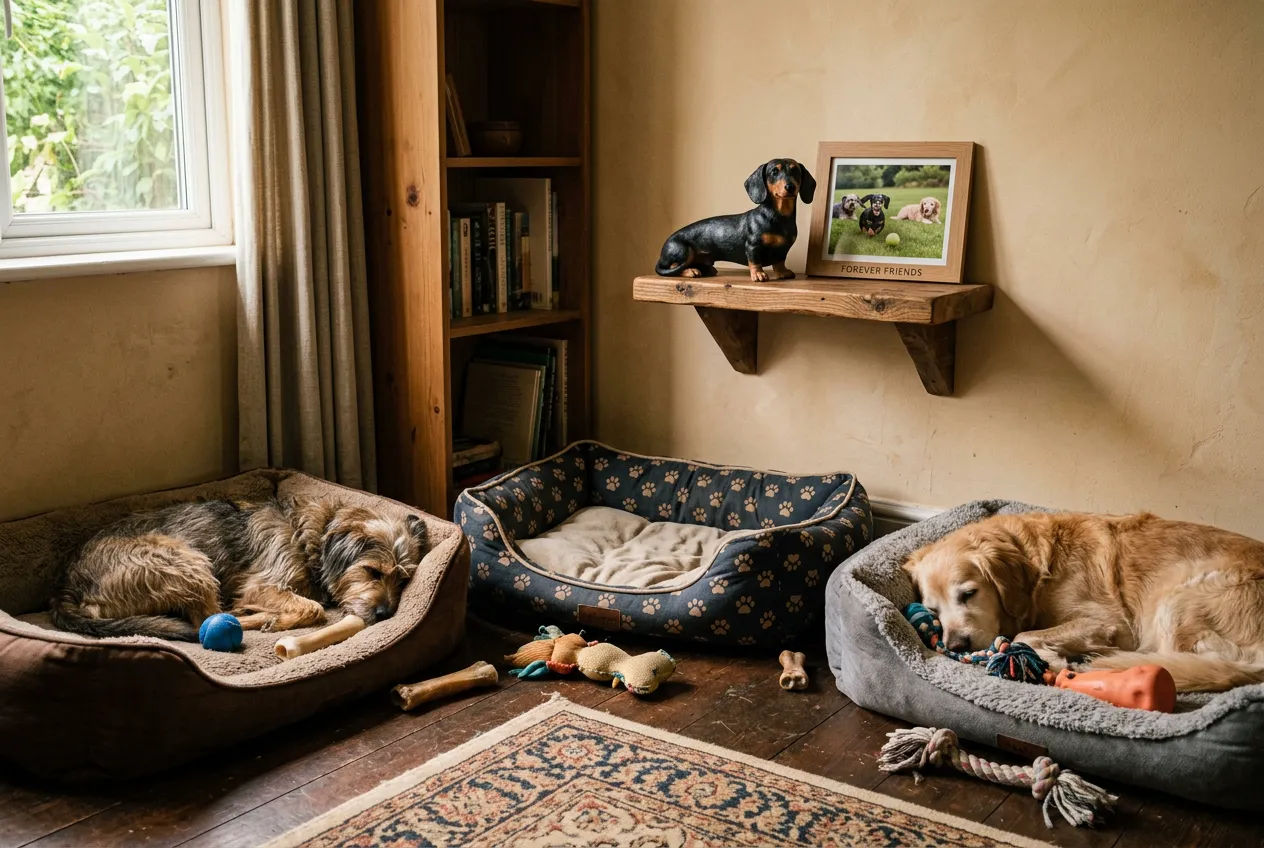
Salt water pooled in the crease of her palm where she'd been resting it on the dachshund's back for the last hour, and now the tide was coming in and the towel was empty and her golden retriever kept circling the spot, pressing his nose into the fabric. That's the thing about multi-pet household grief—it doesn't just live in you. It moves through the whole pack.
Quick Takeaways
- Your surviving dogs are grieving too—watch for appetite changes, door-guarding, and unusual vocalization within the first 72 hours
- Resist the urge to "fix" the pack dynamic immediately—the social reshuffling needs 3-6 weeks to settle naturally
- Guilt about feeling relief is grief's cruelest trick—it doesn't mean you loved your dachshund less
- Tangible memorials help the whole family—a custom pet figurine placed at your dog's favorite spot gives everyone, including surviving pets, an anchor point
- Your dachshund's scent is a tool, not a relic—use it strategically to ease your other dogs' transition
The Grief Map Nobody Gives You: Why Multi-Dog Loss Is Different
Most grief resources treat pet loss like a solo event. One pet. One owner. One arc of sadness. But if you're reading this, you know that's not your reality. You lost your dachshund, and now you're standing in a kitchen where the food bowls are wrong, the walking formation has a gap, and your other dogs are looking at you like you have the answer.
You don't. And that's okay.
Here's the counterintuitive truth that most guides skip entirely: grieving in a multi-pet household is harder not because you're sadder, but because you can't fully grieve. You're managing your own loss while simultaneously reading behavioral cues from animals who can't tell you what they need. You're a grief counselor, a pack leader, and a mourner—all before breakfast.
We've worked with thousands of pet families at PawSculpt, and the ones navigating multi-dog loss consistently tell us the same thing: "Nobody warned me I'd have to hold it together for them." The golden retriever who won't stop sniffing the empty crate. The terrier mix who suddenly won't eat unless you sit on the floor next to her. The senior lab who starts sleeping in the dachshund's old spot and growls if anyone comes near.
These aren't random behaviors. They're a grief map—and once you learn to read it, you can navigate this for everyone in your household.
"The hardest memorials we create aren't for the pet who's gone—they're for the family still figuring out how to rearrange around the absence."
— The PawSculpt Team
Reading the Room: How Your Surviving Dogs Actually Process Loss
Let's kill a myth right now. Dogs don't grieve the way we do—but they grieve more specifically than most people realize. They're not mourning an abstract concept of death. They're responding to a disruption in pattern, scent, and social structure. That distinction matters because it changes everything about how you help them.
The 72-Hour Window
The first three days after your dachshund's passing are the most behaviorally volatile for your surviving dogs. Here's what you might see—and what it actually means:
| Behavior | What It Looks Like | What It Actually Means | Your Response |
|---|---|---|---|
| Door guarding | Sitting by the door, whining, checking the yard | Expecting the missing pack member to return | Don't redirect—let them search, then offer calm presence |
| Appetite refusal | Skipping meals, sniffing food and walking away | Stress response, not illness (unless it lasts 72+ hours) | Offer high-value food by hand; don't force routine yet |
| Increased vocalization | Howling, barking at nothing, whimpering at night | Calling behavior—trying to locate the missing dog | Respond with physical touch, not verbal correction |
| Shadowing you | Following you room to room, refusing to be alone | Seeking reassurance that the pack leader is stable | Allow it—this is healthy attachment seeking |
| Aggression or resource guarding | Growling over toys, beds, or food that weren't contested before | Social hierarchy is destabilized and being renegotiated | Don't punish—separate resources and give space |
The mistake most people make? Trying to immediately restore normalcy. New feeding schedule. New walk route. Rearranging the crates. Your instinct says: remove the reminders, move forward.
But your dogs need the opposite. They need the familiar scaffolding to stay in place while they figure out what's changed. Keep the same walk times. Keep the same feeding order. Leave the empty bed where it is for at least two weeks.
The Scent Strategy Most People Get Wrong
Here's something you won't find in the first five Google results for surviving pets grief: your dachshund's scent is the single most powerful tool you have right now, and most people either throw it away too fast or preserve it too preciously.
Your dachshund's blanket, collar, or favorite toy carries a scent profile that your other dogs can read like a letter. In the first week, leave these items accessible. Let your dogs investigate them. You'll notice them returning to sniff, then walking away, then coming back. This is processing. This is healthy.
After 7-10 days, you can begin gradually reducing scent access. Fold the blanket. Move it to a less central location. Don't wash it yet—but let it become background rather than foreground.
The counterintuitive part? If your surviving dog starts ignoring the scent items entirely, that's actually a sign of progress. It means they've integrated the absence. The searching phase is ending.
One family we worked with had a three-dog household—a dachshund, a beagle, and a border collie. When the dachshund passed, the beagle spent four days sleeping on the dachshund's bed, nose buried in the fabric. On day five, she moved back to her own bed and didn't return. The border collie, meanwhile, never touched the bed once but started herding the beagle more intensely, as if compensating for the missing member. Same loss. Completely different grief signatures.
The Emotion You're Not Admitting: Relief, Guilt, and the Cruelest Trick
We need to talk about the thing you're probably not saying out loud.
If your dachshund was sick—and dachshunds, with their long spines and genetic predisposition to IVDD, often are toward the end—there's a feeling that arrived alongside your grief. Maybe it showed up in the car on the way home from the vet. Maybe it crept in at 2 a.m. when you realized you didn't have to set an alarm for medication.
Relief.
And right behind it, like a shadow with teeth: guilt about the relief.
This is grief's cruelest trick, and it targets multi-pet households with particular precision. Because not only did you feel relief that your dachshund's suffering ended—you might have also felt a flicker of something when you realized mornings would be simpler. One less dog to medicate. One less set of mobility exercises. One less anxious scan of the backyard to make sure the steps weren't too icy for a dog with a bad back.
That relief doesn't make you a monster. It makes you someone who was carrying an enormous weight and felt their shoulders drop. The guilt that follows is your love talking—it's proof that you cared deeply enough to sacrifice your own ease for their comfort, for months or years.
Here's what we'll be real about: the guilt is a liar. It tells you that relief and love can't coexist. They can. They do. They almost always do when a caretaker loses the one they were caring for.
If you're feeling this right now, try this: say it out loud. Not to social media. Not to the friend who says "it was just a dog." Say it to the person in your life who gets it—or write it down in a notebook that nobody else will read. The feeling loses its fangs when it hits air.
"Relief and grief aren't opposites. They're two hands holding the same heart."
The Judgment You're Bracing For
And while we're naming the unnamed—let's talk about feeling judged. Multi-pet households face a specific brand of dismissal that single-pet homes don't: "Well, at least you still have the others."
As if dogs are interchangeable. As if the dachshund-shaped hole in your evening routine can be filled by a retriever who doesn't even like the same corner of the couch.
That comment, however well-intentioned, can make you feel like your grief needs justification. Like you need to prove that this particular dog mattered, even though you have others. You don't need to prove anything. The pack dynamic you lost was specific, irreplaceable, and yours.
Some people pull away from friends during this time. That isolation is a normal response to anticipated judgment. But if you can, find the people who understand—online communities for dachshund owners, pet loss support groups, or even the Association for Pet Loss and Bereavement, which offers resources specifically for navigating these complex emotions.
Pack Dynamics After Loss: The Reshuffling Nobody Prepares You For
Here's where multi-pet household grief gets genuinely complicated—and genuinely fascinating.
Your dogs had a social structure. Maybe your dachshund was the instigator, the one who started every play session. Maybe she was the peacekeeper who'd wedge herself between two dogs getting too rowdy. Maybe she was the alarm system, the first to bark at the mail carrier, which gave the others permission to join in.
Whatever role she played, that role is now vacant. And your surviving dogs are going to audition for it.
The Three Phases of Pack Reshuffling
Phase 1: The Freeze (Days 1-7)
Everything pauses. Dogs who normally play don't play. The hierarchy feels suspended. You might notice your dogs being unusually polite with each other—giving wide berths, avoiding eye contact, deferring at doorways. This isn't peace. It's uncertainty.
Phase 2: The Negotiation (Weeks 2-4)
This is where things get bumpy. One dog may start testing boundaries—claiming the dachshund's sleeping spot, pushing ahead on walks, demanding attention first. Another might become withdrawn or clingy. You might see brief scuffles that never happened before. This is normal pack restructuring, not a behavior problem.
Phase 3: The New Normal (Weeks 4-8)
The dust settles. New patterns emerge. The hierarchy stabilizes. But—and this is the part that catches people off guard—the new normal won't look like the old normal minus one dog. It'll be a fundamentally different dynamic. Dogs who were best friends might become more independent. A shy dog might bloom into confidence. The whole texture of your household shifts.
| Phase | Timeline | What You'll See | What to Do |
|---|---|---|---|
| The Freeze | Days 1-7 | Reduced play, excessive politeness, searching behavior | Maintain routines, allow scent access, increase calm physical contact |
| The Negotiation | Weeks 2-4 | Boundary testing, brief conflicts, role experimentation | Supervise but don't intervene unless safety is at risk; separate resources |
| The New Normal | Weeks 4-8 | Stabilized hierarchy, new play patterns, settled sleeping arrangements | Reinforce the new structure with consistent leadership |
The Day-in-the-Life Reality
Here's what this actually looks like on a Tuesday morning, three weeks in: You wake up and your golden retriever is sleeping in the hallway instead of the bedroom—he's claimed the spot where the dachshund's crate used to be. Your smaller dog has started eating faster, almost frantically, because the mealtime dynamic shifted and she's not sure of her place yet. You pour coffee and realize you only grabbed two leashes instead of three, and the correction hits you in the sternum. You clip the leashes on, step outside, and the walk feels lopsided—the formation pulls left where it used to pull right. By the time you're home, you've grieved, managed, and adapted before 7:30 a.m.
That's the multi-pet household grief map in practice. It's not a single emotion. It's a hundred micro-adjustments layered on top of a loss that hasn't finished landing.
Honoring Your Dachshund Without Erasing Them From the Pack
This is where most advice gets vague. "Create a memorial." "Plant a tree." "Make a scrapbook." Fine. But what does honoring a specific dog in a specific household actually look like when you're also managing living animals who are affected by every choice you make?
The Physical Memorial Principle
Here's something we've learned from years of working with grieving families: the most effective memorials occupy physical space. Not digital space. Not mental space. Actual, three-dimensional, you-can-touch-it space.
Why? Because grief is abstract, and your brain craves something concrete to anchor it to. A photo on your phone disappears when you swipe. A framed picture on the wall becomes wallpaper after a month. But something with weight and texture—something you can pick up, hold, feel the cool surface of—that stays present.
This is one reason families increasingly choose tangible keepsakes like custom 3D-printed pet figurines that capture their dachshund's specific markings, posture, and personality. The technology behind these pieces is remarkable—full-color resin where the color is embedded directly in the material, voxel by voxel, so your dachshund's red coat or dapple pattern isn't a surface layer that can chip. It's part of the structure itself. Protected by a clear coat, the texture has a fine grain that feels substantial in your hand. Real. Present.
But a figurine is one option among many. The point is physicality. Consider:
- A shadow box with their collar, a tuft of fur, and their favorite squeaky toy
- A garden stone placed where they used to sunbathe (dachshunds and their sunbathing—you know)
- A custom illustration that