
After the Euthanasia Decision: How a Dachshund Owner Found Peace in a Single Ritual
She was gripping the steering wheel in the veterinary clinic parking lot, engine still running, when she noticed the dachshund hair woven into the fabric of the passenger seat—and that's when the grief after dog euthanasia hit, not inside the building where she'd just said goodbye, but here, alone, running her thumb across a texture she'd never bothered to notice before.
Quick Takeaways
- Euthanasia guilt follows a predictable three-phase pattern — understanding the sequence helps you stop fighting yourself
- Physical rituals outperform emotional processing alone — your body needs to participate in grief, not just your mind
- The 72-hour window after euthanasia shapes long-term healing — what you do (or don't do) in those first three days matters
- Tangible memorials like custom pet figurines serve a neurological function — they give grief a physical anchor point
- Dachshund owners face breed-specific grief patterns — the intensity of the bond creates unique challenges worth naming
The Counterintuitive Truth About Euthanasia Grief
Here's what nobody tells you, and what you won't find in the first ten grief articles Google serves up: the decision to euthanize isn't actually the hardest part. The hardest part is the retroactive doubt that starts roughly 48 to 96 hours later—when the crisis fog lifts and your brain starts replaying the timeline, looking for the fork in the road where you could've chosen differently.
We've worked with thousands of pet families at PawSculpt, and we hear this pattern described so consistently it's almost formulaic. The first day: numbness. The second day: tears. The third day: the prosecutor shows up in your head and starts cross-examining every decision you made in the last six months.
"Should I have tried the other medication?"
"Was she really in that much pain, or was I projecting?"
"Did I wait too long—or not long enough?"
That internal trial? It's not a sign that you made the wrong call. It's actually a well-documented neurological response. When we make irreversible decisions under emotional duress, the brain's default mode network kicks into overdrive afterward, generating counterfactual scenarios—alternate timelines where things went differently. It's the same mechanism that makes people replay car accidents or breakups. Your brain isn't telling you that you were wrong. It's processing the magnitude of what you chose to carry.
And here's the counterintuitive part: trying to reason your way out of that guilt actually makes it worse. The more you argue with the prosecutor in your head, the more evidence it manufactures. The research on rumination is clear on this—engaging with the loop feeds it.
So what works instead? We'll get there. But first, let's talk about why dachshund owners specifically tend to get hit harder than most.

Why Dachshund Grief Hits Different (And It's Not Just Sentimentality)
Look, every dog owner's grief is real. We're not ranking pain here. But there's a structural reason why losing a dachshund tends to create a particular kind of devastation, and it has to do with the physical architecture of the bond.
Dachshunds are contact dogs. Not in the way a golden retriever is friendly with everyone at the park—dachshunds are specific. They choose a person, and they burrow. Literally. Under blankets, into laps, against the curve of your back at 3 AM. The relationship is built on sustained physical touch in a way that's different from breeds that show affection through play or proximity.
| Bond Characteristic | Dachshunds | Retrievers | Terriers | Herding Breeds |
|---|---|---|---|---|
| Primary attachment style | Single-person, intense | Multi-person, distributed | Independent, playful | Task-oriented, loyal |
| Physical contact frequency | Near-constant | Moderate | Low-moderate | Situational |
| Touch type | Burrowing, pressing, warmth-seeking | Leaning, nudging | Brief, energetic | Positioned nearby |
| Absence felt most in | Bed, couch, lap—body-level | Doorway greetings, walks | Play routines | Daily structure |
| Grief trigger profile | Tactile (texture, warmth, weight) | Spatial (empty rooms, routes) | Activity-based (toys, games) | Routine-based (schedules) |
This matters because tactile grief is processed differently than other kinds. When you lose a dog whose primary love language was pressing their warm, smooth body against yours, the absence registers in your nervous system, not just your emotions. You feel it in your skin. The bed feels wrong. Your lap feels empty in a way that's physically uncomfortable. You might catch yourself reaching down beside the couch to touch a head that isn't there—and your hand meets cold air, and something in your chest just... drops.
One family we worked with described it perfectly: "It's not that I miss seeing her. It's that my body misses the weight of her."
That's not poetry. That's neuroscience. Tactile memory is stored in the somatosensory cortex, and it's remarkably persistent. The phantom sensation of your dachshund's fur under your fingertips—that slightly coarse topcoat over the downy undercoat, the velvet of their ears—can persist for months. And every time it fires without resolution (reaching down and finding nothing), it reinforces the grief signal.
This is why, for dachshund owners specifically, physical rituals and tangible objects play an outsized role in healing. But we'll come back to that.
"Grief doesn't live in your thoughts. It lives in your hands, reaching for what isn't there anymore."
The Three Phases of Euthanasia Guilt (A Framework That Actually Helps)
Okay, so let's map this out. Because when you're drowning in guilt after putting your dog down, the last thing you need is someone telling you to "be gentle with yourself." You need a framework. You need to know where you are, what's coming next, and when it shifts.
Based on what we've observed across years of working with grieving pet owners—and consistent with what veterinary behaviorists and grief counselors describe—euthanasia guilt tends to move through three distinct phases:
Phase 1: The Decision Echo (Days 1-7)
This is the replay loop. Your brain cycles through the decision itself—the conversation with the vet, the moment you said yes, the drive to the clinic, the room, the table, the needle. You're not processing yet. You're just... replaying.
The dominant emotion here isn't sadness. It's disbelief mixed with hypervigilance. Part of your brain is still scanning for a way to undo it. You might catch yourself thinking "I need to call the vet" before remembering there's nothing to call about.
What helps in Phase 1: Don't try to feel better. Seriously. The pressure to "start healing" in the first week is counterproductive. Your nervous system is still in crisis mode. Let it be in crisis mode. The only task here is basic self-care—eating, sleeping, hydrating. That's it.
Phase 2: The Prosecutor (Days 7-30)
This is where the guilt gets specific and vicious. The replay loop evolves from "what happened" to "what I should have done differently." This is the phase where people torture themselves with timelines.
"If I'd caught it in March instead of May..."
"If I'd gone to the specialist sooner..."
"If I hadn't been so selfish about wanting more time..."
Here's what you need to know about Phase 2: the guilt is almost never about the euthanasia itself. It's about the entire arc of caregiving. The euthanasia decision just becomes the focal point because it's the most concrete, most irreversible moment in the story. But underneath it, you're actually processing every moment where you felt uncertain, overwhelmed, or inadequate as a caretaker.
And here's the feeling that almost nobody talks about, the one that makes people feel like monsters: relief. That wave of relief you felt when their suffering ended? When you didn't have to set another alarm for medication, or carry them outside one more time, or watch them struggle to do something that used to be effortless?
That relief doesn't make you a bad person. It makes you someone who was running on fumes, carrying an impossible weight, and your body finally set it down. The guilt that chases the relief is one of grief's cruelest mechanisms—it takes evidence of your exhaustion and reframes it as evidence of your selfishness. It's a lie. A convincing one, but a lie.
"Relief after euthanasia isn't betrayal. It's your body finally exhaling after holding its breath for months."
What helps in Phase 2: Externalize the prosecutor. Write down the accusations your brain is making. All of them. Then—and this is important—show them to someone. A friend, a therapist, an online grief group. The prosecutor loses power when it's no longer a private conversation. The Association for Pet Loss and Bereavement offers resources specifically for this kind of processing, including support groups where you'll hear other people voicing the exact same accusations you've been whispering to yourself.
Phase 3: The Integration (Month 2-6+)
The guilt doesn't disappear. It transforms. In this phase, the sharp, accusatory guilt softens into something more like tender regret—a gentler acknowledgment that you did the best you could with what you knew, even if what you knew wasn't enough.
This is also where the fear of forgetting shows up. And honestly? This one's sneaky. Because it disguises itself as other things—suddenly wanting to reorganize photos, or panicking when you realize you can't quite remember the exact shade of their fur, or the specific sound of their bark. The fear of forgetting is really a fear that the bond wasn't real enough to last. It was. It is.
| Phase | Timeline | Dominant Emotion | What It Sounds Like | What Actually Helps |
|---|---|---|---|---|
| Decision Echo | Days 1-7 | Disbelief, hypervigilance | "Did that really happen?" | Basic self-care only. Don't force processing. |
| The Prosecutor | Days 7-30 | Guilt, relief-shame cycle | "I should have done X differently" | Externalize thoughts. Share with others. |
| Integration | Month 2-6+ | Tender regret, fear of forgetting | "I'm starting to forget details" | Create tangible anchors. Establish rituals. |
What helps in Phase 3: Tangible anchors. This is where physical objects become genuinely therapeutic, not as retail therapy, but as neurological tools. Your brain needs something concrete to attach the memory to—something you can touch, hold, see on a shelf. Something with texture and weight that tells your somatosensory cortex: this bond was real, and here's the proof.
The Ritual That Changed Everything (And Why "Ritual" Is the Right Word)
So here's where we get specific. Because "create a memorial" is vague advice, and vague advice is useless advice.
The dachshund owner from the parking lot—let's call her the customer we worked with last spring—she didn't start healing by talking about her feelings or journaling or meditating. She started healing by doing something with her hands.
She gathered every photo she had of her dachshund, Fritz. Not the cute Instagram ones. The weird ones. The blurry 2 AM photo where he's mid-yawn and looks like a gremlin. The one where he's wedged himself so far under the couch cushion that only his tail is visible. The one from the car where he's sitting in the passenger seat like a tiny, disapproving businessman.
She laid them out on the kitchen table—physically printed, not on a screen—and she spent an evening just... touching them. Running her fingers over the glossy surfaces. Arranging and rearranging them. Not crying, necessarily. Just being present with the physical evidence of his life.
Then she chose three photos that captured something essential about Fritz—his posture, his coloring, the way his ears sat slightly asymmetrical—and she sent them to our team to create a custom 3D-printed figurine.
Here's what she told us when the figurine arrived: "I picked it up and it had weight. It felt like something. And I realized that's what I'd been missing—something that felt like something."
That's not a sales pitch. That's a neurological reality. Grief that lives in the body needs a body-level response. A photo is visual. A figurine—with its texture, its weight, its three-dimensional presence on a shelf—engages touch, proprioception, spatial awareness. It occupies physical space the way your pet occupied physical space.
"We've learned that grief needs weight. Not metaphorical weight—actual, physical, hold-it-in-your-hands weight. That's what brings people back to themselves."
— The PawSculpt Team
Why "Ritual" and Not Just "Memorial"
There's a distinction here that matters. A memorial is a thing. A ritual is a practice. The families who heal most completely don't just get a memorial object—they build a ritual around it.
What does that look like? It varies. Some people place the figurine on a specific shelf and light a candle next to it on the anniversary. Some keep it on their desk and touch it briefly each morning—a two-second acknowledgment, like a nod to a friend. Some hold it during the hard moments, when the grief surges unexpectedly, and the weight and texture of it in their palms becomes a grounding tool.
The point isn't the specific ritual. The point is that ritual creates a container for grief—a designated time and place and action that says: this is where I hold this feeling. Not everywhere. Not all the time. Here. Now. With this object in my hands.
And then you set it down. And you go make dinner.
That's not "moving on." That's integration. It's the difference between grief flooding your entire house and grief having its own room—a sacred space you can visit intentionally and leave when you're ready.
Myth vs. Reality: What Actually Helps After Euthanasia
Let's bust some common misconceptions, because there's a lot of well-meaning but genuinely unhelpful advice floating around:
Myth 1: "You need to let yourself cry it out."
Reality: Forced emotional expression can actually intensify distress. Some people process grief through action, through making things, through organizing and creating structure. If you're not a crier, you're not doing it wrong. The research on grief processing shows that oscillation—moving between confronting the loss and taking breaks from it—is healthier than sustained emotional immersion. Watch a dumb movie. Organize a closet. Then come back to the grief when it calls you. That rhythm is healing.
Myth 2: "Getting another dog too soon means you haven't processed your grief."
Reality: There's no "too soon." The anxiety about getting another pet—the fear that it means you're replacing them, or that you didn't love them enough—is one of the most isolating feelings in pet grief. Some people need the presence of another animal to function. Some need years of empty space. Neither is wrong. The only question worth asking is: "Am I getting a new pet to avoid grief, or am I getting one because my capacity to love didn't die with my dog?" If it's the latter, Fritz would probably approve.
Myth 3: "Time heals all wounds."
Reality: Time doesn't heal anything by itself. Time plus intentional processing heals. Time plus avoidance just creates a longer runway for unresolved grief to build speed. This is why people sometimes break down over a pet loss that happened years ago—not because they're "still not over it," but because they never actually moved through it. They just moved away from it.
The 72-Hour Window: What to Do (And Not Do) Right After
Okay, let's get practical. If you're reading this in the immediate aftermath of euthanasia, here's a framework for the first three days. Not because there's a "right way" to grieve, but because having a structure when everything feels structureless can be genuinely stabilizing.
Hours 0-24: The Fog
Your only job is logistics and basic survival. Eat something, even if it's crackers. Drink water. If you have other pets, maintain their routine—they need the stability, and honestly, so do you.
Do not make any permanent decisions about your pet's belongings. Don't throw away the bed, the toys, the leash. Not yet. You're in no state to decide what you'll want later.
Do text or call one person. Just one. Say the words out loud: "I had to put [name] down today." Hearing yourself say it begins the reality-integration process. Keeping it internal keeps it abstract.
Hours 24-48: The Surge
This is typically when the first big wave hits. The numbness cracks and something raw comes through. You might cry. You might rage. You might feel absolutely nothing and then panic about feeling nothing. All of it is normal.
Do something physical. Walk. Clean. Carry something heavy. Your body is flooded with cortisol and adrenaline from the sustained stress of caregiving and decision-making, and it needs a physical outlet. Sitting still and "processing" often just means marinating in stress hormones.
Do not go on social media to post a tribute yet (unless you genuinely want to). The pressure to perform grief publicly—to craft the perfect caption, to respond to comments—can hijack your actual processing. There's time for that later.
Hours 48-72: The Inventory
This is when most people start looking around the house and noticing all the small accommodations they'd made. The ramp by the couch (because dachshund backs are fragile and jumping is risky). The water bowl in the hallway. The indent in the dog bed that still holds the shape of a curled body.
Do take photos of these things before you change anything. The ramp, the bed, the worn spot on the carpet. These aren't just objects—they're evidence of a life lived together, and you may want them later.
Do begin thinking about what kind of memorial feels right. Not deciding—just thinking. Some options to consider:
- A memorial garden planting (physical, seasonal, living)
- A photo book or shadow box (visual, archival)
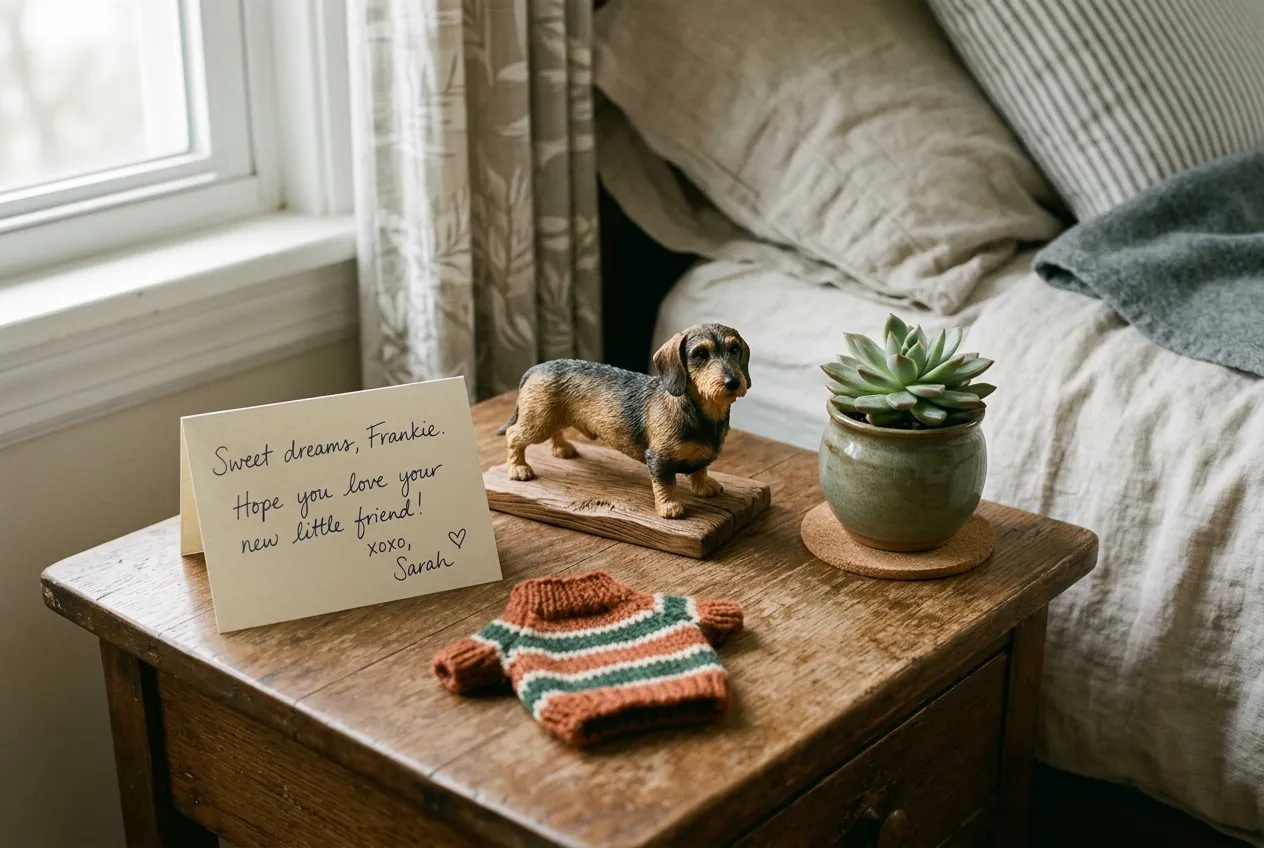
- A custom figurine that captures their specific look and personality (tactile, dimensional, permanent)
- A charitable donation in their name (purposeful, outward-facing)
- A written letter to them (private, emotional, cathartic)
You don't have to choose now. But starting to think about it gives your brain something forward-looking to hold onto, which is genuinely important in the first 72 hours.
Coping After Putting Your Dog Down: The Stuff Nobody Mentions
Let's talk about the weird grief. The grief that doesn't show up in the sympathy cards.
The jealousy. You're at the park and you see someone with a dachshund—same coloring, same ridiculous proportions—and something hot and ugly flares in your chest. Why do they still have theirs? That feeling is normal. It doesn't make you a bad person. It makes you a person whose brain is scanning the environment for what it lost and finding reminders everywhere.
The anger at the vet. Even if they were wonderful. Even if they were gentle and kind and gave you all the time you needed. Some part of you might be furious at them, because they're the last person who touched your dog, and your brain needs someone to blame who isn't you. That's normal too.
The shame about how much this hurts. Especially if you have people in your life who don't get it. The coworker who says "it was just a dog." The family member who asks when you're going to "move on." The internal voice that says you're being dramatic, that people lose children and you're falling apart over a fifteen-pound wiener dog.
Here's the thing: grief isn't proportional to the species of the one you lost. It's proportional to the bond. And the bond you had with a dachshund who slept pressed against your ribcage every night for twelve years? That's not a small bond. That's a body-level, nervous-system-level, identity-level attachment. The AVMA recognizes pet loss as a legitimate and significant form of bereavement, and veterinary grief research consistently shows that the intensity of pet grief often matches or exceeds grief for human relationships.
You're not being dramatic. You're being accurate.
Building Your Sacred Space (A Practical Guide)
Alright, let's get concrete about creating a ritual space. Not in a woo-woo way—in a "this is a practical tool for neurological and emotional regulation" way. Though honestly, the spiritual dimension matters too. There's something about designating a physical space as sacred—as belonging to the spirit of your relationship with your pet—that shifts how you relate to the grief.
Here's a simple framework:
- Choose a location. Somewhere you'll see daily but that isn't in a high-traffic, high-stress area. Not the kitchen counter where you're rushing through breakfast. A bookshelf in the living room. A windowsill in the bedroom. A small table in the hallway.
- Select your anchor object. This is the centerpiece. It could be a figurine, an urn, a framed photo, a collar displayed on a small stand. The key quality is dimensionality—something that occupies space, that has texture you can touch, that changes slightly in different light. Flat objects (photos, prints) work, but three-dimensional objects engage more sensory pathways.
- Add one living element. A small plant. A candle you light periodically. Something that changes, that requires minimal tending, that introduces the concept of ongoing care into the space. Grief spaces that are entirely static can start to feel like museums. A living element keeps time moving in the space—reminding you that life continues even in the presence of loss.
- Include one tactile item. Something you can pick up and hold. A smooth stone they used to lie beside in the yard. A small piece of their blanket folded into a square. The collar, not hung on display, but placed where you can run your thumb across it. Touch activates neural pathways that visual memory alone can't reach.
- Give it one rule. Just one. Maybe the rule is: every time you light the candle, you say one thing out loud that you remember. Maybe the rule is: you visit the space every Sunday morning with your coffee. The rule creates ritual. Ritual creates structure. Structure holds grief in place so it stops flooding every room.
Why This Works (The Science Behind Sacred Spaces)
Bereavement research shows that having a designated physical space for grief reduces the frequency of intrusive thoughts. It's counterintuitive—you'd think creating a memorial spot would keep the wound fresh. But what actually happens is the opposite: the grief has a place. It's not ambient, floating through every corner of your house. It's located. You can visit it deliberately, and that sense of control changes the grief's relationship to your daily life.
For dachshund owners specifically, this matters because dachshunds are physically everywhere in your home. They burrow under blankets, wedge into impossible corners, claim specific cushions with a territorial intensity that belies their size. When they're gone, the absence isn't in one place—it's in dozens. A designated memorial space gives you one place to go to, instead of dozens of places that ambush you.
The Ritual That Changes Shape Over Time
The ritual you build in the first week won't be the same ritual you practice at six months. And it shouldn't be. In the beginning, the ritual might be raw—sitting with the figurine in your lap, reading through old text conversations with your partner about the dog, letting yourself cry without timing it.
At three months, the ritual might soften. You light the candle, look at the figurine, and instead of crying, you remember the time your dachshund stole an entire rotisserie chicken by somehow climbing onto a chair, then the table, then dragging the bird to the floor in one heroic sequence. You laugh. The laugh surprises you. It feels like a betrayal at first. Then it feels like proof that love outlasts pain.
By a year, the ritual might be almost elegant. A moment of pause. A deep breath. A quiet thank you to an animal who taught you that ferocity comes in small packages and that being carried is not the same as being weak.
Let the ritual evolve. It will tell you where you are in your grief better than any therapist's checklist.
Ready to Give Your Dachshund's Memory a Permanent Home?
A memorial ritual needs an anchor—something physical, tangible, and unmistakably theirs. A custom PawSculpt figurine captures your dachshund's exact proportions, markings, and that signature expression that only they wore. It becomes the centerpiece of your sacred space, the thing your eyes land on every morning.
Visit pawsculpt.com to start your order—free AI preview, a 3D artist preview within 7 days, and 5 free revisions
Frequently Asked Questions
How do I cope with guilt after putting my dog down?
Guilt after euthanasia is one of the most common emotions pet owners experience, and it does not mean you made the wrong choice. It helps to write down the specific reasons you made the decision—pain levels, quality of life indicators, your veterinarian's assessment. When guilt spirals, return to that list. You chose compassion over comfort.
Is it normal to feel relief after euthanizing a pet?
Completely normal—and more common than people admit. Relief does not mean you wanted your pet gone. It means you recognized their suffering and yours, and you are relieved that both have ended. Relief and grief are not opposites; they coexist, and acknowledging the relief does not diminish how deeply you loved your dachshund.
What rituals can help after losing a pet to euthanasia?
Rituals that engage your senses tend to help most: lighting a specific candle on anniversaries, planting something in their favorite outdoor spot, or placing a small figurine where they used to sleep. The key is repetition and intention—doing the same quiet act at the same time creates a container for grief that makes it feel less shapeless.
How long does grief last after losing a dachshund?
There is no standard timeline. Acute grief—the waves that knock you sideways—typically softens over three to six months. But quieter grief can linger for years, surfacing on anniversaries or when you see another dachshund at the park. The goal is not to stop grieving but to integrate the loss so you can carry it without being crushed by it.
Should I be there when my dog is euthanized?
Most veterinarians and grief counselors recommend staying if you can. Your presence provides comfort to your pet in their final moments, and being there often gives owners a sense of closure they struggle to find otherwise. That said, if you cannot handle it, that is also a valid choice—your dog knows they were loved regardless of whether you were in the room.