
The Quiet After a Multi-Cat Home Loses Its Maine Coon: When the Hierarchy Shifts
Dust motes drifted through the attic light as Claire knelt over a box of old cat toys, and the small orange mouse at the bottom—chewed, faded—broke something open in her chest. Her multi-cat household had lost its Maine Coon three weeks ago, and grief had rearranged everything, including the cats themselves.
Quick Takeaways
- Your remaining cats are grieving too — watch for appetite changes, vocalization shifts, and territorial redistribution within the first two weeks
- The hierarchy vacuum is real — expect behavioral upheaval as cats renegotiate social rank over 3–8 weeks
- Your guilt about the "wrong" emotions is normal — relief, jealousy, and anger are part of authentic grief, not failures of love
- Physical memorials anchor healing — tangible keepsakes like custom pet figurines give grief a place to rest outside your own body
- Don't rush a new normal — forcing stability on a grieving multi-cat home delays genuine integration for both humans and animals
The Throne Left Empty: Why Losing a Maine Coon Reshapes the Entire Household
There's a concept in ecology called a keystone species—an organism whose influence on its ecosystem far exceeds what its size alone would predict. Remove it, and the entire web of relationships reconfigures. Biologists study this in forests and coral reefs. But anyone who has lived in a multi-cat household with a Maine Coon understands it on a visceral, domestic level.
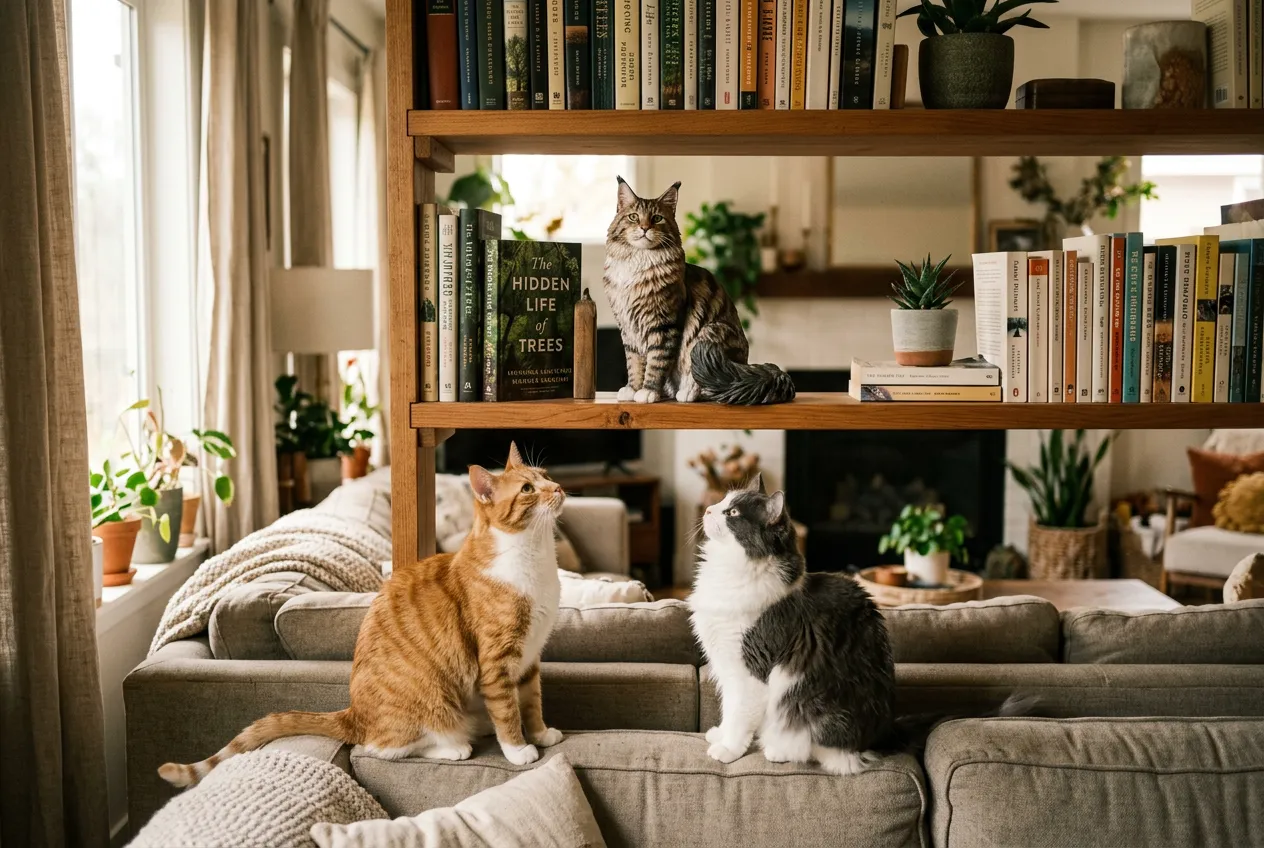
Maine Coons don't just occupy space. They organize it. Their physical enormity—fifteen, eighteen, sometimes twenty-plus pounds of presence—creates gravitational order. The other cats orbit. The feeding schedule, the sleeping arrangements, the invisible pathways through the living room that each cat navigates around the other: all of it bends around the Maine Coon's body and temperament. They tend to be gentle monarchs, rarely aggressive but unquestionably in charge. Their deep, chirping trills set the emotional temperature of the room.
When that presence vanishes, the ecosystem doesn't just lose a member. It loses its architecture.
Claire—one of our customers whose story has stayed with us—described it this way: "The first morning after we lost Goliath, I watched our tabby, Pepper, walk into the kitchen and just... stop. She stood in the middle of the floor like she'd forgotten the route. Goliath always ate first. Pepper always waited by the window. Without him there, she didn't know where she belonged."
That disorientation isn't poetic license. It's behavioral science. And it's the part of multi-cat household pet loss that almost nobody talks about with the specificity it deserves.
"Grief doesn't just empty a room. It rearranges the furniture."
The Hierarchy Collapse: What Actually Happens When the Alpha Cat Dies
Most pet loss resources treat a multi-pet home as a collection of individuals who each grieve separately. That framing misses the point entirely. A multi-cat household is a social system, and the death of a dominant cat triggers what feline behaviorists describe as a status vacuum—a period of social instability that can last anywhere from a few days to several months.
Here's what makes Maine Coon death and other cats grieving particularly complex: Maine Coons often serve as what researchers call the "parental" cat, a role that combines social dominance with emotional regulation. They break up conflicts. They initiate group resting. They set the pace. Unlike more aggressive alpha cats, Maine Coons typically maintain order through sheer calm presence rather than intimidation.
When that calming force disappears, the remaining cats don't simply feel sad. They feel unsafe.
The Three Phases of Feline Hierarchy Restructuring
Understanding these phases helps you anticipate your cats' needs—and your own emotional reactions to their behavior.
| Phase | Timeframe | Cat Behavior | What It Looks Like |
|---|---|---|---|
| Searching | Days 1–7 | Vocalizing, pacing, checking the deceased cat's favorite spots | Increased meowing, especially at night; sitting near doors or windows |
| Testing | Weeks 2–5 | Resource competition, minor scuffles, claiming new territory | Cats eating from the deceased's bowl, sleeping in their spot, occasional hissing |
| Settlement | Weeks 6–12+ | New hierarchy emerges, routines stabilize | One cat assumes a more central role; others adjust patterns |
The searching phase is the one that guts you. Watching your surviving cats wander to the Maine Coon's favorite perch, sniff the air, and walk away—there's a particular shade of sorrow in that. It mirrors your own impulse to glance toward their spot on the couch, to listen for the heavy thud of their jump from the counter.
But the testing phase? That's where it gets emotionally complicated for you.
When Your Cats' "Moving On" Feels Like Betrayal
Here's the counterintuitive truth that no one prepares you for: watching your other cats claim the deceased cat's territory can feel like a personal offense.
When Pepper started sleeping on Goliath's heated bed within ten days of his passing, Claire told us she felt a flash of genuine anger. Not at Pepper—she knew the cat was just being a cat. But at the universe. At the casual way life fills a vacuum. "It felt like the house was erasing him," she said. "And my own cats were helping."
This reaction is startlingly common, and it deserves more attention than the tidy "animals grieve differently" platitudes that most guides offer. What's actually happening is a collision between two legitimate realities: your cats are doing exactly what healthy, adaptive animals should do (reorganizing for survival), and you are watching the physical evidence of your loved one's existence get overwritten in real time.
Both things are true. Both things hurt.
The ASPCA's guidelines on pet grief in multi-animal households acknowledge that surviving pets may show behavioral changes, but they tend to focus on the animal's experience. What's less discussed is how the animal's adaptation becomes a secondary grief trigger for the human.
You're not just mourning your Maine Coon. You're mourning the configuration of your home—the specific choreography of bodies and personalities that made your household feel like itself.
The Emotions Nobody Warns You About in a Multi-Cat Loss
Losing a cat in a multi-pet home generates a specific emotional profile that differs from losing an only pet. The presence of surviving animals creates a strange duality: you are simultaneously grieving and caregiving, broken open and forced to function. The remaining cats still need feeding at 6 AM. They still deposit hairballs on the bathroom rug. Life insists on continuing, and it uses your other cats as the vehicle for that insistence.
This duality breeds emotions that feel contradictory—and that contradiction breeds shame.
The Relief You Didn't Ask to Feel
Let's name it directly, because too few resources do: if your Maine Coon's final months involved chronic illness, declining mobility, or escalating veterinary interventions, you may have felt a wave of relief when they passed. And that relief may have arrived tangled with something even harder to admit—a sense of logistical ease. One less medication schedule. One less litter box to monitor. One less body to lift onto the bed at night.
That wave of relief you felt when their suffering ended? It doesn't make you a bad person. It makes you someone who loved them enough to carry an unsustainable weight for as long as you did, and whose body finally set it down. The guilt that follows that relief is one of grief's cruelest tricks—it takes your exhaustion and reframes it as evidence of insufficient love.
It isn't. Your exhaustion was proof of your love. The relief is your nervous system acknowledging what your heart won't yet accept: that the hardest part of caregiving is over.
Second-Guessing the Timing
If euthanasia was part of your Maine Coon's passing, the question will find you. Usually at 2 AM. Usually with excruciating specificity: Was it too soon? Could we have tried one more treatment? Did she still have good days left?
Or the opposite: Did we wait too long? Were those last three weeks for us or for her?
Both versions of this question are normal. Both are unanswerable in any satisfying way. And both are made more acute in a multi-cat home, because you watched your other cats interact with the declining Maine Coon in those final weeks. You saw them groom her. You saw them give her space. You may have noticed the moment they started treating her differently—approaching more cautiously, sniffing longer—and wondered if they knew something you were still trying to deny.
The truth is, they probably did. Cats are remarkably attuned to physiological changes in their companions. But that doesn't mean they were ready either, and it certainly doesn't mean your timing was wrong.
The Fear of Forgetting
This one operates differently in a multi-cat home, and it's rarely acknowledged. With an only pet, the fear of forgetting is straightforward—you worry that time will erode the details. But when you still have cats, the fear takes a more specific shape: you worry that the living will overwrite the dead.
New funny moments with your surviving cats feel like they're competing for the same emotional real estate. You laugh at the tabby's antics and then feel a stab of disloyalty, as though your capacity for joy with these cats somehow diminishes your grief for the one you lost.
It doesn't. The heart is not a zero-sum territory. But the feeling is real, and it deserves to be spoken aloud rather than carried silently.
"Love is not a limited resource. Grieving one cat while laughing at another isn't betrayal—it's range."
Practical Steps for Supporting Your Remaining Cats During the Transition
Now let's move from the interior landscape to the actionable. Your surviving cats need specific support during the hierarchy restructuring, and the timing of your interventions matters more than most guides acknowledge.
The First 48 Hours: Preserve, Don't Purge
Do not immediately remove the deceased cat's belongings. This is perhaps the most important practical advice in this entire article, and it runs counter to the human instinct to "clean up" and create a fresh start.
Your surviving cats are using scent to process the absence. The Maine Coon's bed, blanket, scratching post, and favorite resting spots all carry olfactory information that the remaining cats need in order to complete their searching phase. Removing these items too quickly can prolong disorientation and anxiety.
A reasonable timeline:
- Days 1–3: Leave everything in place. Let the cats investigate freely.
- Days 4–7: Begin gradually moving items—shift the bed a few feet, relocate the scratching post to a less central spot.
- Weeks 2–3: Remove items one at a time, spaced days apart. Watch for stress responses (excessive grooming, hiding, litter box avoidance).
- Week 4+: Most items can be stored or repurposed. Keep one scent-rich item (an unwashed blanket or bed) available for several more weeks if any cat is still showing stress.
Feeding Rituals in the Aftermath
The Maine Coon likely ate first. That ritual is now disrupted. Here's what actually helps more than free-feeding (which many guides recommend as a stress reducer):
Establish a new, consistent feeding order within the first week. Cats find security in predictability, not in abundance. Choose the cat who is naturally moving toward a more central social role and feed them first—not because you're "appointing" a new alpha, but because you're giving the group a pattern to organize around.
Specific steps:
- Feed at the same times your Maine Coon was fed. The schedule is an anchor.
- Use the same bowls in the same locations initially. Change one variable at a time.
- Watch for resource guarding. If a previously submissive cat begins blocking access to food or water, separate feeding stations by at least six feet.
Environmental Modifications
| Change | Why It Helps | When to Implement |
|---|---|---|
| Add a second water station | Reduces competition during the testing phase | Immediately |
| Open up vertical space (new shelves, cat trees) | Gives cats escape routes during social tension | Within the first week |
| Add a Feliway diffuser near the deceased cat's primary area | Synthetic pheromones reduce anxiety during transition | Days 1–3 |
| Create a new "safe room" for the most anxious cat | Provides a pressure-free zone during hierarchy shifts | If hiding behavior persists beyond day 5 |
| Rotate interactive toys into common areas | Redirects testing-phase tension into play | Weeks 2–4 |
One thing we've noticed working with families navigating a multi-cat household after loss: the cats who struggle most are often not the ones closest to the deceased. It's the middle-ranking cat—the one who was neither dominant nor fully subordinate—who loses the most social certainty. Keep a close eye on that cat. They're the one most likely to act out or withdraw.
"Every household we've worked with tells us the same thing: it's not the empty bed that undoes them. It's the moment they realize the other cats have stopped looking for the one who's gone."
— The PawSculpt Team
The Sacred Geometry of a Multi-Cat Home: Why Space Becomes Spiritual
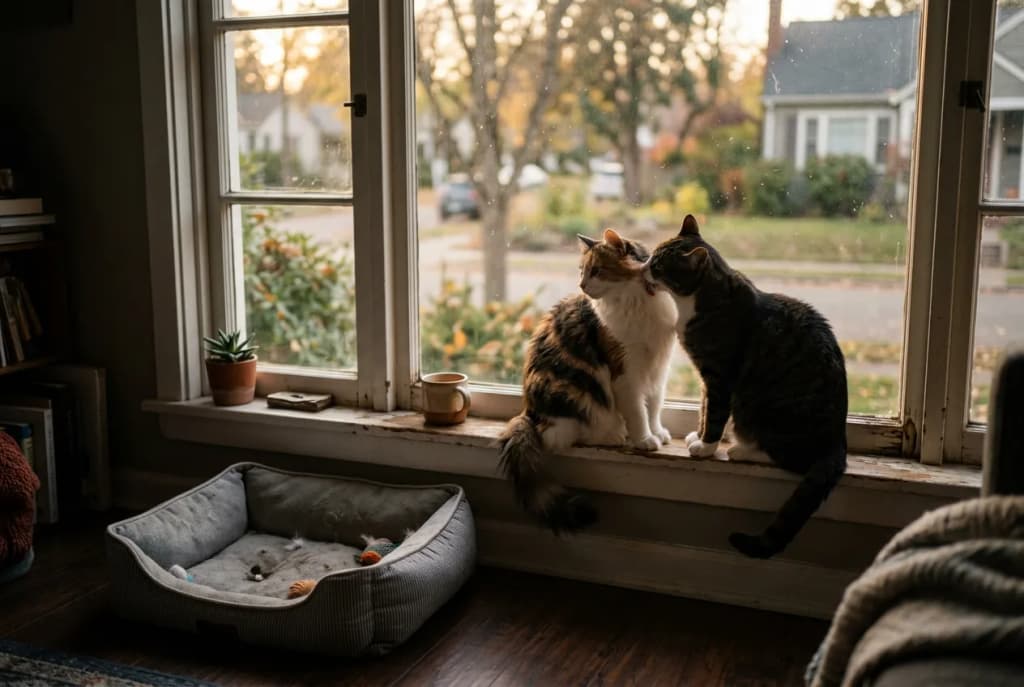
There's something almost liturgical about the way cats divide domestic space. Each cat claims certain rooms, certain patches of sunlight, certain elevations. A windowsill. The third stair from the top. The spot behind the couch where the heating vent exhales warm air in winter. These territories aren't random—they're negotiated over months and years, shaped by personality and hierarchy and the slow accumulation of scent.
When a Maine Coon dies, these sacred spaces become relics. The wide berth other cats once gave the armchair where the Maine Coon sprawled—that invisible boundary dissolves. The spot on the bed that no other cat would claim? Within weeks, someone will be sleeping there.
And here is where the spiritual dimension of multi-cat loss reveals itself: the renegotiation of space is a ritual of release. Whether or not you believe in the persistence of a cat's spirit or energy, the physical reality is that your home is rewriting its memory. New pathways. New hierarchies. New warmth patterns on the couch cushions.
Some pet owners find this unbearable. Others—often after the initial resistance—discover something unexpectedly meaningful in it. Claire told us, months later, that watching Pepper finally settle into Goliath's old spot by the fireplace felt less like erasure and more like inheritance. "It wasn't that Pepper replaced him," she said. "It was like she was carrying his preference forward. Keeping it warm for him."
This is the kind of meaning that lives beneath the surface of grief, available only to those willing to sit with discomfort long enough to see it transform.
Creating Ritual in the Aftermath
Humans have always used ritual to navigate loss. We light candles. We gather. We speak names into the air. But in a multi-cat household, there's an opportunity for a more specific, lived ritual—one that honors the deceased while acknowledging the living.
Some ideas that families we've worked with have found meaningful:
- A daily "Goliath minute": One family set a timer each evening, sat on the floor with their surviving cats, and simply said the deceased cat's name aloud. The cats, drawn by the stillness and the familiar word, would gather. It became a nightly ritual of collective pause.
- A memorial feeding: On the anniversary of the loss, prepare a special meal for the surviving cats using the deceased cat's bowl. It sounds simple. It carries weight.
- A dedicated space: Rather than letting the Maine Coon's favorite spot be fully absorbed, some families place a small memorial there—a photo, a candle, a custom 3D-printed figurine that captures the cat's exact markings and posture. The surviving cats can still access the area, but the human has marked it as sacred ground.
That last option, in particular, resonates with something deep in the human psyche. We are a species that builds shrines. From the ancient Egyptians who mummified their cats alongside gold amulets to the Victorian mourning brooches woven with pet hair, we have always felt the need to make grief tangible. To give it weight and form and a place on the mantle where the afternoon light can catch it.
A figurine—especially one rendered with precision, where the specific amber of your Maine Coon's eyes and the silver-tipped guard hairs along their ruff are reproduced in full-color resin, voxel by voxel—becomes more than décor. It becomes an anchor. A fixed point in a home that is otherwise rearranging itself around an absence.
When Should You Worry? Grief vs. Behavioral Crisis in Surviving Cats
Not all post-loss behavior in your remaining cats is normal grief. Some of it signals a genuine behavioral crisis that may require professional intervention. The challenge is knowing the difference—and most online guides are frustratingly vague about the line.
Here's a more specific framework:
Normal Grief Behaviors (Monitor But Don't Panic)
- Reduced appetite lasting up to 5–7 days
- Increased vocalization, especially at dawn and dusk (when the deceased cat was most active)
- Seeking out the deceased cat's belongings and spending time near them
- Temporary clinginess with human family members
- Brief, mild aggression between surviving cats during the testing phase (hissing, swatting without contact)
Red Flags (Contact Your Vet)
- Complete food refusal beyond 48 hours (hepatic lipidosis is a serious risk in cats who stop eating)
- Litter box avoidance that persists beyond one week
- Self-harm behaviors like excessive grooming leading to bald patches or skin lesions
- Sustained aggression with physical contact (biting, clawing, drawing blood)
- Total withdrawal—a cat who hides for days and resists all interaction
The red flags are particularly important in multi-cat homes because the social stress of hierarchy restructuring compounds the grief response. A cat who might have bounced back from the loss in a single-cat home can spiral in a multi-cat home because they're processing two disruptions simultaneously: the absence of the deceased and the instability of the new social order.
We're not veterinarians, and we always encourage families to consult with their vet or a certified animal behaviorist if anything feels off. But we've heard from enough customers to know that the "wait and see" approach has a shelf life. If your gut says something is wrong with one of your cats at the two-week mark, trust that instinct.
The Question You're Afraid to Ask: When Is It Okay to Get Another Cat?
This question carries enormous emotional freight in a multi-cat home, and it's loaded differently than in a single-cat home. Because here, it's not just about your readiness. It's about the readiness of your surviving cats—who are still mid-restructuring, still finding their new normal.
The counterintuitive insight: bringing a new cat into the home too early doesn't just risk your emotional wellbeing. It can actually destabilize the hierarchy settlement that your surviving cats are working through, resetting the social clock to zero.
Most feline behaviorists suggest waiting until the surviving cats have fully settled into their new dynamic—typically a minimum of 3 months, and ideally closer to 6. Introducing a new cat during the testing phase forces your surviving cats to negotiate two social disruptions at once: integrating the newcomer while still figuring out their own post-loss roles.
But there's a second layer here, and it's the one that keeps people up at night: the guilt about wanting another cat. As though desire for a new companion somehow retroactively diminishes the bond with the one you lost. As though love requires an exclusivity clause.
It doesn't. A new cat is not a replacement. It's a new relationship. The Maine Coon you lost is not diminished by the kitten you might someday bring home. These are parallel stories, not competing ones.
Claire waited eight months. When she eventually adopted a young ginger cat named Roux, she worried that it would feel like closing a chapter on Goliath. Instead, she said, it felt like opening a window in a room that had been sealed too long. The air moved differently. Pepper, now the senior cat and the settled matriarch, regarded Roux with the same tolerant, measured calm that Goliath had once shown her.
Some patterns, it turns out, are inherited.
Anchoring Memory: Why Physical Memorials Matter More Than You Think
Grief, left entirely internal, tends to become diffuse—a fog that settles over everything without belonging to anything specific. This is why humans across every culture and century have built physical markers for their dead. We need grief to land somewhere.
In a multi-cat home, this need is amplified by a specific anxiety: the fear that the ongoing life of your household—the feeding, the playing, the new hierarchies—will gradually crowd out the memory of the cat you lost. The surviving cats won't talk about Goliath at dinner. They won't pull out photo albums. The biological machinery of their lives will keep turning, and your Maine Coon will become a gap in the pattern rather than a presence.
Physical memorials resist that erosion. A framed photo. A paw print casting. A garden stone. Each gives memory a postal address—a specific location where grief can visit.
Among the options, three-dimensional keepsakes hold a particular power. There's a difference between looking at a photograph—a flat, frozen moment—and holding a form. A museum-quality custom figurine captures something a photo cannot: the volume of your cat. The way they occupied space. The specific curve of a Maine Coon's massive plumed tail, the tufted ears, the broad chest that made them look like a small, benevolent lion. When that form is digitally sculpted by artists who study your photos with obsessive care and then precision-printed in full-color resin—the color embedded in the material itself, not painted on—you get something that feels less like a product and more like a relic. Something sacred.
We've seen families place these figurines on the mantle, on the windowsill where their Maine Coon used to watch birds, on the nightstand where they can reach out in the dark and touch something solid. The clear-coat finish catches lamplight, and for a moment—just a fraction of a breath—the room remembers its old geometry.
That's not commerce. That's care crystallized into form.
The Long View: What Your Multi-Cat Home Looks Like Six Months Later
We want to be honest about timelines, because the internet tends to either rush grief ("you'll feel better soon!") or romanticize its permanence ("you'll never stop hurting"). Both framings fail the actual experience.
Here's what we've observed across hundreds of conversations with families who've lost a cat in a multi-pet home:
At one month: The searching phase is over. The testing phase is well underway. You may notice surprising behavioral shifts—a previously shy cat becoming more social, an independent cat suddenly seeking lap time. These aren't anomalies. They're the personality expansions that happen when social pressure changes. Your cats are showing you sides of themselves that the previous hierarchy suppressed.
At three months: A new normal is recognizable but fragile. The surviving cats have generally settled into new roles, though occasional flare-ups of testing behavior may resurface, especially around resource-rich areas (food, prime sleeping spots, your lap). You, the human, may be experiencing a strange form of delayed grief—the adrenaline of managing the transition has faded, and the raw loss arrives fresh, as though it just happened.
At six months: The household has stabilized. But "stable" doesn't mean "healed." You'll still hear a thud from the other room and think, for one electric second, that it's your Maine Coon jumping off the counter. The absence has stopped being an emergency and become a texture—a permanent change in the weave of daily life.
At one year: You can talk about them without crying every time. You can look at photos and feel warmth alongside the ache. The surviving cats have fully integrated their new hierarchy, and you've stopped comparing every group dynamic to the way things were. But some mornings—usually the golden ones, when the light slants in at exactly the angle your Maine Coon used to bathe in—you'll feel it all again. Sharp and clean and strangely welcome.
This is not failure. This is fidelity. It means the bond was real enough to leave a permanent impression, and your heart is healthy enough to keep feeling it.
"The mark of a great love isn't that the grief disappears. It's that the grief becomes a place you know how to visit."
A Word About the Ones Still Here
In all of this—the mourning, the remembering, the slow work of honoring what was lost—don't forget to look down. Your surviving cats are still here, padding across the same floors, purring against the same ribcage. They weathered the loss too. They restructured their world, adapted their routes, adjusted their expectations.
They deserve to be celebrated in the present tense—not as consolation prizes for the cat you lost, but as their own complete stories, still being written.
Claire told us something we think about often. She said that Goliath taught her how to love a cat—how to be patient with a giant, gentle creature who knocked over every glass on every table. But it was Pepper, in the aftermath, who taught her how to keep loving after loss. How to stay open. How to let the warmth back in.
Both lessons matter. Both cats mattered.
And the figurine of Goliath on her mantle—amber eyes catching the firelight, silver-tipped ruff rendered in full-color resin so precise it almost breathes—doesn't compete with the living cat on her lap. It completes the room.
That's the thing about losing a cat in a multi-cat home. The love doesn't divide. It layers. And every layer—present and past, living and remembered—is part of the same story.
Somewhere in your attic, in a box you haven't opened yet, there's a chewed orange mouse that still carries the scent of everything you're afraid to forget. You won't forget. The ones we love leave marks deeper than memory. They leave us changed, and the shape of that change is the memorial—the most permanent one of all.
Frequently Asked Questions
How long do cats grieve when another cat in the household dies?
Cats typically display grief behaviors—reduced appetite, increased vocalization, searching behavior, and changes in sleep patterns—for anywhere from 2 to 6 months. The most acute signs usually appear in the first 2–4 weeks. However, some cats show subtle behavioral shifts that persist much longer, especially in multi-cat homes where hierarchy restructuring adds social stress to the grief process.
Is it normal to feel guilty after losing a cat in a multi-pet home?
Absolutely. Guilt is one of the most common and least discussed emotions in pet loss. You might feel guilty about the timing of euthanasia, guilty about feeling relief after a long illness, or guilty that your surviving cats seem to be adapting while you're still struggling. All of these responses are normal and reflect the depth of your bond, not any failure in your love.
Should I remove my deceased cat's belongings right away?
No—and this is one of the most important pieces of advice for multi-cat households. Your surviving cats use scent to process the absence, so leave belongings in place for at least the first week. Gradually relocate and remove items over the following 2–3 weeks, watching for stress signals in your other cats. Rushing this process can prolong anxiety and searching behavior.
How long should I wait before getting a new cat after one dies in a multi-cat home?
Most feline behaviorists recommend waiting a minimum of 3 months, ideally 6, before introducing a new cat. This allows your surviving cats to fully settle into their new social hierarchy. Introducing a new cat during the active restructuring phase forces your existing cats to manage two social disruptions simultaneously, which can lead to prolonged stress and behavioral problems.
Do cats know when another cat in the house has died?
Yes, in their own way. Cats are highly attuned to the physiological and behavioral changes that accompany illness and decline. After a companion dies, surviving cats often exhibit searching behavior—checking the deceased cat's favorite spots, vocalizing more frequently, and sniffing areas where the other cat spent time. This indicates a clear awareness of the absence, even if their understanding of death differs from ours.
How do I help my remaining cats adjust after losing the dominant cat?
Maintain existing routines—especially feeding times and locations—as much as possible. Add extra resources (water stations, litter boxes, vertical space) to reduce competition during the hierarchy testing phase. Preserve the deceased cat's scent items temporarily. Avoid forcing interaction between surviving cats; let them renegotiate at their own pace. If any cat shows red-flag behaviors like total food refusal or self-harm, consult your veterinarian promptly.
Ready to Honor Your Maine Coon's Legacy?
Some bonds reshape us permanently—and the bond with a cat who organized your entire household is one of them. Whether you're navigating the raw early days of a multi-cat household pet loss or you're further along and ready to anchor their memory in something you can hold, a custom PawSculpt figurine captures the presence that made your Maine Coon irreplaceable—every tufted ear, every silver-tipped hair, every ounce of quiet authority.
Visit pawsculpt.com to explore the process, see examples, and learn how our team brings your pet's likeness to life in full-color resin