
You Chose Mercy: Finding Peace After Euthanasia for Your Aging German Shepherd
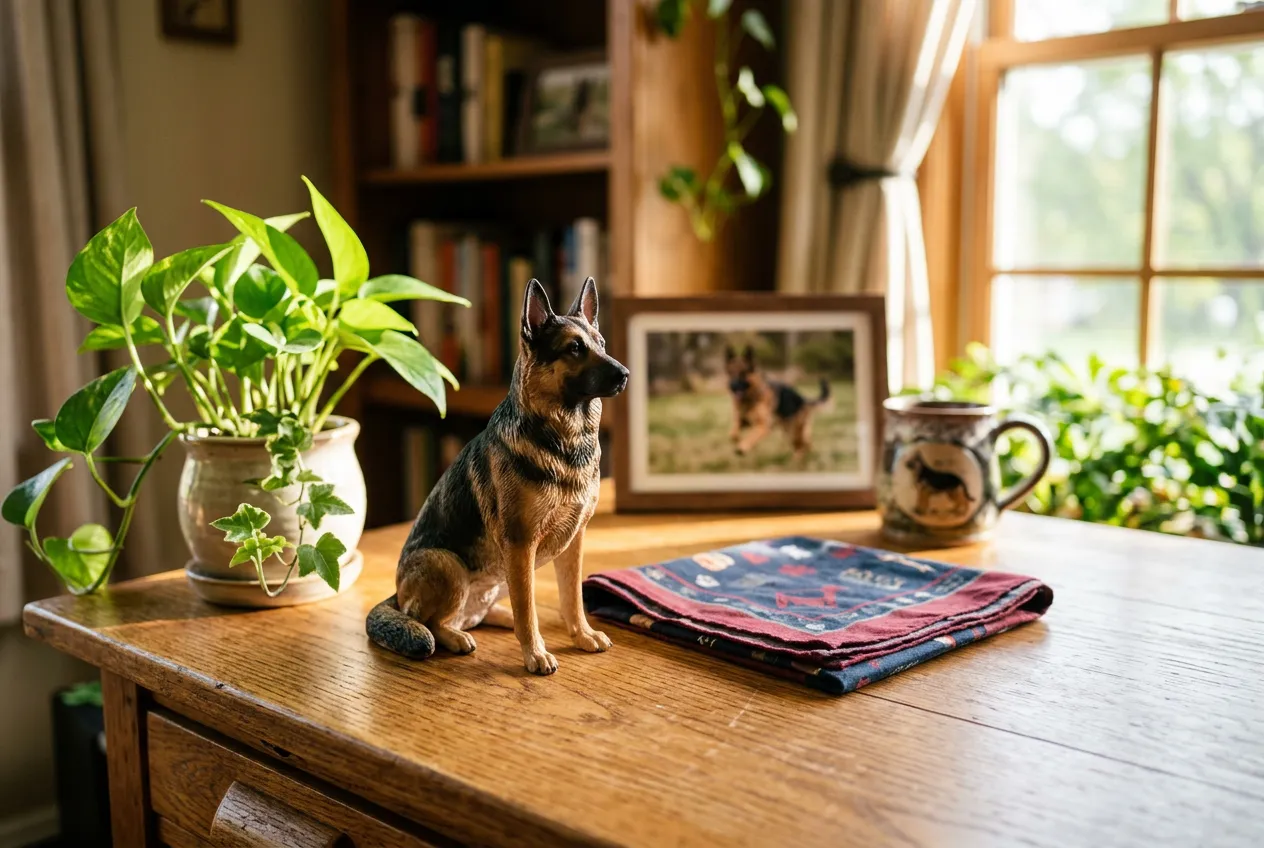
The backyard grass still holds the shape of her—a flattened oval near the fence where your German Shepherd spent every afternoon pressing her warm belly into the cool earth. You run your fingers across that patch and the blades feel different there, softer somehow, worn smooth by seventy pounds of loyalty. And now you're carrying the weight of german shepherd euthanasia guilt like a stone in your chest, wondering if mercy was supposed to hurt this much.
Quick Takeaways
- Relief after euthanasia doesn't mean you loved them less — it means you prioritized their comfort over your own pain
- The first 72 hours are about logistics, not healing — handle the practical tasks now, grieve on your own timeline
- Guilt is grief wearing a disguise — most owners who second-guess the timing actually waited exactly long enough
- Physical anchors help more than abstract coping — tangible memorials like custom pet figurines from PawSculpt give grief something to hold onto
- Your other pets are grieving too — watch for behavioral shifts in the first two weeks and adjust routines accordingly
Why German Shepherd Euthanasia Guilt Hits Different
Here's something nobody talks about in those generic "coping with pet loss" articles: German Shepherd owners carry a specific, breed-shaped grief that doesn't map neatly onto the usual advice.
Think about it. You didn't just lose a pet. You lost a partner. German Shepherds don't love casually. They assign themselves a job—protecting you, reading your moods, positioning themselves between you and the front door—and they perform that job with an intensity that borders on sacred. So when you made the decision to let them go, it didn't feel like "putting a pet down." It felt like betraying your bodyguard. Your shadow. The one creature on earth who took your safety personally.
That's why the guilt lands harder. The bond with a German Shepherd is operational, not just emotional. They were your co-pilot, and you made a unilateral decision about the flight.
And there's a physical dimension too. German Shepherds are big dogs. The absence of a big dog is loud. You feel it in the empty space beside the bed, the leash that's suddenly too light in your hand, the way the house sounds wrong without the click-click-click of nails on hardwood. A Chihuahua's absence is a whisper. A German Shepherd's absence is a shout.
None of this makes your grief more valid than anyone else's. But it does make it specific. And specific grief needs specific understanding—not a pamphlet.
The Counterintuitive Truth About "Too Soon" vs. "Too Late"
Most owners who agonize over timing—Did I wait too long? Did I do it too soon?—are actually asking the wrong question entirely. The real question isn't about timing. It's about control.
We can't control degenerative myelopathy. We can't control hip dysplasia. We can't control the moment a thirteen-year-old Shepherd's back legs simply stop answering the phone. The only thing we can control is the ending. And that tiny sliver of agency in an otherwise helpless situation? It becomes the thing we obsess over, because it's the only variable we had any say in.
Here's what veterinary professionals consistently observe (and what the American Veterinary Medical Association confirms in their end-of-life guidance): owners almost never choose too early. The far more common pattern is waiting slightly too long—not out of selfishness, but out of love. Out of hope. Out of the desperate wish that tomorrow might be a good day.
So if you're reading this and wondering whether you pulled the trigger too soon: you probably didn't. You probably gave them every possible good day and then one more.
"You didn't end their life. You ended their suffering. Those are two very different things."

The Emotions Nobody Warns You About After Putting Your Dog Down
Sadness? Sure, everyone expects that. But the emotional landscape after euthanasia is way more complex and way more uncomfortable than simple sadness. Let's get honest about what's actually happening in your head right now.
Relief (And the Guilt That Stalks It)
That exhale you felt when it was over—when the vet said "she's gone" and your first thought wasn't sorrow but thank God she's not hurting anymore—that moment is haunting you now, isn't it?
Relief after euthanasia is not a character flaw. It's a biological response to the end of sustained emotional crisis. You've been in caretaking mode for weeks, maybe months. Monitoring her breathing. Carrying her outside because her legs gave out. Sleeping on the floor beside her because you were afraid she'd try to stand alone at 3 a.m. Your nervous system has been running a marathon, and when it stopped, your body did what bodies do: it exhaled.
The guilt that follows that relief is one of grief's cruelest tricks. It whispers, If you really loved her, you wouldn't feel relieved. But the opposite is true. You feel relieved because you loved her. You couldn't bear watching her suffer. That's not weakness. That's the whole point.
Anger You Can't Aim
Some mornings you'll wake up furious and not know who to be mad at. The vet? They were gentle. Yourself? You did your best. God? The universe? The breed's genetic predisposition to degenerative conditions?
Anger after pet loss is normal, and it's made worse by the fact that there's no villain. There's nobody to blame. Nobody did anything wrong. And anger without a target just ricochets around inside you, looking for something to hit. Sometimes it hits your partner. Sometimes it hits the remaining pets. Sometimes it hits a stranger who makes an innocent comment about dogs.
Name it when it shows up. Say it out loud: "I'm angry and I don't know where to put it." That sentence alone takes some of the charge out of it.
The Isolation of "It Was Just a Dog"
You know who said that? Your coworker. Your brother-in-law. Maybe even your own internal voice, trying to rationalize why you're this wrecked over an animal.
Feeling judged for the intensity of your grief is one of the most isolating experiences in pet loss. And German Shepherd owners get a double dose of it, because people assume that since the dog was "tough," you should be too. As if the breed's stoicism was contagious.
Here's what you need to hear: the people who say "it was just a dog" have either never loved one or have forgotten what it felt like. Either way, their opinion is irrelevant to your experience. You are not overreacting. You are reacting exactly as much as the love warrants.
| Emotion | What It Feels Like | Why It's Normal | What Helps |
|---|---|---|---|
| Relief | Exhaling after months of vigilance | Your nervous system is exiting crisis mode | Say "I'm relieved she's not in pain" without adding "but" |
| Anger | Rage with no clear target | Loss without a villain creates directionless fury | Physical activity—walk the route you walked with her |
| Guilt | Replaying the decision on loop | You're searching for control in a helpless situation | Write down the reasons you chose mercy; read them when guilt spikes |
| Isolation | Feeling like nobody understands | Society undervalues pet grief | Seek out pet loss communities (online or local) |
| Fear of forgetting | Panic that details are already fading | Memory naturally softens over time | Collect sensory anchors—her collar, a paw print, a figurine |
Finding Peace After Putting Your Dog Down: A Practical Framework
Okay. Let's shift from the emotional terrain to the tactical. Because honestly, in the first few weeks after euthanasia, your brain isn't great at abstract coping strategies. It needs tasks. Structure. Things to do with your hands.
Here's a framework that actually works—not because it erases the pain, but because it gives the pain somewhere to live that isn't the center of your chest.
Phase 1: The First 72 Hours (Logistics, Not Healing)
Don't try to heal right now. Seriously. The first three days are about getting through, not getting over. Here's what to handle:
- Decide about remains immediately. If you chose cremation, confirm the details with your vet's office. If you want a private cremation (ashes returned to you), say so explicitly—some clinics default to communal cremation unless you specify.
- Put away triggers selectively. The food bowl, the medications, the pill pockets—put those away. But leave the bed. Leave the blanket. Removing everything at once creates a void that's harder to sit with than the objects themselves.
- Tell people on your own terms. You don't owe anyone a phone call. A text is fine. A social media post is fine. Silence is fine. But do tell at least one person, because carrying it alone makes it heavier.
- Cancel recurring orders. The auto-ship kibble delivery. The flea medication subscription. The daycare reservation. These small administrative tasks feel brutal, but getting a surprise bag of dog food on your porch two weeks from now feels worse.
Phase 2: Weeks 1-3 (The Habit Void)
This is where it gets weird. Your body still runs on the old schedule. You'll reach for the leash at 6 a.m. You'll listen for the jingle of tags. You'll save a scrap from dinner before remembering there's nobody to give it to.
The habit void is the most underestimated phase of pet grief. It's not the big moments that break you—it's the micro-routines. The muscle memory.
What helps:
- Don't fill the void immediately. Resist the urge to adopt another dog in the first month. (More on this below.)
- Redirect the routine. If you walked her every morning at 7, still go outside at 7. Walk the same route if you can stand it. Your body needs the movement, and the route will feel different over time—less painful, more memorial.
- Create a physical anchor. This is where tangible objects matter more than people realize. A paw print casting. Her collar mounted in a shadow box. A custom 3D-printed figurine that captures her exact coloring and stance. Something you can touch. Grief lives in the body, and the body needs something to hold.
"We've noticed that families who create something tangible—something they can pick up and hold—tend to move through grief differently. Not faster. But with more steadiness."
— The PawSculpt Team
Phase 3: Months 1-3 (Integration)
This is the long middle. The acute pain dulls into something more like weather—some days are clear, some days storm in without warning. A song. A dog that looks like her at the park. The sound of a German Shepherd bark from across the street.
Your goal in this phase isn't to "get over it." It's to integrate the loss into your life without letting it consume your identity.
Practical moves:
- Start a memory document. Open a note on your phone and write down every specific thing you remember. The way she tilted her head when confused. The specific pitch of her bark when the mail came. The texture of her ears—velvet on the inside, coarse on the outside. You think you'll remember everything. You won't. Write it down now while the details are sharp.
- Talk to your vet. Seriously. Call the clinic and ask if they have grief resources or can recommend a pet loss support group. The Association for Pet Loss and Bereavement maintains a directory of support options, and many are free.
- Evaluate your other pets. If you have other animals in the home, they've noticed. Dogs especially may show changes in appetite, energy, or sleeping patterns for 2-6 weeks after a companion animal dies. Monitor, but don't project your grief onto them.
| Phase | Timeline | Primary Challenge | One Concrete Action |
|---|---|---|---|
| Immediate | Days 1-3 | Shock and logistics | Handle cremation/burial arrangements; put away medications |
| Habit Void | Weeks 1-3 | Muscle memory and micro-routines | Keep the walking schedule but redirect the energy |
| Integration | Months 1-3 | Waves of grief triggered by random cues | Create a detailed memory document while recall is fresh |
| Rebuilding | Months 3-6+ | Redefining daily life without them | Consider whether/when to open your home to another pet |
Myth vs. Reality: What People Get Wrong About Coping After Euthanasia
Myth #1: "You'll know when it's time."
Reality: Almost nobody "just knows." What actually happens is a slow accumulation of bad days outweighing good ones, a growing dread in your stomach, and a conversation with your vet where they gently confirm what you've been afraid to say out loud. The certainty people talk about? It usually arrives after the decision, not before. And sometimes it never arrives at all—you just act on the best information you have and live with the ambiguity.
Myth #2: "Getting another dog will help you heal."
Reality: Getting another dog before you've processed the loss doesn't heal the wound—it covers it with a bandage. The new dog deserves to be welcomed as their own being, not as a replacement or a coping mechanism. Most grief counselors and veterinary behaviorists suggest waiting at least 3-6 months before bringing a new animal home. And here's the part nobody mentions: some people feel intense guilt about even considering a new dog, as if wanting another companion is a betrayal. It's not. But the timing matters.
Myth #3: "Grief has stages and you'll move through them in order."
Reality: The Kübler-Ross model was never designed for pet loss (it was originally about terminal diagnosis, not bereavement). Grief doesn't move in a line. It moves in circles, spirals, and ambushes. You'll feel fine on a Tuesday and shattered on a Wednesday for no discernible reason. The only "stage" that's reliably sequential is the first one: shock. Everything after that is a weather system, not a staircase.
The Fear of Forgetting (And What to Do About It)
This one deserves its own section because it's the emotion that sneaks up on you at month two or three, and it's terrifying.
You're going about your day and suddenly you realize you can't remember which ear she tilted when she was curious. Was it the left? The right? And that tiny gap in your memory sends you into a spiral, because if you're already forgetting the ears, what's next? Her bark? The weight of her head on your lap? The specific roughness of her paw pads against your palm?
The fear of forgetting is really a fear of the love disappearing. And it won't. But memory does soften over time—that's not a flaw, it's a feature. It's what allows you to eventually remember without doubling over.
But you can take concrete steps to preserve the details:
- Record a voice memo describing her. Not a eulogy. Just talk. Describe her like you're telling a stranger what she looked like, sounded like, felt like. The texture of her coat—that dense double layer that shed everywhere, the coarser outer guard hairs and the impossibly soft undercoat beneath. The warmth of her body pressed against your leg. Get granular.
- Save the vet records. Her weight at every visit. The notes about her personality. ("Patient is alert, friendly, attempts to herd staff.") These clinical details become precious later.
- Gather your best photos and do something with them. Not just a folder on your phone—something physical. A printed photo book. A canvas print. Or a memorial pet figurine that translates her likeness into something three-dimensional, something with weight and texture you can actually hold. PawSculpt's process uses full-color 3D printing technology—digital sculptors model your pet's exact features, and the figurine is printed in full-color resin where the color is embedded directly into the material, not applied on top. The result has a warmth and authenticity to it, a subtle grain that feels more real than a glossy photograph ever could.
"Memory fades. Love doesn't. Build the bridge between them."
The point isn't to freeze time. It's to create anchors—physical, tangible objects that your future self can pick up and immediately be transported back to the feeling of her. Because the feeling is what matters. Not the perfect recall of which ear tilted which way.
Coping After the Euthanasia Decision: What Actually Works (And What Doesn't)
Let's be blunt about some common advice that sounds good but doesn't actually help, and what to do instead.
What Doesn't Work
- "Stay busy." Distraction isn't processing. You can stay busy for six months and then fall apart at a dog food commercial. Busyness delays grief; it doesn't diminish it.
- "They're in a better place." Maybe. But you're not. And right now, your pain is the thing that needs attending to. Spiritual comfort has its place, but it shouldn't be used to skip over the messy human part.
- "At least they had a good life." True, and also completely unhelpful when you're sobbing into their blanket at 2 a.m. Gratitude and grief can coexist, but one doesn't cancel the other.
What Actually Works
- Structured journaling (not free-writing). Give yourself a prompt: "The funniest thing she ever did was..." or "The moment I knew she trusted me was..." Free-writing can spiral. Prompts keep you in the story, not the sorrow.
- Physical contact with something textured. This sounds strange, but grief counselors who specialize in pet loss consistently note that tactile grounding helps. Hold her collar. Run your thumb over the worn leather. Press a blanket to your face and breathe. Touch is the sense most directly linked to emotional memory, and engaging it deliberately can move grief through the body instead of trapping it in the mind.
- Talking to her. Out loud. In the backyard. At her spot by the fence. You're not losing it. You're maintaining a connection while your brain catches up to the reality. Talk to her for as long as it helps.
- Setting a "grief appointment." This is a technique borrowed from cognitive behavioral therapy: instead of letting grief ambush you all day, designate 15-20 minutes where you sit with it intentionally. Look at photos. Cry if you need to. Then close the album and return to your day. You're not suppressing grief—you're containing it so it doesn't flood everything.
| Strategy | Why It Works | How to Start |
|---|---|---|
| Prompted journaling | Keeps you in specific memories, not abstract pain | Write one prompt per day for 10 days |
| Tactile grounding | Engages the body's memory system directly | Hold a personal object of hers for 5 minutes, focusing on texture |
| Speaking to her | Maintains connection during the adjustment period | Go to her favorite spot; talk like she's there |
| Grief appointments | Prevents emotional flooding while honoring the pain | Set a daily 15-minute window; use a timer |
| Physical memorial creation | Gives grief a permanent, tangible home | Choose one project: shadow box, figurine, garden stone |
When Your Remaining Pets Grieve Too
If you have other dogs—or even cats—in the household, you've probably noticed something's off. Maybe your other dog is searching the house. Maybe they're sleeping in her spot. Maybe they've stopped eating as enthusiastically.
Animals grieve. Not abstractly, but behaviorally. They notice the absence of a pack member, and they respond to the shift in household energy—including your grief, which they can smell and sense with an accuracy that borders on unsettling.
What to watch for in the first 2-4 weeks:
- Changes in appetite (eating less or more)
- Increased vocalization (whining, barking at nothing)
- Searching behavior (checking her usual spots, sniffing her bed)
- Clinginess or withdrawal (both are normal responses)
- Sleep pattern changes
What to do:
- Maintain their routine ruthlessly. Same feeding times. Same walk schedule. Same bedtime. Predictability is comfort for animals in upheaval.
- Don't remove her scent too quickly. Leave her bed out for a week or two. The remaining pets may find comfort in it, and removing it abruptly can increase their anxiety.
- Give extra contact but don't smother. Follow their lead. If they want to be close, let them. If they want space, respect it.
If behavioral changes persist beyond 4-6 weeks or include refusal to eat, lethargy, or aggression, consult your veterinarian. Prolonged grief responses in animals sometimes indicate an underlying health issue that was masked by the household dynamics.
The Question That Haunts Every Owner: "Did I Wait Too Long?"
Let's sit with this one, because it's the question that wakes you up at 3 a.m.
You're replaying her last weeks. That day she fell on the stairs. The morning she couldn't stand up without help. The afternoon you found her lying in her own urine, looking at you with those eyes—not accusing, never accusing, but asking. And you wonder: did I make her suffer an extra week because I wasn't ready?
Here's what we know from working with thousands of families navigating this exact moment: the fact that you're asking this question is evidence that you didn't wait too long. The owners who truly wait too long aren't the ones agonizing over it afterward. They're the ones who never agonize at all.
You were watching. You were paying attention. You were consulting with your vet, tracking good days versus bad days, probably using some version of a quality-of-life scale even if you didn't call it that. And when the balance tipped, you acted. Maybe not the exact day it tipped—maybe a day or two later, because you needed to be sure, because you needed one more morning with her, because you're human.
That's not cruelty. That's love negotiating with loss in real time.
And if you did wait a little longer than ideal? Forgive yourself the way she would have. Instantly. Without conditions. Without a second thought. She never held a single thing against you in her entire life. She's not about to start now.
Rebuilding: What Life Looks Like on the Other Side
There's a version of your future where you can say her name and smile before you cry. Where you can look at her photo and feel warmth before you feel the ache. Where the backyard patch of flattened grass has grown back, and you can stand on it and feel grateful instead of gutted.
That version is real. It's coming. But it doesn't arrive on a schedule, and it doesn't arrive complete. It builds in fragments—a good hour inside a bad day, a memory that makes you laugh out loud for the first time in weeks, a moment where you catch yourself thinking about the future without dread.
Some practical things that help the rebuilding:
- Create a ritual, not just a memorial. A memorial is static—a photo on the mantel, an urn on the shelf. A ritual is active. Light a candle on her birthday. Walk her favorite trail on the anniversary. Pour a cup of coffee and sit in the backyard on Saturday mornings the way you used to while she patrolled the fence line. Rituals keep the relationship alive in a way that objects alone can't.
- Write her a letter. Tell her what she meant to you. Tell her about the guilt, the relief, the anger, the love. You don't have to send it anywhere. The act of writing it is the point.
- When you're ready, consider a permanent tribute. Some families plant a tree. Others commission a portrait. Some choose a custom 3D-printed figurine that captures their dog's specific markings, stance, and personality—something with physical weight and presence that sits on a shelf and says she was here, she was real, she mattered. Whatever form it takes, a permanent tribute marks the transition from acute grief to enduring love.
"Choosing mercy is the last great act of love. It costs you everything and gives them peace."
Coming Back to the Backyard
That patch of grass by the fence—it'll grow back. The blades will straighten. New growth will fill the space where she pressed her belly into the cool earth every afternoon.
But you'll always know it's there. You'll always be able to walk to that spot, crouch down, and run your fingers through the grass the way you used to run them through her coat—that dense, warm, impossible fur that got everywhere, on every piece of clothing, in every corner of the house, and that you'd give anything to find on your black pants one more time.
You chose mercy. You chose it when every cell in your body was screaming to keep her one more day. You chose her comfort over your need. And that decision—the one that's keeping you up at night, the one you're Googling at 2 a.m. looking for someone to tell you it was okay—that decision was love in its most selfless, most painful, most sacred form.
Finding peace after putting your dog down isn't about reaching a destination. It's about learning to carry the weight differently. And one morning—not tomorrow, probably not next week, but one morning—you'll step into the backyard and the grief will still be there, but it'll be standing next to gratitude instead of guilt. And you'll know. She knew too.
She always knew.
Frequently Asked Questions
Is it normal to feel guilty after putting my German Shepherd down?
Completely normal—and nearly universal. Guilt after euthanasia is one of the most common emotional responses, even when the decision was clearly the right one medically. It stems from the human need to find control in a situation where you had very little. The guilt doesn't mean you made the wrong choice. It means you loved them enough to carry the weight of making it.
How long does grief last after euthanizing a dog?
There's no expiration date. Acute grief—the kind that disrupts your daily functioning—typically runs strongest for 1-3 months. But waves of grief can surface for a year or more, often triggered by dates, seasons, or unexpected sensory cues. Grief doesn't follow a linear timeline. If you're still hurting at six months, you're not "stuck." You're human.
How do I know if I put my dog down too soon?
If you were monitoring her quality of life, consulting with your veterinarian, and tracking good days versus bad days, you almost certainly did not act too soon. The overwhelming pattern veterinary professionals observe is that owners wait slightly too long, not too little. The fact that you're asking this question is itself evidence of how carefully you considered the decision.
How do I cope with the decision to euthanize my dog?
Focus on structured actions rather than abstract coping. Try prompted journaling (specific memory prompts, not free-writing), tactile grounding with your pet's personal objects, daily 15-20 minute "grief appointments," and creating at least one tangible memorial. Physical engagement with grief—through touch, movement, and ritual—tends to be more effective than trying to think your way through it.
Do other pets grieve when a companion dog dies?
Yes. Remaining pets often exhibit behavioral changes including reduced appetite, searching behavior, increased vocalization, clinginess, or withdrawal. These responses typically last 2-6 weeks. Maintain their routine as closely as possible, leave the deceased pet's scent items available for a week or two, and consult your vet if changes persist beyond six weeks.
When should I get another dog after putting one down?
Most grief counselors and veterinary behaviorists recommend waiting at least 3-6 months. This isn't a rigid rule, but it allows you to process the loss so that a new dog is welcomed on their own terms—not as a replacement or emotional bandage. And if you feel guilty even thinking about another dog, that's normal too. Wanting to love again isn't a betrayal. It's a testament to how good the first love was.
Ready to Honor Your German Shepherd's Memory?
Some loves are too big for a photograph. Your German Shepherd gave you years of unwavering loyalty, and preserving their likeness in a form you can actually hold—something with weight, texture, and presence—can become a quiet anchor as you find peace after putting your dog down. PawSculpt's master digital sculptors work from your photos to create a museum-quality, full-color 3D-printed figurine that captures every detail, from the slope of their ears to the exact pattern of their saddle markings. If you're carrying german shepherd euthanasia guilt tonight, know this: choosing mercy was the bravest thing you've ever done. And choosing to remember them is the next.
Visit pawsculpt.com to see how the process works and explore your options