
Why Numbness on the First Night Without Your Border Collie Isn't a Failure of Love
You are coiling the garden hose at dusk when you see the flattened patch of lavender where your border collie used to sleep, a few black and white hairs still caught in the low gold light, and you wait for tears that do not come.
Feeling numb on the first night does not mean you loved your dog less. Veterinary grief resources say there is no correct way to grieve and no normal timeline, and responses vary between people. The stillness is not a verdict on your love.
Quick Takeaways
- Writing about the loss of a cat, the Cornell Feline Health Center says there is no "correct" way to grieve and no "normal" timeline for grief. Dry eyes on the first night are not a measure of your bond.
- Grief can disturb sleep and daily routine. A strange, sleepless, or flat first night is part of loss, not a sign you're doing it wrong.
- Relief can sit right beside sadness, especially after a long illness. Cornell lists relief alongside sadness, anxiety, tiredness, and guilt as normal.
- Support exists at many levels, from a free helpline to virtual groups to professional grief counseling.
- Keepsakes can wait. Photographs, writing, art, or a sculpted figurine can come later, when you're ready to look closely again.
The First Night, Seen in Low Light
Picture the house after dark. The reading lamp throws a small circle of warm yellow across the nightstand. Beyond it, the room goes gray, then charcoal. The dog bed in the corner still holds a shallow oval where a body curled every night. The leash hangs on its hook by the door, a thin dark line against the pale wall. Everything looks exactly the same, and that sameness is the strangest part.

The first night after a dog dies often has this quality. Nothing has been moved yet. The evidence of a life is everywhere, arranged just as it was, and your mind keeps glancing at it the way your eyes keep finding a bright window after you look away.
It makes sense if sleep doesn't come easily. The Humane World for Animals guide to coping with the death of a pet notes that loss and grief can affect sleep and daily routine. Cornell University's College of Veterinary Medicine says the same, and adds that support is available. So if you find yourself awake at 2 a.m., staring at the shape of the bed in the dim light, you are not failing at grief. You are living inside its first hours.
You don't have to decide anything tonight. You don't have to wash the blanket, put away the bowls, or call anyone. If it helps, leave the lamp on. If it helps, leave the bed where it is. Some people write down one small thing before they lie down: the color of the light on the last walk, the way the white tip of the tail moved through the grass. Others write nothing. Both are fine.
The first night is not a test. It's just the first night.
Why You Can't Cry After Your Dog Died (and What That Doesn't Mean)
Here is the question many people carry quietly, sometimes with shame: why can't I cry after my dog died? You loved this animal. You built years of mornings around those dark eyes watching you from the hallway. So why does it feel like someone switched off the color?
It's worth asking why we expect tears in the first place. Tears are visible. They're proof you can see, the outward sign that something inside has broken. And we want proof because love, especially love for an animal, can feel like it needs a witness. For some of us, crying can feel like the receipt that says this mattered.
But go one level deeper. Why does love need a receipt at all?
Much of what you shared with your dog was never spoken or performed. It lived in habit: the angle you set the food bowl, the sound of claws on the kitchen floor, the black-and-white shape that appeared at the edge of your vision whenever you picked up your keys. That kind of love is woven into the texture of ordinary days. It doesn't always announce itself on cue.
The sources here don't describe a fixed sequence of feelings, and that's the point. Humane World for Animals states plainly that the grief process is not linear, that grief after losing a pet is normal, and that it's okay, even important, to mourn the relationship you had. Cornell's College of Veterinary Medicine describes grief as a gradual journey that rarely follows a straight path. The Cornell Feline Health Center, writing about the loss of a cat, puts it most directly: there is no correct way to grieve and no normal timeline.
Think of an old darkroom print sliding into the developer tray. For a while, the paper stays blank. Then a shadow appears, then an edge, then a face. Nobody looks at the blank paper and decides there was never an image there. Whatever you call what you're feeling, numbness or simply nothing yet, it isn't evidence of absence. Your grief may surface tomorrow, next week, or in a grocery aisle months from now when you see a particular brand of treats. Or it may move through you more gently than you expected. Responses vary between people, and none of them are the wrong answer.
What numbness doesn't mean: that you didn't love enough, that you're cold, that something is wrong with you, or that your dog would have wanted more from you. None of the veterinary grief resources set a rule that sorrow must arrive on the first night, in a certain amount, in a certain form.
Relief in the Same Frame as Grief
Sometimes the stillness on the first night isn't numbness at all. Sometimes it's relief, and relief can feel like a betrayal.
If your border collie was sick for a long time, you may have spent weeks or months watching closely. Reading the color of the gums under the kitchen light. Noticing how long it took to stand. Lying awake listening to breathing. The ASPCA's guidance on end-of-life care calls coping with the impending loss of a pet one of the most difficult experiences an owner will face, and notes that anticipatory grief, the mourning that starts before a pet dies, is common.
That means some of your grieving may have already happened. You may have cried in the car outside the vet's office in March. You may have said goodbye a hundred small times on slow evening walks. When the end finally comes, part of what you feel might be the exhaustion of that long watch finally lifting.
The Cornell Feline Health Center lists relief right alongside sadness, anxiety, tiredness, and guilt as normal parts of grief. Not a lesser feeling. Not a shameful one. Just one of the colors in the picture.
Guilt often comes with relief, especially if you made the decision about euthanasia. If you're replaying that choice in the dark, two points from the ASPCA may help. First, a veterinarian is the best person to advise on when the time is right. Second, medical test information is often more accurate than what an owner can observe about a pet's health. Your dog may have had bright eyes and a wagging tail on the last good afternoon. That image is real, and it's worth keeping. But it was never the whole picture, and you didn't make the decision alone or blind.
Relief and grief can share the same frame. One can sit in the foreground while the other waits in shadow, and then they swap. Neither cancels the other out.
Grief in a Multi-Dog Household
If another dog still lives with you, the first night has an extra layer. The routine doesn't pause. Someone still needs dinner. Someone still waits by the door at the usual hour.
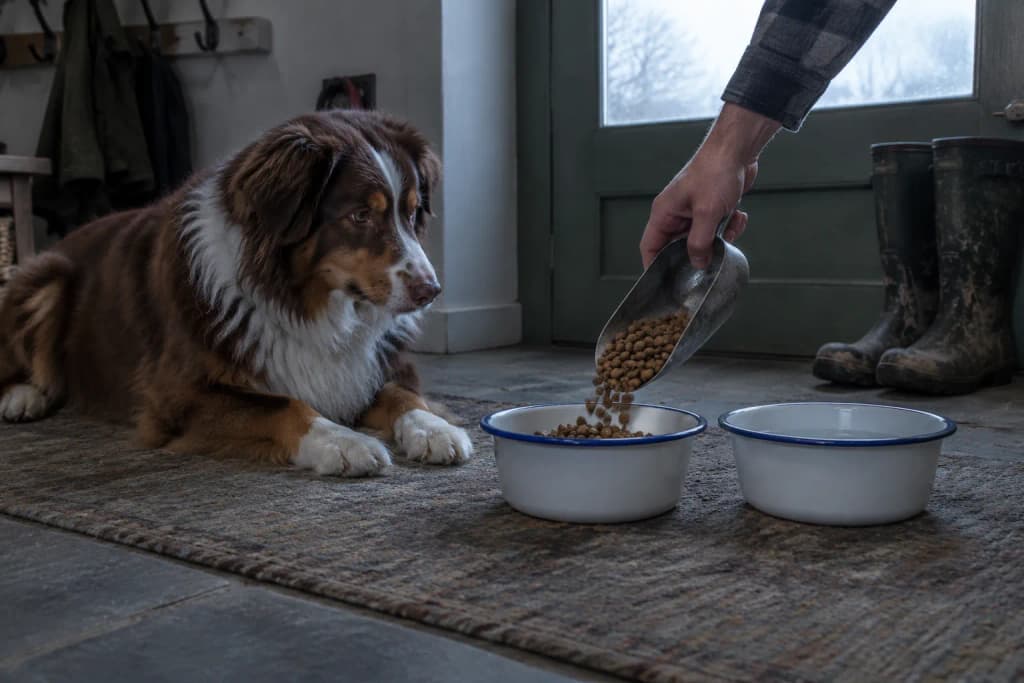
You may find yourself filling one bowl instead of two, and the empty space on the mat looks larger than it should. You might call two names out of habit at the back door and hear only one set of paws on the deck. In a multi-dog home, the ordinary rhythm of care keeps going, and that can be both a comfort and a sharp reminder. It's hard to fall apart when someone needs a walk. It's also hard to feel your grief fully when you're busy keeping things normal for another animal.
Humane World for Animals notes that grief can affect daily routine.
A note of honesty: the sources this article draws on focus on how people grieve. They don't describe how a surviving dog experiences the loss, so this piece won't make claims about that. If you have questions about your other dog, your own veterinarian knows that animal and is the right person to ask.
For your own part, it's okay if your grief comes in pieces between feedings and walks. It's okay if your other dog gets the tears you couldn't find on the first night, a week later, face pressed into a warm neck. There's no correct way to do this, in a house with one dog or five.
Decision Checklist
Answer yes or no to each question to see whether this article fits where you are right now.
- Did your border collie die recently, and are you surprised by how little you feel?
- Are you judging yourself for not crying, or for not crying "enough"?
- Is relief, or guilt about relief, showing up next to the sadness?
- Has the loss affected your sleep or daily functioning in a way that feels hard to manage?
- Would it help to talk with a supportive, non-judgmental person who understands pet loss?
If you answered yes to questions 1 through 3, the reflections above were written for you. If you answered yes to question 4 or 5, the support options in the next section are worth a look. The Cornell Feline Health Center notes that professional grief counseling is an option when loss affects daily functioning or sleep.
Grief Therapy for Dog Loss and Other Kinds of Support
Some people move through pet loss with family and friends. Others find that the people around them don't quite understand, or that they need someone outside their life to talk to. Both are reasonable, and there's a range of support designed specifically for people who've lost an animal.
Cornell's College of Veterinary Medicine notes that support resources and memorialization can help some people. Tufts University's helpline description says that talking with a supportive, non-judgmental person can help with grief. Here's what the sources describe:
| Resource | What it offers | Details from the source |
|---|---|---|
| Tufts Pet Loss Support Helpline | Free phone support staffed by veterinary students | Staffed 6 pm to 9 pm Eastern, Monday through Thursday; 24-hour voicemail |
| Lap of Love Pet Loss Support | Virtual support led by certified pet loss coaches | Free and fee-based sessions; small-group and one-on-one; anticipatory grief and children's pet-loss support offered |
| Ohio State Honoring the Bond | Veterinary social work program | Support through illness, loss, and grief; help with quality-of-life decisions and bereavement referrals |
| Professional grief counseling | Individual counseling | An option when loss affects daily functioning or sleep, per the Cornell Feline Health Center |
A few gentle notes on choosing.
If the first nights are the hardest, a helpline's evening hours may line up with when you need it most, and voicemail is there outside those hours. If you want to hear from other people who've been through it, a small virtual group lets you listen before you share. If your border collie's illness raised hard questions about care or timing, a veterinary social work program is built for exactly that territory. And if weeks pass and your sleep, work, or basic functioning still feel off, professional grief counseling is a legitimate step, not an overreaction.
Lap of Love describes grief support as helping people heal at their own pace. That phrase is worth holding onto. Asking for support doesn't speed you up or slow you down. It just means you don't have to carry the whole weight alone.
Ohio State's program also reflects something larger: veterinary institutions recognize the human-animal bond as worth honoring. Some veterinary centers even hold annual remembrance ceremonies for pets that have died. Your grief, whether loud or quiet, belongs to something people take seriously.
The Texture of Memory: Keeping What You Saw
Eventually, numb or not, you'll want to hold onto something. Not right away, maybe. But one morning the light will slant through the kitchen window at a certain angle and you'll realize you can't quite picture how it used to catch the white blaze on that muzzle. That's often when people start reaching for ways to preserve what they saw.

Cornell's College of Veterinary Medicine mentions remembrance, writing, and art as ways some people find support after loss. None of these is required, and none needs to be grand. Here are a few forms remembrance can take, each with its own texture.
Photographs. Go through them slowly, when you're ready. Notice which ones actually look like your dog to you, and which ones only show a dog. Often the best images aren't the sharpest. They're the ones where the light was right: the backlit fur glowing at the edges in late afternoon, the two-tone face half in shadow under the porch roof. Print a few. A photograph on paper catches light differently than a screen.
Writing. Try describing your border collie only in colors and shapes, as if for someone who'd never met them. The exact black of the coat in sun versus shade. The ruff of white at the chest. The shape of the ears when listening versus resting. This kind of writing can surprise you, because looking closely is its own form of tenderness. It may also be where tears finally find you, or where they don't, and that's fine either way.
Art. A sketch, a painting, a stitched outline, a pressed sprig of lavender from the garden spot. Making something with your attention can turn a loose cloud of memory into an object you can set down on a shelf and come back to.
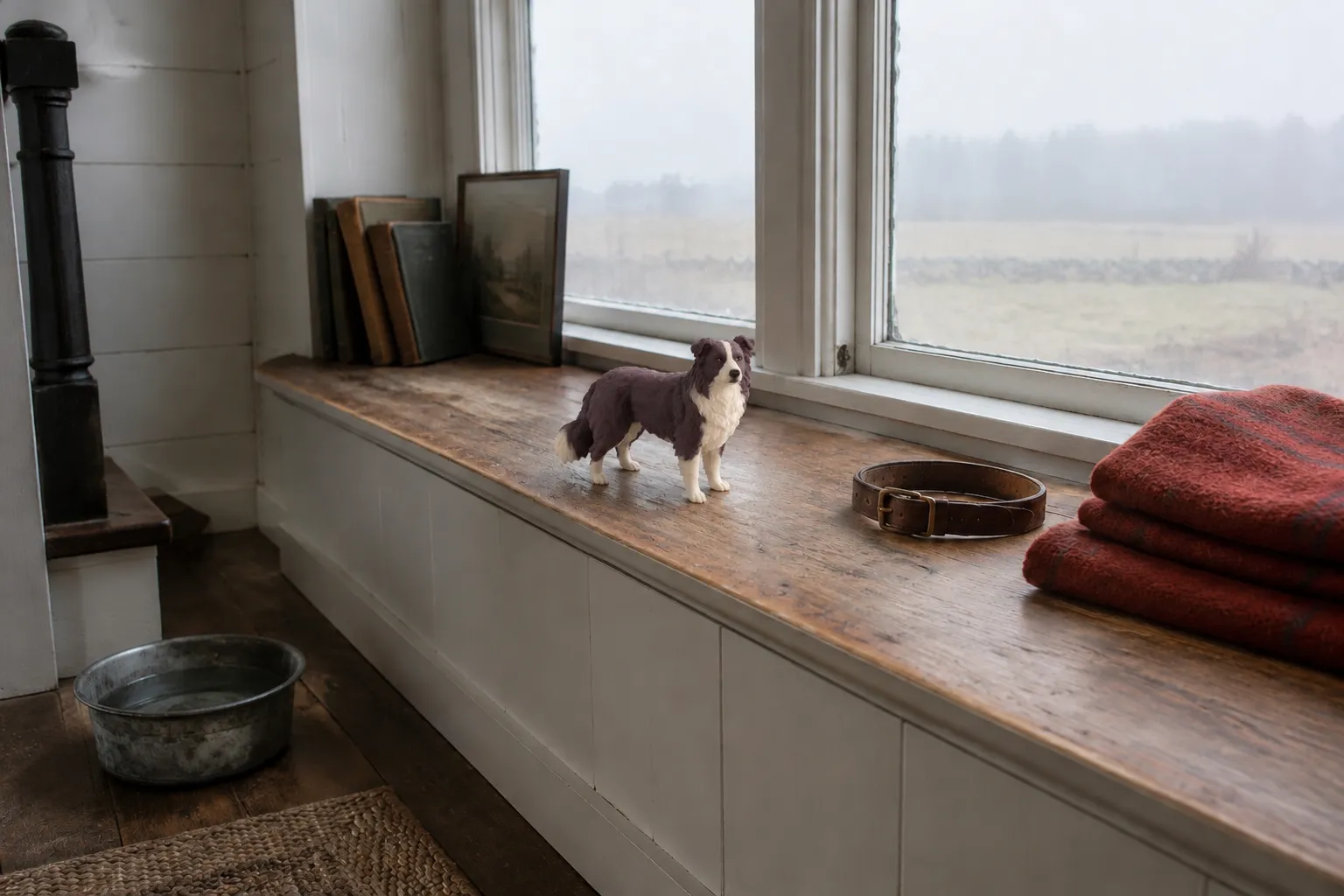
A sculpted portrait. Some people want a memory they can see from every side, with depth and shadow and the way light falls across a form. A three-dimensional figurine offers that. It's worth being clear about what this is and isn't. A good sculpted portrait is an artistic interpretation, shaped by an artist working from your photos. It isn't a photocopy and shouldn't be expected to be one. What it can offer is presence: a small, still form on a nightstand, catching the lamplight the way your dog used to.
At PawSculpt, for example, an artist reviews your reference photographs, digitally sculpts the portrait, and shares a preview for you to confirm before anything is printed.
There's no deadline on any of this. The photographs will still be there next month. The lavender will bloom again next summer. If you're numb tonight, you're not too late for anything.
Frequently Asked Questions
Is it normal to feel numb the first night after my dog dies?
Veterinary grief resources say there is no correct way to grieve and no normal timeline, and responses vary between people. Feeling little on the first night is not a measure of how much you loved your dog.
Why can't I cry after my dog died?
Grief is not linear and rarely follows a straight path, according to Humane World for Animals and Cornell. Tears may come later, in pieces, or differently than you expect. Their absence tonight is not a failure of love.
Is it wrong to feel relieved after my dog died?
No. The Cornell Feline Health Center lists relief alongside sadness, anxiety, tiredness, and guilt as normal. Relief is especially understandable after a long illness, when anticipatory grief often begins before the loss.
When should I consider grief therapy for dog loss?
The Cornell Feline Health Center notes professional grief counseling is an option when loss affects daily functioning or sleep. You can also reach out sooner simply because talking to someone would help.
Are there free pet loss support options?
Yes. Tufts runs a free pet loss helpline staffed by veterinary students, Monday through Thursday, 6 to 9 pm Eastern, with 24-hour voicemail. Lap of Love offers some free virtual sessions led by certified pet loss coaches.
Do I need to decide on a memorial keepsake right away?
No. Grief has no prescribed timeline, and keepsakes can wait. Photographs, writing, art, or a figurine can all come later, whenever looking closely at your dog's image feels right to you.
When You're Ready, a Portrait That Waits for Your Approval
If a time comes when you'd like to see your border collie's shape again, resting on a nightstand in the lamplight, chin on crossed paws, PawSculpt makes custom full-color resin pet memorial figurines from your photographs. Our approach is simple to say: a sculpted portrait, not a photocopy.
Here's how it works, so nothing catches you off guard:
- Your photos come first. We review your reference photographs, and an artist digitally sculpts the portrait from them.
- You see it before it's made. The first artist preview is typically delivered within 7 days after complete references are available and the order enters IN_DESIGN. Five revisions are included, and nothing prints until you confirm the preview.
- Printed in full color. The approved model is printed on a Mimaki 3DUJ-553, equipment capable of more than 10 million colors. Supports are removed, the surface is inspected, and a transparent protective coat is applied. Figurines are made for indoor shelf display.
- Sizes and pricing. Figurines range from 2.5 to 6 inches tall. A single figurine is $429 at 2.5 inches, $489 at 3 inches, $589 at 4 inches, $789 at 5 inches, and $999 at 6 inches (USD). A black acrylic base is included, and a nameplate with your dog's name is a $9 add-on.
- A clear deposit boundary. Orders begin with a 40% deposit. You can get a full refund before the order enters IN_DESIGN; once the artist starts modeling, the deposit becomes non-refundable.
- Delivery. Figurines arrive 27 to 40 days after final payment in the US, or 33 to 47 days internationally. No separate shipping fee is added at checkout for worldwide delivery, though international customers remain responsible for local customs duties, taxes, or import fees.
There's no rush. Gather photos when looking at them feels bearable. When you're ready, you can start a memorial figurine for your border collie and see the artist's preview before deciding anything final.