When Grief Feels Like Forgetting: How a Pug Owner Found Her Way Back to the Memories
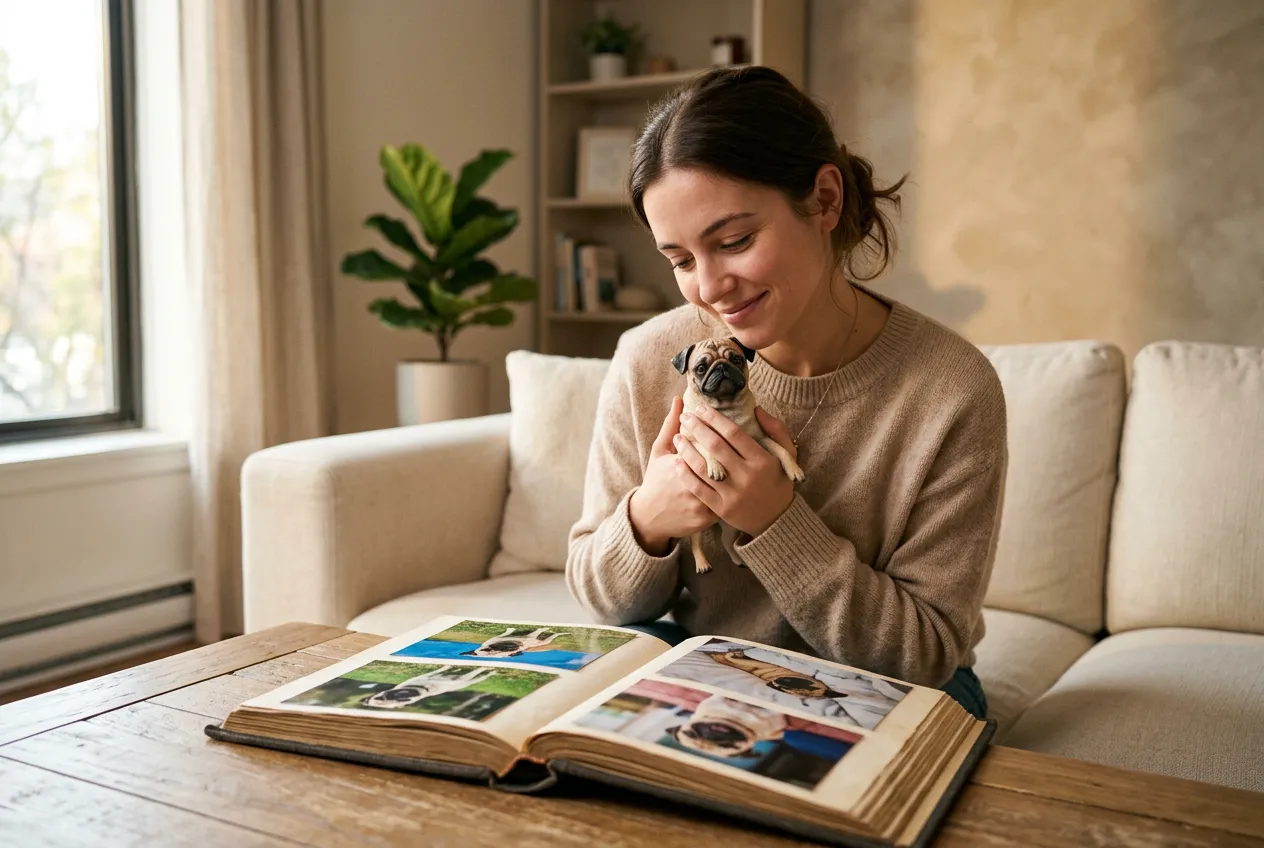
"To live in hearts we leave behind is not to die." — Thomas Campbell wrote those words in 1825, and nearly two centuries later, they still catch in your throat if you've loved a pug whose warm, wrinkled weight once pressed against your chest every single night. But here's what Campbell didn't say—what nobody warns you about: the fear of forgetting pet after death doesn't arrive with the loss. It arrives weeks later, when you realize you can't quite recall the exact texture of that velvet ear between your fingers.
Quick Takeaways
- Forgetting details is not betrayal — it's how memory naturally compresses, and it doesn't erase love
- Your body holds memories your mind can't access — physical habits prove your bond was real
- Structured memory preservation works better than passive hoping — specific rituals lock details in place
- Tangible keepsakes like custom pet figurines anchor fading memories — giving grief something to hold onto
- The fear of forgetting often peaks 3–8 weeks after loss — knowing the timeline helps you prepare
The Grief Nobody Talks About: When Memory Starts to Blur
You didn't expect this part.
The crying, sure. The empty food bowl you couldn't bring yourself to pick up for eleven days. The phantom jingle of a collar in the hallway. That stuff—painful as it is—at least made sense.
But this? This feeling of reaching for a memory and finding it slightly out of focus? Pug loss grief hits differently here because pugs are so physically present in your life. Their snoring. The sandpaper-rough tongue on your ankle. That specific warm-bread smell of the folds around their nose. These aren't abstract memories—they're tactile, visceral, full-body experiences. And when those start to soften around the edges, it feels less like grief and more like erasure.
You start panicking.
When did I last hear that exact snore? Can I still hear it if I try?
Was her left ear darker than her right, or was it the other way around?
Did he spin clockwise or counterclockwise before lying down?
And then comes the thought that buckles your knees: What if I forget them entirely?
You won't. But we need to talk about why your brain is telling you that you will—and what's actually happening underneath.
Why Your Brain "Forgets" (And Why That's Not What's Really Going On)
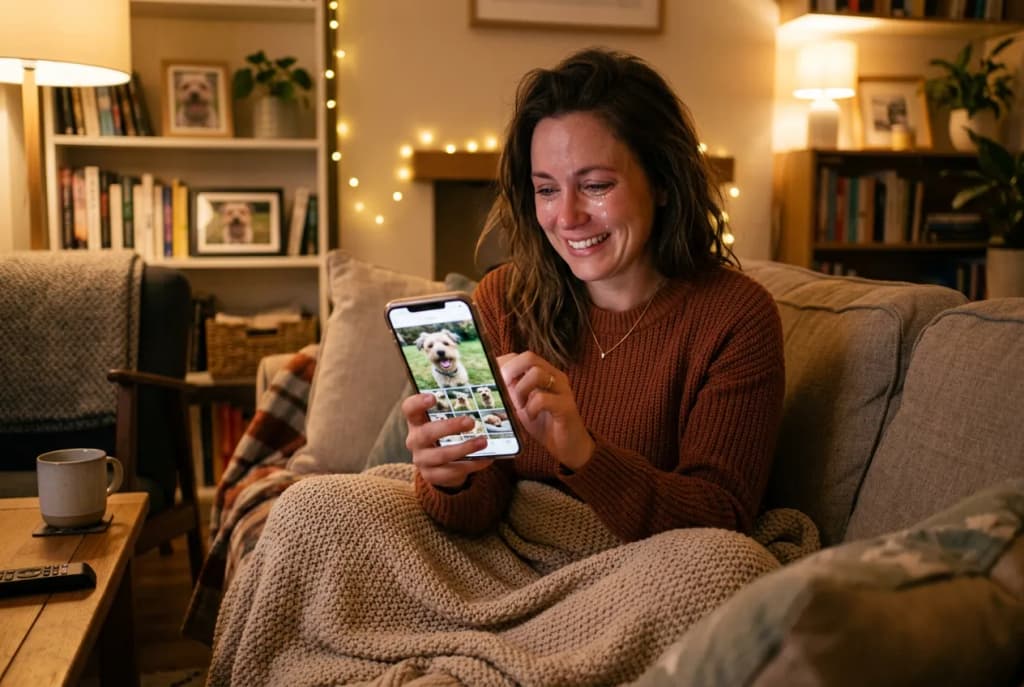
Here's the counterintuitive truth that most pet loss memory preservation guides completely miss: the details you're afraid of losing were never stored as a file you could open and replay. They were stored as feelings. As reflexes. As neural pathways carved by ten thousand repetitions of the same small ritual.
That's why you still glance at the foot of the bed before you pull the covers back. Your body hasn't forgotten. It remembers so thoroughly that it acts without permission.
The fear isn't that you're forgetting. The fear is that conscious recall is shifting—and you're mistaking that shift for loss.
Neuroscience backs this up. Memories of daily routines—the kind that define life with a pug—get encoded differently than episodic memories (like a specific trip to the vet or the day you brought them home). Routine memories compress. They merge into a felt sense rather than a filmstrip. That compression isn't decay. It's your brain saying: this was so constant, so woven into everything, that I turned it into part of who you are.
You didn't lose the memory. You became the memory.
"You didn't lose the memory. You became it."
But knowing that intellectually doesn't stop the 2 AM spiral. So let's get practical.
The Timeline of Forgetting Fear: What to Actually Expect
One thing we've noticed working with thousands of grieving pet families at PawSculpt is that the fear of forgetting pet after death follows a surprisingly consistent pattern. Not identical for everyone—but close enough to be useful.
| Timeframe After Loss | What's Happening With Memory | What You Might Feel |
|---|---|---|
| Days 1–7 | Hyper-vivid recall; memories feel almost too sharp | Overwhelm, inability to think about anything else |
| Weeks 2–4 | Sensory details begin softening; you notice the first "gaps" | Panic, guilt, desperate scrolling through photos |
| Weeks 4–8 | Routine memories compress; you catch yourself "moving on" | Fear of forgetting, shame about normalcy returning |
| Months 2–6 | Emotional memory stabilizes; details settle into feeling-states | Grief waves triggered by unexpected sensory cues |
| Months 6+ | Memory becomes integrated; less sharp, but deeply embedded | Bittersweet comfort; occasional acute waves |
That window between weeks two and eight? That's where most people land when they search for this article at midnight. If that's you—you're right on schedule. Nothing is broken. Nothing is being erased.
The Guilt About Normalcy
Here's the emotional nuance that almost no grief resource names directly, so we will: many pug owners feel genuine shame when normal life starts to resume.
You laugh at something on TV and then freeze. You enjoy a meal and feel sick about it. You go an entire afternoon without thinking about them and then spiral into self-punishment.
This is grief's cruelest trick—convincing you that healing is betrayal.
It's not. Healing doesn't mean forgetting. It means the love finds a new shape. But that reshaping process feels like forgetting when you're inside it, and nobody around you understands why you just went quiet in the middle of dinner.
We've worked with families who delayed ordering a memorial keepsake for months because they felt they didn't deserve comfort yet. That breaks our hearts every time. You deserve comfort on day one. On day one hundred. On day one thousand.
Personal Aside: Honestly? Our team talks about this a lot internally. We've seen orders come in at 3 AM with notes attached that read like love letters. "Please get her markings right. I'm starting to forget." That sentence shows up more than you'd think. It's the sentence that keeps us obsessive about accuracy in our digital sculpting process. It matters more than we can say.
Five Concrete Ways to Preserve Pug Memories (Beyond the Photo Album)
Most guides tell you to "make a scrapbook" or "write a letter to your pet." Those are fine. They're also what you'd find in the first five Google results, and they don't address the specific fear of sensory memory loss—the feeling of fur, the sound of breathing, the weight on your lap.
Here's what actually works for preserving the memories that matter most.
1. Record a "Sensory Inventory" Within the First Two Weeks
Don't wait. Sit down with your phone's voice recorder and describe every physical sensation you associate with your pug. Be embarrassingly specific.
- The exact weight of them on your chest (heavy for their size? like a warm bowling ball?)
- The texture of their coat in different spots—smooth on the belly, coarser along the spine, impossibly soft behind the ears
- The sound of their breathing—the snort, the wheeze, the little sigh before sleep
- The temperature of their body pressed against your leg
- The roughness of their paw pads against your palm
Why this works: Verbal description forces your brain to convert felt-sense memory into explicit memory. You're essentially creating a backup file of what your body knows but your conscious mind might lose access to.
Most people never do this because it feels unbearable in the first two weeks. But that's precisely when sensory recall is sharpest. If you're reading this and your loss is recent: do it today.
2. Capture Their Specific Markings Before Memory Edits Them
Here's something that surprises people: your brain will "correct" your pet's appearance over time. Memories of their markings will gradually drift toward the breed standard. Your fawn pug's particular shade—that slightly golden undertone, the exact width of the black mask—will slowly merge with a generic "pug" image unless you anchor it.
Print your favorite three photos and keep them where you see them daily. Not on your phone where they're buried under 10,000 images. Physical prints. On the fridge. On the nightstand.
Better yet, consider a three-dimensional representation. This is one reason families reach out to companies like PawSculpt—because a full-color 3D printed figurine captures specific markings, exact coloring, and unique physical features in a form you can actually hold. There's something about wrapping your hand around a tangible object that flat images can't replicate. The weight of it. The solidity. It tells your brain: this was real. This existed in three dimensions. Don't let it flatten.
3. Map Their Daily Routine in Writing
Not "my dog liked walks." That's useless in three years when the details have compressed.
Write the full sequence:
- Wake up. Pug already awake, staring at you from six inches away.
- Stretch routine—always the front legs first, then that ridiculous full-body shake.
- Walk to the kitchen. Specific route (around the left side of the couch, not the right).
- Breakfast. The way they'd look up between every third bite.
- Post-breakfast nap location. Always the same spot.
Map every micro-ritual. These are the memories that compress first because they happened every single day. And they're the ones you'll miss most.
4. Ask Other People What They Remember
This one's overlooked and incredibly powerful.
Your partner, your kids, your dog walker, your vet—they all hold pieces of your pug's personality that you might not have noticed or might remember differently. Other people's memories don't replace yours. They expand them.
Text three people who knew your pug and ask: "What's the one thing you always noticed about [name]?" The answers will surprise you. They'll fill in blind spots you didn't know you had.
5. Create a "Trigger Map"
A trigger map is a list of specific sensory cues that bring your pug rushing back—and it's something you build intentionally rather than being ambushed by.
| Sense | Trigger | Memory It Unlocks | Where to Access It |
|---|---|---|---|
| Touch | Warm velvet fabric | Ear texture | Keep a piece of similar fabric in your desk drawer |
| Sound | Specific snoring frequency | Nighttime presence | Record a similar sound; save on your phone |
| Smell | Their blanket (unwashed) | Morning cuddles | Seal in a ziplock bag to preserve the scent |
| Sight | Specific shade of fawn | Their face | Pantone match the color; keep the swatch |
| Taste | The treat you'd share | Training sessions | Buy the same brand; eat one on their birthday |
Why this works: You're building deliberate memory anchors instead of waiting for accidental ones. You control the access points. That control directly reduces the fear of forgetting because you've created reliable pathways back.
"Grief doesn't need answers. It needs anchors."
The Emotion Nobody Admits: Relief, and the Guilt That Follows
We promised emotional honesty, so here it is.
If your pug was older—struggling with breathing issues, spinal problems, the mobility challenges that plague the breed—you may have felt a wave of relief when their suffering ended. And then, almost instantly, a tidal wave of guilt crashed over that relief.
What kind of person feels relieved that their best friend is gone?
The answer: the kind of person who loved them so much that watching them struggle was its own form of suffering. Relief and love are not opposites. Relief is what happens when empathy is finally released from its most painful duty.
The ASPCA's resources on pet loss acknowledge that this mix of emotions is not only normal—it's nearly universal among owners who've cared for aging or ill pets. But reading that it's "normal" and feeling like it's normal are two different things.
So let us say it plainly: if you felt relief, you are not a monster. You are someone who was holding an unbearable amount of love and pain simultaneously, and your nervous system finally exhaled. The guilt that chases that exhale? It's not evidence of wrongdoing. It's evidence of how deeply you cared.
The Second-Guessing Spiral
While we're naming the unnameable: many pug owners second-guess the timing of euthanasia decisions for months or even years.
Was it too soon? Should I have tried one more treatment? Or did I wait too long—did they suffer because I wasn't ready to let go?
Both directions of that spiral lead to the same place: guilt. And both are almost always unfounded. You made the best decision you could with the information and the love you had in that moment. Full stop.
If you're stuck in this spiral, one thing that genuinely helps is writing down—specifically—what you knew at the time of the decision. Not what you know now with hindsight. What you knew then. The vet's words. The symptoms you were seeing. The look in their eyes. When you reconstruct the actual decision context, the "obvious" alternative choices usually evaporate.
"We've learned that grief doesn't ask for perfection. It asks for presence. You were there. That was enough."
— The PawSculpt Team
Pug-Specific Grief: Why This Breed Hits Different
Not all pet loss is the same. And pug loss grief carries specific textures that owners of other breeds might not fully understand.
Pugs are contact dogs. They don't just live in your house—they live on your body. On your lap. Against your side. With their chin resting on whatever part of you is available. The physical absence of a pug isn't just emotional—it's thermal. You feel colder. Your lap feels wrong. The couch cushion next to you stays cool.
This matters because the grief of losing a pug is disproportionately physical. You feel it in your skin, in the weird lightness of your arms, in the silence where snoring used to be. And because it's so physical, the fear of forgetting is also physical—you're not just afraid of losing a mental image. You're afraid of losing a body memory.
Here's what we'd suggest for pug owners specifically:
- Weighted blankets can replicate some of the pressure and warmth. It sounds strange. Several families we've worked with swear by it for the first few weeks.
- Keep one unwashed item that carries their scent. Scent is the strongest memory trigger humans have, and it degrades. A sealed bag buys you months.
- A tangible, three-dimensional keepsake matters more for pug owners than almost any other breed, because the relationship was so three-dimensional. A flat photo doesn't capture what it felt like to hold them. Something with weight, with volume, with texture—that's what your hands are looking for.
This is why the families who come to PawSculpt for a custom memorial figurine so often tell us the same thing when they first hold it: "It's the right weight." Not the literal weight of their pug, obviously. But the rightness of holding something solid. Something that takes up space in the world the way their pug did.
Our process—digitally sculpted with obsessive attention to your specific pug's features, then precision 3D printed in full color so that every marking, every shade, every wrinkle is captured directly in the resin—exists for exactly this moment. The moment your hands need something to hold.
When Other People Don't Get It
Let's talk about isolation.
You told a coworker you were struggling, and they said, "It was just a dog." Or worse—they said nothing at all, because they didn't think it warranted acknowledgment.
Feeling judged for the intensity of your grief is one of the most isolating experiences in pet loss. And pug owners get hit with a double layer: not only are you grieving a pet (which some people already dismiss), but you're grieving a small, "funny-looking" pet. The breed that's become a meme. People who've never felt a pug fall asleep in their arms genuinely don't understand the depth of the bond.
You're not overreacting. The bond was real. The grief is proportional.
If your immediate circle doesn't get it, seek out pug-specific communities online. Reddit's r/pugs, Facebook groups for pug owners, breed-specific forums—these spaces are filled with people who understand exactly what you're carrying. Shared grief doesn't halve the weight, but it proves the weight is real.
The Fear of Getting Another Dog
One more emotion to name: the anxiety about whether you'll ever want another pet.
Some people feel guilty for even considering it ("Am I replacing them?"). Others feel terrified that they'll love again and lose again. Both responses are completely valid. And here's the thing nobody says clearly enough: you don't have to decide right now. There is no timeline. There is no rule. Some families adopt within weeks and find it healing. Others wait years. Some never get another dog and live full, complete lives.
The only wrong answer is someone else's timeline imposed on your grief.
A Story About a Pug Named Dolly
One of our customers—we'll call her Megan—reached out to us about eight weeks after losing her pug, Dolly.
Her message was short: "I'm starting to forget her face. I have photos but they don't look like her. They look like a pug. I need something that looks like my pug."
That distinction—between a pug and my pug—is everything.
Photos flatten. They capture a moment but lose the dimensionality. The particular way Dolly's left ear folded slightly more than her right. The exact distribution of silver hairs around her muzzle. The way her underbite made her look perpetually skeptical.
Our 3D artists worked from seven photos Megan provided, sculpting Dolly digitally with the kind of granular attention that only matters when you know a specific animal. The full-color resin print captured Dolly's precise fawn tone—warmer than standard, almost apricot—and the particular pattern of her facial wrinkles.
When Megan received the figurine, she sent us a voice memo instead of a text. She was crying. But what she said was: "I can see her again. Not a pug. Her."
That's the moment that keeps our team going.
Practical Memory Preservation: A Month-by-Month Guide
Because "preserve your memories" is vague advice, here's what actually helps—broken down by when you'll need it.
| Month | Action | Why Now | Time Required |
|---|---|---|---|
| Month 1 | Record sensory inventory (voice memo) | Sensory recall is sharpest now | 20 minutes |
| Month 1 | Seal one unwashed item in airtight bag | Scent degrades quickly | 2 minutes |
| Month 1–2 | Print 3–5 best photos; display physically | Prevents "photo library burial" | 30 minutes |
| Month 2–3 | Write their daily routine in detail | Routine memories compress around now | 45 minutes |
| Month 2–3 | Commission a tangible keepsake | You'll want something to hold as recall shifts | Varies |
| Month 3–6 | Create a trigger map (see above) | Builds intentional memory pathways | 30 minutes |
| Month 6+ | Establish an annual ritual (birthday, adoption day) | Gives grief a predictable container | Ongoing |
Don't try to do everything at once. Pick one action for this week. That's enough.
The Counterintuitive Truth About Forgetting
Here's the insight we promised—the one that might change how you think about all of this.
The pets we forget fastest are the ones we loved least.
Read that again.
The fact that you're terrified of forgetting your pug is itself proof of how deeply they're woven into you. People don't lose sleep over fading memories of casual acquaintances. The fear of forgetting is, paradoxically, evidence of an unforgettable bond.
Your pug changed the shape of your daily life. They altered your sleep patterns, your walking routes, your furniture arrangements, your morning rhythm. Those alterations don't disappear when the dog does. They're embedded in the architecture of your habits.
You will reach for them in the hallway for months. You'll buy their brand of treats by accident. You'll hear a snore in a TV show and feel your chest tighten.
That's not forgetting. That's the opposite of forgetting. That's a love so thorough it rewired your autopilot.
What Healing Actually Looks Like (It's Not What You Think)
Healing from pug loss grief doesn't look like "moving on." It looks like integration.
It looks like telling the story of their last day without your voice breaking—and then one Tuesday, your voice breaks again, and that's fine too.
It looks like smiling at a pug on the street instead of looking away.
It looks like holding a figurine of them on your shelf and feeling warmth instead of only ache.
It looks like being able to say their name in conversation without prefacing it with "I'm sorry, this is silly, but..."
It's not linear. It's not smooth. Some Wednesdays will be harder than the Monday after they died. That's normal. That's the deal.
"Healing isn't forgetting how to cry. It's remembering how to breathe between the tears."
The Things That Stay
You will not forget the important things.
You will not forget the way they greeted you at the door—the full-body wiggle, the circular spinning, the snorting joy that made every arrival feel like a homecoming.
You will not forget the weight of them in your lap during the hard seasons. The breakup. The job loss. The year everything went sideways and the only constant was a fourteen-pound pug who thought you were the entire world.
You might forget which ear had the slightly darker fold. You might lose the exact pitch of their bark. The specific grain of their coat between your thumb and forefinger might soften in your mind's eye.
But the feeling? The feeling of being chosen by a small, loud-breathing, warm-bellied creature who asked for nothing but your presence?
That doesn't fade. It can't. It's part of you now.
The fear of forgetting pet after death is real, and it deserves to be taken seriously. But the fear itself is proof that forgetting isn't what's happening. What's happening is that love is finding a new shape—one that doesn't require a warm body beside you, but carries the warmth anyway.
Your pug is not disappearing from your memory. Your pug is settling into your bones.
And you'll carry them there—steady, solid, warm—for the rest of your life.
Frequently Asked Questions
Is the fear of forgetting my pet after death normal?
Completely. The fear of forgetting pet after death is one of the most common—and least discussed—aspects of pet grief. It typically intensifies around 3–8 weeks after loss, right when sensory memories begin their natural compression. The fear itself is actually evidence of an unforgettable bond. Your brain isn't erasing your pet—it's integrating them into your identity.
How long does pug loss grief typically last?
There's no expiration date. Acute grief—the kind that makes it hard to function—often lasts 2–6 months, but grief waves can surface years later, triggered by a sound, a smell, or an unexpected pug sighting. Pug loss grief in particular can feel intensely physical because the breed's constant-contact nature leaves a sensory void that other breeds may not.
Why do I feel guilty about feeling relieved after my pet died?
Because grief plays cruel tricks. Relief after a pet's suffering ends is nearly universal—especially among owners of breeds prone to health complications—and it reflects deep empathy, not absence of love. You prioritized their comfort over your need to keep them close. That's not something to feel guilty about. That's love at its most selfless.
What are the best ways to preserve memories of my pet?
Go beyond photos. Record a voice memo describing every sensory detail within the first two weeks while recall is sharpest. Seal an unwashed blanket or toy in an airtight bag to preserve scent. Print physical photos and display them where you'll see them daily. Write out their complete daily routine. And consider a tangible keepsake—like a custom 3D figurine—that gives your hands something to hold when memory feels too abstract.
How do I deal with people who dismiss my grief?
You don't owe anyone an explanation for the depth of your grief. If your immediate circle doesn't understand, seek out breed-specific online communities where people genuinely get it. Your grief is proportional to your love, and that love was real—regardless of anyone else's opinion about what "justifies" mourning.
Is it too soon to get another dog after losing my pug?
There's no universal right answer. Some people find healing in opening their home to a new dog quickly. Others need years. Some never get another pet and that's a complete, valid choice. The only wrong timeline is one someone else imposes on you. When and if you're ready, you'll know.
Ready to Honor Your Pug's Memory?
Every wrinkle, every marking, every expression that made your pug yours—those details deserve to be preserved in more than just memory. A custom PawSculpt figurine captures the specific features that photos flatten, giving you something solid to hold when the fear of forgetting pet after death feels overwhelming.
Visit pawsculpt.com to see how our full-color 3D printing process works and explore your options