
The Color Psychology of Grief: Why a Full-Color Persian Cat Sculpt Heals Better Than Bronze
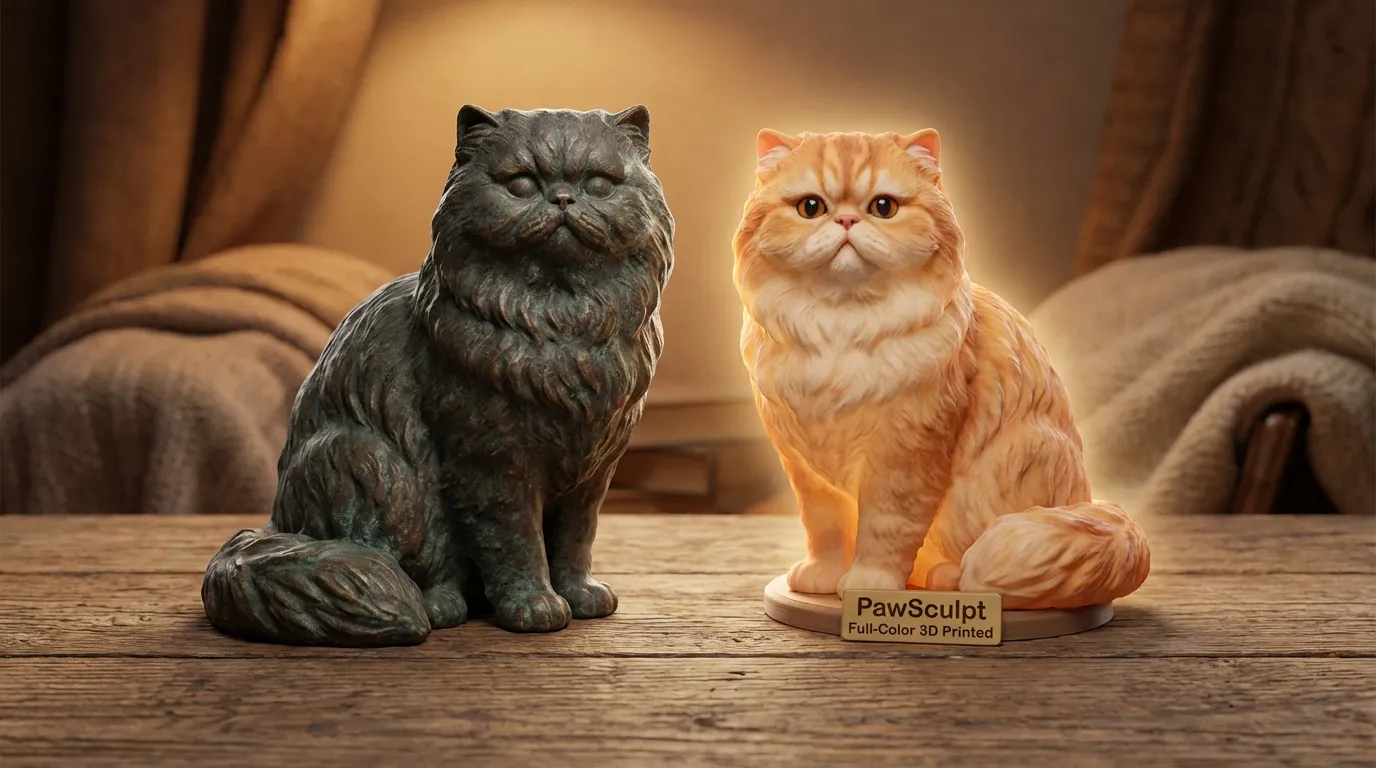
Recent psychological studies indicate that the human brain processes color 60,000 times faster than text or shape, triggering emotional responses in the limbic system before we even consciously recognize what we’re looking at. Standing in a dusty garage, holding a cold, monochromatic bronze urn, you might realize something is missing—not just the weight of your cat, but the specific, chaotic harmony of their colors. A Persian cat memorial needs more than just a silhouette; it needs the copper of their eyes and the smoke of their fur to truly unlock the healing process.
Quick Takeaways
- Color triggers specific memories — The exact shade of your cat's fur accesses different neural pathways than shape alone.
- Bronze abstracts, color validates — Traditional metal statues create distance; full-color realism creates presence.
- Texture is a love language — For tactile grievers, seeing the visual texture of fur is crucial for grounding.
- Personalization aids acceptance — A custom full-color figurine prevents the "replacement" feeling by honoring unique markings.
The Science of "Visual Hunger" in Grief
We often talk about the stages of grief, but we rarely talk about the craving. When a pet passes, specifically a breed as visually distinct as a Persian, your brain enters a state of withdrawal. It is constantly scanning your environment for that specific fluff, that particular shade of cream or smoke, those copper eyes.
This is called "visual hunger."
When you look at a silhouette or a generic bronze statue, your brain has to do a lot of heavy lifting. It has to project your memory onto a blank canvas. It’s exhausting mental work at a time when you are already depleted.
"Grief isn't a problem to be solved. It's a love story that continues after the last chapter."
A full-color representation works differently. It bridges the gap between memory and reality instantly. When you see the specific gradient of a smoke Persian’s coat—dark at the roots, silver at the tips—your brain relaxes. It recognizes the subject immediately. It doesn't have to work to find your friend; your friend is simply there, visually represented in a way that aligns with your neurological map of them.
Why Persians Are visually Complex
Persian cats are not just "fluffy." From an artistic perspective, they are topographical maps of color.- The Coat: It’s rarely one solid block of color. It captures light. A "white" Persian has undertones of ivory, blue, or pink depending on the lighting.
- The Eyes: The contrast between a Persian's flat face and their large, expressive eyes is a defining feature. Losing that color contrast in a monochromatic metal sculpture means losing the expression entirely.
Bronze vs. Full-Color: A Psychological Comparison
For centuries, bronze and stone were the gold standards of memorialization. They represent permanence, weight, and history. But they also represent the past—something finished, something distant.
In our studio, we’ve noticed a shift. Pet parents aren't looking for "statues" anymore; they are looking for connections.
| Feature | Bronze/Metal Statues | Full-Color 3D Print | Psychological Impact |
|---|---|---|---|
| Color | Monochromatic (Patina) | Photorealistic | Color triggers immediate emotional recognition. |
| Texture | Smooth/Cold | Visual Grain/Texture | Visual texture mimics the softness we miss touching. |
| Eyes | Blank/Hollow | Replicated Color | Eye contact is the primary way we bonded with them. |
| Vibe | "Here lies a cat" | "Here is your cat" | Shifts focus from death/absence to life/presence. |
| Detail | Generalized | Specific Markings | Validates that this specific individual mattered. |
The counterintuitive insight here is that permanence (bronze) can sometimes feel like closure you aren't ready for. A full-color piece feels softer, more immediate, and less like a tombstone.
The "Uncanny Valley" and Why Accuracy Matters
You might worry that a realistic figurine would be "creepy" or fall into the "uncanny valley"—that feeling of unease when something looks almost alive but not quite.
This is a valid fear, but it usually stems from poor craftsmanship or generic mass-production.
The "uncanny valley" happens when the geometry is wrong. When the eyes are slightly too far apart, or the snout length is generic rather than specific to your pet.
This is why the artistic process is non-negotiable. We don't just scan a photo and hit print. Our digital sculptors spend hours mapping the topography of a Persian's face. We look at the "squish" of the nose, the specific ear set, and the way the ruff sits around the neck.
When the geometry is accurate, the color acts as the final soul-injection. It doesn't look creepy; it looks familiar. It triggers a dopamine release—a "recognition spark"—rather than a recoil.
The Role of "Transitional Objects"
In psychology, a "transitional object" is something that helps us navigate a difficult emotional change. Usually, we talk about this with children and security blankets. But grieving adults need transitional objects too.
A memorial figurine isn't just decor. It serves a specific function:
- The Anchor: It gives you a physical place to direct your thoughts. Instead of talking to the empty air, you can speak to the figurine.
- The Permission Slip: Seeing the figurine on your desk is a reminder that it’s okay to still be sad, and it’s okay to still love them.
- The Touchstone: While our full-color resin prints are rigid, the visual softness of a Persian's fur rendered in color provides a "phantom touch" sensation. Your eyes tell your hands what it felt like.
"We've seen families heal by holding something tangible. Grief needs an anchor."
— The PawSculpt Team
Addressing the Guilt of "Moving On"
One of the darkest, rarely discussed aspects of pet grief is the fear that if you stop hurting, you are betraying them. You might feel that a realistic memorial is an attempt to "replace" them.
Let's reframe that.
Honoring their specific colors—that tiny patch of orange behind the ear, the one white whisker among the black ones—is the ultimate act of validation. You aren't replacing them; you are proving that you saw them. You noticed the details. You witnessed their life in high definition.
A generic angel statue says, "I miss a cat."
A custom full-color portrait says, "I miss this cat."
How to Choose the Right Reference Photos
If you decide to go the route of a full-color custom piece, the artistic output is only as good as the reference material. Because we are dealing with 3D modeling and color mapping, lighting is everything.
The "Golden Hour" Rule
Avoid photos taken with a flash at night. Flash flattens the face (disastrous for Persians) and causes "red-eye" or "green-eye" reflection, masking the true eye color.- Best: Photos taken in natural, indirect daylight (near a window).
- Why: This shows the true texture of the fur and the depth of the eye color.
The "Personality" Shot
Don't just look for the photo where they look perfect. Look for the photo where they look like themselves.- Is their tongue slightly out?
- Do they have "grumpy face" resting expression?
- Is one ear slightly tipped?
These "imperfections" are actually the emotional hooks. A statue that is too perfect won't heal you. A statue that captures their specific quirk will.
Frequently Asked Questions
Why is full-color resin better than hand-painting?
Hand-painting, while traditional, often leaves brush strokes or creates a "layer" of paint that sits on top of the surface. Full-color 3D printing builds the color into the object, pixel by pixel (or voxel by voxel). This allows for incredibly subtle gradients—like the transition from cream to apricot in a Persian's coat—that mimic biology better than acrylic paint can.Will the colors fade over time?
We use high-grade, UV-resistant materials and seal every piece with a protective clear coat / varnish. This locks in the color. However, just like a watercolor painting or a family photograph, we recommend displaying your memorial out of direct, scorching sunlight to preserve its vibrancy for generations.Can you capture the specific eye color of my cat?
Absolutely. The eyes are the window to the personality. Because we don't rely on standard paint tubes, we can digitally match the specific chartreuse, copper, or odd-eyed combinations that Persians are famous for.How long does the process take?
Grief doesn't rush, and neither do we. Because this is a custom digital sculpture followed by a complex printing process, it typically takes 3-6 weeks. We provide a preview of the digital model first to ensure we've captured the likeness before we ever hit print.Ready to Celebrate Your Pet?
Every pet has a story worth preserving. Whether you're honoring a beloved companion who's crossed the rainbow bridge or celebrating your furry friend's unique personality, a custom PawSculpt figurine captures those details that make your pet one-of-a-kind.
Free instant AI preview • 3D artist preview within 7 days • 5 free revisions