
The Shelf-Life of Grief: Curating a Rotating Display for Your Late Dachshund
You open the bottom drawer and your hand brushes against that ridiculous, elongated sweater that only ever fit a dachshund’s unique physique. It still smells faintly of corn chips and earth, instantly transporting you back to cold morning walks before the house felt so empty.
Quick Takeaways
- Static shrines become invisible — rotating your memorial items keeps the memories vivid and prevents "shrine fatigue."
- Categorize by personality — sort your dachshund's items into themes like "The Hunter," "The Napper," and "The Clown" for focused displays.
- Reclaim your floor space — it is healthy, not hateful, to donate bulky IVDD ramps and crates to rescues that desperately need them.
- Anchor with a focal point — center your display around a tangible likeness, such as a custom figurine, to give the eye a place to rest.
The Problem With the "Forever Shrine"
Here is the hard truth about grief that most people won't tell you: if you leave everything out, you eventually stop seeing it.
When you first lose your dachshund, the instinct is to freeze time. You leave the water bowl where it was. You pile the toys in the corner. You arrange the collar and the ashes on the mantel. You create a shrine.
But within three months, that shrine gathers dust. It becomes part of the furniture. Instead of sparking a distinct, beautiful memory of your dog, it becomes a static monument to their absence. It becomes a "sad corner" that you subconsciously learn to avoid looking at because it hurts too much, or conversely, it blends into the background so thoroughly that you walk past it without a thought.
The Practical Solution: The Rotating Curator Method.
Treating your dog’s memory like a museum exhibit rather than a graveyard changes the dynamic of your grief. Museums don't display their entire collection at once. They rotate items. They curate themes. They tell specific stories at specific times.
- You keep the memory active. Every time you switch the display, you actively engage with your dog's life, not their death.
- You reclaim your home. You can clear the clutter without feeling like you are "erasing" them.
Phase 1: The Great Sort (The Hard Part)
Dachshunds come with a lot of gear. Because of their long spines and propensity for burrowing, you likely have an accumulation of ramps, specific beds, heating pads, and oddly shaped coats.
You need to do an audit. This is not about throwing things away; it is about categorization. Get three large plastic bins. Do not use cardboard; cardboard attracts moisture and pests, and we are preserving these items for the long haul.
- The Archive (Deep Storage)
- The Rotation (Display Items)
- The Rescue (Donation)
The "Rescue" Bin: Dealing with the Big Stuff
Let's address the elephant in the room—or rather, the ramps in the living room. Dachshund owners often have hundreds of dollars invested in IVDD-prevention ramps and stairs.Counterintuitive Insight: Keeping the ramps "just in case" or because you feel guilty moving them often prolongs the pain. Every time you trip over a ramp for a dog that isn't there, you trigger a micro-moment of frustration followed immediately by guilt.
Move the ramps. If you aren't getting another dog immediately, donate them. Dachshund rescues are perpetually in need of ramps. Donating your late dog’s mobility aids is a power move against grief. It transforms a painful reminder into an active good for another long-backed dog.
The "Archive" vs. "Rotation" Decision
This is where you need to be ruthless.- Keep for Rotation: The collar, their absolute favorite toy (the one they destroyed), the sweater they looked handsome in, a lock of fur, their tag.
- Archive: The backup leash, the toys they rarely played with, the medical records, the extra blankets.
"Grief isn't a problem to be solved. It's a love story that continues after the last chapter."
Phase 2: Defining Your Themes
A dachshund is never just one thing. They are complex little characters. To keep your rotating display fresh, you need to identify the different "personas" your dog inhabited.
Most dachshunds fall into a few distinct categories. Use these to plan your displays.
| Theme | The Vibe | Items to Include | Best Season |
|---|---|---|---|
| The Badger Hunter | Earthy, energetic, tenacious | Earth-tone collar, squeaky prey toys, photos of them digging or running | Spring/Summer |
| The Burrower | Cozy, soft, sleepy, safe | Their softest blanket folded small, the heating pad cover, photos of them under covers | Winter/Autumn |
| The Gourmet | Food-motivated, intense, begging eyes | Their favorite treat jar (empty or filled with pebbles), ceramic bowl, photos of "the stare" | Thanksgiving/Holidays |
| The Sun Worshipper | Warm, peaceful, solar-powered | Bright colors, sun-bleached harness, photos of them in a sunbeam | Summer |
Phase 3: The Mechanics of the Display
You need a dedicated surface. This should not be a high-traffic area where things get knocked over, but it shouldn't be hidden in a closet either. A small floating shelf, the top of a bookshelf, or a specific corner of your desk works best.
- The Anchor: This is the tallest or most substantial item (The urn, a framed photo, or a figurine).
- The Texture: Something soft or tactile ( The collar, a folded bandana, a toy).
- The Spark: A small, shiny, or detailed item (The tags, a tealight candle).
The Role of the Anchor Piece
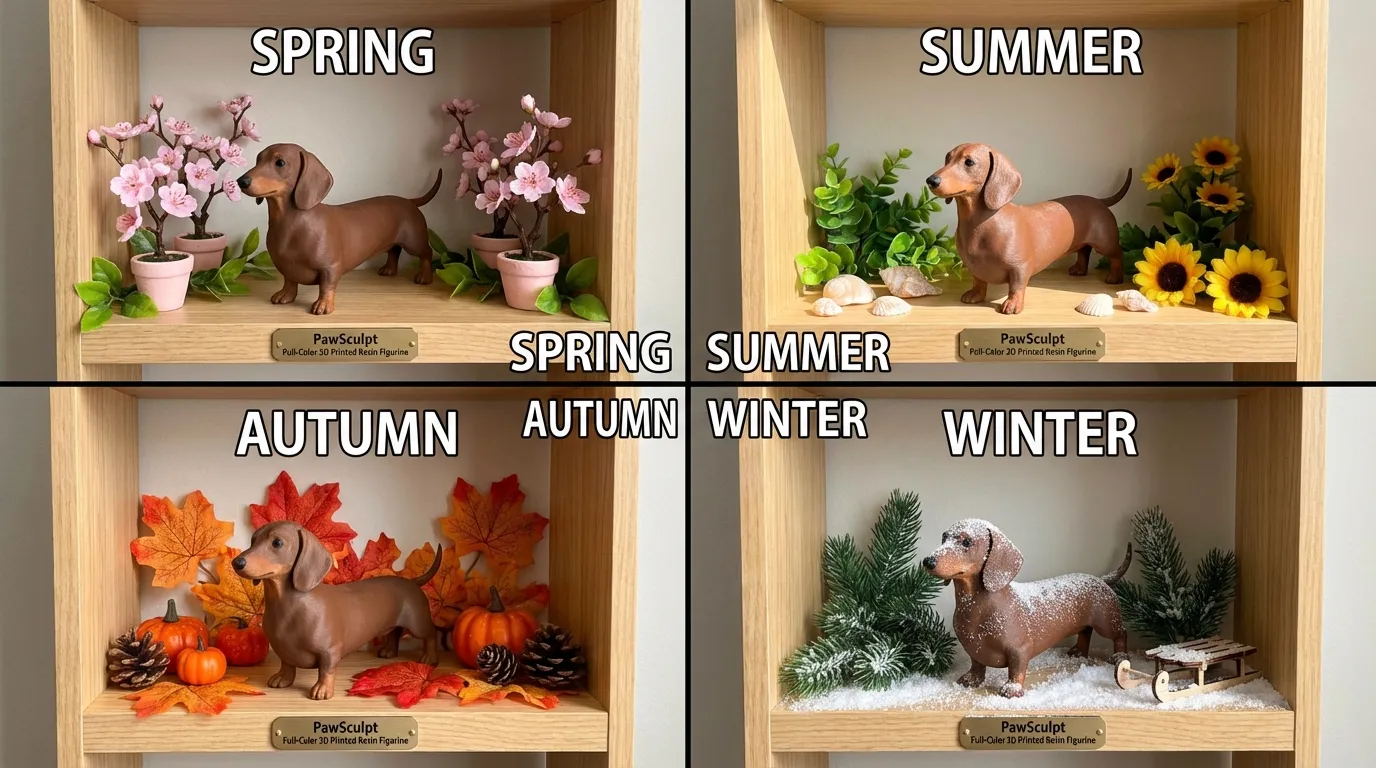
Photographs are essential, but they are flat. Grief is three-dimensional. You miss the physical presence—the way the light hit the curve of their back, the specific posture of their sit.This is where many pet owners find solace in a 3D representation. A custom figurine serves as a permanent anchor for your rotating display. Unlike a photo, which captures a split second, a figurine captures the essence of the dog.
At PawSculpt, we utilize full-color 3D printing technology. This isn't about hand-painting a generic model. We digitally sculpt the dog based on your photos—capturing the slight crook in the tail or the specific asymmetry of a dapple pattern—and then print it in full-color resin. The color is intrinsic to the material, not painted on top. This provides a depth and realism that feels substantial when you hold it.
"We've seen families heal by holding something tangible. Grief needs an anchor, something with weight that proves they were real."
— The PawSculpt Team
Phase 4: The Seasonal Rotation Schedule
Here is the practical "how-to" for keeping the memory alive without letting the grief become stagnant. Mark these dates in your calendar.
Spring: The "Earth Dog" Rotation
- Timing: First day of Spring.
- Focus: Vitality and stubbornness.
- Items: Bring out the muddiest collar (cleaned, obviously, but the rugged one). Display the toys they murdered. Use a photo of them outside.
- Action: If you have a garden, this is when you plant something in their honor. If not, buy a small succulent for the shelf.
- The "Why": Spring is about life returning. Remind yourself of their energy, not their end.
Summer: The "Sunbeam" Rotation
- Timing: June Solstice.
- Focus: Warmth and relaxation.
- Items: The light harness. The cooling bandana. Photos of them sunbathing belly-up.
- Action: Take the figurine or the photo outside for a few minutes. Sit in the sun with it.
- The "Why": Dachshunds are heat-seeking missiles. This season honors their ability to find comfort anywhere.
Autumn: The "Burrow" Rotation
- Timing: First frost.
- Focus: Comfort and connection.
- Items: Fold their favorite small blanket into a square to use as the base of the display. Place the urn or figurine on top of the soft fabric.
- Action: Light a candle in the evenings near the display.
- The "Why": As the world gets colder, you are symbolically keeping them warm.
Winter: The "Festive" Rotation
- Timing: December 1st.
- Focus: Joy and inclusion.
- Items: That ridiculous holiday sweater we talked about in the opening. Their stocking.
- Action: Put a handwritten note in their stocking about what you miss this year.
- The "Why": The holidays are the hardest time for grief. Including them in the decor prevents the "elephant in the room" feeling where everyone is sad but no one says why.
Phase 5: Managing the "Guilt of Relief"
We need to talk about the feeling you might be ashamed of.
When a dachshund passes—especially if they had IVDD, heart failure, or mobility issues—there is often a wave of relief. You no longer have to carry them down stairs. You don't have to worry about them jumping off the couch. You can walk across the room without looking down.
Then, immediately after the relief, comes the crushing guilt. How can I be relieved that my best friend is dead?
Stop that thought train immediately.
You are not relieved they are dead. You are relieved that the suffering (theirs and yours) has ended. You are relieved that the high-alert anxiety state you lived in is over. This is a biological response, not a moral failing.
The "Clean Shelf" Therapy:
Sometimes, the best rotation is an empty one. It is okay to take everything down for a week. Pack the shrine away. Dust the shelf. Leave it bare.
This acknowledges that they are gone, and that you are still here. It forces you to confront the empty space, which is a necessary part of processing. When you bring the items back out a week later, you will appreciate them more. You will choose them consciously, rather than out of habit.
Phase 6: Digital Preservation
While we focus on physical objects, your digital clutter needs curation too. We all have 4,000 photos on our phones, 3,000 of which are blurry or duplicates.
- Create a dedicated album on your phone.
- Limit it to 50 photos. Only the absolute best.
- Upload these to a digital frame that sits near your physical display.
The Audio Archive:
Did you ever record their bark? The sound of their nails on the hardwood? The specific whine they made when dinner was late?
Back these files up to the cloud immediately. Visual memory fades, but audio memory fades faster. Losing the sound of their voice is a specific kind of heartbreak. If you have these files, save them in three places.
Frequently Asked Questions
How soon should I pack away my dog's things?
There is no set timeline. Some do it immediately to avoid triggers; others wait months. A practical approach is to pack away the "medical" items (pills, cones, ramps) within 48 hours, as these often trigger trauma memories. Leave the "love" items (toys, blankets) until you feel ready to curate them.Is it disrespectful to donate my dog's toys?
Absolutely not. Dogs live to play. Letting another dog enjoy those toys honors your dog's spirit more than letting them rot in a box. However, keep one or two absolute favorites—the ones they really worked on—for your memorial display.My dachshund had a favorite blanket that smells like him. How do I preserve the scent?
Scent fades, but you can prolong it. Fold the blanket (do not wash it) and place it in a vacuum-seal bag or an airtight Ziploc. Keep it in a dark, cool place. Open it only when you really need that sensory connection, then reseal it immediately. Exposure to air dissipates the scent molecules.How do I handle the guilt of getting a new dog?
Your heart is not a limited-capacity room; it expands. Loving a new dog doesn't subtract love from the one you lost. Your late dachshund taught you how to be a good owner. Using those skills on a new dog is the ultimate tribute to their teaching.Ready to Celebrate Your Pet?
Every pet has a story worth preserving. Whether you're honoring a beloved companion who's crossed the rainbow bridge or celebrating your furry friend's unique personality, a custom PawSculpt figurine captures those details that make your pet one-of-a-kind. A Dachshund memorial shouldn't just be a sad reminder—it should be a beautiful tribute to the long, low, and lovely life they lived.
Free instant AI preview • 3D artist preview within 7 days • 5 free revisions