How to Photograph a Hyper Beagle and Pick the Right Finish for Sculpting
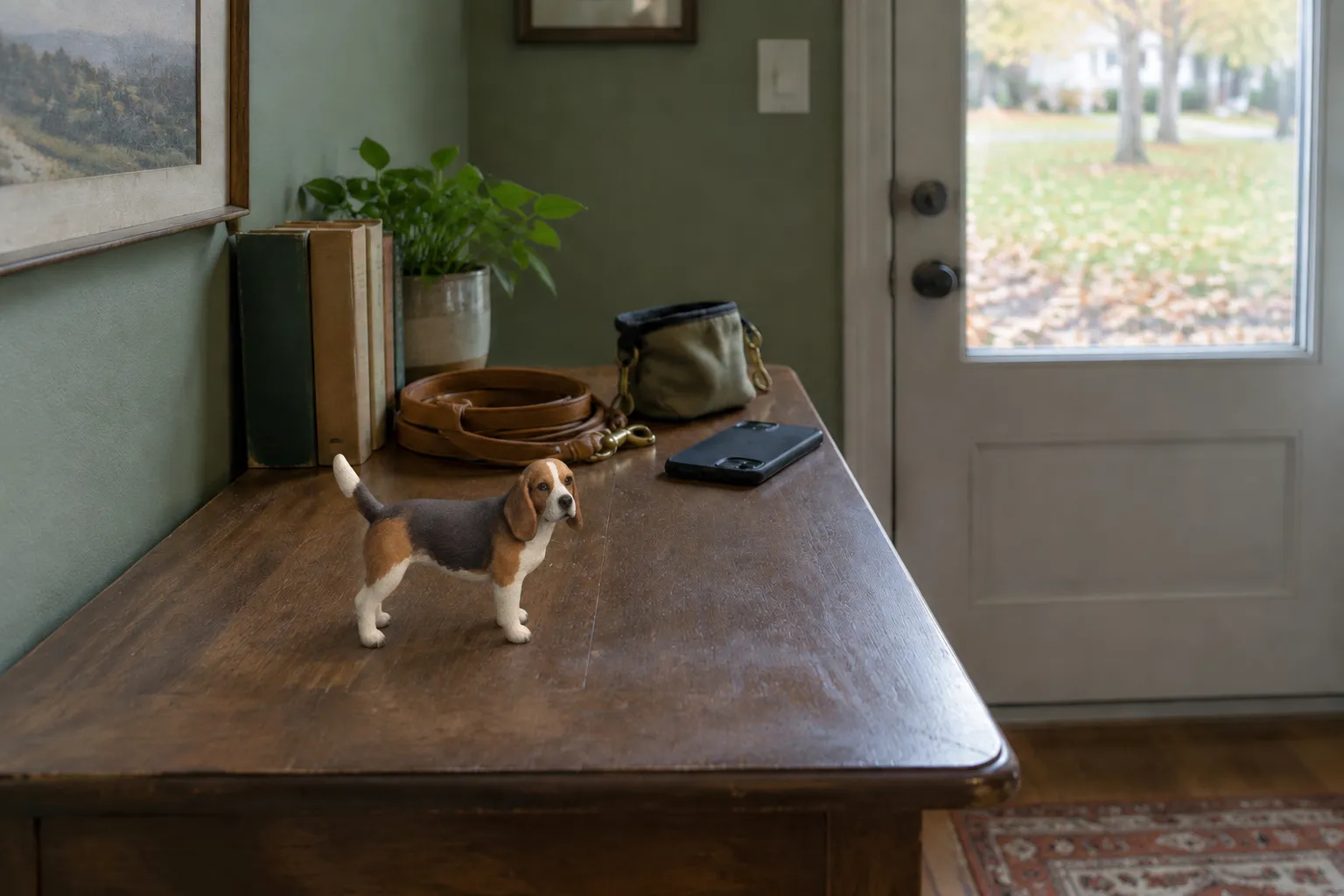
Last spring, a beagle named Cooper spent his mornings blurring across the bedroom rug, ears flapping, rope toy clenched in his jaw, refusing to hold still for a single frame. Now the phone camera catches him mid head-tilt near the window—and that half-second is exactly what a good reference photo needs.
If you want to photograph a hyper dog for a figurine, the fix is less about the dog and more about your setup. Let's break down why energetic short-coat breeds like beagles are tricky to shoot, and how the photos you take shape the finish decision later.
To photograph a hyper beagle for a figurine, shoot in bright, even light near a window, drop to the dog's eye level, and use burst mode to freeze motion. Capture the head-tilt, perked ears, and tricolor markings from several angles. Clear, well-lit references give an artist the detail needed to sculpt an accurate portrait.
Quick Takeaways
- High-energy dogs need fast shutter conditions—bright, even light and burst mode do most of the work.
- Short-coat breeds like beagles show their markings clearly, so photograph the color boundaries head-on and from the side.
- Take references at the dog's eye level, not from above, to capture true proportions.
- Multiple angles matter more than one "perfect" shot; an artist sculpts in three dimensions.
- A PawSculpt figurine is a sculpted artistic portrait, not a photocopy—your finish choices influence how the final piece reads.
Why a Hyper Beagle Fights the Camera (and What That Means for Your Photos)
There's a biological reason a beagle won't sit still for a portrait. Beagles were bred as scent hounds, and their brains are wired to follow stimulation—movement, smell, sound. When something catches their attention, their arousal level spikes, and a stimulated dog moves. That's not misbehavior; it's the same drive that makes the breed good at what it was built for.
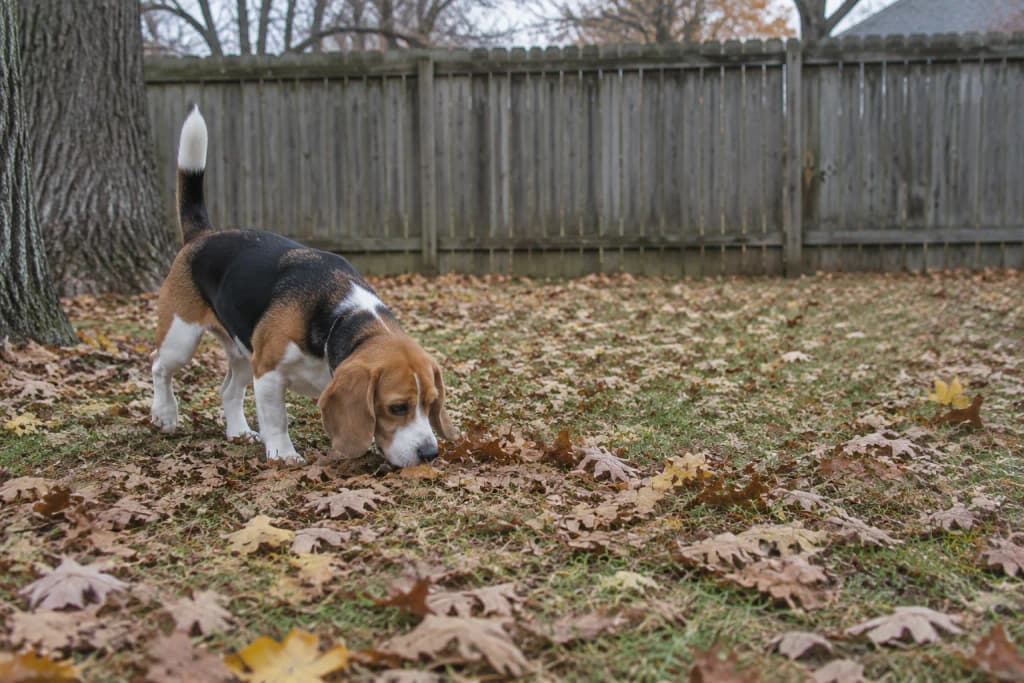
Practically, this creates two photography problems that feed into each other.
First, motion blur. A dog that shifts its head every second forces your camera to either freeze the frame with a fast shutter or smear the details. In dim indoor light, most phone cameras slow the shutter to gather more light, which is exactly the wrong direction when your subject is bouncing.
Second, the settling problem. Trying to force a hyper dog to hold a pose usually backfires. The more you correct, the more the dog reads your tension. Dogs are sensitive to human cues, so a frustrated handler often produces a distracted, alert-in-the-wrong-way subject.
The workaround is to stop fighting the energy and design around it. You don't need a calm dog. You need bright light and a fast burst, and you need to work in the windows when the dog naturally pauses—right after exercise, or in that curious head-tilt moment when a new sound registers.
The head-tilt is worth waiting for
That gentle head-tilt, ears perked, is one of the most photogenic and most sculptable expressions a beagle offers. It happens when the dog is processing something—a whistle, a squeaky toy, an unfamiliar word. It's brief, but it's repeatable. Make the sound, wait for the tilt, and fire a burst. You'll get several frames of that alert, curious posture to choose from.
The Practical Photo Setup for a Short-Coat Dog
Here's the cause-and-effect chain that makes reference photos work: more light means a faster shutter, a faster shutter means frozen motion, and frozen motion means an artist can actually see your dog's markings and proportions.
Follow this sequence.
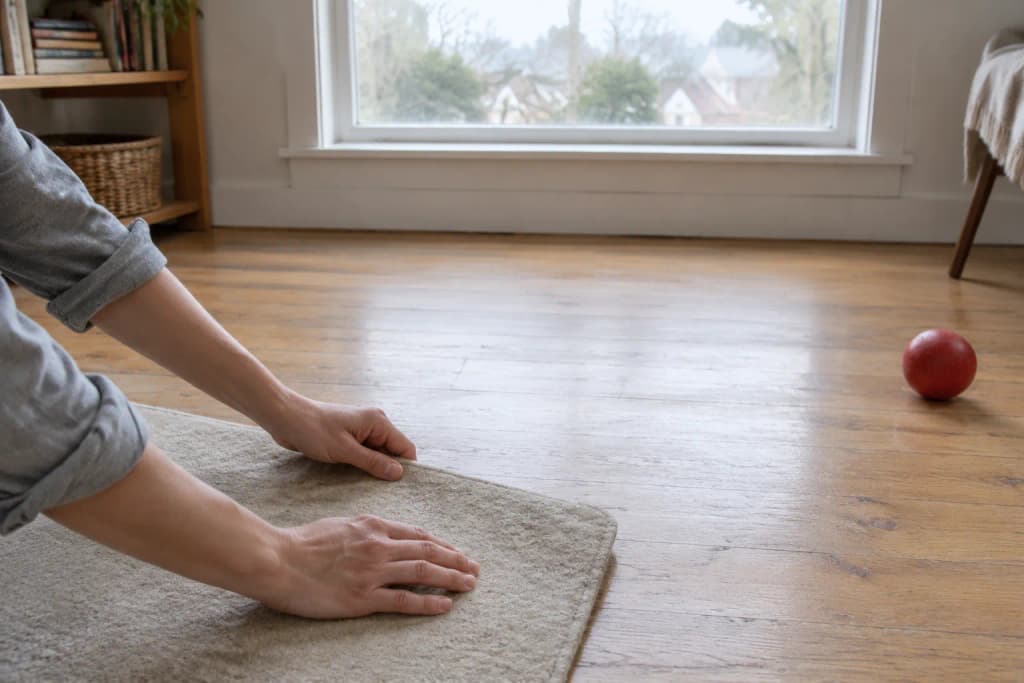
- Move to a window with indirect daylight. A living room rug near a bright window is close to ideal. You want strong light without harsh direct sun, which blows out the white patches on a tricolor coat and buries the black in shadow.
- Turn off overhead lights that fight the window. Mixing warm indoor bulbs with cool daylight muddies your dog's true colors. Let one light source dominate.
- Drop to the dog's eye level. Shooting from standing height distorts a small dog's proportions—big head, tiny body. Kneel or lie down so the lens is level with the dog's eyes. This is the single most common fix people miss.
- Use burst mode. Hold the shutter and let the camera take ten or twenty frames in a row. With a moving dog, one frame in that burst will be sharp and well-composed. This is how you beat the settling problem.
- Fill the frame, but don't crop tight. Get close enough that the dog fills most of the shot, but leave a little room around the edges. Cropping off an ear or paw removes information the artist needs.
- Shoot several angles. Front, both sides, and a three-quarter view. A sculpt is three-dimensional, so the artist needs to understand the whole dog, not just one flattering face.
What good references look like for a tricolor beagle
Beagle coats have distinct color zones—typically black, tan, and white in bold, defined patches. Unlike a long-coat breed where fur texture dominates, a short-coat dog is defined by where one color stops and another starts.
That means your job is to document the boundaries. Photograph the face straight-on so the artist can see how the tan and white split around the muzzle and eyes. Get a clean side shot showing the saddle of black across the back. Capture the ears, which on a beagle are long, low-set, and often solidly colored.
| Reference goal | Why it matters for a short-coat sculpt |
|---|---|
| Even, bright lighting | Reveals true color boundaries between black, tan, and white |
| Eye-level angle | Preserves accurate head-to-body proportion |
| Multiple angles | Gives the artist a three-dimensional understanding |
| Sharp focus on the face | Captures the expression that makes the portrait recognizable |
| Full body in frame | Prevents missing details on ears, paws, or tail |
Because a beagle's identity lives in its markings more than its fur texture, clean color references matter even more here than they would for a fluffy breed. The clearer your photos, the more faithfully an artist can translate those patches into a sculpted portrait.
How Your Photos Become a Sculpted Figurine
Understanding what happens after you send the photos helps you judge which references to prioritize. At PawSculpt, the process is digital sculpting followed by full-color resin printing—not hand painting, and not a single-color print you'd color yourself.
Here's the workflow in order:
- Your reference photographs are reviewed. This is why photo quality is the foundation. Everything downstream depends on what the artist can see.
- An artist digitally sculpts the portrait. This is a genuine interpretation. The artist builds a three-dimensional model, reading your photos to understand form, pose, and markings. The first artist preview is typically delivered within 7 days after complete references are available and the order enters the design stage.
- You confirm the artist preview before anything prints. You review the model and approve it. This is your checkpoint—if the head-tilt isn't quite right or a marking is off, this is where it gets fixed.
- The approved model is printed in full color. PawSculpt uses the Mimaki 3DUJ-553, a full-color 3D printer whose equipment supports more than 10 million colors. The color is printed into the model itself rather than added by hand afterward.
- Supports are removed and the surface is inspected. After printing, the structural supports come off and the piece is checked.
- A transparent protective coat is applied. This clear finish goes over the printed surface. The result is designed for indoor shelf display.
The revision structure matters for your decision-making. Five revisions on the artist preview are included, so you have room to refine the model before it prints. That's a meaningful safety net when your subject is a dog whose exact expression you're trying to capture.
Because the color is built into the print rather than brushed on, the fidelity of your photos to the final markings is direct. A washed-out photo where the tan reads as gray gives the artist less to work with than a well-lit shot where every color zone is distinct.
Picking the Right Finish and Size for a Short-Coat Sculpture
Finish selection is really two separate decisions: the size of the figurine, and the base and add-ons that frame it. Both affect how the sculpted portrait reads on a shelf.
Size
PawSculpt figurines range from 2.5 to 6 inches tall. For a short-coat breed with defined markings, size interacts with detail in a straightforward way—a larger figurine gives the color boundaries more room to read clearly, while a smaller one reads more as a compact keepsake.
| Size | Single figurine price (USD) |
|---|---|
| 2.5-inch | $429 |
| 3-inch | $489 |
| 4-inch | $589 |
| 5-inch | $789 |
| 6-inch | $999 |
If you're capturing a specific detailed pose—like Cooper's head-tilt with the rope toy—a larger size gives that composition breathing room. If the figurine is one of several on a shelf, a smaller size keeps the group balanced. There's no single right answer; it depends on where the piece will live.
Add-ons and bases
The base and extras are where you shape the scene around the dog. Every value below comes straight from the current price sheet.
| Add-on | Price (USD) |
|---|---|
| Second pet | $179 |
| Extra pet (4-inch and larger only) | $199 |
| Nameplate | $9 |
| Extra toy | $30 |
| Diamond glass base | $29 |
| Black crystal base | $39 |
| Rush | $29 |
A few notes for a beagle portrait specifically:
- The chewed rope toy in Cooper's scene would be an extra toy add-on at $30, and it does real work—a favorite toy is often as recognizable as the dog itself.
- A nameplate reading "Cooper" is $9 and anchors the piece as clearly his.
- The black acrylic base is included. If you want something with more presence under a tricolor dog, the diamond glass base ($29) or black crystal base ($39) are the upgrades. A darker or clearer base changes how the white patches of the coat stand out.
- A companion pet is a separate line: a second pet is $179, and an extra pet is $199 but only available on figurines 4 inches and larger. If your beagle shares the home with another dog and you want them together, the size decision and the companion decision are linked.
You can review these options in more detail on the custom sculptures page.
Counter-Point: When Photos Aren't the Right Medium
Here's the honest nuance. A sculpted figurine is a wonderful way to hold onto a dog's personality in three dimensions, but it isn't the only meaningful keepsake, and for some situations it isn't the best one.
If what you love most about your beagle is a specific candid moment—the exact light, the exact blur of motion—then a printed photograph or an enlarged canvas may serve that memory better than a sculpt. A figurine interprets your dog as a form and a set of markings; it deliberately isn't a frozen snapshot. A PawSculpt piece is a sculpted portrait, an artistic interpretation, not a photocopy of one frame.
Similarly, if your references are genuinely poor—blurry, dark, or only shot from above—the sculpt has less to draw on. In that case, the better move might be to spend a week getting real photos first, or to consider a written tribute or a photo book that works with the images you already have. The figurine rewards good input, so it's worth being honest with yourself about whether you have that input.
And there's the practical dimension: the protective coat and design are meant for indoor shelf display. If you're imagining something to carry outdoors or handle constantly, temper that expectation. This is a display piece.
None of this argues against a figurine. It argues for matching the medium to what you actually want to preserve—the form and personality, or the specific captured moment. For a lively, expressive breed like a beagle, the sculpted form often captures something a flat photo can't: the posture, the tilt, the alert readiness that defines the dog in motion.
A Realistic Timeline If You're Planning Ahead
Because energetic dogs take time to photograph well, and because sculpting has its own schedule, it helps to reason backward from any deadline.
After final payment, delivery runs 27–40 days for US orders and 33–47 days for international orders. Before that, the first artist preview typically arrives within 7 days once complete references are in and the order enters the design stage, and you have your revision rounds after that. No separate shipping fee is added at checkout for worldwide delivery, though international customers remain responsible for local customs duties, taxes, or import fees.
If you're aiming for Christmas 2026, the last order-by dates are November 3, 2026 for international orders and November 10, 2026 for US orders—and you'll want to confirm the preview and pay the balance promptly. Orders placed after those cutoffs are delivered in January, but the artist preview still arrives within about 7 days of entering the design stage, and that preview image can be shared as the gift in the meantime.
On the money side: a 40% deposit starts the order. You can get a full refund before the order enters the design stage, but once the artist begins modeling, the deposit becomes non-refundable. That boundary is worth knowing before you commit—get your references ready first, so you're confident when modeling begins.
Frequently Asked Questions
How do I photograph a hyper dog that won't hold still?
Use bright, even light near a window and burst mode to freeze motion. Shoot at the dog's eye level, and wait for natural pauses like a curious head-tilt to catch a sharp, well-composed frame.
Why do short-coat breeds like beagles need special reference photos?
A beagle's identity lives in its color markings more than its fur texture. Photograph the boundaries between black, tan, and white head-on and from the side so an artist can sculpt them accurately.
Is the figurine an exact copy of my photo?
No. A PawSculpt figurine is a sculpted artistic portrait, not a photocopy. An artist digitally sculpts your dog in three dimensions, and you confirm the preview before it prints in full color.
How many revisions do I get on the preview?
Five revisions on the artist preview are included. The first preview is typically delivered within 7 days after complete references are in and the order enters the design stage.
What add-ons work well for a beagle portrait?
A nameplate is $9, an extra toy like a rope is $30, and upgraded bases are $29 (diamond glass) or $39 (black crystal). The black acrylic base is already included.
When should I order for Christmas 2026 delivery?
Order by November 3, 2026 for international and November 10, 2026 for US delivery, and confirm the preview and pay the balance promptly. Later orders arrive in January.
Ready to Turn Cooper's Head-Tilt Into a Portrait?
Good references are the foundation, so start there: a bright window, eye-level angles, and a burst mode session that catches your beagle's most characteristic expression. Once you have photos that show the markings clearly, you're in a strong position to decide on size, base, and the small touches—like a nameplate or a favorite toy—that make the piece unmistakably your dog's.
When you're ready to explore sizes, bases, and how the full-color sculpting process works, browse the custom pet sculptures collection. If you have questions about references, timelines, or the refund boundary before you commit, the FAQ page and the contact page are the places to start.