
Plush Replica vs Eco-Resin Chinchilla Figurine: A Before-and-After Comparison
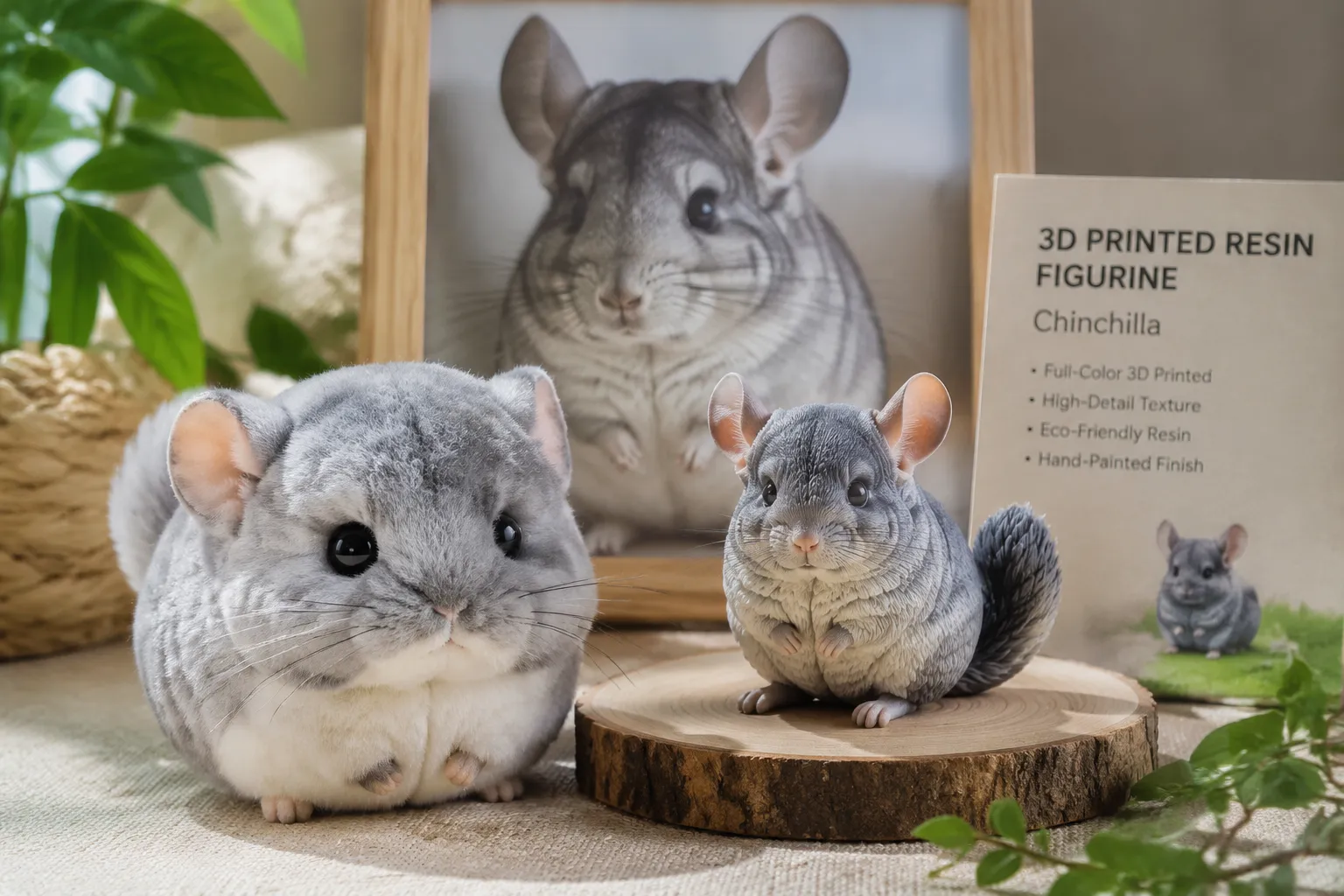
A chinchilla grows roughly 80 hairs from a single follicle—the densest coat of any land mammal, which is why predators can't get a grip on them. On the bedroom shelf where yours used to perch, a plush replica sits beside an eco-resin chinchilla figurine, and the quiet difference between the two is teaching you something about memory.
Quick Takeaways
- Plush replicas comfort first, resin endures longest — softness fades, but a figurine holds its detail for decades.
- "Eco-friendly" mostly means durability — an object that lasts 30 years replaces dozens of disposable ones.
- Scent is the hidden variable — plush absorbs and eventually loses your pet's smell; resin stays neutral.
- Color printed into the material won't peel or fade — explore how full-color 3D printed keepsakes capture a chinchilla's banded fur.
- The "before and after" isn't about looks—it's about what each object becomes as the years pass.
Two Objects, One Shelf: The Plush vs Resin Question Nobody Frames Correctly
Most comparisons of plush vs resin start with the wrong question. They ask which one looks more like your pet on the day you buy it. That's the easy question, and honestly, it tells you almost nothing.
Here's the thing we've learned working with thousands of pet families: an object's value isn't fixed at the moment of purchase. It's revealed slowly, over years, through handling and dust and sunlight and the particular way grief or affection moves through a household.
So the real question is this. What does each object become?
A plush chinchilla and a resin chinchilla figurine begin as near-equals on a shelf. Give them a year, then five, then fifteen, and they diverge in ways that say a great deal about why we make keepsakes at all.
"A plush toy remembers with you. A figurine remembers for you, long after the scent has gone."
We're going to do something the first five Google results won't. Instead of a tidy "pros and cons" chart, we'll walk both objects through time—a genuine before-and-after—and pay attention to the things people feel but rarely put into words. Texture. Smell. The small rituals that grow up around a kept thing.
Because a chinchilla isn't a generic animal you can approximate with a stock toy. Those silver-blue coats, the bands of color along each hair shaft (a pattern biologists call agouti banding), the round ears, the impossible softness—these are specific. And specificity is exactly what time tests.
Why a Chinchilla Makes This Comparison Unusually Honest
Some pets forgive a rough likeness. A black cat figurine can be a little generic and still read as "your cat." A chinchilla can't.
The coat does something strange under light. According to PetMD's overview of chinchilla care, that extreme fur density—the trait that keeps them dry and parasite-free in the high Andes—also gives the coat a velvety depth that flattens in cheap reproductions.
A plush toy approximates this with pile fabric. A resin print reproduces it as actual sculpted form and printed color. The gap between "approximate" and "reproduce" is the whole story, and it widens with time.
Before and After: What a Single Year Actually Does
Let's get concrete. We've handled returns, repairs, and re-orders long enough to know how these objects age in real homes—not in marketing photos.
Picture two shelves in two bedrooms. One holds a plush chinchilla, one holds an eco-resin figurine. Both arrived looking lovely. Now let's check on them.
Here's a side-by-side before and after comparison of how each keepsake typically changes over time:
| Timeframe | Plush Replica | Eco-Resin Figurine |
|---|---|---|
| Day 1 | Soft, huggable, accurate-ish silhouette | Sharp detail, true color, firm to hold |
| 6 months | Slight matting, dust settling into pile | Visually unchanged; light dusting wipes clean |
| 2 years | Faded patches, flattened fur, absorbed odors | Color identical to day 1; clear coat intact |
| 5 years | Seams loosening, stuffing compressed | Minor surface dust only; detail preserved |
| 15+ years | Often discarded or stored away | Display-ready; reads as an heirloom |
Notice what's happening. The plush object trends toward entropy. The resin object trends toward permanence.
Neither is wrong. They serve different emotional jobs. But if your goal is a keepsake that your future self—or your kids—can still hold and recognize, the trajectory matters more than the first impression.
The Plush Trajectory: Comfort That Fades
A customer once told us she kept her late chinchilla's plush stand-in on her pillow for the first three months. She'd press her face into it at night. For grief, that tactile softness is real medicine—pressure, warmth, something to hold when the room feels too large.
But plush has a built-in arc. The fibers compress. The pile mats where hands and cheeks touch most. Sunlight from the bedroom window leaches the dye, usually starting on the side facing the glass.
And here's the part people don't expect. The very feature that made it comforting—its ability to absorb and hold scent—also means it absorbs everything else. Dust. Detergent. The slightly sweet, musty note of a fabric that's been loved hard.
By year two, that plush often smells less like a comfort object and more like, well, an old toy. The thing that anchored you to your pet has quietly become something else.
The Resin Trajectory: Detail That Holds
The eco-resin figurine takes the opposite path. It doesn't invite face-pressing. It's firm, cool to the touch, a little heavier than you expect.
What it offers instead is fidelity that doesn't degrade. In a full-color resin 3D print, the color is part of the material itself—printed voxel by voxel into the body of the piece, not coated on the surface. There's nothing to peel, chip, or rub away.
The only thing applied afterward is a clear protective coat for sheen and durability. That's it. So when you dust it five years from now, you're looking at the same banded silver coat you saw on arrival.
For a chinchilla specifically, this is the difference-maker. Those subtle gradations from dark roots to pale tips survive because they're baked into the object, not painted on top of it.
"Permanence isn't cold. Sometimes it's the kindest thing an object can offer a grieving heart."
The "Eco-Friendly Pet Keepsake" Claim—Decoded Honestly
Let's talk about the phrase eco-friendly pet keepsake, because the marketing around it is often vague to the point of meaningless. We'd rather be straight with you.
Most plush toys are polyester—a petroleum-derived plastic fiber. They feel natural and soft, which fools people into assuming they're somehow gentler on the planet. They aren't. Synthetic plush doesn't meaningfully biodegrade, and when it wears out (which it does), it heads to a landfill where it persists for a very long time.
Here's the counterintuitive part. The most eco-friendly keepsake is usually the one you never have to replace.
A resin figurine that survives 30 years displaces every replacement plush you'd have cycled through in that time. Longevity is sustainability. An heirloom is, by definition, a thing that resists the disposable economy.
We're not going to overclaim and tell you resin is compostable—it isn't, and we won't pretend otherwise. What we'll say honestly is that durability and UV-resistance mean one object does the work of many, which is a real environmental argument that doesn't depend on greenwashed buzzwords.
The Overlooked Cost of "Cheap and Replaceable"
There's an emotional cost to disposability that no one prices in.
When a plush keepsake wears out, you face a small, strange grief all over again. Do you throw it away? It held your pet's name, maybe their scent. But it's matted and faded now. So it goes in a drawer, and the drawer becomes a place you avoid.
A family we worked with described exactly this—a closet shelf they couldn't bring themselves to open because the old plush was up there, neither displayed nor discarded, just suspended in guilt.
That limbo is the hidden tax of objects designed to age badly. A keepsake meant to honor a bond shouldn't eventually become a source of low-grade dread.
Myth vs. Reality
We hear the same misconceptions constantly. Let's clear three of them.
Myth #1: "Plush is always more comforting than resin."
Reality: Plush wins on day one for tactile comfort. But comfort that degrades can reopen the wound. Many people find that a permanent, unchanging figurine becomes the steadier long-term anchor—a presence that doesn't decay alongside the memory.
Myth #2: "Resin figurines look like cheap plastic."
Reality: This is true of mass-produced injection-molded plastic, not full-color 3D printed resin. Modern prints carry a fine natural grain—visible layer texture—that reads as authentic and organic, not glossy-fake. It looks made, not manufactured.
Myth #3: "Eco-friendly means flimsy or low-quality."
Reality: The opposite, usually. The genuine environmental win comes from objects built to last decades. Flimsy is the least sustainable thing there is, because flimsy gets replaced.
The Sensory Test: Smell, Weight, and the Memory in Your Hands
This is the section the generic articles skip entirely, and it's the one that matters most. Keepsakes aren't experienced through the eyes alone. They're experienced through the whole body, and especially—this surprises people—through smell.
What a Plush Chinchilla Smells Like Over Time
If you've shared your home with a chinchilla, you know their smell. Almost no odor at all, honestly—a faint clean warmth, the dry-cereal note of timothy hay, the powdery scent that lingers after a dust bath. It's one of the gentlest animal smells there is.
A new plush toy smells like nothing your pet ever was. Factory fabric, a whiff of packaging. Over months, it takes on the scent of your home and your hands. Some owners deliberately tuck it where their chinchilla slept, hoping to capture that hay-and-dust note.
It works, for a while. Then it doesn't. Fabric holds scent, but scent is volatile—it lifts away, replaced by dust and the generic must of aging textile. The smell you were trying to preserve is precisely the thing plush is worst at keeping.
"We don't keep figurines to forget. We keep them so the forgetting never gets the final word."
What a Resin Figurine Smells Like (And Why That's a Feature)
A resin figurine smells like almost nothing. A faint, clean note of the protective clear coat at first, fading to neutral within weeks.
People sometimes think this is a downside. We'd argue it's quietly profound.
A figurine doesn't pretend to be your pet's body. It doesn't impersonate their scent and then betray you when that scent disappears. It stands as a deliberate representation—an object that says "I remember" without trying to be the thing it remembers.
There's a kind of honesty in that. The plush asks you to mistake it for presence. The figurine asks you to recognize it as memorial. One of those relationships ages gracefully.
The Weight Difference Nobody Mentions
Pick up a plush chinchilla. It weighs nothing. That weightlessness is part of its charm and part of its problem—nothing weightless feels permanent.
Now pick up a resin figurine. There's heft. It settles into your palm. Grief and love both crave something with mass, something that pushes back against the hand. We've heard this again and again from customers: the unexpected comfort of weight.
It's the same reason weighted blankets soothe anxiety. Mass reads to the nervous system as stability, as here-ness. A keepsake you can feel the gravity of is doing emotional work the lightweight version simply can't.
How a Full-Color 3D Printed Chinchilla Figurine Comes to Life
If you're leaning toward the resin route, here's what the process actually involves—demystified, without the marketing gloss.
A custom chinchilla figurine isn't carved or cast. It's digitally sculpted by master 3D artists, then precision-printed in full-color resin. Understanding the steps helps you send the right materials and set realistic expectations.
| Stage | What Happens | Your Role |
|---|---|---|
| Photo submission | You provide reference images of your pet | Choose clear, well-lit shots from multiple angles |
| Digital sculpting | Artists model the form and markings in 3D | Review the preview, request adjustments |
| Full-color printing | The figurine is printed in color resin, voxel by voxel | Wait while the machine builds it layer by layer |
| Clear coat finish | A protective gloss is applied by hand for sheen and durability | None—this is the only manual finishing step |
| Delivery | The finished figurine ships to you | Find a good spot with indirect light |
For exact turnaround windows, revision policies, and guarantees, it's best to check the current details on PawSculpt's process page, since those specifics evolve.
What Photos Actually Work Best for a Chinchilla
This is where most people stumble, and chinchillas are trickier than most pets to photograph well. That dense coat eats detail in bad lighting.
- Natural, diffuse light — near a window on an overcast day beats harsh direct sun, which blows out the silver tones.
- Multiple angles — at minimum a clear side profile and a straight-on face shot, so the artists can model the full form.
- Show the markings — if your chinchilla has a specific color mutation (standard gray, beige, white mosaic, black velvet), include a shot that captures it accurately.
- Eye-level, not above — shooting down distorts those round proportions; get the camera level with them.
- Avoid motion blur — easier said than done with an animal that moves like a popcorn kernel. Burst mode is your friend.
The "so what" here: the figurine can only be as faithful as your references. Five good photos beat fifty blurry ones. We've seen a single crisp profile shot produce a stunning result, and we've seen folders of dark, fuzzy images slow everything down.
"A chinchilla's coat is too intricate to fake with stitching. We let the print carry every band of color the way the animal wore it."
— The PawSculpt Team
Care Instructions That Actually Extend the Life
A resin figurine is low-maintenance, but a few habits keep it heirloom-grade for decades.
- Display out of direct sunlight. The materials are UV-resistant, but indirect light is still gentler over a 20-year horizon.
- Dust with a soft dry cloth or a makeup brush. Skip household sprays and solvents—the clear coat doesn't need them.
- Keep it off heat sources. Avoid radiators, sunny dashboards, and fireplace mantels that get warm.
- Handle by the base when you can. Natural skin oils won't ruin it, but minimizing contact keeps the finish pristine.
Compare that to plush, which needs gentle spot-cleaning, never tolerates a washing machine well, and traps allergens regardless. The maintenance gap is another quiet point in resin's favor.
The Deeper Comparison: What We're Really Choosing Between
Step back from the materials for a moment. The choice between plush and resin is, underneath, a choice between two philosophies of remembering.
The plush philosophy says: let me hold something soft, something that ages and fades the way memory itself fades. There's a melancholy beauty in that. The Japanese have a concept for the poignancy of impermanence, and a worn plush toy embodies it—a thing that decays in sympathy with our own forgetting.
The resin philosophy says something different. It says: let me build a small monument. Let me fix this likeness in a form that outlasts my own grief, that my children might one day pick up and ask about.
This is the older instinct, honestly. Humans have made durable images of the beloved—in stone, in bronze, in clay—for as long as we've made anything. We didn't render the dead in soft cloth meant to wear out. We rendered them in materials that defied time, because the act of memorializing is fundamentally an argument against forgetting.
A figurine on a shelf is a small participation in that ancient ritual. It says the bond was real enough to deserve permanence.
When Plush Is Genuinely the Better Choice
We're not here to pretend resin wins for everyone. It doesn't.
If the keepsake is for a young child who needs to hold and squeeze, plush is the right call—you don't hand a grieving four-year-old a firm resin object and ask them to find comfort in its heft. They need softness, and that's exactly correct for them.
If the object is meant to be temporary—a comfort for the rawest first weeks, something you fully expect to let go of—plush serves beautifully and there's no shame in that.
And if budget is the deciding factor right now, a plush stand-in today doesn't preclude a permanent figurine later, when you're ready. Plenty of families do exactly that. The soft thing for the early grief, the lasting thing for the long memorial.
Being honest about this is the whole point. The best keepsake is the one that fits your moment, not the one a blog post insists upon.
Cost, Value, and the Math of Keeping
Let's talk value without inventing numbers we can't stand behind.
A plush toy carries a low upfront cost. A custom resin figurine costs more at the outset—it's bespoke, modeled to your specific animal. That's the obvious comparison, and it's the one that makes plush look like the "smart" choice.
But run the math across time. Here's how the value equation tends to shake out:
| Factor | Plush Replica | Custom Resin Figurine |
|---|---|---|
| Upfront cost | Low | Higher (bespoke) |
| Lifespan | A few years, realistically | Decades |
| Replacements needed | Several over a lifetime | None expected |
| Likeness accuracy | Generic to approximate | Specific to your pet |
| Heirloom potential | Minimal | High |
| Cost per year of keeping | Adds up with replacements | Drops steadily over time |
The figurine's cost per year of keeping keeps falling the longer you own it. The plush's effective cost climbs each time you replace one. Cheap things are often expensive in slow motion.
For current pricing on custom work, visit PawSculpt's main site directly—we won't quote figures here that might be out of date by the time you read this.
The Gift Dimension
One thing worth naming: these objects function very differently as gifts.
A plush toy is a kind gesture. A custom figurine is an event. We've watched recipients go silent—the good kind of silent—when they unwrap a figurine that captures a pet they thought no object could ever do justice to.
That reaction comes from recognition. The shock of seeing those specific markings, that specific posture, rendered in a thing they can hold. It's why custom keepsakes work so well for memorial gifts and milestone celebrations alike. If you're weighing options, the PawSculpt blog has more on choosing between living-pet celebrations and memorial pieces.
A Note on Living Pets, Not Just Memorials
Here's something we wish more people knew: you don't have to wait until your chinchilla is gone to commission a figurine.
In fact, some of the most joyful orders we see are for living, thriving pets—a chinchilla mid-popcorn, ears up, caught in a moment of pure absurd happiness. There's a particular freedom in making the keepsake while the subject is still bounding around your living room.
"The keepsakes made in joy and the keepsakes made in grief sit on the same shelf. Both say: this mattered."
The reference photos are easier to get when your pet is healthy and present. And there's something to be said for celebrating the bond out loud, now, rather than only memorializing it later. A figurine of a living pet is a small act of gratitude—a way of marking that this companionship is sacred while it's still here.
The bond between people and animals has measurable effects on human wellbeing; ongoing work documented through the NIH's human-animal interaction research continues to map just how deep that connection runs. Honoring it in a tangible form isn't sentimental excess. It's a recognition of something real.
Frequently Asked Questions
Is a plush or resin chinchilla figurine better?
It depends on what you need the object to do. Plush wins on immediate tactile comfort, especially for children or the rawest early weeks of grief. Resin wins on longevity, likeness accuracy, and heirloom potential, holding its detail for decades. For a permanent keepsake, resin is the stronger long-term choice.
Are resin pet figurines actually eco-friendly?
The honest answer is that their main environmental advantage is durability. Resin isn't biodegradable, but a figurine built to last 30 years replaces all the disposable plush toys you'd otherwise cycle through. Longevity is a genuine form of sustainability that doesn't rely on greenwashed claims.
Will a 3D printed figurine fade or peel over time?
In a full-color resin print, the color is part of the material—printed throughout the object rather than applied as a surface layer. There's nothing to peel or chip away. Combined with UV-resistant materials and a protective clear coat, the piece keeps its appearance for many years with simple dusting.
What photos work best for a custom chinchilla figurine?
Clear, well-lit images from multiple angles produce the best results. Aim for a side profile and a straight-on face shot taken at the chinchilla's eye level, in soft natural light. Avoid harsh sun, which washes out the silver tones, and skip blurry shots—a few crisp photos beat dozens of fuzzy ones.
Can I get a figurine made of a chinchilla that's still alive?
Absolutely, and we'd encourage it. Some of the most joyful pieces we see are of healthy, living pets caught mid-leap or mid-popcorn. Photos are easier to capture while your pet is active, and celebrating the bond now is its own quiet reward.
How do I care for a resin figurine so it lasts?
Display it out of direct sunlight, dust it with a soft dry cloth or makeup brush, and keep it away from heat sources like radiators or sunny windowsills. Avoid household cleaning sprays. With minimal care, it stays display-ready for decades.
Ready to Celebrate Your Pet?
Every pet has a story worth preserving. Whether you're honoring a beloved companion who's crossed the rainbow bridge or celebrating your chinchilla's springy, dust-bathing personality while they're still here, a custom eco-resin chinchilla figurine captures the banded silver coat and specific markings that make your pet impossible to replicate with off-the-shelf plush.
Visit pawsculpt.com to learn more about our full-color 3D printing process, preview turnaround, revisions, and quality guarantee.