DIY 3D Scan vs a Studio Husky Figurine: Which Delivers Faster, and Better?
Two summers ago, a husky named Koda churned up the same patch of park grass that now lies flat and still. The diy 3d scan vs custom figurine debate began for one family right there—on the bench where they used to wait.
Quick Takeaways
- A DIY 3D scan captures geometry, not likeness — the shape is easy; the presence is the hard part.
- Turnaround speed is a vanity metric — what matters is how few times you redo the work.
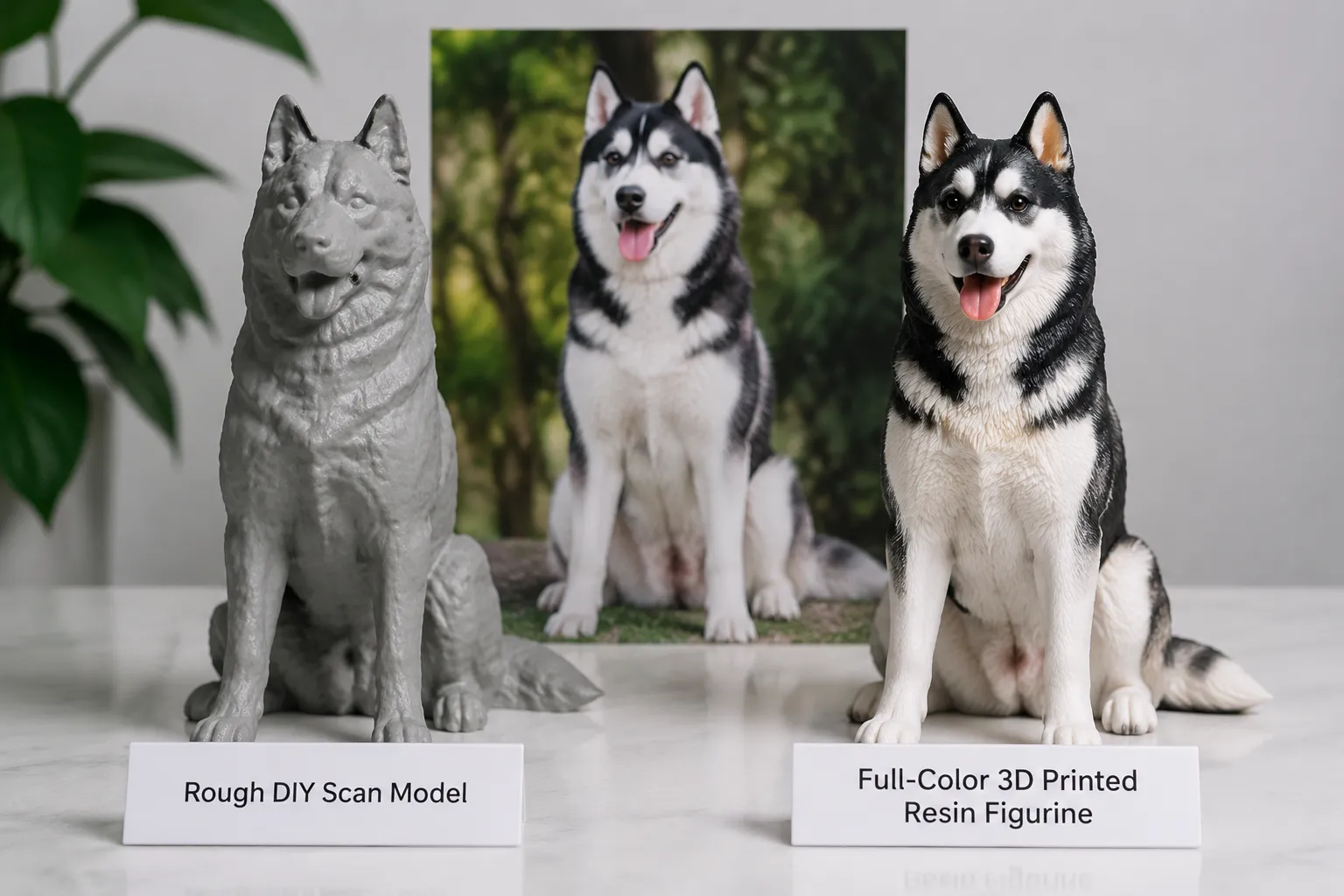
- Full-color resin printing reproduces husky markings directly — no approximation, no repainted guesswork.
- The pose you scan is usually an accident — intentional posing is what makes a piece feel alive.
- Before deciding, compare your real options with a studio that uses full-color 3D printing rather than guessing from a phone app.
The Question Underneath the Question
People think they're asking which method is faster. They're not.
When someone types "diy 3d scan vs custom figurine" into a search bar at eleven at night, the husky is usually asleep on the floor nearby—or the floor is empty in a way that has started to feel loud. The real question is quieter: Can I keep this? Can I hold the part of him that I'm afraid I'll forget?
Speed is just the mask the question wears.
We've worked with thousands of pet families, and the ones who chase "fast" almost always come back to "right." That's worth saying out loud before we get technical, because the entire comparison changes depending on which question you think you're answering.
Here's the thing most articles on this topic skip. They treat your dog like a coffee mug—an object to be measured, replicated, shipped. A husky is not a coffee mug. A husky is a specific arrangement of weight, attention, and warmth that you recognize from across a room before you can see his face. Capturing that is a problem of meaning, not millimeters.
So let's run the comparison nobody actually runs.
What a DIY 3D Scan Actually Captures (And What It Quietly Loses)
The technology is genuinely impressive. Modern phones with LiDAR (light detection and ranging—the sensor that maps depth by bouncing light) can build a usable 3D mesh of an object in minutes. Apps like Polycam or the scanning features in newer devices have put a tool in your pocket that cost tens of thousands of dollars a decade ago.
For a vase, a shoe, a chair? Remarkable. For a living husky? This is where the romance meets the grain of reality.
A scan needs its subject to hold still. Completely still, for the full sweep around the body. Ask any husky owner how that conversation goes. Huskies are working dogs bred for motion and independence—the American Kennel Club's breed profile describes a breed built to run, not to pose. The instant you circle them with a phone, they turn to follow you. They sniff the lens. They flop.
What you usually end up with is a mesh of a dog mid-blink, mid-shift, fur compressed where he was lying down, one ear caught at a strange angle.
"A scan freezes a random second. A sculpture chooses the second worth keeping."
That distinction is the whole ballgame. A scan is a transcription; a sculpture is a translation. One records what happened to be there. The other decides what mattered.
The Resolution Trap
Here's a counterintuitive truth: higher scan resolution often makes the problem worse, not better.
A high-detail scan faithfully records every flaw of that frozen instant—the saliva on the chin, the grass stuck to the coat, the way the cheek sagged against the floor. It captures the accident with perfect fidelity. You wanted your dog; you got a forensic snapshot of one unflattering moment, rendered in unforgiving detail.
The coat is the cruelest part. A husky's double coat (a dense insulating undercoat beneath longer guard hairs) reads to a scanner as noisy surface chaos. Scanners tend to either smooth it into a featureless blob or render it as digital static. Neither looks like the dog who leaned into your hand last winter.
When DIY Scanning Genuinely Works
We're not here to dismiss it. Honesty matters more than the pitch.
DIY scanning is a real, good option when:
- You have an extremely calm, trained, or older dog who will hold a pose for sixty seconds.
- You enjoy the process itself and treat the imperfections as part of the keepsake.
- You want a quick novelty, not a piece meant to outlive you.
- Budget is the hard constraint and approximate is genuinely good enough.
If that's you, go for it. Some memories don't need museum treatment, and there's dignity in a homemade thing made with love.
But if you're reading this because the floor feels empty, keep going.
Husky Figurine Turnaround: Why "Faster" Is the Wrong Finish Line
Let's talk about time honestly, because the husky figurine turnaround question deserves a real answer instead of a marketing number.
A DIY scan feels instant. Three minutes of scanning, upload, done. Studio work involves digital sculpting, review, printing, finishing. On paper, DIY wins the stopwatch by a mile.
On paper.
Here's what the stopwatch hides. The family that scanned Koda spent an evening capturing him, two more evenings cleaning the mesh, discovered the ears were fused to the head, tried to fix it, gave up, rescanned, and three weeks later had a file they didn't love. The "three-minute" solution ate a month of effort and ended in disappointment.
"The fastest path to a keepsake is the one you don't have to walk twice."
Real turnaround is measured in iterations, not minutes. A process that gets you to right on the first or second pass beats one that gets you to almost on the fifth.
Below is the comparison the way it actually plays out, not the way the stopwatch sells it.
| Stage | DIY 3D Scan | Studio Full-Color Print |
|---|---|---|
| Capture | 3 min (if dog cooperates) | Submit existing photos |
| Cleanup / sculpting | Hours to days (you) | Done by 3D artists |
| Color accuracy | Manual, approximate | Printed from photo reference |
| Revisions | Start over each time | Reviewed before printing |
| Likely redo rate | High | Low |
| Emotional payoff | Variable | Designed for it |
Notice the row that decides everything: revisions. With DIY, a mistake means restarting the entire chain. With a studio that previews before printing, a mistake is a comment you leave on a draft. That's the difference between editing a document and rewriting it.
For the specifics of how a particular studio handles previews and timing, you'll want to check their actual process—those details shift, and we'd rather you see current information than trust a number we typed once. You can explore how custom pet figurines move from photo to finished piece directly on the site.
Personal aside: Honestly, the orders that haunt us aren't the rush jobs. They're the ones where someone scanned their dog "to save time" in the last week of his life, got a mesh they couldn't use, and then he was gone and the chance was gone with him. We tell people this gently. Speed is not the same as not losing time.
The Pet Model Comparison Nobody Runs: Geometry vs. Presence
Every pet model comparison online stops at the same shallow checklist—polygons, price, print size. Useful, sort of. But it measures the wrong things.
The variable that actually determines whether you'll keep a figurine on your nightstand or shove it in a drawer is something no spec sheet lists: presence. Whether the piece, sitting silent on a shelf, makes the room feel a little less empty.
Presence comes from three things a raw scan can't supply.
1. The Pose Has to Mean Something
A scan captures whatever pose the dog happened to be stuck in. A sculpted model lets you choose the pose that is the dog—the play bow, the head tilt, the specific way he sat with one paw slightly turned out.
One family we worked with didn't want their husky standing heroically. They wanted him in the exact slump he made against the back door every evening, waiting to be let out for his last patrol of the yard. That slump was him. A generic scan would have erased it.
2. The Eyes Have to Look Back
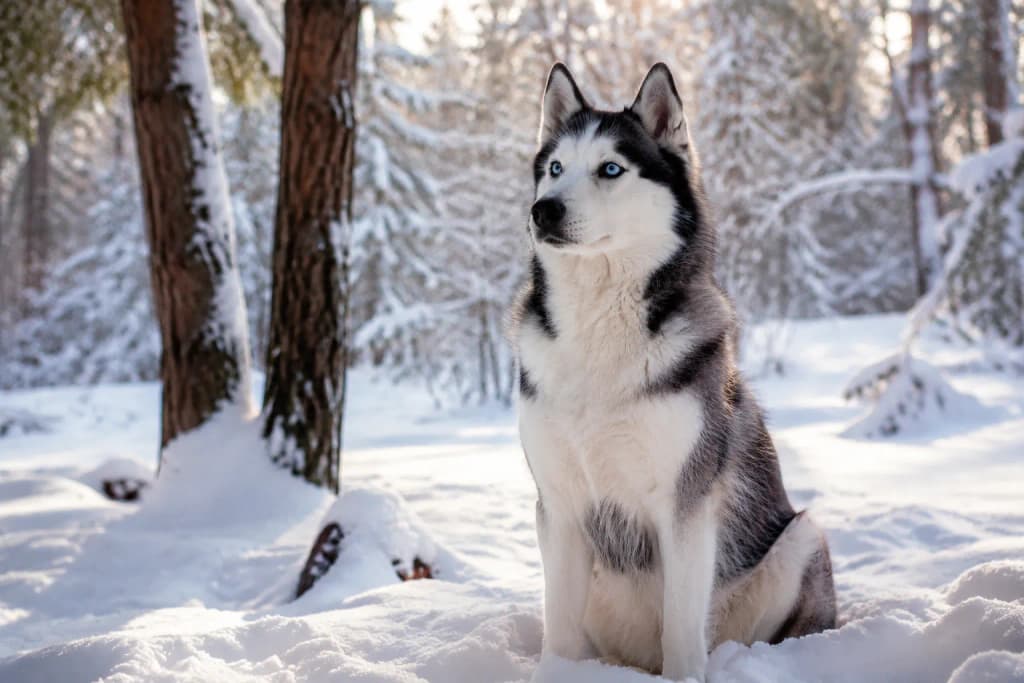
Huskies carry an enormous amount of their identity in the eyes—the almond shape, the ice-blue or brown or the striking heterochromia (two different colored eyes) that so many of them have. Scanners read eyes as dark, recessed holes. The light dies in them.
"The eyes are where a likeness becomes a presence—or fails completely."
Getting eyes right is patient, deliberate digital work. It's the single most common reason a finished piece either stops people in their tracks or leaves them cold.
3. The Markings Are a Fingerprint
No two huskies share the same mask. The way the dark saddle breaks across the shoulders, where the white blaze splits the face, the speckle of agouti coloring along the spine—these are as individual as a fingerprint. This is exactly where the creation method stops being a technicality and becomes the entire point.
Which brings us to the part most comparisons get embarrassingly wrong.
Resin Material Science: Why the Material Decides the Memory
This is the section that should change how you think, so we're going to slow down.
Most people assume color goes onto a figurine. You make the gray shape, then someone adds the colors on the surface. That mental model is decades out of date, and it's why so many "custom" figurines look like a generic dog wearing the wrong coat.
Here's the leap. In full-color resin 3D printing (the technology behind a museum-quality piece), color is not applied on top. The color is printed into the material, voxel by voxel—a voxel being a 3D pixel, the smallest unit of the printed volume. The machine deposits full-color resin point by point, so the markings are part of the object's body, not a coat draped over it.
Read that again, because it matters more than it sounds. The husky's mask isn't painted on. It's built in.
This is the resin material science that actually affects your keepsake:
- Color lives inside the resin, so it can't chip off a high point or wear away at the edges over years.
- UV-resistant formulations resist the fading that turns a vivid coat into a washed-out gray on a sunny windowsill.
- A protective clear coat is the one finishing touch added afterward—a varnish for sheen and protection, nothing more.
- The natural print texture (fine layer grain) gives the surface an authentic, tactile quality instead of a slick, plastic-perfect lie.
That last point is one we feel strongly about. A real husky's coat is not glossy plastic. The subtle grain of a full-color print reads, under the right light, more like fur than a mirror finish ever could. We'll be real—some people expect "perfect," and we have to explain that authentic and perfect aren't the same thing. The grain is a feature, not a flaw.
Here's how the material approaches actually compare on the things that determine whether your piece survives the next ten years on a shelf.
| Factor | Surface-Colored Models | Full-Color Resin Print |
|---|---|---|
| Where color lives | On the surface | Inside the material |
| Marking accuracy | Approximated | Reproduced from photos |
| Fade resistance | Varies, often poor | UV-resistant resin |
| Chipping risk | Color can flake | Color runs through |
| Finish | Often glossy plastic | Natural grain + clear coat |
| Best for | Quick novelty | Lasting keepsake |
"A husky's markings are a fingerprint. We don't approximate a fingerprint—we reproduce it, printed straight into the resin."
— The PawSculpt Team
This is why the DIY-scan-plus-manual-finishing route so often disappoints on huskies specifically. The breed's whole visual identity lives in subtle color transitions across the coat. Approximate those transitions and you get a husky. Reproduce them from real photographs, printed into the material, and you get your husky. The difference is the entire reason you wanted one.
What to Expect From a Studio Husky Figurine
If you've decided approximate isn't good enough, here's the honest walk-through—no invented timelines, just how the work actually flows.
The Photos Matter More Than the Camera
You do not need a professional camera. You need good reference, and good reference follows a few rules.
The single biggest upgrade is natural light. Window light, an overcast day outside, anything soft and even. Flash flattens the coat and kills the depth that makes a husky look three-dimensional. Below is what genuinely helps the artists.
| Shot | Why It Matters | Quick Tip |
|---|---|---|
| Front face, eye level | Captures expression and eye color | Get down to the dog's height |
| Full body, side profile | Defines proportion and posture | Stand back, zoom with feet |
| The signature pose | Captures personality | The pose you picture when you think of him |
| Close-up of markings | Reproduces the mask accurately | Photograph in shade, no flash |
| Both eyes if heterochromatic | Two-color eyes are easy to miss | One clear shot of each side |
A studio with skilled 3D artists can work from imperfect photos—we've reconstructed dogs from blurry, years-old phone pictures when that's all a grieving family had left. But the better your reference, the closer the likeness, and the fewer revisions you'll need.
The Process, Without the Fairy Tale
- You submit photos of your husky, ideally covering the angles above.
- 3D artists digitally sculpt the model, building the form, the pose, the eyes.
- You review a preview before anything is printed—this is your chance to say "the ears sit higher" or "that's not quite his tilt."
- The approved model is precision-printed in full-color resin, markings built into the material.
- A clear protective coat is applied for sheen and durability.
The review step in the middle is the quiet hero. It's what turns "close" into "that's him," and it's exactly what a DIY scan can't offer, because there's nobody on the other side translating your feedback into the model.
For current details on previews, revisions, and guarantees—the things that genuinely vary—the PawSculpt process page is the place to look rather than relying on numbers in a blog post.
Caring For the Finished Piece
A full-color resin print is durable, not indestructible. Keep it out of direct, all-day sun even with UV-resistant material—why tempt fade. Dust it with a soft, dry cloth. Skip harsh chemical cleaners that can dull the clear coat. Keep it off the edge of a shelf where a tail-wagging living dog might send it flying. That's genuinely the whole maintenance list.
So, Which Delivers Faster and Better?
Faster, on the stopwatch, sometimes the DIY scan—if your dog cooperates and your expectations are modest.
Faster to something you'll actually keep? Almost always the studio route, because you skip the redo spiral. Better? There's no real contest once the eyes and markings enter the conversation.
The deeper truth is that this was never a technology comparison. It's a question about what you're trying to preserve. A scan keeps a measurement of your dog. A sculpted, full-color print keeps a decision about which version of him you want to carry forward.
Researchers studying the human-animal bond—work supported by institutions like the National Institutes of Health—keep finding what every pet owner already knows in their body: these relationships occupy the same emotional architecture as our closest human ones. We don't grieve a coffee mug. We grieve a presence. And we reach, instinctively, for something to hold.
That reaching is ancient and it is not silly.
Frequently Asked Questions
Is a DIY 3D scan good enough for a husky figurine?
It depends on what you want. For a calm dog and a quick novelty, a scan can be a fun project. But huskies move, their double coat confuses scanners, and eyes read as dark holes. For a piece you'll keep for years, studio sculpting paired with full-color printing delivers a far stronger likeness.
How long does a husky figurine actually take?
Honestly, the meaningful number isn't print time—it's how many revisions you need. A DIY scan can fail and force you to start over repeatedly, eating weeks. A studio that lets you review a preview before printing usually gets you to "that's him" in fewer passes. Check the studio's site for current turnaround details.
Why do full-color resin prints reproduce markings better than painted models?
Because the color isn't on the surface—it's printed into the resin itself, point by point. A husky's mask, blaze, and saddle are reproduced from your actual photos and built into the material, so they can't chip or wear, and they match your specific dog instead of a generic template.
Will the figurine fade or get damaged easily?
Quality full-color resin is made with UV-resistant material and finished with a protective clear coat. It's durable, though not indestructible. Keep it out of all-day direct sun, dust it with a soft dry cloth, and avoid harsh cleaners. With that, it holds up beautifully for years.
What photos should I take for the best result?
Shoot in soft natural light, never flash. Get down to your dog's eye level for the face, capture a clean side profile for proportion, take a close-up of the markings in shade, and—most important—photograph the pose that you picture when you close your eyes and think of him.
Ready to Celebrate Your Pet?
That bench in the park, the slump against the back door, the eyes that looked back at you across a crowded room—those are the details worth preserving exactly, not approximately. When you weigh the diy 3d scan vs custom figurine choice, what you're really deciding is whether to keep a measurement or keep a presence. A custom PawSculpt figurine, digitally sculpted by master 3D artists and printed in full-color resin, captures the markings and the moment that make your husky unmistakably yours.
Visit pawsculpt.com to explore the process, preview options, and quality guarantee.