Don't Force the Sit: Why Action Shots Make Better Samoyed Figurines
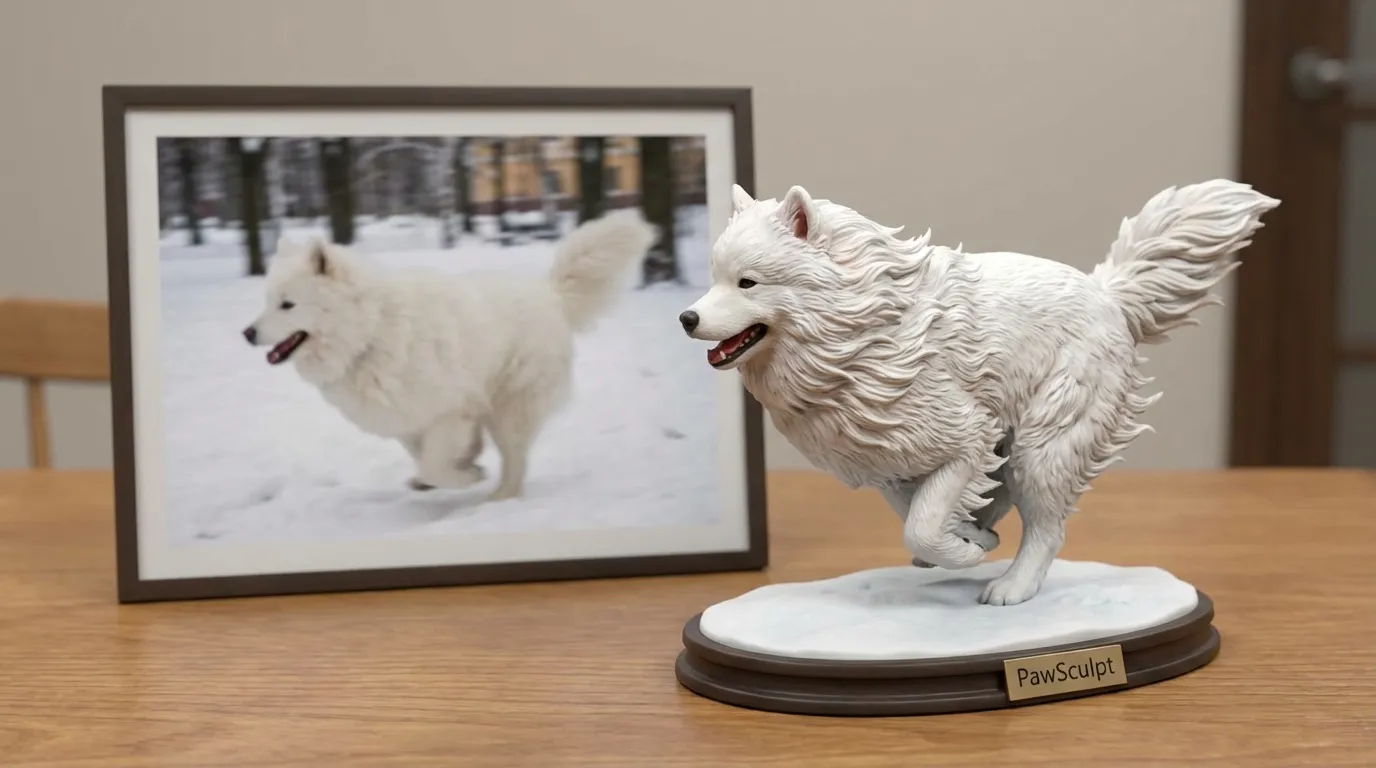
"Life is movement." — Aristotle. You’re standing in the frozen grass of the dog park, breath clouding in the chill air, watching a white blur streak past you. That explosion of joy is the essence of the breed, yet most owners struggle to capture Samoyed action shots that truly reflect that spirit.
Quick Takeaways
- Static poses flatten fur — sitting compresses the coat, making Samoyeds look like generic "white blobs" in photos and figurines.
- Movement defines anatomy — running or jumping separates fur layers, creating the contrast needed for detailed 3D modeling.
- Overcast is an advantage — bright sun blows out white highlights; cloudy days act as a natural softbox for texture.
- Capture the "Sammy Smile" — panting during play naturally exposes the characteristic upturned mouth corners better than posed smiles.
- Turn photos into art — use your best action shots to create custom pet figurines that preserve that energy forever.
The "White Blob" Problem: Why Sitting Ruins the Shot
Let’s be honest: we’ve all tried to force the sit. You hold the treat high, command "stay," and wait for your Samoyed to freeze. The result? Usually, a photo that looks like a well-groomed snowman.
Here is the practical reality of photographing double-coated white dogs: light reflection kills detail.
When a Samoyed sits still, their guard hairs lay flat against the undercoat. In a photograph, and subsequently in a 3D model, this creates a uniform surface. Without shadows to define the muscles or the separation of fur clumps, the camera sensor (and later, the 3D printer) interprets the dog as a single mass of white.
"A static Samoyed is a cloud; a moving Samoyed is a lightning storm. You want to capture the lightning."
The Physics of Fluff
To get a high-quality figurine or a stunning photo, you need texture. Texture is created by shadow.- Separation: The long guard hairs lift away from the dense undercoat.
- Shadowing: Light gets trapped between these layers, creating dark definitions that show the dog's actual shape.
- Directionality: The fur flows backward, illustrating speed and wind direction.
If you send us a photo of a sitting Samoyed for a custom figurine, we can model it beautifully. But if you send us a photo of a Samoyed mid-trot, coat blowing in the wind? That figurine will look like it’s about to jump off the shelf.
Gear Settings: Stop Guessing, Start Freezing
You do not need a $3,000 DSLR to get this right. You just need to stop using "Auto" mode. Whether you are using an iPhone or a mirrorless camera, the goal is to freeze motion without losing the white details.
The "Action Priority" Setup
Most people get blurry photos because their shutter speed is too slow. A Samoyed moves deceptively fast.For Smartphone Users:
- Turn OFF Live Photo: It reduces the resolution of the key frame.
- Use Burst Mode: Hold the shutter button and slide left (iPhone) or hold down (Android). You need 10 frames per second to catch the perfect paw placement.
- Lock Focus: Tap and hold on the area where the dog will be, not where they are.
For Camera Users (Manual/Pro Mode):
- Shutter Speed: Minimum 1/1000th of a second. If it’s sunny, go to 1/1600th.
- Aperture: f/4.0 to f/5.6. You want a little depth of field so the nose and tail are both in focus.
- ISO: Auto (let the camera decide this part).
The Exposure Compensation Trick
This is the insider secret for white dogs. Camera meters are designed to make everything "middle gray." When a camera sees a big white dog, it thinks the scene is too bright and darkens the image, making your bright white Samoyed look dingy or gray.The Fix: Go into your exposure settings (usually a +/- symbol) and set it to +0.7 or +1.0. This tells the camera, "Yes, this object is supposed to be bright white."
The Best Dynamic Poses for 3D Modeling
Not all action is created equal. A photo of a dog mid-shake often looks bizarre frozen in time (eyes closed, lips flapping). We need "controlled chaos."
Here are the three specific movements that translate best into dynamic pet poses for figurines:
1. The Floating Trot
This is the show-ring standard for a reason. It’s when diagonal legs move together (front right and back left).- Why it works: It shows off the plume of the tail and the ruff around the neck perfectly.
- How to get it: Have a friend walk parallel to you, calling the dog. Do not run directly at the camera.
- Figurine Result: Elegant, regal, and structurally stable.
2. The Play Bow
The universal sign of "let's go!" Front elbows on the ground, rear end in the air, tail wagging.- Why it works: It stretches the back, separating the spinal fur. It also usually guarantees the "Sammy Smile" and alert ears.
- How to get it: Get on your stomach in the grass. You need to be at their eye level. Make a sudden movement or squeak a toy near the ground.
- Figurine Result: High energy, inviting, and emotionally resonant.
3. The "Zoomie" Turn
Catching the dog as they bank around a corner.- Why it works: Centrifugal force flares the coat outward. It makes the dog look twice as fluffy.
- How to get it: Throw a ball past you, but slightly to the side, so they have to arc to get it.
- Figurine Result: Dramatic and impressive. The 3D printing process captures the "flying" fur details beautifully.
Lighting: The Enemy of the White Dog
Most pet blogs tell you to shoot during "Golden Hour" (sunset). For Samoyeds, this is risky advice.
The warm, yellow light of sunset can stain a white dog’s coat in photos. If you want a figurine that looks like your dog—pure white, biscuit, or cream—you need neutral light.
The Cloud Cover Advantage
The best weather for photographing a Samoyed is a bright, overcast day. The clouds act as a giant diffuser. This prevents harsh black shadows (which look like holes in the dog) and blown-out highlights (which look like white holes).Table: Lighting Scenarios for White Coats
| Lighting Condition | Effect on White Fur | Suitability for Modeling | Pro Tip |
|---|---|---|---|
| Direct Noon Sun | High contrast, deep shadows. | Poor. Hides eyes, blows out top of head. | Move to open shade under a tree. |
| Golden Hour | Beautiful mood, yellow cast. | Medium. Colors may be inaccurate. | Adjust White Balance to "Cool" later. |
| Overcast/Cloudy | Soft shadows, high texture. | Excellent. Best for 3D detail. | Shoot against a dark background (green grass/trees). |
| Indoors | Grainy, yellow tint. | Poor. Avoid unless using studio lights. | Move furniture to get near a window. |
Grooming for the Action Shot
You might think you should brush your dog smooth before a photo session. Don't.
For a 3D figurine, we want texture. A perfectly slicked-down coat looks like plastic. A coat that has been "line brushed" (brushed from the skin out) and then roughed up by play has depth.
- Brush the dog thoroughly to remove mats (mats look like lumps in 3D).
- Just before shooting, run your hands backward through their ruff.
- Let them shake.
- Shoot immediately.
This separates the guard hairs and allows the camera to see the individual strands, which our digital sculptors can then replicate in the 3D model.
"We see thousands of photos. The ones that make the best figurines aren't the perfect portraits—they're the ones where the fur is messy, the tongue is out, and the dog is visibly happy."
— The PawSculpt Team
From Pixel to Polymer: How Action Shots Become Figurines
Understanding how we work at PawSculpt helps you take better reference photos. We use full-color 3D printing technology. This isn't a white statue that gets painted later. The color is inherent in the resin material itself.
The "Voxel" Difference
Our printers lay down material voxel by voxel (think of a 3D pixel). This means we can achieve gradients that hand-painting simply cannot match.- Biscuit Markings: If your Samoyed has biscuit coloring on the ears or elbows, an action shot in natural light shows us exactly where that gradient starts and stops.
- The "Silver Tips": Many Samoyeds have silver tips on their guard hairs. In a static indoor shot, these disappear. In an outdoor action shot, they catch the light, allowing us to incorporate that sheen into the digital sculpt.
- Structural Integrity: When we digitally sculpt a running dog, we ensure the legs are thick enough to support the model while maintaining the look of fine bone structure using fur volume.
What we don't do: We do not use acrylic paints or brushes. We don't "guess" the color. We pull the data directly from the visual information you provide. That’s why a blurry photo results in a less detailed figurine, and a sharp action shot results in a masterpiece.
"Grief isn't a problem to be solved. It's a love story that continues after the last chapter."
The Emotional Weight of Action
There is a deeper reason to choose an action shot over a static sit, especially if you are commissioning a memorial piece.
When we lose a pet, the first thing we forget is not what they looked like sleeping—it’s how they moved. We forget the specific rhythm of their trot, the way they banked off the couch during zoomies, or the bounce in their step when they saw the leash.
A figurine of your Samoyed sitting is a beautiful object. A figurine of your Samoyed running is a memory in motion. It captures the agency and the life force of the animal.
Case Study: The "Flying" Samoyed
We recently worked with a family whose Samoyed, Koda, was known for his vertical leaps. They had plenty of photos of him sleeping on the rug. But they dug through their archives and found a blurry, chaotic photo of him mid-air catching a frisbee.Using that reference (and several others for color accuracy), our artists sculpted Koda in mid-flight, supported by a discreet clear resin base. When the family unboxed it, they didn't just see a dog; they saw Koda. The static poses were cute, but the action pose was true.
Frequently Asked Questions
Can I use a video instead of a photo for a custom figurine?
Yes! High-resolution 4K video is actually excellent for 3D modeling. We can pause the video frame-by-frame to see the dog's anatomy from multiple angles and capture the perfect split-second pose that illustrates their stride or jump.Does the background of my photo matter?
For white dogs like Samoyeds, a dark background is best. Green grass, dark trees, or a gray wall provides the necessary contrast. Avoid photographing a white dog against a white wall or snow, as the edges of the fur will get lost, making it harder for our artists to distinguish the silhouette.How many photos do I need to send for a custom figurine?
We recommend 5-10 photos. One "hero shot" for the main pose, and then supplementary photos showing the face close-up, the tail markings, and both sides of the body. The more angles we have, the more accurate the digital sculpture will be.Can you fix the leash in the photo?
Absolutely. Our digital sculptors routinely remove leashes, harnesses, and collars from the design unless you specifically want them included. We reconstruct the fur texture digitally where the gear was covering it, ensuring a natural look.Ready to Celebrate Your Pet?
Every pet has a story worth preserving. Whether you're honoring a beloved companion who's crossed the rainbow bridge or celebrating your furry friend's unique personality, a custom PawSculpt figurine captures those details that make your pet one-of-a-kind. Don't settle for generic; let's turn your best Samoyed action shots into a lasting legacy.
Free instant AI preview • 3D artist preview within 7 days • 5 free revisions