
Why Keeping Your Rabbit's Memory Box Isn't Hoarding—It's a Healing Ceremony
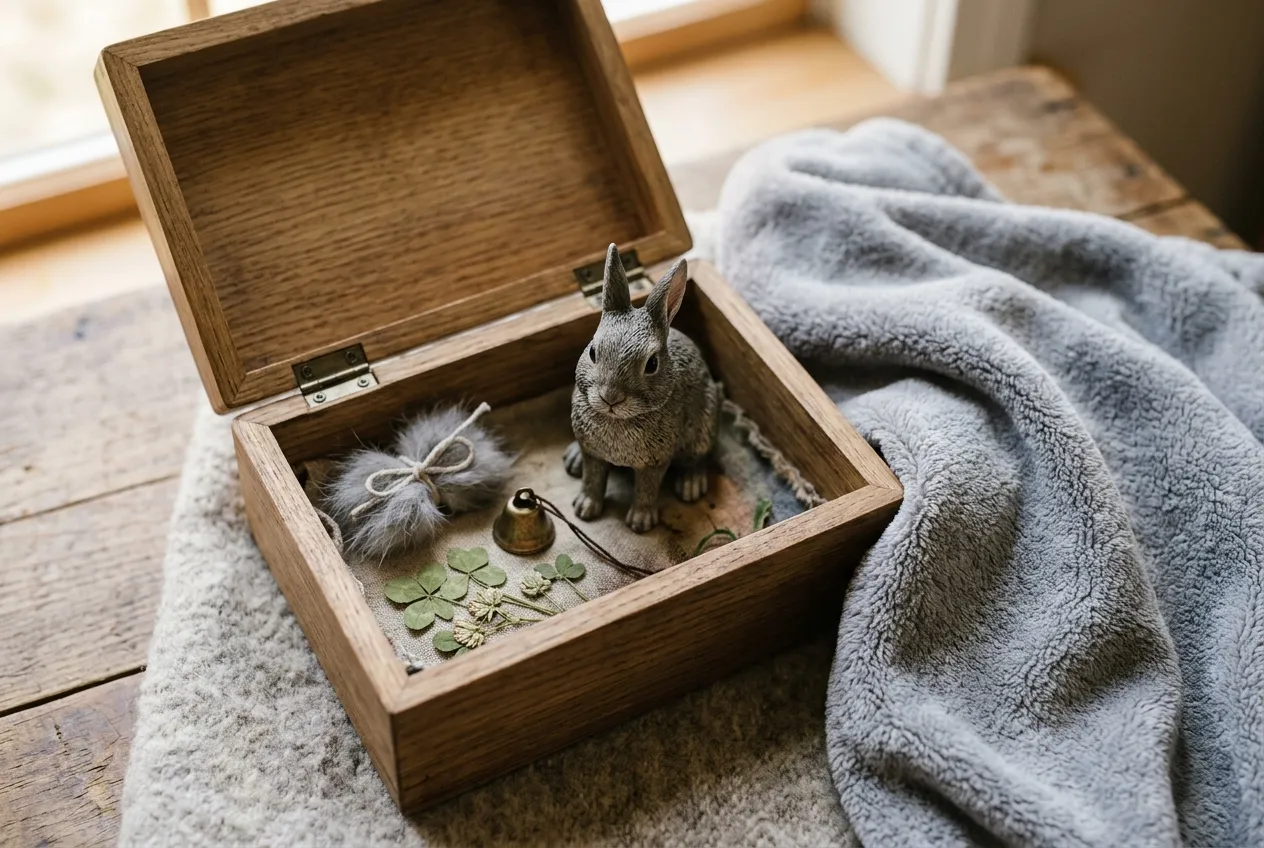
The hay-dust smell hits you first—sweet, grassy, faintly medicinal—as you stand in the pet store aisle where the rabbit supplies used to matter. Your hand lingers on a bag of timothy hay, and somewhere in the back of your mind, you're already building a rabbit memorial memory box without realizing it.
Quick Takeaways
- A memory box isn't clutter—it's a psychological anchor that gives grief a physical address in your home
- Curate with intention, not volume — five meaningful objects outweigh fifty random ones
- Include sensory items like a pinch of hay or a swatch of fleece to activate memory pathways beyond photographs
- Pair physical keepsakes with a dimensional tribute like a custom 3D-printed figurine to preserve your rabbit's unique likeness
- Revisit your box on your terms — there's no schedule, no expiration date, no right way to grieve
The Neuroscience of Why You Can't Throw Their Things Away
Here's something most grief articles won't tell you: the reason you physically cannot bring yourself to discard your rabbit's belongings has almost nothing to do with sentimentality. It's neurological.
When you held your rabbit—felt the vibration of a purr-like tooth grinding against your chest, watched those ears pivot toward your voice—your brain was busy encoding multisensory memory traces. Smell, touch, sound, sight, all woven together in the hippocampus and amygdala like threads in a braid. Those objects in your home? They're not just things. They're keys to neural pathways that still fire as if your rabbit is alive.
Attachment theory, first described by John Bowlby in the context of human bonds, applies to our relationships with animals with striking precision. The bond you formed with your rabbit activated the same oxytocin-driven attachment circuits that govern parent-child bonding. When that bond is severed—by death, by absence—the brain doesn't just feel sad. It feels disoriented. It searches.
That water bottle still hanging on the cage wire? Your brain registers it as evidence that the attachment figure might return. Removing it triggers a stress response—a spike in cortisol—because at a neurological level, you're erasing proof that your rabbit existed.
So no, keeping a small ceramic bowl with teeth marks on the rim doesn't make you a hoarder. It makes you a human whose brain is doing exactly what brains do: holding on to anchors in a storm.
"A memory box isn't about the past. It's about giving your love somewhere to live right now."
The distinction between hoarding and honoring is intentionality. Hoarding is avoidance—piling objects to dodge pain. A pet memory box is the opposite: it's curation. Selection. A deliberate act of choosing what matters most and giving it a container, both physical and emotional.
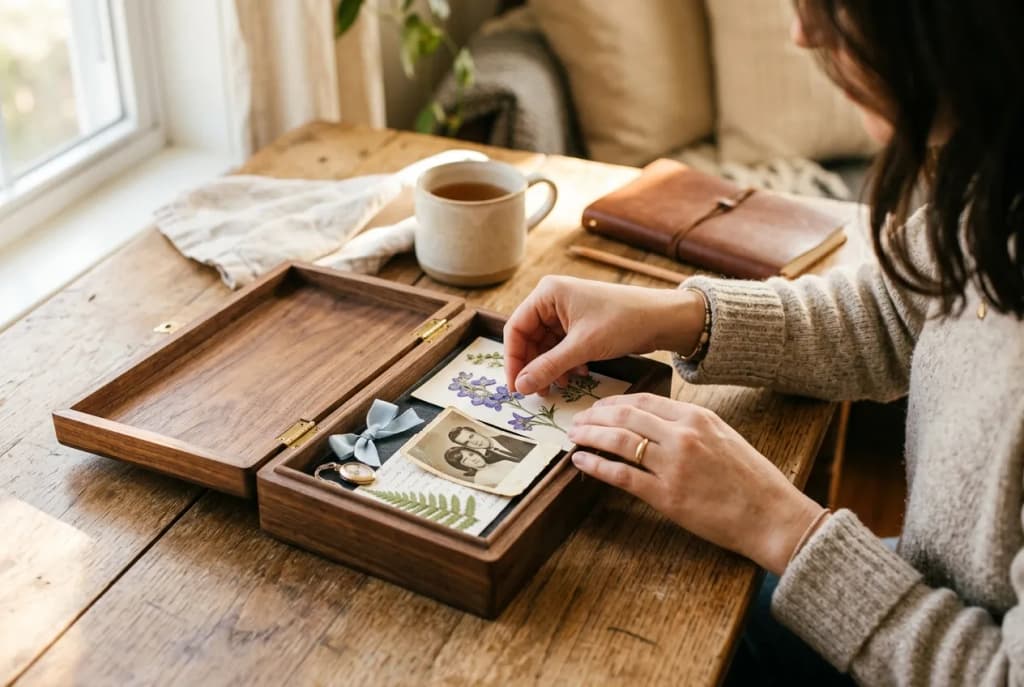
What Actually Belongs in a Rabbit Memorial Memory Box (And What Doesn't)
Most guides hand you a generic checklist. Collar. Photo. Paw print. But rabbits aren't dogs, and the keepsakes that matter for rabbit owners are specific, sometimes strange, and deeply personal.
Let's get practical.
The Sensory Layer: Items That Trigger Memory Pathways
Your strongest memories aren't stored as images. They're stored as sensations. Prioritize objects that engage multiple senses simultaneously:
- A small bag of their favorite hay — sealed in a zip-lock, that smell will last years. Timothy hay, orchard grass, whatever they loved. Open it on hard days. Your olfactory bulb connects directly to the amygdala, which is why scent triggers emotion faster than any photograph.
- A swatch of their favorite fleece blanket — not the whole blanket, just a palm-sized piece. Texture matters. The softness under your thumb can pull you back to a specific evening, a specific lap.
- A few strands of fur — tucked into a small envelope or vial. We know this one feels odd. But fur carries scent and color and the literal DNA of the creature you loved.
- A piece of chewed cardboard or a willow stick — tooth marks are signatures. Your rabbit's teeth left a specific pattern no other rabbit would replicate. That's a fingerprint.
The Visual Layer: Documenting Who They Were
| Item | Why It Matters | Storage Tip |
|---|---|---|
| 3-5 printed photographs | Anchors specific moments, not just general appearance | Use acid-free photo corners, not adhesive |
| A short written description of their personality | Memory fades; written words don't | Handwrite it—your handwriting adds a personal layer |
| Veterinary records or their adoption paperwork | Documents their origin story | Fold and tuck into an envelope |
| A screenshot of a favorite social media post about them | Captures how you talked about them to others | Print it; digital files corrupt |
The Symbolic Layer: Objects That Represent, Not Replicate
This is where most people either overthink or underthink. The symbolic layer is about representation—objects that stand in for something larger.
A small figurine that captures your rabbit's exact markings, ear set, and coloring can hold more emotional weight than a dozen photos. This is where technology has genuinely changed what's possible. Companies like PawSculpt use full-color 3D printing to produce figurines from photographs—your rabbit's specific coat pattern, their particular lop or upright ear carriage, reproduced in color resin where the pigment is embedded directly into the material itself. It's not a generic "bunny statue." It's your rabbit.
A figurine like this becomes a focal point for the memory box—something three-dimensional you can hold, turn in your hands, set on a shelf where it catches the light the way your rabbit used to catch the morning sun on the living room floor.
What to Leave Out
Honestly? Leave out anything that triggers avoidance grief rather than integrated grief. If holding their harness makes you feel panicked rather than tender, it's not ready for the box yet. You can always add things later. A memory box is a living collection, not a time capsule you seal shut.
And here's a counterintuitive insight most grief resources skip: you don't need to include everything that reminds you of them. A memory box that contains too much becomes overwhelming—a miniature version of the room you can't walk into. The power of a pet keepsake box lies in its boundaries. Five carefully chosen items carry more emotional clarity than a crate full of accessories.
Personal Aside: We worked with a customer once who included exactly three things in her rabbit's memory box: a tuft of grey fur, a dried chamomile flower from her garden where her rabbit used to binky, and a PawSculpt figurine. She told us the figurine was the one thing she could look at without crying—because it showed her rabbit alive, alert, ears forward. "The photos show me what I lost," she said. "The figurine shows me what I had." That distinction has stuck with us ever since.
The Emotions Nobody Warns You About After Losing a Rabbit
Grief counselors talk about stages. Denial, anger, bargaining—you know the list. But rabbit loss carries a particular emotional texture that general pet grief frameworks tend to miss, partly because society still hasn't fully recognized rabbits as the deeply bonded companion animals they are.
The Shame of Grieving "Just a Rabbit"
Let's name this one directly, because it poisons everything else.
Many rabbit owners feel ashamed of the intensity of their grief. A coworker loses a dog and gets sympathy cards, a day off work, gentle check-ins. You lose a rabbit and get— what? A shrug. An awkward joke about Easter. The implicit message: it was just a small animal. It didn't even bark.
This is what psychologists call disenfranchised grief—mourning a loss that your social environment doesn't fully recognize or validate. The Association for Pet Loss and Bereavement has documented this phenomenon extensively among owners of rabbits, birds, reptiles, and other non-traditional companion animals. The grief is identical in neurochemistry. The social support is not.
If you've felt this shame—if you've caught yourself minimizing your own pain because you were afraid someone would think you were overreacting—know that your brain formed the same oxytocin bonds with your rabbit that it would have with any companion animal. The weight of the loss is proportional to the depth of the bond, not the size of the animal.
"Grief isn't measured in pounds. It's measured in moments shared."
The Guilt You Might Not Want to Admit
Here's the one people whisper about but rarely say out loud.
Some rabbit owners feel relief when their rabbit dies—especially after a long illness—and then immediately feel guilty about that relief. GI stasis, head tilt, cancer. Rabbit illness is sudden, repetitive, expensive, and terrifying. If you spent months administering critical care through a syringe, sleeping on the floor next to their enclosure, rushing to the exotic vet at midnight—your nervous system was in a sustained state of hypervigilance. Chronically elevated cortisol. Fight-or-flight, but for weeks or months on end.
When your rabbit finally passed, your body exhaled. The relief was physiological before it was emotional. And then the guilt arrived like a second wave: How can I feel relieved? Does this mean I wanted them to die? What kind of person feels lighter after their pet's death?
The kind of person who was carrying an impossible weight out of love. That's who.
The relief doesn't cancel the grief. They coexist—two truths in the same body at the same time. Psychologists call this cognitive dissonance, and it's one of the most disorienting features of bereavement. You don't have to resolve it. You just have to stop punishing yourself for feeling it.
Second-Guessing the Euthanasia Decision
Rabbit euthanasia decisions are uniquely agonizing because rabbits hide pain so effectively—a survival instinct inherited from prey animals. The window between "maybe they're okay" and "they're clearly suffering" can be heartbreakingly narrow.
If you've replayed the timeline—Did I wait too long? Did I act too soon? What if the vet was wrong?—that repetitive thought loop is your brain trying to regain a sense of control over something that was, fundamentally, uncontrollable. The loop isn't productive, but it's normal. It typically peaks in the first three to six weeks after loss and gradually loosens its grip as the brain processes the trauma.
One concrete strategy that helps: write the timeline down. Not to analyze it, but to externalize it. When the loop lives only in your head, it spirals. When it lives on paper—dates, vet visits, symptoms observed—it becomes a narrative with a beginning, middle, and end. And narratives, unlike loops, can be closed.
The Fear of Forgetting
This one creeps in later. Maybe a month out, maybe three. You try to recall the exact shade of brown behind their ears and it's... fuzzy. You can't remember if they thumped with their left foot or their right. The sound of their water bottle clicking in the middle of the night is fading.
The fear of forgetting is one of the deepest anxieties in pet grief, and it's the reason memory boxes matter so much. They function as what neuroscientists call external memory stores—physical objects that supplement and stabilize biological memory, which is inherently unreliable and subject to decay.
Your memory box isn't nostalgia. It's architecture. It's the scaffolding that holds the memory in place while your brain does the slow, imperfect work of integrating loss into the ongoing story of your life.
Building the Box: A Step-by-Step Ceremony (Not a Craft Project)
The word "ceremony" matters here. This isn't a Pinterest project. It's not about decorative washi tape or matching ribbons (unless that's your thing—no judgment). It's about creating a ritualized space for grief, which anthropologists and psychologists alike have identified as one of the most effective tools for processing loss.
Step 1: Choose the Container
The box itself matters more than you'd think. It becomes the physical boundary of your grief—a defined space that says, This is where the sadness lives. It has edges. It is contained.
| Container Type | Best For | Considerations |
|---|---|---|
| Wooden keepsake box (unfinished) | Owners who want to customize over time | Can be carved, stained, or written on |
| Archival storage box (acid-free) | Protecting fragile items like photos or paper | Available at craft stores; looks plain but performs well |
| Decorative tin or vintage box | Owners who want something that fits their home aesthetic | Make sure it's deep enough for a figurine |
| Fabric-lined jewelry box | Small collections (5-7 items) | The velvet interior feels ceremonial |
| Ceramic or porcelain container | A more permanent, display-worthy option | Heavier; less portable but beautiful |
Choose something you wouldn't mind seeing on a shelf. Something that looks intentional, not hidden.
Step 2: Gather Without Judging
Set aside an hour when you won't be interrupted. Walk through your home with a basket or tray. Collect anything that pulls at you—hay, toys, their nail clippers, a receipt from the vet, a half-chewed baseboard (yes, really).
Don't edit yet. Just gather.
Step 3: Sort by Emotional Weight
Lay everything out on a table or bed. Now ask yourself, for each item: Does this make me feel closer to who they were, or does it pull me into the panic of losing them?
Items in the first category go in the box. Items in the second category go into a separate bag—you can revisit them later, donate them, or let them go. This sorting process is itself therapeutic. You're training your brain to distinguish between grief-as-connection and grief-as-wound.
Step 4: Add a Written Element
This is the step most people skip, and it's the one that matters most in the long run.
Write a letter to your rabbit. Or write a list of their habits. Or write the story of the day you brought them home. Doesn't matter what form it takes. What matters is that you're converting episodic memory (the brain's raw, sensory footage) into semantic memory (organized, narrative knowledge). This conversion is how the brain moves from acute grief toward integrated remembrance.
Some prompts if you're staring at a blank page:
- The first time they binkied in your house
- Their most ridiculous habit
- The sound they made when they wanted treats
- Where they liked to sleep at 2 p.m.
- Something they destroyed that you secretly loved them for destroying
Step 5: Place a Centerpiece
Every memory box benefits from a focal object—something that represents your rabbit as a whole, not just a fragment of their life. A portrait works. A cast paw print works. But three-dimensional objects tend to carry more emotional weight because they occupy space the way your rabbit did.
"Every whisker position, every ear tilt—those aren't just details. They're the vocabulary of a relationship."
— The PawSculpt Team
A custom pet figurine serves this role particularly well for rabbit owners because rabbit coloring and markings are so individual—the specific pattern of a broken tort, the eye rings of a Dutch, the frosted tips of a blue otter. PawSculpt's full-color 3D printing process embeds color directly into the resin at a voxel level, meaning your rabbit's exact coat pattern is structurally part of the figurine, not a surface treatment that could chip or fade. It's a distinction that matters when you're creating something meant to last decades.
Step 6: Close the Box (But Not Forever)
Place the lid on. Put the box somewhere you'll see it—a bookshelf, a nightstand, the spot on the floor where their enclosure used to be.
And here's the part nobody tells you: you get to open it whenever you want. There's no protocol. Some people open theirs every day for the first month, then weekly, then on anniversaries. Some people never open it again but feel anchored knowing it's there. Both approaches are valid. The box exists on your terms.
The Empty Space Problem: What to Do With the Hole in Your Home
This is the angle most memorial guides completely ignore, and it's the one that hits rabbit owners hardest.
Rabbit enclosures are large. An x-pen setup, a dedicated room, a multi-level condo—whatever your rabbit's living space looked like, its absence is spatial. It's architectural. You walk into a room and the geometry is wrong. There's too much floor. The corner where the litter box sat is just... a corner now.
This isn't metaphorical grief. This is spatial disorientation, and it's a genuine psychological phenomenon. Environmental psychologists have studied how humans form cognitive maps of their living spaces, and companion animals become landmarks in those maps. Remove the landmark, and the map glitches.
Should You Dismantle the Enclosure Right Away?
No one gets to answer this question for you. But here's what we've observed from working with thousands of pet families:
Dismantling too fast can feel violent—like erasing evidence. It can trigger a cortisol spike similar to the original loss. If someone pressures you to "clear it out" before you're ready, that person means well but doesn't understand the neuroscience of spatial attachment.
Keeping it up indefinitely without change can calcify grief—turning the space into a shrine that you orbit but never integrate. The enclosure becomes a wound you walk past fifty times a day.
The middle path, which works for many people: dismantle gradually. Remove the hay rack first. Then the water bottle. Then the litter box. Over days or weeks, let the space transition. And when the enclosure itself comes down, consider placing something intentional in that spot—a plant, a small shelf with their photo and memory box, a reading chair. You're not replacing your rabbit. You're telling your brain: this space has a new purpose now. The map is updating.
Common Mistakes That Turn Healing Into Hoarding
Let's be honest about the line between a rabbit memorial memory box and a problem. Because there is a line, and it's worth acknowledging with compassion rather than judgment.
Keeping Everything
One bag of hay is a memory. Seventeen bags of hay stored in the garage is avoidance. If you find yourself unable to discard any item associated with your rabbit—including things with no emotional significance, like a half-used bag of litter—consider speaking with a grief counselor who specializes in pet loss. The ASPCA's pet loss resources can help you find support.
Never Looking at What You've Saved
A memory box you shove under the bed and refuse to open isn't serving as a healing tool. It's functioning as an anxiety container—a place you've locked your feelings so they can't get out. The healing comes from interaction, not storage.
Making the Box a Replacement for Processing
A memory box supplements grief work. It doesn't replace it. If you're pouring all your emotional energy into curating the box—researching archival materials, ordering custom items, spending hours arranging and rearranging—and none into actually sitting with the grief, the box has become a distraction strategy.
The test is simple: does touching the items in the box make you feel something, or does it help you avoid feeling something? Connection versus numbing. Only you know the answer.
| Sign of Healing | Sign of Avoidance |
|---|---|
| You can hold an item and feel sad and grateful | You can't touch any items without panic |
| You add things gradually over time | You obsessively search for more items to add |
| You share the box with someone you trust | You hide the box and deny its existence |
| Some days you don't think about the box at all | The box dominates your daily thoughts for months |
| You can talk about your rabbit in past tense | You consistently avoid any reference to their death |
When a Memory Box Becomes a Ceremony: Rituals That Work
The difference between a box of stuff and a healing ceremony is intentional repetition. Rituals work because they give the brain a predictable structure in which to process unpredictable emotions.
Here are three rituals that rabbit owners have shared with us—ones that surprised us with their simplicity and effectiveness:
The Anniversary Opening
Once a year—on the anniversary of their passing, their adoption day, or their birthday—open the box. Smell the hay. Read the letter. Hold the figurine. Sit with whatever comes. Then close the box and continue your day.
This annual ritual serves as a neurological bookmark—a scheduled moment when the brain has permission to access the full depth of the grief without it bleeding into daily functioning. Over time, the anniversary opening shifts from devastating to bittersweet to something almost peaceful.
The Introduction
When a new person enters your life—a partner, a close friend, a child old enough to understand—open the box and introduce them to your rabbit. Tell the stories. Show the photos. Let them hold the figurine.
This ritual transforms private grief into shared narrative. And shared narratives, according to research on narrative identity theory, are more psychologically stable than private ones. Your rabbit becomes part of your story that others can witness, not a secret you carry alone.
The Addition
When you encounter something that reminds you of your rabbit—a wildflower that matches their coloring, a poem, a small toy—add it to the box. The box grows over time, not as accumulation but as evidence that your relationship with your rabbit's memory is alive and evolving.
"Memory isn't a museum. It's a garden—it keeps growing if you tend it."
The Question Nobody Asks: Can You Have a Memory Box for a Rabbit Who's Still Alive?
This is the counterintuitive part.
You don't have to wait for loss to begin preserving. In fact, some of the most powerful memory boxes we've encountered were started while the rabbit was still alive—often after a health scare, but sometimes simply because the owner recognized that memory preservation is an act of love, not an act of grief.
Starting a keepsake collection while your rabbit is alive has two psychological advantages:
- It reduces anticipatory grief anxiety. If you've ever caught yourself catastrophizing—What if something happens? What will I have left?—a living memory practice gives that anxiety a constructive outlet. You're not preparing for death. You're documenting life.
- It produces better materials. You can photograph your rabbit in their favorite spot with intention. You can save a tuft of fur during a molt without it feeling morbid. You can commission a 3D-printed figurine of your living pet and watch your rabbit investigate their own miniature likeness. (We've had customers send us photos of this, and they're universally delightful.)
The memory box becomes a celebration box. And if the worst does happen, you're not scrambling to collect fragments in the fog of acute grief. You already have the foundation.
Why This Matters More Than You Think
Here's the truth beneath all of this, the thing that ties the neuroscience to the ceremony to the box sitting on your shelf:
Western culture is profoundly uncomfortable with grief that doesn't resolve on a schedule. We have three days of bereavement leave. We have sympathy cards that arrive within a week. We have the implicit expectation that after a month, maybe two, you should be "better."
But the brain doesn't work on that timeline. Especially not when the bond involved daily physical contact, routine-based care, and the kind of quiet companionship that rabbits uniquely offer—present without demanding, warm without performing, alive in a way that fills a room with a particular kind of occupied stillness.
A rabbit memorial memory box is a rebellion against the cultural pressure to move on. It says: I am not done. This mattered. This still matters. And I will decide when and how I carry this.
That's not hoarding. That's not pathological attachment. That's a human being honoring the full weight of a love that happened to take the shape of a four-pound creature with velvet ears and an opinion about which corner of the couch was theirs.
The hay-dust smell in the pet store aisle will fade. The muscle memory of opening the fridge for cilantro will eventually stop firing. But the box on the shelf—the figurine catching afternoon light, the letter in your handwriting, the small bag of timothy hay you can still unseal and breathe—that stays. And it stays because you chose it.
Not because you couldn't let go. Because you understood that some things aren't meant to be let go of. They're meant to be held differently.
Frequently Asked Questions
What should I put in a rabbit memorial memory box?
Focus on items that engage multiple senses: a sealed bag of their favorite hay for scent, a swatch of fleece for texture, 3-5 printed photographs, and a written note describing their personality or habits. Add a three-dimensional centerpiece—like a custom figurine or paw cast—as a focal object. Limit yourself to items that make you feel connected, not panicked. Five meaningful objects carry more emotional clarity than fifty random ones.
Is it normal to feel guilty after euthanizing my rabbit?
Completely normal, and far more common than most people admit. Rabbits hide pain as a survival instinct, which makes the euthanasia window feel impossibly narrow. The guilt is your brain replaying the timeline, searching for a moment where a different choice might have led to a different outcome. Writing the timeline down—vet visits, symptoms, decisions—can help externalize the loop and eventually quiet it.
How long does grief last after losing a pet rabbit?
There's no expiration date. Acute grief—the phase where daily functioning is disrupted—typically begins to soften between three and six months. But waves of sadness can return for years, triggered by sensory cues like the sound of a water bottle or the sight of hay at a store. These waves aren't setbacks. They're your brain doing maintenance on a memory it considers important.
When should I dismantle my rabbit's enclosure after they pass away?
Whenever you're ready, and not a moment before. Rushing can feel traumatic; waiting indefinitely can calcify grief. A middle path—removing items gradually over days or weeks—lets your brain update its spatial map of the room without the shock of sudden emptiness. Consider placing something intentional in the space afterward, like a plant or their memory box.
Is keeping my rabbit's belongings a sign of hoarding?
The distinction is intentionality. A curated memory box with selected items you interact with emotionally is a healthy grief practice. Storing every item associated with your rabbit—including things with no sentimental value—while refusing to engage with any of it may indicate avoidance. The test: does touching the items help you feel, or help you avoid feeling?
Can I start a pet memory box while my rabbit is still alive?
Yes, and there are real psychological advantages to doing so. It reduces anticipatory grief anxiety by giving you a constructive outlet, and it produces better keepsakes—intentional photographs, fur saved during a molt, a figurine commissioned from photos of your rabbit in their prime. The memory box becomes a celebration of life rather than a response to death.
Ready to Honor Your Rabbit's Memory?
Some bonds are too specific to live only in your mind. The curve of an ear, the exact placement of a nose marking, the way they held their body when they were completely at ease—these details deserve to exist in the world, not just in your memory. A custom PawSculpt figurine captures your rabbit's unique likeness in full-color resin, preserving the details that made them irreplaceably yours—a lasting centerpiece for any rabbit memorial memory box.
Visit pawsculpt.com to explore the process, see examples, and learn how it works