
The Reassurance Guide: Why a 3D Calico Figurine Outlasts Any Stuffed Replica
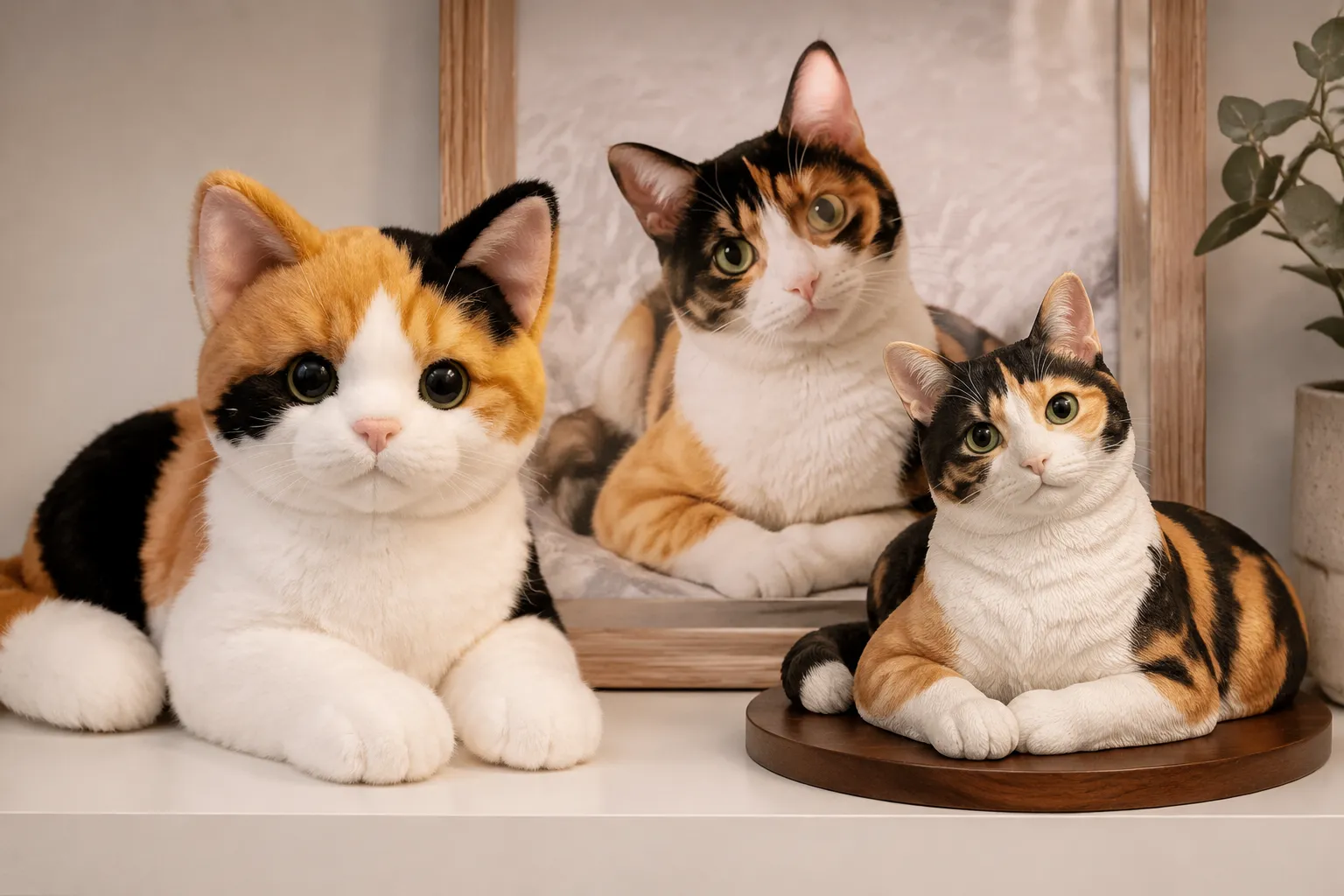
Sand grits between her fingers as she lifts the threadbare stuffed calico from the beach bag, one ear chewed down to felt nubs. That's the moment the calico figurine vs stuffed animal question stops being abstract for her. The toy smells like saltwater now. It didn't used to smell like anything but her cat.
Quick Takeaways
- Plush replicas degrade fast — fur mats, seams split, and washing fades the very markings you loved.
- A calico's pattern is the hard part — random tri-color patches are nearly impossible to reproduce in fabric.
- Buy for the markings, not the silhouette — accuracy beats cuteness when the goal is remembrance.
- Durable keepsakes earn their keep — explore how full-color 3D pet figurines hold color and detail for decades.
- Gift recipient reactions split predictably — generic plush gets a polite smile; an accurate replica gets silence, then tears.
Calico Figurine vs Stuffed Animal: What Actually Survives the Years
Here's something nobody selling you a plush toy will say out loud: the stuffed version is built to look right on day one and nowhere near day one thousand.
We've processed thousands of pet replica requests, and the calico cases teach us the most. A calico isn't a color. It's a riot of color — orange, black, and white thrown across the body in patterns no two cats share. Mass-produced plush can't touch that. Custom plush tries, and tries hard, but it's fighting the medium itself.
Fabric fades. Dye lots drift. The white belly that made your cat look like she'd stepped in cream goes dingy gray after the third time it falls off the nightstand and gets wiped down.
That customer on the beach — we'll call her Dana, and her cat was Marigold — brought us into her story after the plush memorial she'd ordered elsewhere started coming apart at eighteen months. The orange had gone the color of weak tea. One eye hung loose. She told us the worst part was the sound: the faint plastic rattle of the loose eye when she picked it up, like the toy was reminding her it was just a toy.
"A keepsake shouldn't make a sound that reminds you it's breaking."
The core difference is structural, not cosmetic. A stuffed animal stores your grief in something soft and perishable. A figurine stores it in something that holds.
The myth of the "comfort object"
Most articles will tell you plush wins on one front: you can hug it. And honestly, that's true, and it matters for some people, especially kids.
But here's the nuance ten years in this work teaches you. The hugging phase is intense and short. The looking phase lasts forever.
People reach for the soft thing in the first weeks. Then the soft thing moves to a shelf, and from that shelf it does one job for the next twenty years — it gets looked at. And a faded, matted, lopsided plush is a poor thing to look at every morning over coffee.
So if you want both, get both. Keep a soft object for the hard nights. But don't ask the soft object to be your permanent monument. That's not what it's good at.

Pet Replica Reviews: How to Read Them Without Getting Burned
Pet replica reviews are a minefield, and we'll be real about why. The five-star photos you see were almost always shot the week the item arrived, under good light, by someone still riding the high of getting it.
What you rarely see is the two-year review. Nobody comes back to post a photo of the same item after it's lived a normal life on a normal shelf in a house with normal sunlight.
So you're reading reviews of a moment, not a lifespan. That skews everything.
When you scan pet replica reviews, train your eye on a few specific things instead of the star count:
- Look for pattern accuracy callouts. Reviewers who mention "they got the patch over her left eye exactly right" are telling you the maker handles markings well — the single hardest skill in this craft.
- Search the reviews for the word "fade." If even one buyer mentions fading, multiply that by years of UV exposure.
- Check whether photos show the back and underside. Sellers who only show the good angle are hiding the bad ones.
- Watch for the phrase "looks just like the photo I sent." That's the whole game. The reference photo is everything.
"Five-star reviews capture the honeymoon. Read for the marriage."
The counterintuitive part about plush reviews
People rate plush replicas higher on arrival than 3D figurines. That surprised us too, the first time we dug into it.
The reason is expectation. A plush is soft and warm and feels like a hug, so it triggers an emotional response immediately, before your brain checks the accuracy. A figurine asks to be examined. It invites scrutiny because it's promising realism.
So plush gets graded on feeling, and figurines get graded on fidelity. That's why a mediocre plush can pull a five-star "so cuddly" review while a near-perfect figurine gets four stars because the whisker on the right was a millimeter off.
Knowing this protects you. Don't trust raw star averages across two completely different product categories. You're comparing a feeling to a forensic match.
The Durable Pet Keepsake: Why the Material Decides Everything
If you remember one thing, remember this. The thing that determines whether your durable pet keepsake survives is not the artistry. It's the material the artistry lives in.
A breathtaking plush calico made of perishable fiber is still perishable. Beautiful and doomed. The artistry rides along with the material, for better or worse.
Let's get concrete about what actually happens to each material over a real decade in a real home.
Here's how the common pet replica materials hold up against the forces that actually live in your house — sunlight, dust, curious hands, and time.
| Material | Color Longevity | Detail Retention | Real-World Weak Point |
|---|---|---|---|
| Plush / fabric | Fades in 1-3 years | Mats and flattens | Seams, dust, washing damage |
| Painted resin | 5-10 years | Good, until chips | Surface paint chips and scratches |
| Full-color 3D resin | Decades (UV-resistant) | Holds fine detail | Can crack if dropped on hard floor |
| Ceramic | Long, if undamaged | Excellent | Shatters completely if dropped |
Notice the pattern. Every material has a weak point — there's no perfect option, and anyone telling you otherwise is selling something. But the failure modes differ enormously.
Plush fails slowly and constantly, every single day, a little at a time. You don't notice until you compare it to a photo and realize how much you've lost.
Why "the color is in the material" changes the math
This is the insider detail that reframes the whole comparison, and most buyers never hear it.
With painted figurines, color sits on the surface as a separate layer. Scratch the surface, lose the color. That's physics, not craftsmanship.
The figurines we make at PawSculpt work differently. They're digitally sculpted by master 3D artists, then precision 3D printed in full color — meaning the color is printed into the resin itself, voxel by voxel, not applied on top. The orange of a calico's patch isn't a coat of paint waiting to chip. It's baked into the material's structure.
The only manual step is a clear protective coat for sheen and durability. No brushes, no surface color to lose. That's why a calico's chaotic tri-color map survives — because the color and the object are the same thing.
"A calico's markings are the cat. Lose the pattern and you've lost the pet, no matter how soft the result feels."
— The PawSculpt Team
When Dana sent us Marigold's photos, the patch we obsessed over was the one shaped like a comma under her chin. In plush, that comma had been approximated with a roughly orange triangle. In full-color 3D resin, the comma is the comma. That specificity is the whole point of a replica.
The Gift Recipient Reaction Nobody Warns You About
If you're buying this for someone else — a grieving friend, a parent who lost a longtime companion — you need to know how gift recipient reactions actually unfold. Because they don't go the way greeting cards suggest.
A generic pet gift gets a warm, immediate, slightly performative reaction. "Oh, that's so sweet, thank you." Smiles. A hug. Done in thirty seconds.
An accurate replica produces something stranger and far more powerful. We've watched it on video clips customers send us, and the gift recipient reaction follows a near-universal arc.
First, silence. A real pause, sometimes uncomfortably long, where the person goes very still.
Then recognition — you can see the exact second their brain stops seeing "a figurine" and starts seeing their actual cat. Often a hand goes to the mouth.
Then, usually, tears. Not sad tears, or not only sad. The tears of being seen, of having their specific grief honored with a specific object.
Why the silence matters more than the smile
Here's the counterintuitive insight we've learned the hard way: the better the gift, the worse the immediate reaction looks.
A polite smile means the gift was pleasant and forgettable. The stunned silence — the one that makes nervous gift-givers think "oh no, they hate it" — is the sign you nailed it. The silence is the sound of impact.
We had a customer who nearly canceled an order halfway through because she got scared the figurine would "make her mom cry." We told her what we'll tell you. Those tears are the gift working. A keepsake that doesn't move someone is just an object that takes up shelf space.
"The stunned silence isn't rejection. It's the sound of a memory landing."
The mistake most people make with memorial gifts is optimizing for a comfortable reaction. They pick the soft, safe, smile-inducing option. But comfort isn't the assignment. Recognition is.
This is where matching the gift to the recipient really matters. Use this quick guide before you buy anything.
| Recipient | What They Actually Want | Why It Works |
|---|---|---|
| Recently grieving | An accurate likeness, no rush to "feel better" | Honors the specific pet, not grief in general |
| Kids | Something they can hold plus something permanent | Soft for comfort, durable for the long haul |
| Older parent | Low-maintenance, display-ready keepsake | No washing, no upkeep, just looking |
| The "moved on" friend | A celebration piece of a living pet | Shifts the gift from mourning to joy |
That last row matters. These replicas aren't only for loss. Some of our most joyful orders are for very-much-alive pets — birthday surprises, "just because" gifts, celebrations of a senior dog still going strong. The reaction arc is the same. Silence, recognition, joy.
What to Expect When You Order a Calico Replica
Let's get practical, because this is where good intentions meet logistics and most people fumble.
The single biggest factor in how your figurine turns out has nothing to do with the maker's skill. It's your reference photos. Garbage in, garbage out — that's true of every replica process on earth, and doubly true for a calico, where the markings are everything.
We can't reconstruct a pattern we can't see. If you send one blurry photo from above, we're guessing at the belly, the paws, the patches on the far side. Guessing is the enemy of a good replica.
Here's what actually helps when you're gathering photos for any custom pet replica.
| Shot You Need | Why It Matters | Quick Tip |
|---|---|---|
| Full side profile | Maps the main body markings | Shoot at the cat's eye level, not above |
| Front face, straight on | Captures facial pattern symmetry (or lack of it) | Natural light from a window, no flash |
| Top-down | Shows the back and spine markings | Hold treats above to get them to look up |
| Close-up of unique markings | The comma patch, the white sock, the spot | Get close enough to fill the frame |
| Natural standing pose | Informs the figurine's posture | Candid beats posed every time |
A few hard-won notes on photos:
- Avoid flash. It blows out the whites and flattens the very texture that makes fur read as fur. Window light, always.
- Shoot in the morning or late afternoon. Harsh noon light kills detail in dark fur — and a calico's black patches eat detail fast.
- More angles beat higher resolution. A dozen decent phone photos from different sides beat one gorgeous portrait that only shows half the cat.
- Old photos work. If your pet has passed, send whatever you have. Our 3D artists are used to working from imperfect references and piecing a full picture together.
The general process, honestly described
We won't quote you specific turnaround times or policies here, because those shift and we'd rather you get the current details straight from the PawSculpt process page. But the shape of the journey looks like this:
- You submit photos and notes. Tell us what matters most — the comma patch, the crooked ear, the way she always sat with one paw tucked.
- Master 3D artists digitally sculpt the model. This is digital craftsmanship, not a factory stamp. The markings get mapped to your specific cat.
- You review a preview. This is your chance to catch anything off — the angle of the ears, a missed patch. Speak up here. This is the step that separates "close" from "that's her."
- The model is precision 3D printed in full-color resin. Color printed into the material itself.
- A clear protective coat goes on, for sheen and durability, and it ships.
The preview step is where you have real power, so use it. We'd rather revise the ears three times than send you something that's almost-but-not-quite Marigold. Almost-but-not-quite is its own small heartbreak, and you've had enough of those.
Care that keeps it lasting
A durable keepsake still benefits from basic sense. The good news is the routine is almost nothing compared to plush.
- Dust it with a soft dry cloth. No chemicals, no water baths.
- Keep it out of a south-facing window that bakes in direct sun all day — UV-resistant doesn't mean immortal.
- Don't display it on a wobbly shelf above a tile floor. Resin is tough, but a long drop onto hard tile is the one thing that can crack it.
That's the entire care manual. Compare that to plush, which collects dust like a magnet, can't really be cleaned without damage, and degrades whether you touch it or not.
For deeper context on the human-animal bond and why these objects matter so much to us, the Human Animal Bond Research Institute and veterinary sources have plenty on why pets occupy the place in our brains they do. We're not scientists — we just see the proof of it in every order that crosses our studio.
Where Dana's Story Landed
Dana sent us eleven photos of Marigold. Three were blurry. Two were great. The comma patch showed up clearly in exactly one, taken in the kitchen by a window, Marigold mid-yawn.
That one photo did most of the work.
When the figurine arrived, Dana texted our team a short clip. No words in it. Just her picking it up, going still, and the small catch of breath you can hear even through a phone speaker. Then she set it on the windowsill — the same windowsill where Marigold used to sit and watch the gulls, back when the beach was their normal weekend.
She told us later the best part wasn't how it looked. It was what it didn't do. It didn't rattle. It didn't sag. It didn't smell like saltwater and decay. It just sat there, accurate and permanent, the comma patch right where it belonged, catching the morning light the way Marigold used to.
Frequently Asked Questions
Is a calico figurine really better than a stuffed animal?
For day-one cuddling, plush has an edge. For everything after that — display, accuracy, longevity — a full-color resin figurine wins clearly. The plush fades and mats while the figurine holds its markings for decades. Many families keep a soft object for comfort and a figurine for the permanent memorial.
Why is a calico pattern so hard to get right?
Because it's essentially random. A calico's orange, black, and white patches form a one-of-a-kind map, and fabric can only suggest it with rough patches of dyed material. Full-color 3D printing maps the exact pattern from your reference photos, so the comma under the chin stays a comma instead of becoming a vague triangle.
What photos should I send for the best result?
Multiple angles in natural light beat one perfect portrait. Aim for a side profile at the cat's eye level, a straight-on face shot, a top-down view, and tight close-ups of any signature markings. Skip the flash, which blows out whites and flattens texture. Old or imperfect photos still work — our 3D artists piece full pictures together regularly.
What if the gift makes the recipient cry?
That's almost always the gift landing exactly right. We've seen the same arc repeatedly: a beat of silence, the moment of recognition, then tears. Don't read the stunned pause as disappointment. A keepsake that produces no emotion is the one that didn't work.
How do I keep a resin figurine looking good for years?
Very little effort. Dust it with a soft dry cloth, keep it out of harsh all-day sun, and don't perch it above a hard floor where a fall could crack it. UV-resistant full-color resin handles normal home life easily, which is exactly why it outlasts fabric.
Can I order a figurine of a pet that's still alive?
Absolutely, and we love these orders. Birthdays, adoption anniversaries, or no reason at all. The recipient reaction tends to be pure joy rather than grief, and it's a refreshing change from the memorial pieces we often create.
Ready to Celebrate Your Pet?
Every pet has a story worth preserving. Whether you're honoring a companion who's crossed the rainbow bridge or celebrating a calico still claiming her sunny windowsill, a custom PawSculpt figurine captures the exact markings that make your pet unmistakably theirs — the patches, the crooked ear, the comma under the chin.
When you weigh the calico figurine vs stuffed animal question for a keepsake meant to last, choose the one built to hold both the detail and the memory.
Visit pawsculpt.com to explore our full-color 3D printing process, preview options, and quality guarantee.