
The Rationalist's Guide to Pet Shrines: Organizing Memories of Your Rottweiler
The heavy plastic tote smells faintly of old rubber and dried saliva. You’re standing on the cold concrete of the garage, holding a studded leather collar that weighs nearly a pound, caught in the paralysis of deciding whether boxing it up is an act of preservation or betrayal.
Quick Takeaways
- Externalize your grief — Creating a physical space for memory helps your brain process the abstract concept of loss.
- Curate, don't hoard — Select 3-5 "totem" items that trigger specific positive neural pathways rather than keeping everything.
- Acknowledge the "Ghost Weight" — Your brain’s spatial prediction models need time to adjust to the absence of a large breed dog.
- Anchor the memory — Use a custom 3D figurine to create a permanent visual focal point that captures their unique markings without taking up physical space.
The Neurobiology of the Empty House
For the rational mind, the death of a Rottweiler presents a logistical paradox alongside the emotional devastation. You are not just missing a companion; you are missing a massive physical presence that dictated the flow of your home. A 100-pound dog displaces air. They create traffic patterns in your living room. When they are gone, the brain suffers a form of cognitive dissonance.
Your hippocampus—the area responsible for spatial memory—is still predicting the dog's presence. You step over a phantom shape in the hallway. You brace for the "Rottweiler lean" against your leg that never comes. This isn't just sadness; it is a neurological misfire.
We often try to solve this discomfort by either scrubbing the house clean immediately (erasure) or leaving everything exactly as it was (museumification). Neither approach helps the brain rewire. The "shrine"—or a curated memorial space—is the psychological middle ground. It provides a designated location for your grief to live, allowing the rest of your home to eventually become neutral territory again.
"Grief isn't a problem to be solved. It's a love story that continues after the last chapter."
The Physics of Grief: Why Rottweilers Leave Bigger Holes
When you lose a hamster, you lose a focal point. When you lose a Rottweiler, you lose a roommate. The psychology of grieving a large breed is distinct because the sensory deprivation is total.
The "Ghost Weight" Phenomenon
Biologically, our brains are prediction machines. For years, your amygdala and motor cortex coordinated to manage a large, powerful animal. You developed muscle memory for holding a heavy leash. You adjusted your stride to accommodate their bulk.
When that resistance is removed, the nervous system can feel unmoored. This is why holding a heavy collar or a dense, solid object can be surprisingly grounding. It stimulates the proprioceptive senses that are starving for input.
Identifying Your Totems
You cannot keep every shredded tennis ball. To build an effective memorial, you must apply the "Peak-End Rule" of memory. We tend to remember the most intense moments and the end of an experience.Choose artifacts that trigger the peak positive memories, not the decline.
| Item Category | Keep or Archive? | Psychological Reasoning |
|---|---|---|
| The Collar | Display | High tactile value. The weight mimics the dog's presence. |
| Medication Bottles | Discard | Triggers "caregiver trauma" and memories of decline. |
| Favorite Toy | Display (1 only) | Represents the dog's personality and "play state." |
| Bedding | Donate/Discard | Takes up too much space; scent fades; prevents new spatial mapping. |
| Leash | Archive | Good for memory boxes, but difficult to display aesthetically. |
The Architecture of a Memorial Shelf
Organizing a memorial is an act of "continuing bonds"—a concept in bereavement psychology that suggests we heal not by detaching, but by restructuring our relationship with the deceased.
A chaotic collection of items can induce cortisol spikes (stress). A curated, intentional display induces dopamine (reward/comfort).
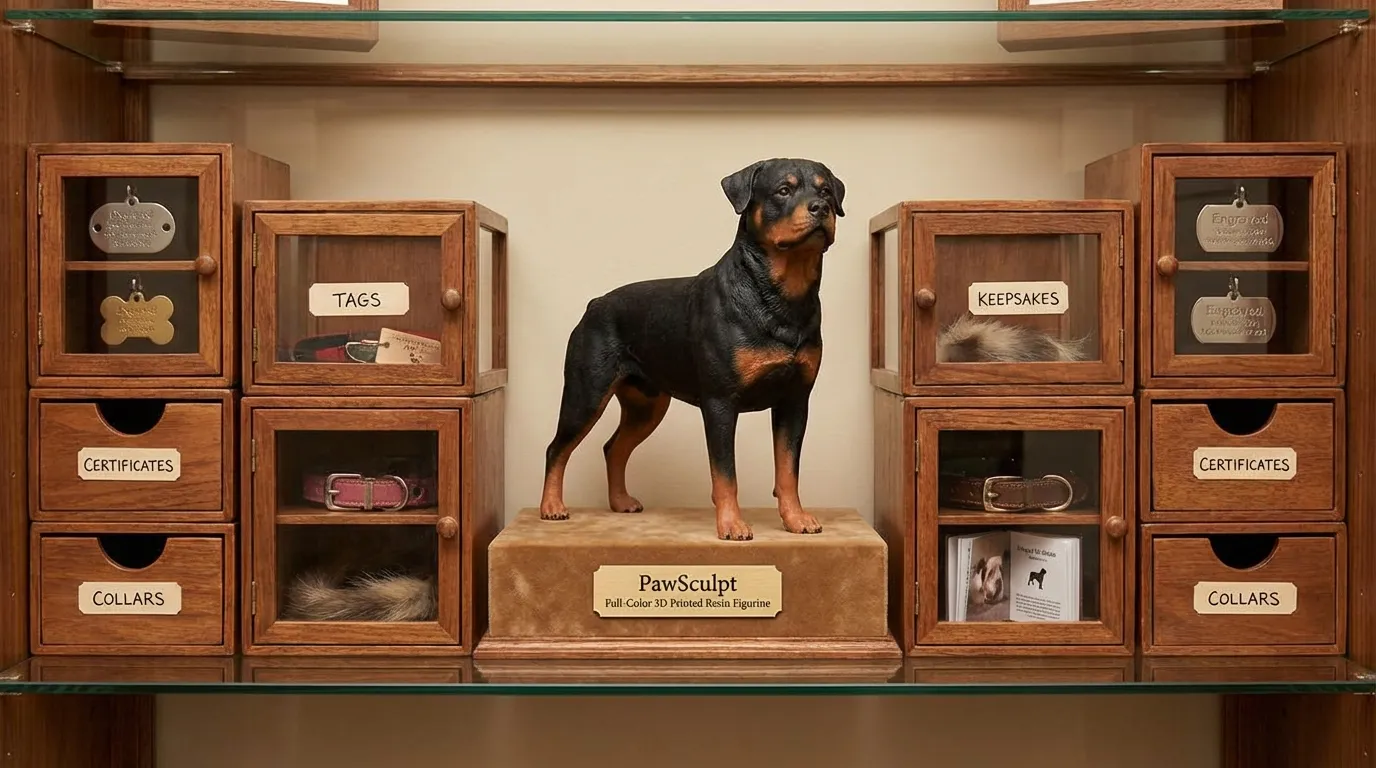
1. The Anchor Piece
You need a central visual element. Photos are flat; they engage the visual cortex but lack depth. This is where three-dimensional representation becomes crucial.At PawSculpt, we utilize full-color 3D printing technology to create resin figurines that capture the specific volume and markings of your dog. Unlike a generic statue, a custom print derived from your photos captures the specific asymmetry of your Rottweiler’s mask or the unique way they held their ears.
Because we use industrial-grade printers that fuse color directly into the resin voxel-by-voxel—rather than hand-painting over a generic shape—the result is an authentic, textured representation of your specific dog. It gives the eye a place to rest.
2. The Tactile Element
Rottweiler owners are used to heavy textures: leather, steel, coarse fur. Incorporate these materials. Drape their leather collar around the base of the figurine or a heavy ceramic urn. The contrast of the cool metal tags against the warm memories provides sensory grounding.3. The Olfactory Trigger
Smell is the only sense that bypasses the thalamus and goes directly to the brain's emotional center. If you have a piece of blanket that still smells like them, seal it in a glass jar. Open it only when you need to deliberately access that memory. Leaving it out allows the scent (and the neural trigger) to dissipate.The "Relief" You Feel (And the Guilt That Follows)
Here is the counterintuitive truth that few pet owners admit, but psychologists see constantly: Relief is a primary component of grief.
If your Rottweiler had mobility issues, incontinence, or aggression in their final months, your life was likely ruled by cortisol and vigilance. When that duty ends, your body physically exhales.
Then, the guilt strikes.
You might think, "I'm a monster for feeling relieved that I don't have to carry a 90-pound dog down the stairs today."
The Science of Caregiver Burnout
This isn't a lack of love; it's biology. Your parasympathetic nervous system is finally engaging after months of "fight or flight." Acknowledging this relief doesn't diminish your bond.
A structured memorial helps here, too. It allows you to compartmentalize. You can pay your respects at the shelf, feeling the love and sadness, and then walk away to enjoy the freedom of your day without feeling like you are abandoning them. The shrine holds the grief so you don't have to carry it every second.
"We've seen families heal by holding something tangible. Grief needs an anchor."
— The PawSculpt Team
Digital Clutter vs. Curated Memory
In the smartphone age, we don't have shoeboxes of photos; we have 4,000 unorganized JPEGs. This digital hoard can be overwhelming.
The "Rule of 10"
To organize your digital memories, create a specific album on your phone. Limit it to the "Top 10" photos that capture their essence.
- The "Regal" shot (chest out, alert).
- The "Goofball" shot (tongue lolling, upside down).
- The "Bond" shot (you and them together).
By narrowing the focus, you strengthen the neural pathways associated with those specific, high-quality memories, rather than diluting the emotion across thousands of blurry images.
When to Start (The Timeline of Processing)
There is no scientific "right time" to build a shrine, but there is a wrong time.
0-48 Hours: Do not make permanent decisions. Your brain is in shock. Do not throw away the bed yet if it distresses you.
2-4 Weeks: The "numbness" fades and the reality sets in. This is often the hardest time. This is the ideal time to commission a custom figurine or order a specialized urn. The act of ordering gives you a future date to look forward to—a small light on the horizon.
3-6 Months: You may find you need less "stuff." This is when you might move the shrine from the living room to a quieter spot, or reduce the items displayed. This isn't forgetting; it's integrating.
Frequently Asked Questions
Is it healthy to keep a shrine for a pet?
Yes. Psychologically, a memorial space allows for "continuing bonds," helping you externalize grief rather than internalizing it. It gives you a designated place to mourn, which can actually help you function better in other areas of life.What should I do with my Rottweiler's large bed and crate?
Donate them when you are ready. Many shelters desperately need large-breed supplies. Knowing your dog's items are providing comfort to another animal can trigger a "helper's high" (endorphin release) that counteracts the pain of grief.How accurate are 3D printed pet figurines?
Extremely accurate. We use full-color 3D printing technology that reproduces markings and fur patterns directly from your photos. The color is part of the resin material, not painted on, ensuring durability and realism.Why do I feel relieved after my dog died?
Caregiver burnout is real. If your pet was sick or high-maintenance, your body was under chronic stress. Relief is a physiological response to that stress ending, not a reflection of your love. It is a normal part of the grieving process.Ready to Celebrate Your Pet?
Every pet has a story worth preserving. Whether you're honoring a beloved companion who's crossed the rainbow bridge or celebrating your furry friend's unique personality, a custom PawSculpt figurine captures those details that make your pet one-of-a-kind.
Free instant AI preview • 3D artist preview within 7 days • 5 free revisions