Stop Posing Your Dog: Capturing the 'Natural Slouch' of Your Great Dane for Sculpting
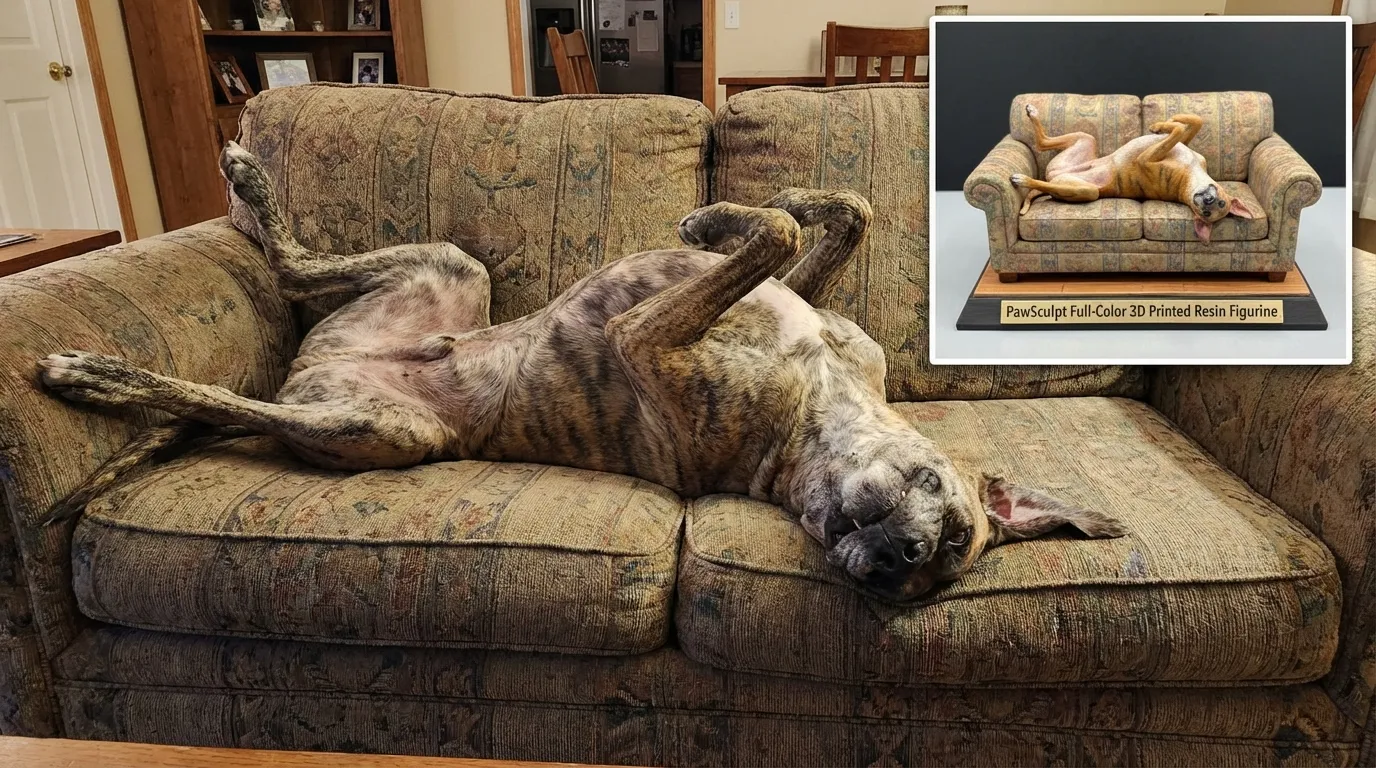
The drywall in your hallway bears a specific, polished groove at hip height—evidence of a hundred mornings where 150 pounds of affection decided to lean against the plaster while you tied your shoes. You know that specific thud of a heavy body collapsing onto a hardwood floor, a sound that signals the end of a patrol and the beginning of a three-hour nap.
Quick Takeaways
- Biologically Authentic — A dog's "slouch" reveals more about their skeletal comfort and psychological safety than a commanded "sit."
- The Observer Effect — Direct eye contact or holding a camera often triggers "performance anxiety" in dogs, ruining candid moments.
- Volume Over Pose — For 3D modeling, a relaxed posture provides better data on muscle mass and fur texture than a rigid stance.
- Memory Anchors — Custom pet figurines based on candid photos trigger deeper neurological recall than generic poses.
The Cognitive Dissonance of the "Perfect" Photo
We have a psychological tendency, rooted in what sociologists call "impression management," to present the best versions of those we love to the world. When you pull out your phone to photograph your Great Dane, your instinct is likely to whistle, hold up a treat, and demand a "sit." You want the ears up, the chest out, the noble statue of a dog that matches the breed standard.
But there is a cognitive dissonance at play here.
While the "Show Dog" pose is aesthetically pleasing, it rarely aligns with your emotional bond. When you close your eyes and think of your Dane, you likely don't picture them standing at attention. You picture the "shrimp" curl on the sofa, the "frog legs" splay on the rug, or the infamous "Great Dane Lean" that nearly knocks you over.
From a neurobiological perspective, these relaxed states are where limbic resonance happens—the non-verbal emotional synchronization between mammal and human. A rigid sit is a state of working; a slouch is a state of being. If you want to capture the soul of your dog for a keepsake, you need to stop directing the scene and start documenting the biology of their relaxation.
"We photograph what we want the world to see, but we mourn the quiet moments no one else witnessed."
The Biomechanics of the Great Dane Slouch
To understand why the "slouch" is so characteristic of this breed—and why it makes for such compelling Great Dane photography—we have to look at their anatomy.
Great Danes are operating with a massive skeletal structure that requires significant energy to maintain against gravity. A "proper" sit, where the hocks are tucked and the spine is erect, requires active engagement of the core and stabilizer muscles.
The "Puppy Sit" Phenomenon
You’ve seen it: the dog sits, but slides one hip out to the side, resting on their glutes rather than their hocks. In obedience trials, this is a fault. In candid dog photos, it is gold.Biologically, this is an energy-conservation strategy. It unloads the hip joints and allows the heavy musculature of the thigh to relax. Capturing this asymmetry is crucial for a realistic sculpture because it changes the entire topography of the dog's back. The spine curves, the ribcage rotates slightly, and the skin folds differently.
The Physics of "The Lean"
The "Lean" is essentially a tripod stability mechanism. By shifting their weight against your leg (or a wall), a Great Dane creates a stable base with minimal muscular effort. This behavior is also deeply rooted in thigmotaxis—a biological drive to maintain physical contact with solid objects (or people) for security. A photo of your Dane leaning isn't just a funny picture; it's visual evidence of their attachment style.Breaking the Observer Effect
In quantum physics, the Observer Effect states that simply observing a phenomenon changes it. This applies heavily to pet photography.
Dogs are experts at reading human facial micro-expressions. When you raise a phone to your face, you break eye contact (covering your eyes with the lens) and tense your body (to hold steady). Your Dane detects this shift in your baseline behavior.
The result? They either become anxious, approach you to investigate (ruining the shot), or perform a learned behavior like "sit" because they anticipate a command.
Technique: The Hip-Shot Method
To capture the natural slouch without triggering a performance response, you must disengage your "director" persona.- Hold the phone at waist level. Do not raise it to your face.
- Engage in "displacement activity." Look at a book or the TV, not the dog.
- Use the volume button shutter. Tap the screen to focus, but use the side button to snap, keeping your movements subtle.
This technique allows the dog's parasympathetic nervous system (the "rest and digest" mode) to remain dominant, keeping them in that heavy, sleepy, sloppy posture that you love.
The Data of Relaxation: What Makes a Good Sculpting Reference?
At PawSculpt, we often see customers apologize for sending "unflattering" photos where their dog looks like a melting scoop of ice cream. These are actually the best references.
Our process involves digitally sculpting by master 3D artists before using full-color 3D printing technology. We aren't painting a generic model; we are building the geometry of your specific dog.
When a dog is relaxed:
- Gravity takes over: You see the true weight of the jowls and the "excess" skin that Danes are famous for.
- Muscle displacement: You can see how the shoulder blades (scapula) rise when the front legs are sprawled.
- Fur texture: A stretched-out dog reveals the grain of the coat in a way a compressed, sitting dog does not.
Reference Photo Suitability Guide
| Posture | Psychological Signal | Sculpting Value | Why? |
|---|---|---|---|
| Alert / Ears Pricked | High Arousal / Anxiety | Moderate | Good for face detail, but lacks "coziness." |
| Commanded Sit | Obedience / Work Mode | Low | Generic. Hides unique body quirks. |
| The "Sploot" (Frog Legs) | Safety / Vulnerability | High | Shows hip flexibility and tail length perfectly. |
| The "Side Eye" Slouch | Sass / Personality | Critical | Captures the unique "whites of the eyes" expression. |
| Curled Sleeping | Conservation / Comfort | High | Creates a compact, touchable memorial piece. |
"Healthy pets make the best subjects. We love seeing the energy in their photos—even if that energy is zero because they're fast asleep."
— The PawSculpt Team
Lighting the "Black Hole" (and Other Colors)
One of the biggest challenges in Great Dane photography, especially for black or blue Danes, is that cameras struggle to resolve depth in dark fur. This is a physics issue: dark fur absorbs light, flattening the image into a silhouette.
To capture the "slouch" effectively for a 3D artist to interpret:
- Diffuse Window Light: Hard sunlight creates harsh shadows. Indirect window light wraps around the curves of the muscle, defining the 3D volume.
- The "Catchlight" Necessity: Ensure there is a reflection of light in the eyes. Biologically, humans are hardwired to look for eyes. Without that spark, the photo feels lifeless.
- Background Contrast: If you have a black Dane, photograph them against a light rug or wall. The contrast helps our artists see the exact silhouette of the fur.
The Psychology of Memory: Why Imperfection Lasts
Why do we care so much about the slouch?
Research into autobiographical memory suggests that we don't remember days; we remember moments attached to high emotion. While a ribbon-winning show photo is a point of pride, it is rarely the image that triggers the release of oxytocin in your brain.
The "slouch" represents the mundane intimacy of your life together. It is the dog blocking the hallway. It is the head resting on the counter. It is the intrusion into your personal space.
When a pet passes, the silence in the house is often loudest in the spaces they used to occupy. The empty spot on the sofa where they slumped. The corner where they snored.
Creating a physical representation of that specific posture—the "lazy sit"—bridges the gap between memory and reality. It offers a tactile anchor for grief. Touching the figurine and feeling the familiar curve of a relaxed spine can help regulate cortisol levels during bereavement, providing a sensory connection that a flat photograph cannot.
Counterintuitive Insight: The "Bad" Angle
Conventional photography wisdom says "shoot at eye level." However, for a Great Dane, shooting from slightly above (your natural perspective) can sometimes be more emotionally resonant. Why? Because that is how you saw them 90% of the time. You looked down at them while they leaned against your thigh. A figurine or photo that captures this "top-down" perspective of the head tilt can trigger a stronger recognition response than a profile shot you rarely saw in real life.Frequently Asked Questions
How do I take good photos of a black Great Dane?
Lighting is physics, not magic. Black fur absorbs light, making the dog look like a flat silhouette. Always use soft, natural window light—never a direct flash. The flash will wash out the texture. Photograph them against a lighter background (like a beige rug or light wall) so our artists can clearly see where the dog ends and the background begins.Can PawSculpt make a figurine from a sleeping dog photo?
Yes, and these are often the most poignant pieces we create. A sleeping pose captures the dog in their most vulnerable, comfortable state. Because we use full-color 3D printing, we can reproduce the specific way their colors ripple over their curled body. We just need a few angles (top down, face level) to get the geometry right.Why does my dog look away when I take a picture?
This is canine body language 101. Staring is rude in dog culture. When you stare through a lens, you are engaging in "hard eyes." Your dog looks away to de-escalate the tension. To fix this, stop looking at them. Look at your phone screen at waist level, or look past them. If you relax, they will relax.Do I need a professional camera for 3D modeling references?
No. Modern smartphones are capable of capturing all the detail we need. In fact, a 4K video where you slowly walk around your slouching dog is often better than a static photo, as it gives our digital sculptors a 360-degree understanding of your dog's volume and markings.Ready to Celebrate Your Pet?
Every pet has a story worth preserving, and usually, that story is written in their body language. Whether you're honoring a beloved companion who's crossed the rainbow bridge or celebrating your Great Dane's unique ability to take up an entire sofa, a custom PawSculpt figurine captures those details that make your pet one-of-a-kind.
Free instant AI preview • 3D artist preview within 7 days • 5 free revisions