
Your Siamese Knew You by Sound: Why the Silence After Loss Feels Like Forgetting
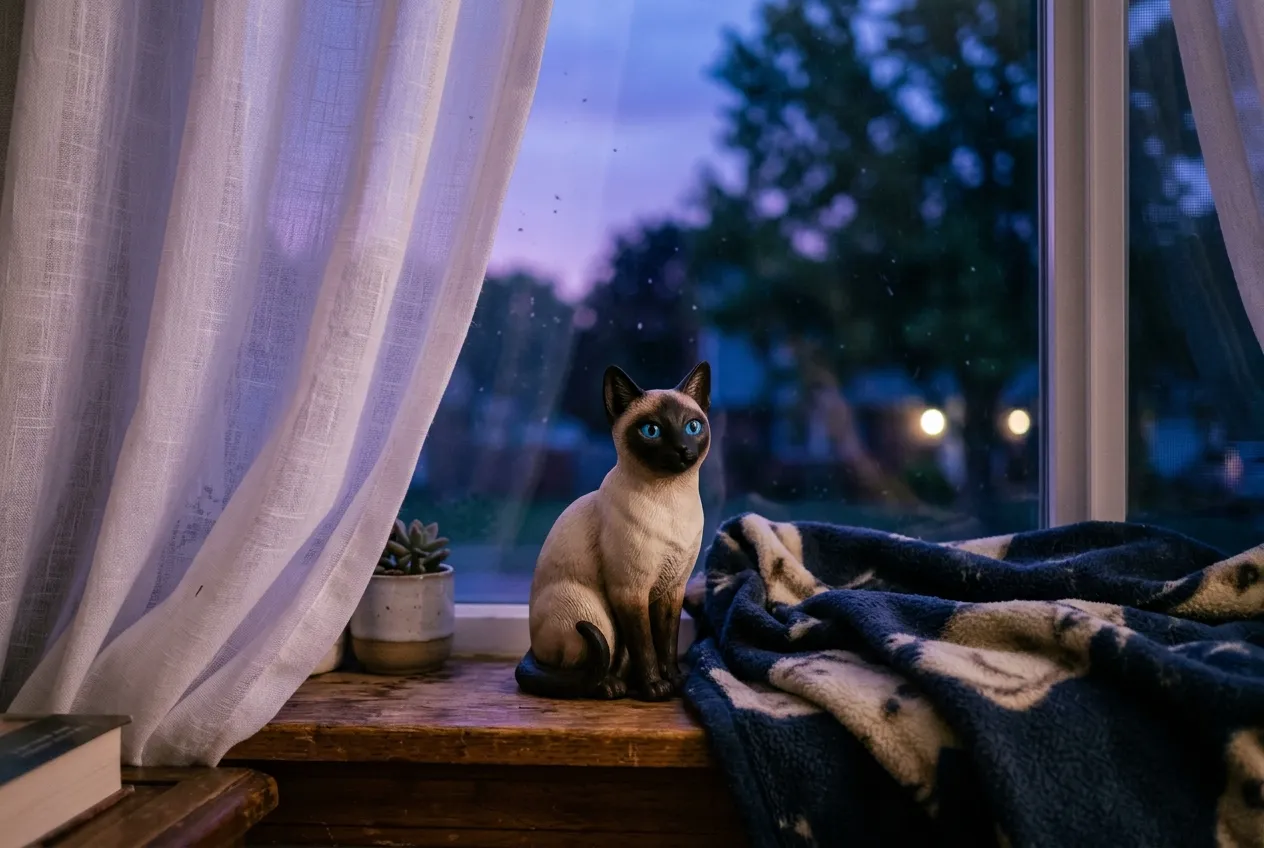
The click of her food bowl hitting the tile—that's what you hear now. Not the soft thud of paws. Not the chirrup she made when you walked in. Just the echo of routines that no longer need performing.
Quick Takeaways
- Sound-based grief is neurological — your brain literally expects auditory cues that no longer come, creating a unique form of loss
- Siamese cats create distinct "sound signatures" — their vocal nature makes the silence after loss particularly disorienting
- Fear of forgetting is normal — but memory works through multiple channels, not just conscious recall
- Tangible anchors help preserve sensory memories — consider options like custom figurines that capture your cat's physical presence when sound fades
The apartment sounds different now. Not quieter—different. You notice the hum of the refrigerator. The neighbor's footsteps upstairs. The way your own breathing fills space that used to belong to her commentary on everything you did.
Siamese cats don't just live with you. They narrate your life. And when that narration stops, you're left reading a book where someone ripped out every other page.
The Neuroscience of Sound-Based Attachment
Your brain built an entire auditory map around your Siamese. Every morning, it anticipated the sequence: the pre-dawn yowl from the bedroom. The escalating demands as you approached the food cabinet. The satisfied trill when the bowl hit the floor. These weren't just sounds. They were temporal landmarks that structured your day.
Auditory memory operates differently than visual memory. It's more immediate, more visceral, harder to control. You can close your eyes to avoid seeing the empty cat bed. You can't close your ears to the absence of sound.
Research on grief and sensory processing shows that auditory cues trigger stronger emotional responses than visual ones. The brain's auditory cortex connects directly to the amygdala—your emotional processing center—with fewer synaptic stops than visual information takes. Translation: sounds hit faster and deeper.
For Siamese owners, this matters more than for people who lost quieter breeds. Your cat didn't just occupy space. She occupied the soundscape. Her voice was a constant thread through your daily routine, and now that thread is cut.
The silence isn't peaceful. It's loud.

What Makes Siamese Loss Different
Not all cat grief sounds the same. Siamese cats create a specific type of bond that amplifies certain aspects of loss while complicating others.
They demand interaction. A Siamese doesn't just coexist—she insists on participation. Every meal you made, she commented on. Every phone call, she interrupted. Every closed door offended her personally. This constant engagement means you didn't just lose a pet. You lost a conversational partner, however one-sided the conversation might have seemed.
They vocalize emotion. Other cats might purr or meow occasionally. Siamese cats have opinions about the temperature, your choice of shoes, the audacity of birds existing outside the window, and the fact that you've been in the bathroom for three whole minutes without checking on her. Their emotional range is audible. Which means when they're gone, you don't just miss them—you miss knowing how they felt about everything.
They create routines through sound. That specific yowl meant "it's 6 AM and I don't care that it's Saturday." That chirrup meant "I forgive you for being gone all day." That low growl meant "the orange cat from next door is in MY yard again." These vocalizations structured time. Without them, days feel formless.
One family we worked with described it perfectly: "I didn't realize how much of my day was spent responding to her until there was nothing to respond to. I'd catch myself pausing, waiting for her input, and then remembering."
"The silence after a Siamese isn't empty. It's full of all the sounds that should be there."
The Fear of Forgetting: Why It Hits Harder With Sound
Here's what nobody tells you about grief: you will forget some things. Not the big things—not her personality or how much you loved her—but the small, specific details that made her uniquely her.
And with sound, this fear intensifies because auditory memory fades faster than visual memory.
You can look at photos and remember exactly what she looked like. The white blaze on her chest. The way her tail kinked at the end. The chocolate points that darkened as she aged. Visual details persist.
But her voice? That specific pitch and timbre? The exact sound of her purr? Those start to blur within weeks. Your brain doesn't store audio recordings. It stores impressions, approximations, emotional associations. And those degrade.
This isn't failure. It's neurology. The brain prioritizes current sensory input over stored memories. Every day without hearing her voice, your auditory memory weakens slightly. Not because you didn't love her enough. Because that's how human memory works.
The fear of forgetting often carries guilt with it. "If I really loved her, I'd remember perfectly." But perfect recall isn't how love works. Love lives in patterns, in habits, in the way you still pause before opening the bedroom door because you used to check if she was sleeping on the bed.
Some pet owners experience relief mixed with grief—relief that the medical crisis is over, that she's not suffering, that the financial strain has eased—and then feel crushing guilt about that relief. This is more common than you think. It doesn't mean you didn't love her. It means you're human, and humans feel multiple things simultaneously.
Others feel anger—at the vet, at themselves, at the unfairness of cats living such short lives. Anger that she got sick. Anger that you had to make impossible decisions. Anger that no one else seems to understand why you're this devastated over "just a cat."
These feelings exist. They're normal. And they're often tied to sound—to the memory of her pain vocalizations in those final days, or to the silence that followed, or to the way other people's voices sound when they tell you "it was just a pet" and you want to scream.
The Acoustic Architecture of Daily Life
Your Siamese didn't just make noise. She created an acoustic architecture—a sound structure that your brain used to navigate time and space.
Morning had a sound. That insistent yowl that started soft and escalated until you acknowledged her existence. The patter of paws on hardwood as she followed you to the kitchen. The crunch of kibble. The satisfied silence that meant she was eating and you could finally make coffee.
Evening had a sound. The greeting trill when you came home. The running commentary as you changed clothes. The demanding meow that meant "it's dinner time and you're late." The purr that started when you finally sat down and she claimed your lap.
Night had a sound. The soft chirrup when she jumped on the bed. The purr that rumbled against your side. The occasional 3 AM yowl that meant absolutely nothing except that she felt like vocalizing.
These sounds marked transitions. They told you where you were in the day. They created rhythm.
Now those transitions are unmarked. You wake up, and there's no reason to get up at any particular time. You come home, and the apartment doesn't acknowledge your arrival. You go to bed, and the silence is complete.
The absence of expected sound creates cognitive dissonance. Your brain keeps anticipating the auditory cue. When it doesn't come, you experience a micro-moment of confusion, then remembering, then grief. This happens dozens of times a day. Each time, it's a small wound reopening.
| Time of Day | Expected Sound | What You Hear Now | Emotional Impact |
|---|---|---|---|
| 6:00 AM | Insistent yowling | Alarm clock only | Disorientation, purposelessness |
| Evening arrival | Greeting chirrup | Door closing echo | Loneliness, lack of welcome |
| Meal prep | Running commentary | Kitchen appliance hum | Absence of companionship |
| Bedtime | Settling purr | Your own breathing | Isolation, emptiness |
Memory Isn't Just Conscious Recall
Here's something that might help: you're not actually forgetting as much as you fear.
Memory operates on multiple levels. Conscious recall—the ability to deliberately remember and describe something—is just one type. There's also procedural memory (how to do things), emotional memory (how things made you feel), and implicit memory (unconscious associations).
You might not be able to perfectly recreate the sound of her voice in your mind. But your body remembers. Your hand still moves to pet the spot where she used to sit. You still pause before closing the bathroom door. You still glance at the window ledge when you hear birds.
These aren't conscious decisions. They're embodied memories—patterns so deeply learned that they operate below awareness. And they don't fade the way conscious memories do.
The fear of forgetting often focuses on the wrong thing. You worry about losing the ability to recall specific details. But what actually matters—the love, the bond, the way she shaped your daily life—that's encoded in ways that persist.
Still, the fear is real. And for some people, having something tangible helps.
Tangible Anchors in an Intangible Loss
Grief needs somewhere to go. Some people create memorial gardens. Some write letters. Some make photo books. And increasingly, people are choosing physical representations that capture not just how their pet looked, but their presence.
This is where something like a custom figurine serves a specific purpose. Not as a replacement—nothing replaces a living being—but as an anchor point for memory.
Full-color 3D printing technology has reached a point where it can capture the specific details that make a Siamese recognizable: the exact shade of seal point or chocolate point, the blue eyes, the elegant proportions, even the personality in their posture. These aren't generic cat statues. They're digitally sculpted by artists who study your photos and recreate your specific cat.
The process matters here. When you work with a service like PawSculpt, you're not just ordering a product. You're engaging in an act of remembrance. You choose the photos. You review the digital model. You make decisions about pose and expression. This active participation creates new memories—memories of honoring her—that layer over the grief.
And then you have something physical. Something you can hold. Something that occupies space the way she used to occupy space.
This doesn't solve grief. Nothing solves grief. But it provides a focal point. When you worry about forgetting, you can look at the figurine and remember. When the silence feels overwhelming, you can hold something solid.
Some families place the figurine where their cat used to sit—on the window ledge, on the bookshelf, on the desk where she supervised work. Others create a small memorial space with the figurine, photos, and her collar. There's no right way. The point is having something that acknowledges: she was here. She mattered. She still matters.
The Ritual of Remembering
Grief isn't linear. It doesn't follow stages. It doesn't resolve on a timeline. But it does benefit from ritual—from intentional acts of remembering that give structure to something that feels structureless.
Sound-based rituals can help. Some people record themselves talking about their cat, describing her voice, telling stories. The act of verbalizing memories helps encode them more deeply. Others create playlists of songs that remind them of their cat—not because the cat liked music, but because certain songs were playing during important moments together.
Physical rituals matter too. Lighting a candle on the anniversary of her passing. Visiting the spot where you scattered her ashes. Rearranging the memorial space. These actions don't change anything material. But they create moments of intentional remembering, which is different from the ambush of unexpected grief.
Creating or receiving a custom figurine can become part of this ritual practice. The process of choosing photos, reviewing the model, and finally receiving the finished piece creates a series of intentional moments. Each step is an act of saying: I remember. I honor this. I'm not letting go of the love, even though I had to let go of the physical presence.
"Grief isn't a problem to be solved. It's a love story that continues after the last chapter."
What Actually Helps (And What Doesn't)
Let's be honest about what helps with sound-based grief and what's just well-meaning noise.
What doesn't help:
- People telling you to "get another cat" (as if she were replaceable)
- Advice to "stay busy" (grief doesn't care about your schedule)
- Suggestions to "focus on the good times" (you're trying, but the silence is loud)
- Timelines for "getting over it" (there is no over it, only through it)
What actually helps:
- Acknowledging that the silence is its own form of loss
- Understanding that forgetting some details doesn't mean forgetting her
- Having something tangible to hold when the intangible feels overwhelming
- Giving yourself permission to grieve as long as you need to
- Recognizing that relief, anger, and guilt are normal parts of grief
Specific actions that help:
- Record your memories now. Write down the specific sounds she made. Describe her voice. Detail the routines. Your memory is clearest in the first few months. Capture it while you can.
- Create a soundscape. Some people find comfort in white noise or ambient sound that fills the silence without trying to replace her voice. Others prefer music. Experiment.
- Talk about her. Out loud. To friends, to family, to yourself. Verbalizing memories strengthens them. And it honors her by keeping her present in conversation.
- Consider a tangible memorial. Whether it's a figurine, a piece of jewelry with her ashes, or a commissioned portrait, having something physical can anchor the intangible memories.
- Be patient with yourself. Some days the silence will feel peaceful. Other days it will feel like drowning. Both are normal.
The Complicated Truth About Moving Forward
Here's what nobody wants to say: you will eventually adjust to the silence. Not because you've forgotten her. Not because you've "moved on." But because the human brain adapts. It has to. That's how we survive loss.
This adaptation often brings its own guilt. The first morning you wake up and don't immediately think of her. The first time you realize you haven't cried in a week. The gradual way the silence becomes normal instead of notable.
This isn't betrayal. This is healing. And healing doesn't mean forgetting.
You can hold both truths simultaneously: She's gone, and you're learning to live with that. You miss her desperately, and you're also okay sometimes. The silence hurts, and you're adapting to it. These aren't contradictions. They're the messy reality of grief.
Some people find that having a physical memorial helps with this transition. It provides continuity—a way to honor her while also moving forward. The figurine sits on the shelf. Life continues around it. Both things are true.
Others find that the fear of forgetting lessens over time. Not because memory improves, but because they realize that the important things—the love, the bond, the way she changed them—those don't fade. The specific pitch of her meow might blur. The feeling of being loved by her doesn't.
When Silence Becomes Something Else
Eventually—and this timeline is different for everyone—the silence stops being primarily about loss and starts being about presence. Not her presence. The presence of memory. The presence of love that persists.
You'll still have moments. A sound that reminds you of her. A time of day that feels empty. The anniversary of her passing. These moments don't disappear. But they change character. They become less about what's missing and more about what was.
This is when tangible memorials often matter most. In the acute phase of grief, nothing helps much. Everything hurts. But later, when you're building a life that includes her memory without being consumed by her absence, having something physical to acknowledge her becomes meaningful in a different way.
The figurine on the shelf isn't trying to replace her. It's saying: she was real. She mattered. This is the shape she took in the world. And that shape is worth preserving.
| Grief Phase | Relationship to Silence | What Helps | What Doesn't Help |
|---|---|---|---|
| Acute (0-3 months) | Silence is shocking, disorienting | Acknowledging the loss, gentle routine | Pressure to "move on" |
| Integration (3-12 months) | Silence becomes familiar but painful | Tangible memorials, ritual | Avoiding all reminders |
| Adaptation (12+ months) | Silence is normal with occasional sharp moments | Honoring memory while living forward | Guilt about healing |
The Sound of Love Continuing
Your Siamese knew you by sound. The jingle of your keys. Your footsteps on the stairs. The specific way you said her name. She learned the acoustic signature of your life and wove herself into it.
Now you're learning to know her by silence. By the space where her voice used to be. By the routines that no longer have their auditory markers. By the way you still pause, still listen, still expect.
This is its own form of knowing. It's not the knowing you want. But it's the knowing you have.
And here's the thing about memory: it's not about perfect recall. It's about carrying forward. You carry her forward in the way you still check the window ledge. In the way you think of her when you see another Siamese. In the way her absence has become part of your daily landscape.
The fear of forgetting is really a fear of losing connection. But connection doesn't require perfect memory. It requires love. And love doesn't fade just because the details blur.
You loved a cat who talked to you constantly. Who narrated your life. Who made sure you never felt alone. That love doesn't end when the sound stops. It transforms. It becomes something you carry instead of something you hear.
And sometimes, having something tangible—a figurine that captures her elegant form, her distinctive coloring, the personality in her posture—helps bridge the gap between the sound you remember and the silence you live with now.
She knew you by sound. You'll know her by memory. And memory, it turns out, has its own kind of voice.
Frequently Asked Questions
How long does it take to stop expecting to hear your cat?
The neurological adjustment period varies, but most people find that the automatic anticipation of familiar sounds begins to fade around 3-6 months after loss. Your brain is literally rewiring its expectations—unlearning patterns that were reinforced daily for years. However, grief triggers can persist much longer. You might stop expecting her morning yowl after a few months, but still feel a pang when you hear a similar sound years later. This isn't regression. It's the nature of deep attachment. The acute disorientation lessens. The love doesn't.
Is it normal to hear phantom cat sounds after loss?
Absolutely normal. Auditory hallucinations of a deceased pet are surprisingly common in early grief, especially with vocal breeds like Siamese. Your brain spent years processing specific sound patterns—her meow, her purr, the click of her claws on hardwood. When those sounds suddenly stop, your auditory cortex sometimes fills in the gap, creating phantom sounds. This typically happens in the first few weeks to months and usually fades as your brain adjusts. If it persists or distresses you significantly, talking to a grief counselor can help.
Why does Siamese cat loss feel different from losing other breeds?
Siamese cats create a specific type of bond centered on vocalization and interaction. They don't just coexist—they demand participation, narrate your activities, and structure your day through sound. Losing a Siamese means losing a conversational partner, a daily commentator, and an acoustic architecture that organized your time. Quieter breeds create equally deep bonds, but the loss manifests differently. With Siamese, the silence itself becomes a primary grief symptom because their presence was so audibly constant.
Will I forget what my cat's voice sounded like?
Specific auditory details—the exact pitch, timbre, and quality of her voice—often do fade within months. This is how human memory works, not a reflection of your love. However, emotional memory persists. You'll remember how her voice made you feel, the contexts in which she vocalized, and the meaning behind different sounds. Behavioral patterns and embodied memories (like pausing when you used to hear her) remain strong. If preserving the memory feels important, record yourself describing her voice now, while it's fresh. But know that forgetting some details doesn't mean forgetting her.
What helps with the silence after losing a vocal cat?
Practical strategies include: recording your memories in detail now (write or voice-record descriptions of her sounds and routines), creating ambient soundscapes that fill silence without trying to replace her, establishing new routines that acknowledge the change rather than pretending nothing happened, and considering tangible memorials that provide a focal point for grief. Some people find that having a physical representation—like a custom figurine—helps anchor memories when auditory recall fades. Most importantly, give yourself permission to grieve without timeline pressure. The silence will eventually feel different, but there's no "should" about when that happens.
Ready to Honor Your Siamese's Memory?
The silence after losing a Siamese cat carries its own weight—a reminder of the voice that once filled your days. While nothing can replace that sound, a custom figurine captures the physical presence and personality that made your cat irreplaceable. Every detail, from their distinctive coloring to the elegant posture that was uniquely theirs, preserved in a tangible form you can hold when memories feel like they're slipping away.
Visit pawsculpt.com to explore how we help families preserve their Siamese cat's legacy through museum-quality figurines