
Tonight, Write This Down: A Stoic Journaling Prompt for the First Night Without Your Persian Cat
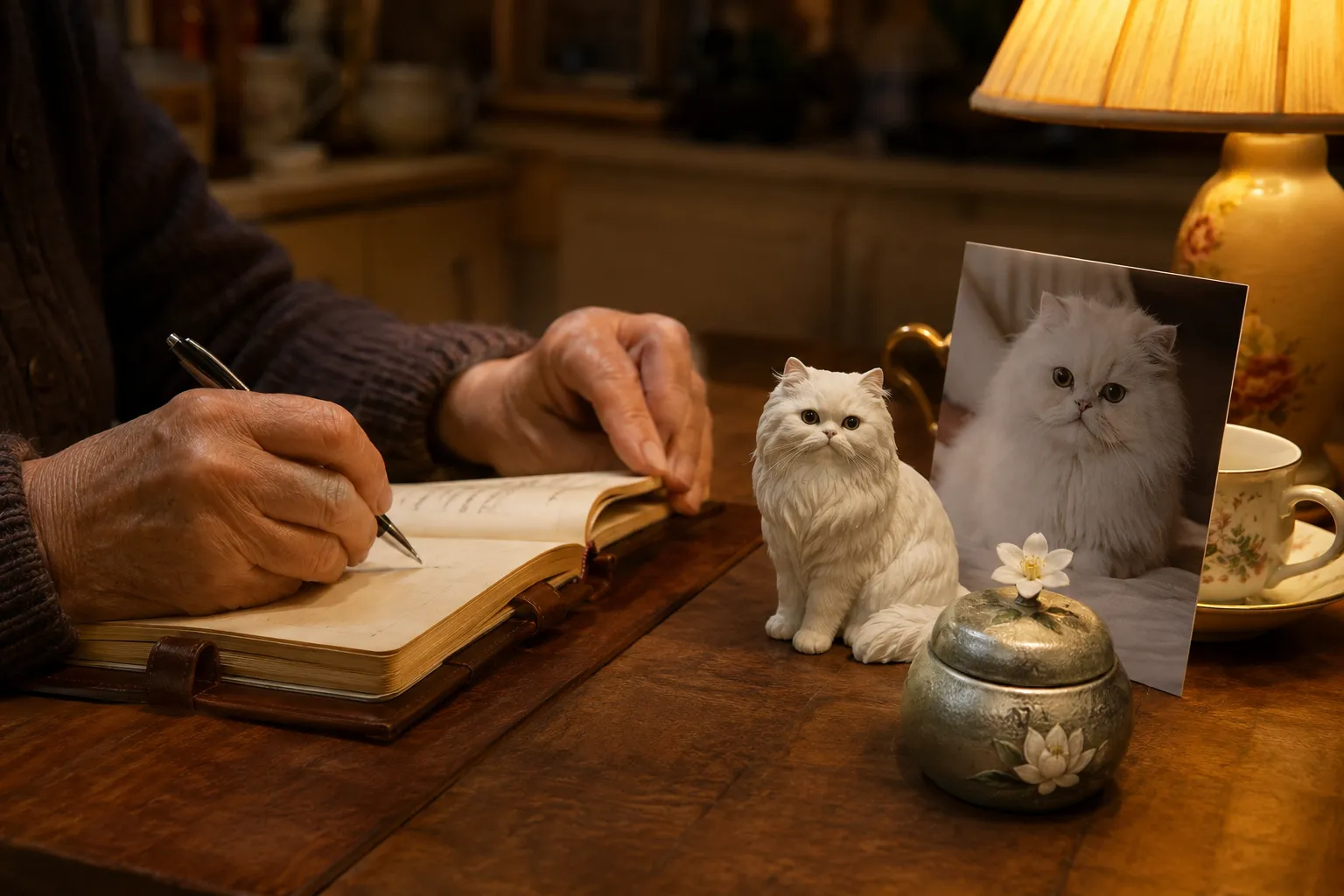
She was halfway down the hallway when her foot caught the edge of the water bowl—still full, still in its spot beside the baseboard where it had lived for fourteen years. The ceramic scraped against tile, and that sound, that small grinding note, became the first night without her Persian cat distilled into a single moment.
Quick Takeaways
- Stoic journaling on the first night of pet loss isn't about suppressing grief — it's about giving formless pain a container
- One specific writing prompt can interrupt the spiral — tonight, write what your cat taught you about stillness
- The empty spaces in your home are not enemies — they're evidence of a life that mattered enough to reshape your environment
- A tangible memorial like a custom pet figurine anchors memory — giving grief something physical to hold onto when words fail
- Persian cat grief carries unique weight — their quiet, constant presence leaves a silence that other people rarely understand
Why the First Night Hits Persian Cat Owners Differently
Here's something we've observed across hundreds of memorial orders: Persian cat owners describe their grief differently than owners of other breeds. Not more intensely, necessarily—but with a spatial quality that's distinct.
Persians don't fetch. They don't do zoomies at 3 AM (usually). They occupy space. They become part of the architecture of your home—the warm weight on the ottoman, the presence in the doorway, the slow blink from across the room that said I see you, and that's enough.
When that presence disappears, what you're left with isn't just emotional absence. It's physical absence. The room feels wrong. The proportions are off. The chair where she always sat looks too large now, somehow.
| Aspect of Loss | Dogs (Typically) | Persian Cats (Typically) |
|---|---|---|
| Primary grief trigger | Disrupted routines (walks, feeding times) | Spatial emptiness (their "spot" is vacant) |
| When grief peaks | Morning and evening activity windows | Quiet moments—reading, watching TV, nightime |
| What others notice | Missing sounds (barking, nails on floor) | Nothing visible—the loss is silent |
| Hardest adjustment | Reduced physical activity | Reduced sense of companionship during stillness |
That last row matters. Because when your grief is roted in stillness, other people often can't see what you've lost. And that invisibility compounds the pain.
The Stoic Framework (And Why It's Not What You Think)
Most people hear "Stoic" and think suppress your feelings. That's a misread of the philosophy—and honestly, it's the opposite of what we're suggesting tonight.
The Stoics—Marcus Aurelius, Epictetus, Seneca—practiced something closer to deliberate engagement with difficult truths. They wrote. Constantly. Marcus Aurelius's Meditations was literally a journal he never intended to publish. He was processing his life in real time, on paper, with radical honesty.
"Your grief is not a problem to solve tonight. It's a truth to witness."
Here's the counterintuitive insight that most grief journaling guides miss: the goal isn't to feel better. The goal is to feel accurately. To name what's actually happening inside you with enough precision that the feeling stops being a shapeless monster and becomes something you can look at directly.
Tonight, you don't need to heal. You need to record.
What Stoic Journaling Is Not
- It's not positive affirmations ("My cat is in a better place")
- It's not gratitude lists (not tonight—those come later)
- It's not problem-solving ("How do I stop feeling this way?")
- It's not performance (no one reads this but you)
What It Is
A practice of witnessing your own experience without judgment, without rushing toward resolution. The Stoics called this prosoche—attention. Paying attention to what is actually true right now, in this moment, in this body, in this room.
The Prompt: What Did She Teach You About Being Still?
Here's your journaling prompt for tonight. Just this one. Don't overthink it.
Write down one thing your Persian cat taught you about stillness.
Not what she taught you about love (too broad tonight, too overwhelming). Not what she taught you about responsibility. Specifically: what did her way of being still—her way of simply existing in a room—teach you about how to live?
Maybe it's that presence doesn't require performance. Maybe it's that comfort can be silent. Maybe it's that watching snow fall through a window is a legitimate way to spend an afternoon, if someone warm is doing it beside you.
Write it down. Tonight. On paper, not a screen—the Stoics were onto something about the physical act of writing. The hand moves slower than the mind, and that friction is the point. It forces you to choose words carefully. It makes you mean what you say.
Why This Specific Prompt Works on Night One
The first night without your pet is characterized by a particular cognitive pattern: the mind scans for what's missing. It inventories absence. The food bowl. The sound of breathing. The weight at the foot of the bed.
This prompt redirects that scanning energy. Instead of cataloging what's gone, you're identifying what transferred. What moved from her life into yours. What you carry forward.
That's not denial. That's not toxic positivity. It's a Stoic practice called turning the obstacle upside down—finding what the difficult thing makes possible. Tonight, the difficult thing makes it possible to articulate something you might never have put into words while she was alive.
Personal Aside: We'll be honest—when we first started suggesting journaling to grieving pet owners, we felt awkward about it. Who are we to prescribe grief practices? But then we kept hearing back from customers, months later, that the thing they wrote down in those first raw hours became the inscription on a memorial, the caption under a photo, the words they whispered to their new cat years later. The first night's writing has a clarity that later writing rarely matches. It's worth capturing.
The Emotions You're Not Supposed to Feel (But Do)
Let's talk about something that most pet grief articles won't touch.
If you felt relief when your Persian cat died—especially if she was elderly, especially if she was ill—that relief is not betrayal. It's not evidence that you didn't love her enough. It's evidence that you were carrying something heavy for a long time, and your body registered the moment that weight shifted.
Here's what we've seen in our work with grieving pet families: the owners who feel relief almost always feel guilt about the relief within hours. It's a one-two punch. First the exhale, then the shame.
We want to name this directly because the Association for Pet Loss and Bereavement recognizes this as one of the most common—and most isolating—experiences in pet grief. You are not alone in this. You are not broken. You loved her enough to carry the weight of her decline, and your nervous system is responding to the fact that you no longer have to watch her suffer.
The guilt that follows? That's grief's cruelest trick. It takes your compassion—the very thing that made you a good caretaker—and weaponizes it against you.
Tonight, if relief showed up, write that down too. The Stoics didn't edit their journals for palatability. Marcus Aurelius wrote about his own pettiness, his irritation, his failures. Your journal is not a performance of perfect grief. It's a record of what's true.
The Fear of Forgetting
There's another feeling that often surfaces on the first night, and it's this: the terror that you'll forget.
Not the big things—you won't forget her name, her color, the general shape of her face. But the small things. The specific weight of her on your chest. The exact sound of her pur (was it more of a rumble or a hum?). The way she positioned herself on the windowsill—was it always the left side, or did she alternate?
This fear is rational. Memory does fade. Details do blur. And for elderly pet owners especially—those who've shared a decade or more with a Persian companion—this fear can feel urgent. Like a clock started ticking the moment she left.
"Memory doesn't need to be perfect to be true. It needs to be held."
Here's what we'd suggest: tonight, write down three physical details. Not emotional memories. Physical, sensory, specific details. The texture of her fur between your thumb and forefinger. The temperature of her ears. The sound her paws made on hardwood versus carpet.
These details are the first to fade. Capture them now.
| Detail Type | Example Why It Fades First | |
|---|---|---|
| Tactile | The specific density of her undercoat | Touch memory has no visual reinforcement |
| Auditory | Her particular purr frequency | We rarely record everyday sounds |
| Spatial | Exactly how much of the pilow she occupied | Photos don't capture scale well |
| Thermal | The warmth of her body against your ankle | No way to preserve temperature memory |
| Kinetic | How she shifted weight when she stood up | Video captures this, but rarely exists for mundane moments |
This table isn't academic. It's practical. Look at it and ask yourself: which of these can I still feel right now, tonight, while the memory is fresh? Write those down first.
The Room Will Feel Wrong Tomorrow Morning
We want to prepare you for something. Tomorrow morning, you'll walk into whatever room she spent the most time in, and for approximately two seconds, your brain will expect her to be there. It will scan her spot. It will not find her.
That two-second scan will happen for weeks. Maybe months. It's not a sign that you're not healing. It's a sign that your neural pathways mapped her presence into your spatial awareness so deeply that your brain literally cannot update the map overnight.
This is, in a strange way, a compliment to the life you built together. Your home learned her. The architecture of your daily perception included her. That doesn't undo quickly, and it shouldn't.
A Stoic Response to Empty Space
The Stoic approach to this isn't to rearrange the furniture immediately (though some people do, and that's fine). It's to notice the scan without resisting it.
When your eyes go to her spot tomorrow morning, don't force them away. Don't fill the spot with something else out of panic. Instead, try this:
- Notice the scan happening ("My eyes just looked for her")
- Name what you see instead ("The cushion is empty")
- Acknowledge what that means ("She was here yesterday. She isn't today. Both are true.")
That's it. Three steps. Takes four seconds. It won't fix anything—but it converts a moment of panic into a moment of presence. And presence, the Stoics argued, is the only place where peace actually lives.
What to Do With the Bowl, the Brush, the Bed
People will tell you to put her things away when you're ready. That's fine advice, as far as it goes. But here's what they don't tell you: there's no consensus on timing, and the "right" answer varies enormously.
Some people need her things gone by day two because every object is a trigger. Others keep the water bowl full for six months because moving it feels like erasing her. Neither response is pathological. Both are legitimate.
What we'd suggest tonight—just tonight—is this: don't make any decisions about objects. The Stoics had a concept called epoché—suspension of judgment. Tonight is not the night to decide what stays and what goes. Tonight is the night to write, to feel, and to let the objects simply be objects.
"The things she touched are not her. But tonight, let them be close."
Tomorrow, next week, next month—you'll know when it's time to make choices about the physical remnants of her life. Some families tell us they keep one object permanently (a favorite toy, a collar) and release the rest. Some create a small memorial shelf. Some choose to commission a memorial figurine that captures her likeness—a way to preserve her physical presence without keeping every item frozen in place indefinitely.
There's no timeline. There's no deadline objects aren't going anywhere tonight.
Journaling Beyond Night One: A Five-Day Stoic Framework
Tonight's prompt is singular and focused. But if you find that writing helps—if putting words on paper gives the formless ache some edges—here's a framework for the first five days.
| Night | Stoic Principle | Prompt |
|---|---|---|
| 1 | Prosoche (Attention) | What did she teach you about stillness? |
| 2 | Memento Mori (Remember death) | What did you know, in your body, before thevet confirmed it? |
| 3 | Amor Fati (Love of fate) | What would you not trade, even knowing this ending? |
| 4 | Sympatheia (Interconnection) | Who else is grieving her? (Other pets, family members, even the vet) |
| 5 | Premeditatio Malorum (Premeditation of adversity) | What's the hardest moment you're anticipating this week? Name it. |
These aren't meant to be completed perfectly. Some nights you'll write three words. Some nights you'll fill pages. The practice is in the returning—picking up the pen again even when it feels pointless.
Why Paper Matters (The Neuroscience Is Clear)
We mentioned this earlier, but it bears expanding: write on paper, not a screen. This isn't nostalgia. Research from the National Institutes of Health has documented that handwriting activates different neural pathways than typing—specifically regions associated with memory consolidation and emotional processing.
When you're grieving, your prefrontal cortex (the planning, organizing part of your brain) is partially offline. Handwriting engages it gently, without the cognitive load of a screen's distractions. No notifications. No autocorrect. No temptation to google "stages of grief" at 2 AM instead of actually feeling what you feel.
A notebook. A pen. The kitchen table or the bed or the floor beside her empty spot. That's all the infrastructure this practice requires.
The People Who Won't Understand
Here's something we need to address directly, because it will happen within48 hours: someone will minimize your grief.
They'll say "it was just a cat." Or they'll say "at least she lived a long life." Or they'll change the subject quickly because your pain makes them uncomfortable. Or—and this one is particularly common with Persian cat owners—they'll say something about how "she was just sleeping all the time anyway" as if a quiet life is a lesser life.
The Stoics had a useful framework for this: the dichotomy of control. You cannot control other people's capacity for empathy. You cannot make someone understand what fourteen years of shared silence meant. What you can control is where you direct your grief—toward people who get it, toward the page, toward practices that honor what was real.
If you're an elderly pet owner, this minimization can be especially acute. People may assume that because you've experienced other losses—human losses—a cat's death shouldn't register as strongly. This is a fundamental misunderstanding of how attachment works. The bond between a person and their Persian cat—especially one who was a daily, hourly, constant companion through retirement, through health changes, through the narrowing of a social world—that bond is not lesser. It's often more intimate precisely because it was so consistent and so quiet.
"We've learned that the quietest bonds often leave the loudest silence. Persian owners feel this more than most."
— The PawSculpt Team
You don't owe anyone an explanation for the depth of your grief. But you might find it useful to identify, tonight, one person who would understand. Write their name down. You don't have to call them tonight. But knowing they exist helps.
The Second-Guessing (Let's Name It)
If your Persian cat waseuthanized—if you made that decision—there's a specific form of torment that may visit you tonight. It sounds like this:
Was it too soon? Could she have had another week? Another month? Did I do it for her, or did I do it because I couldn't watch anymore?
We're going to be direct: almost every owner who choses euthanasia asks these questions. Almost every single one. The ones who waited "too long" wish they'd acted sooner. The ones who acted "early" wish they'd waited. There is no timing that eliminates this doubt, because the doubt isn't really about timing. It's about the impossibility of making a permanent decision on behalf of someone who couldn't tell you what they wanted.
The Stoic response to this isn't "stop thinking about it." It's this: you made the decision with the information you had, the emotional state you were in, with the veterinary guidance available to you. That is all any person can do. Judging your past self by your present grief is not fairness—it's cruelty directed inward.
Tonight, if the second-guessing comes, write this in your journal: I decided with love. Love does not guarantee certainty. I can live with uncertainty. I cannot live with having let her suffer for my comfort.
Then put the pen down. You don't need to resolve this tonight. You may never fully resolve it. That's okay. Some questions are meant to be carried, not answered.
Making Memory Physical
At some point in the coming weeks—not tonight, not necessarily this week—you may feel the urge to do something concrete. To make the memory physical. This is a well-documented grief response, and it's healthy.
Some options people choose:
- A garden stone in a spot she used to watch from the window
- A photo printed and framed—not on a phone, but tangible, on a wall
- A donation to a Persian cat rescue in her name
- A custom figurine that captures her specific coloring, her particular way of sitting, the exact proportions of her face—something you can hold, set on a shelf, touch when the memory feels like it's slipping
That last option is something we know well. At PawSculpt, our digital sculptors work from your photos to create a full-color resin figurine—the color printed directly into the material, voxel by voxel, so her cream coat and copper eyes and the specific pattern of her markings are preserved with a permanence that photos on a phone can't match. It's not a replacement. Nothing is. But it's anchor. Something three-dimensional in a grief that can feel formless.
We mention this not as a sales pitch—tonight is not about purchasing anything—but because the fear of forgetting is real, and having physical object that captures her specific likeness (not a generic Persian, but your Persian) addresses that fear in a way that's hard to replicate otherwise.
Visit pawsculpt.com when you're ready. There's no rush. The photos on your phone aren't going anywhere.
Tonight's Practical Checklist
Before we close, here's what tonight actually looks like, practically:
- Get a notebook and pen. Any notebook. A napkin works. The back of an envelope works.
- Sit somewhere she used to be. Not torture yourself—but because the spatial memory is strongest there.
- Write the prompt at the top of the page: What did she teach me about being still?
- Write for five minutes. Set a timer if you need to. Stop when it goes off, or keep going if the words are coming.
- Write three physical details about her while they're fresh. Texture. Sound. Weight Temperature. Anything sensory.
- Close the notebook. You're done for tonight. You did enough.
Don't read what you wrote. Not tonight. Let it exist without judgment. The Stoics wrote to process, not to produce. Your journal is not content. It's not a eulogy draft. It's a pressure valve.
If sleep doesn't come easily—and it probably won't—that's normal. The bed will feel different without her weight on it. Let it feel different. Don't fight the strangeness. Notice it, name it, and let the night pass at whatever pace it passes.
Coming Back to the Hallway
That water bowl by the baseboard. The one your foot caught on the way to the kitchen, or the bathroom, or wherever you were headed when the ceramic scraped against tile and the whole night crystallized into sound.
It's still there. It'll be there tomorrow. And the day after.
At some point, you'll move it. Or you won't. Both choices are yours, and both are right. But tonight, let it stay. Let it be evidence. Let it be proof that this hallway was shared—that for fourteen years, someone small and warm and impossibly soft arranged herself in this space, and the space remembers.
The Stoics believed that the purpose of philosophy was not to eliminate suffering but to meet it with clarity. Tonight, your clarity might be as simple as this: She was here. I loved her. I am allowed to grieve her fully.
Write that down. Then rest, if you can. Tomorrow the work of living continues. But tonight belongs to her.
Frequently Asked Questions
Is it normal to feel guilty after choosing euthanasia for my cat?
Yes—and "normal" undersells how universal this is. Nearly every owner who makes this decision revisits it. The doubt doesn't mean you chose wrong. It means you loved her enough to carry the weight of an impossible choice. You decided with the information and guidance available to you in that moment, and that is enough.
How long does grief last after losing a Persian cat?
There's no fixed timeline, and anyone who gives you one is oversimplifying. What we can say is that the acute, disorienting phase—the scanning-for-them, the forgetting-they're-gone—typically softens within three to six months. But grief isn't linear. You'll have unexpected waves years later, triggered by a sound or a season. That's not regression. That's love with a long memory.
Does journaling actually help with pet loss grief?
It does, but not in the way people expect. It doesn't make the pain smaller. It makes the pain legible. Handwriting in particular engages neural pathways associated with emotional processing and memory consolidation. Many of our customers have told us that what they wrote on the first night became the most honest, most valued record of their pet's life.
What should I do with my cat's belongings after they pass?
Nothing, tonight. Seriously—suspend the decision. There's no deadline, and choices made in acute grief are often regretted. When you're ready (days, weeks, months—all valid), most people find a middle path: keep one or two meaningful items, donate or discard the rest, and perhaps create a single memorial object that represents the whole.
Why does my house feel so different after losing my cat?
Because your brain literally mapped her into the architecture of your perception. After years of her occupying specific spots, your neural pathways expect her there. The scan-and-miss response—looking at her spot and finding it empty—is your brain's spatial memory updating in real time. It fades gradually, but it's disorienting while it lasts.
Is it normal to feel relief when a sick pet dies?
Completely. Relief after watching a companion suffer is not betrayal—it's the natural response of a nervous system that was carrying sustained stress. You were vigilant for weeks or months, monitoring her comfort, making hard calls daily. Your body registered the moment that vigilance was no longer required. The guilt that chases the relief is grief's cruelest trick, not evidence of inadequate love.
Ready to Honor Your Persian's Memory?
Every Persian cat carries a quiet dignity that deserves to be remembered in three dimensions—not just in pixels on a screen, but in something you can hold, place on a shelf, and touch when the fear of forgetting surfaces. A custom PawSculpt figurine captures her specific markings, her particular posture, the exact way she held herself in the world—printed in full-color resin that preserves those details permanently.
When you're ready—not tonight, but when the time feels right—this is one way to give your first night pet loss journaling a physical companion. Something that says: she was real, she was here, and she mattered.
Visit pawsculpt.com to see how the process works and explore what's possible