Stop Saving Thousands of Bunny Photos: 4 Reasons One Physical Rabbit Sculpt is Worth 1TB of Cloud Storage
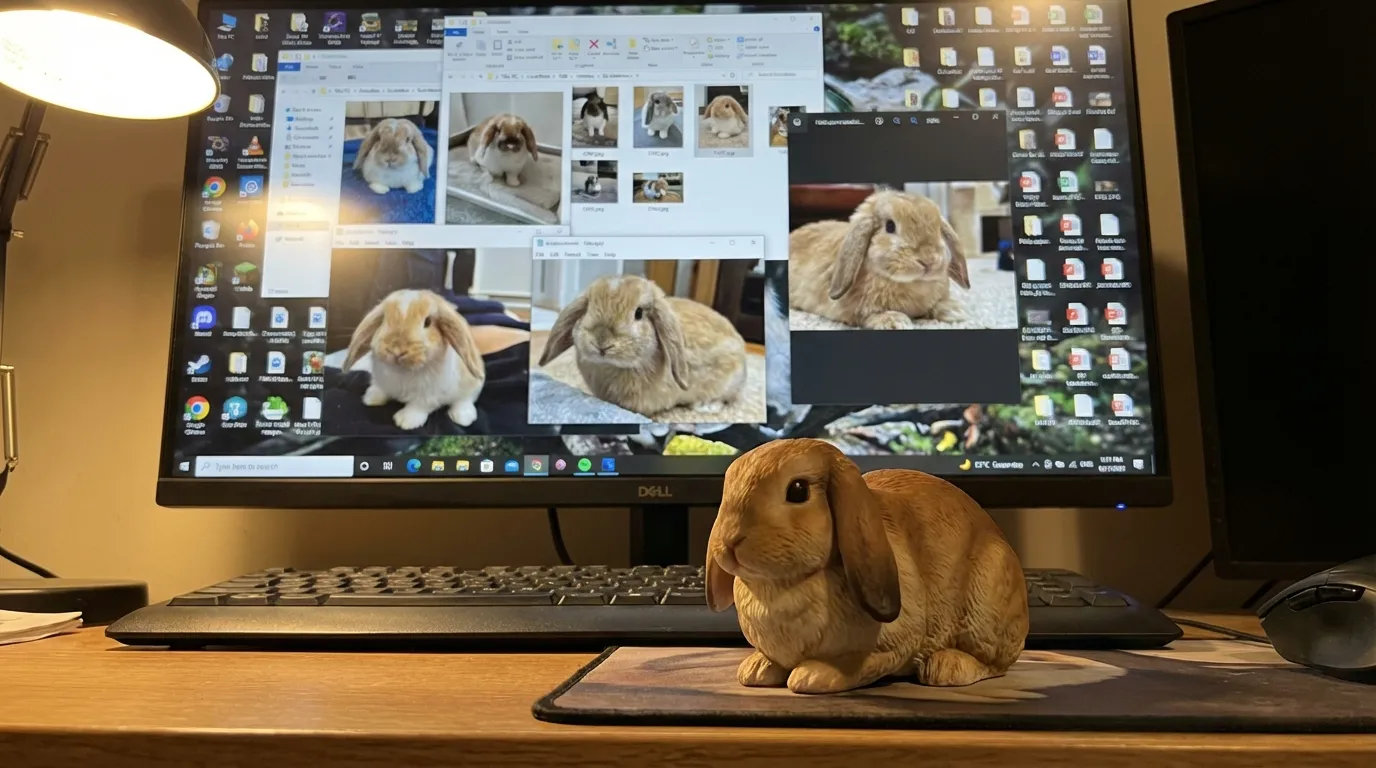
Research from the University of Birmingham suggests that while we take more photos than ever before—an estimated 1.4 trillion globally per year—our ability to actually recall the memories attached to those images diminishes with the volume we store. You're standing in the attic, surrounded by dusty boxes, but the most important archive of your life is trapped on a server farm in a different state, invisible and untouchable.
Quick Takeaways
- Digital amnesia is real — scrolling through thousands of thumbnails actually weakens your brain's ability to retain specific emotional memories.
- Rabbits are tactile creatures — a flat screen cannot replicate the specific curve of a bunny's spine or the texture of their fur like a 3D object can.
- The "Cloud" is fragile — subscription lapses, lost passwords, and corrupted files make digital archives surprisingly precarious.
- Tangible anchors ground grief — holding a physical custom figurine triggers sensory recall that pixels on a screen simply cannot activate.
The Psychology of the "Scroll Trance"
We need to talk about what happens when you open your phone to look at photos of your rabbit. You intend to find that one specific video of them doing a 'binky' in the garden three years ago. Twenty minutes later, you're numb, scrolling mindlessly through hundreds of nearly identical shots, and you feel... empty.
This is what cognitive psychologists call the "photo-taking-impairment effect." When we offload our memories to a device, our brains stop doing the heavy lifting of encoding that memory. We tell ourselves, "I have a picture of it, so I don't need to remember it."
But for rabbit owners, this is particularly devastating. Rabbits are subtle creatures. Their personalities are expressed in micro-movements—the specific tilt of an ear when a treat bag crinkles, the "loaf" position that indicates safety. When you have 5,000 photos of a rabbit, your brain starts to categorize them as data rather than moments.
"We take photos to stop time, but scrolling through thousands of them actually speeds it up, blurring years of love into a wash of pixels."
The counterintuitive insight here is that scarcity creates value. A single, physical object that sits on your desk commands your attention. It invites a pause. A terabyte of photos invites a scroll. When you look at a physical sculpture, your brain engages in "active recall," rebuilding the memory around that object. When you look at a screen, you engage in "passive consumption," which does very little for your grief or your memory.
Why Rabbits Specifically Need 3D Representation
If you've loved a dog or cat, you know they are tactile, but rabbits are architectural. Their beauty is largely defined by their silhouette and their posture. A photo flattens a rabbit. It turns a three-dimensional being into a 2D plane.
Think about the specific anatomy of your bun. Maybe it was the way their dewlap rested over their paws when they slept. Maybe it was the asymmetry of their ears—one lopped, one upright (the "helicopter" look). These are structural details, not just visual ones.
Biologically, humans are wired for haptic (touch-based) feedback. Our fingers contain thousands of mechanoreceptors that send signals directly to the brain's emotional centers. Touching a physical representation of your pet activates different neural pathways than looking at a backlit screen.
The "Ghost Weight" Phenomenon
Many rabbit owners we speak to describe a specific type of grief: the "ghost weight." They miss the physical sensation of their rabbit's weight on their lap or the feeling of petting that impossibly soft fur behind the ears.While a figurine isn't soft, it has volume. It occupies space in the room. It casts a shadow. This spatial presence helps trick the brain into feeling less isolated. It acknowledges that a being occupied space in your life, and now a representation of them occupies space on your shelf. A JPEG file occupies zero space. It is mathematically invisible until you summon it.
| Sensory Input | Digital Photo Album | Physical 3D Tribute |
|---|---|---|
| Visual | High resolution, but backlit and flat | Multi-angle, interacts with room lighting |
| Tactile | Cold glass screen | Texture, weight, distinct shape |
| Spatial | None (exists in code) | Occupies physical volume in your home |
| Interaction | Scrolling/Swiping (passive) | Holding/Touching (active) |
| Emotional Impact | Often overwhelming/numbing | Grounding/Calming |
The Anxiety of Digital Clutter
There is a distinct, rarely discussed anxiety that comes with digital hoarding. You might feel a low-level panic about your backups. Did the cloud sync? What if I lose my password? What if the file format becomes obsolete in 10 years?
This anxiety complicates grief. Instead of just missing your rabbit, you are managing an IT project. You are the curator of a massive, disorganized museum that no one visits—not even you, because it's too painful to sort through.
The "Delete" Guilt
Here is a feeling many pet owners are ashamed to admit: the guilt of deleting bad photos. You have 40 blurry shots of your rabbit's ear because you were trying to catch a yawn. You want to delete them to save space, but it feels like deleting a piece of them. So you keep them. And the clutter grows.
By crystallizing your rabbit's memory into one high-quality physical form, you give yourself permission to relax about the digital archive. You aren't deleting their memory; you have already preserved it in the real world. The pressure releases.
"We've seen families heal by holding something tangible. Grief needs an anchor, not a login screen."
— The PawSculpt Team
The " Shrine" vs. The "Feed"
Social media has conditioned us to view our pets through the lens of a "feed"—a chronological, ephemeral stream of content. But historically, humans don't mourn in feeds. We mourn with shrines, totems, and statues.
When you place a custom figurine on a bookshelf, perhaps next to their urn or a favorite chew toy, you are creating a dedicated space for memory. This is a "sacred space" in your home.
The Ritual of Dusting
This sounds mundane, but it's profound. When you have a physical object, you have to care for it. You might dust it off once a week. You might move it to catch the morning sun. These small, physical acts of care are micro-rituals. They allow you to continue "caring" for your rabbit even after they are gone.
You cannot "care" for a digital photo. You can only view it. The act of caring for a physical object provides an outlet for the nurturing energy you still have, but nowhere to direct. It helps metabolize the grief.
The limits of "Perfect" Photos
One of the counterintuitive things we’ve learned in our studio is that the "perfect" professional photo often isn't the one that triggers the deepest emotional response.
A professional photo might show your rabbit looking majestic with perfect lighting. But the photo you love? It’s the grainy one where they are mid-binky, or the one where they look grumpy because you stopped petting them.
This is where 3D technology bridges the gap. We don't just print a photo. Our artists interpret the geometry of the animal. We can capture the specific "grumpy slump" of a rabbit in a way that a single photo angle often misses.
Why "Full-Color 3D Printing" Matters for Rabbits
Rabbits have incredibly complex coat patterns. Agouti coloring, for instance, involves bands of different colors on a single hair shaft. Harlequin patterns are chaotic and unique.Old-school sculpting often involved painting on top of clay. But paint sits on the surface. Modern full-color 3D printing (the technology we use) builds the color into the material, voxel by voxel (a voxel is a 3D pixel). This allows for the reproduction of those subtle gradients in a rabbit's fur—the way the white belly fades into the grey flank—that hand-painting often struggles to capture authentically. It captures the organic chaos of nature, rather than the interpretation of a painter's brush.
Frequently Asked Questions
Why is a physical memorial better than digital photos?
Physical objects trigger haptic (touch) memory and active recall. When you hold an object, your brain engages differently than when you passively scroll through a screen. A 3D object occupies space in your home, serving as a grounding anchor for your grief, whereas digital files are hidden away until you actively search for them.Can you capture complex rabbit fur patterns?
Yes. We use advanced full-color 3D printing technology. Unlike hand-painted statues where brushstrokes can look artificial, our process builds the color directly into the resin, voxel by voxel. This allows us to reproduce the subtle gradients of agouti fur, the chaotic spots of a broken pattern, or the specific markings of a Harlequin rabbit with high fidelity.My rabbit had a specific ear position, can you replicate that?
Absolutely. This is the advantage of digital sculpting. Our artists look at your photos to understand your rabbit's specific anatomy. If your bun had one ear that always flopped to the left, or "helicopter ears," we model that geometry specifically before the printing process begins.How do I choose the right photo for a figurine?
Don't worry about finding one "perfect" professional shot. Instead, look for the photo that captures their essence. Maybe it's the way they sat when waiting for a treat, or their "sploot" posture. We can combine details from multiple photos (one for the pose, others for the markings) to create a cohesive tribute.Ready to Celebrate Your Pet?
Every pet has a story worth preserving. Whether you're honoring a beloved companion who's crossed the rainbow bridge or celebrating your furry friend's unique personality, a custom PawSculpt figurine captures those details that make your pet one-of-a-kind.
Free instant AI preview • 3D artist preview within 7 days • 5 free revisions