
Why My Therapist Asked About the Last Photo of My Shiba Inu
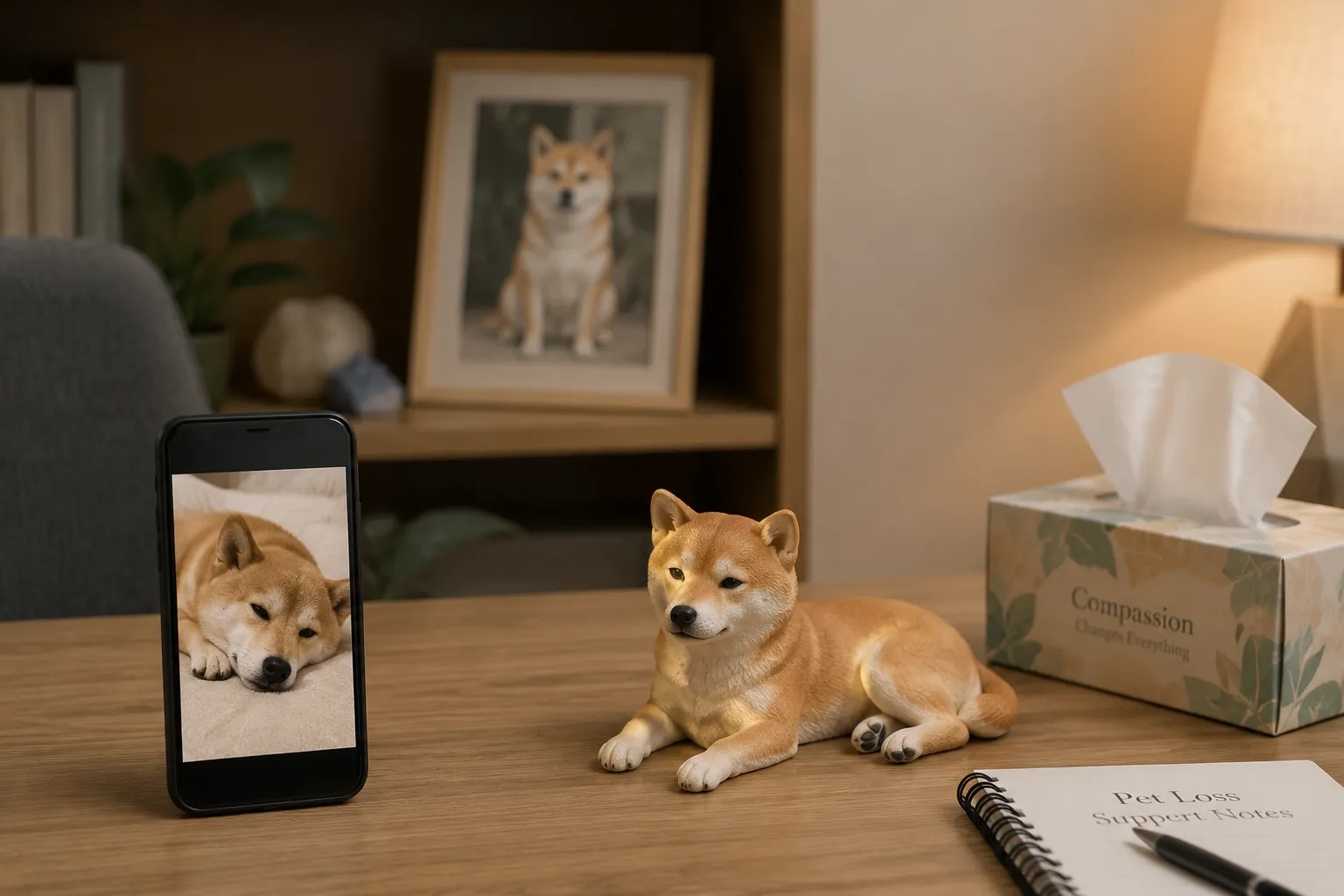
Why would a pet loss therapy session open with a question about a single phone photo? Because that last blurry shot of your Shiba mid-yawn in the hallway holds more than you think. It holds the whole relationship.
Quick Takeaways
- The last photo isn't morbid — therapists use it to locate exactly where your grief got stuck.
- Avoidance prolongs grief — the image you can't look at is often the one that heals fastest.
- Sudden loss rewires the brain differently — your body keeps scanning for a dog that isn't coming back.
- Tangible anchors help grief settle — many families find comfort in custom memorial figurines that hold a specific pose.
- Guilt about timing is near-universal — and it's almost never the verdict your dog would give you.
What a Photo Tells a Therapist That You Won't
Here's something we've learned after working with thousands of grieving pet families through our studio: the last photo people have of their pet is almost never a good one. It's blurry. The dog is mid-blink. Half a tail is cut off. Somebody's thumb is in the corner.
And it's the most important image in their entire camera roll.
A grief therapist asking about that photo isn't being weird. They're doing something precise. The last photo is a map of where the relationship stopped. It marks the exact second the future you assumed you had got deleted. For a Shiba Inu owner, that photo might be a snapshot in the hallway — that classic Shiba stance, ears up, suspicious of the camera, refusing to fully cooperate the way Shibas do.
One of our customers told us her therapist spent an entire session on a photo like that. Not the dog's diagnosis. Not the vet bills. The photo. Because the photo was where she'd frozen.
"The last photo isn't where the story ends. It's where you stopped letting yourself look."
The "Continuing Bonds" Idea Most Grief Advice Skips
Most pet loss articles tell you grief comes in five neat stages and then you "move on." That model is old, and frankly, working clinicians moved past it a long time ago. The framework that actually shows up in modern pet loss therapy is called continuing bonds — the idea that healthy grief doesn't mean cutting the cord. It means changing the shape of the connection so you can carry it.
This is the part that surprises people. You're not supposed to forget. You're supposed to find a new way to keep them present that doesn't shred you every time.
That's why a therapist circles back to a photo. They're testing whether you can look at your dog and feel the love land instead of just the loss. When the photo only triggers panic or guilt, the bond is stuck in the trauma of the ending. When it can hold warmth again, something has shifted.
So what? It means the goal of grief work isn't to feel less. It's to be able to hold the memory without flinching. The photo is the test strip.
The Psychology of Attachment Doesn't Care That It Was "Just a Dog"
If one person says "it was just a dog" to you, you have permission to walk away from that conversation. We mean it.
The psychology of attachment is the same biological machinery whether the bond is with a person or an animal. Your nervous system formed an attachment to your Shiba the same way it bonds to anyone who provides consistent comfort, routine, and physical closeness. The brain doesn't file your dog under "pet." It files them under "safe presence."
This is why the loss hits the body, not just the mind.
Why Your Body Keeps Looking for Them
For weeks after a loss, people report the same thing: they reach for the leash. They wake at 6 a.m. because that's feeding time. They step over a spot on the floor where a dog used to sleep. Their hand drops to the side of the couch to scratch an ear that isn't there.
That's not you being dramatic. That's attachment behavior running on autopilot. Your brain built thousands of tiny prediction loops around your dog's presence — the click of nails on hardwood, the weight settling against your feet, the specific warmth of fur under your palm. When the source disappears, the loops keep firing for a while. They have to be unlearned, one by one.
The texture memories are the cruelest. The coarse outer coat of a Shiba, that double-layer density, the way the fur springs back. People tell us they can still feel it in their hands months later. That's not imagination. That's somatic memory, and it fades slower than visual memory.
"Grief lives in your hands as much as your heart. That's why holding something solid helps."
The Attachment Style Detail Nobody Mentions
Here's an insider nuance from sitting with hundreds of these stories. How you grieve a pet often mirrors your human attachment style. People with anxious attachment tend to replay the final hours obsessively, hunting for the moment they "should have" acted. People with more avoidant patterns often go numb, then get blindsided weeks later by a smell or a sound.
Knowing your own pattern isn't navel-gazing. It tells you what kind of support to ask for. The replayer needs help interrupting the loop. The number needs permission to actually feel it before it ambushes them in a grocery store parking lot.
Sudden Pet Loss Coping: When There Was No Goodbye
There's a difference between losing a pet to a long illness and losing one in an afternoon. Sudden pet loss coping is its own animal entirely, and most grief resources blur the two together. They shouldn't.
When loss is sudden — a car, a sudden collapse, a diagnosis at 2 p.m. and an empty house by 6 — your brain doesn't get the runway it needs. There's no anticipatory grief, no slow goodbye, no chance to memorize them on purpose. The shock itself becomes a layer of grief stacked on top of the loss.
A family we worked with lost their young Shiba to bloat, which can turn fatal in hours. The mom kept saying the same sentence: "He was fine at lunch." That gap — fine at lunch, gone by dinner — is the wound sudden loss leaves. The mind keeps trying to fill in a process that never happened.
The First 48 Hours Matter More Than People Realize
In sudden loss, the first 48 hours set patterns that can last months. Here's what actually helps, concretely:
- Don't strip the house immediately. The instinct to remove every trace within hours usually backfires. Leave the bed, the bowl, the toys for at least a few days. Sudden removal trains your brain to associate "home" with a void.
- Take the photo you're scared to take. If you're at the emergency vet, a final photo or a paw print feels impossible in the moment. Most people who skip it regret it. The ones who took it almost never do.
- Say the timeline out loud to one person. "He was fine at lunch and gone by dinner." Speaking the sequence to another human starts breaking the shock loop. Texting it doesn't work the same way. The voice matters.
- Eat something within those 48 hours. Sounds stupid. It's not. Grief plus low blood sugar produces decisions you'll regret, like giving everything away at 3 a.m.
So what? Sudden loss removes your ability to prepare, so the work shifts to not making the trauma worse in the disoriented hours right after. You can't process yet. You can avoid creating new wounds.
Let me lay out how the type of loss changes the early grief experience, because the difference is real and rarely named:
| Type of Loss | Hardest Early Feeling | What Helps Most First |
|---|---|---|
| Sudden/accidental | Shock and disbelief | Speaking the timeline aloud, keeping routines briefly |
| Long illness | Exhaustion, anticipatory guilt | Permission to feel relief, rest |
| Euthanasia decision | Second-guessing the timing | Vet reassurance, the photo, ritual |
| Old age / in sleep | Quiet, delayed grief | Naming the loss as real, not minimizing |
The Guilt Nobody Admits Out Loud
We need to talk about the feelings people whisper to us but won't post online.
Second-guessing euthanasia timing is the heaviest one. If you made that decision, there's a strong chance you've laid awake asking whether you did it too soon, or worse, too late. Whether that last good day was a sign you should have waited. Whether you robbed them of time or made them suffer an extra week for your own benefit.
Here's the straight talk: there is no perfect day. Vets will tell you the same. The "right time" is a window, not a point, and you almost certainly acted somewhere inside that window. The guilt isn't evidence you failed. The guilt is grief wearing a disguise, looking for somewhere to put all that love with nowhere left to send it.
"Guilt is just love that lost its address. Give it a new one."
And the feeling people are most ashamed of? Relief. If your dog was sick for a long time, or if the final stretch was around-the-clock care and cleaning and worry, you may have felt a flicker of relief when it ended. Then you hated yourself for it.
Stop. That relief doesn't cancel the love. It coexists with it. Feeling relieved that the suffering — theirs and yours — is over doesn't make you cold. It makes you someone who was carrying something genuinely heavy, and you're allowed to notice the weight is gone. Both things are true at once. That's not a contradiction. That's what loving a dying creature actually feels like.
The Fear That Quietly Terrifies People
Then there's the one almost everyone feels and almost nobody says: the fear of forgetting. Not forgetting that they existed — forgetting the specifics. The exact pitch of the bark. The particular way your Shiba did that full-body shake. The smell of their paws (corn chips, every Shiba owner knows). The precise weight of them leaning into your shin.
This fear is why people get frantic about photos and video after a loss. It's a real grief response, and it has a name in the research: it's tied to the brain's natural fading of episodic detail over time. The big shape of the memory stays. The fine grain blurs. That's biology, not betrayal.
This is exactly where physical anchors earn their place — and we'll get to that honestly, including where they help and where they don't.
How a Shiba Inu Memorial Becomes Part of the Healing
A shiba inu memorial isn't about decoration. When it works, it works because it gives the continuing bond a physical home. Grief, as we said, needs an anchor — something with weight you can actually hold.
There are a lot of ways to build that anchor, and we'll be real about the tradeoffs, because not every option fits every person.
| Memorial Option | Effort Level | What It's Best For |
|---|---|---|
| Photo book / album | Low | People who process through narrative and sequence |
| Memorial garden / tree | Medium | People who want a living, seasonal ritual |
| Paw print / clay impression | Low | Capturing physical texture, done at the vet |
| Custom 3D figurine | Medium | Holding a specific pose or expression in 3D |
| Jewelry with ashes | Low | Keeping them physically close, daily |
| Donation in their name | Low | Turning grief into action for other animals |
Why a Pose Matters More Than You'd Guess
Here's something most people don't anticipate. When families ask us to create a figurine, the hardest part isn't the markings or the colors. It's choosing the pose. Because the pose is the memory.
The hallway sit. The play bow. The "Shiba scream" mid-protest. The curl on the couch with the tail wrapped over the nose. People agonize over this, and they should, because they're not picking a statue — they're choosing which version of their dog gets to stay solid.
Our team digitally sculpts each piece from your photos, then it's precision 3D printed in full color, so the markings and that distinctive Shiba coat pattern come through in the resin itself rather than sitting on top as a finish. The color is part of the material. The only thing added by hand afterward is a protective clear coat for sheen and durability. The result has a real, slightly textured surface — fine grain you can feel under your thumb — which honestly is part of why people say it feels less like an object and more like them.
"We've watched people hold a figurine and exhale for the first time in weeks. Grief needs something to land on."
— The PawSculpt Team
That tactile thing is the whole point. A photo lives behind glass. A figurine has weight in your palm, a temperature, an edge. For someone whose hands still remember fur, having something solid to hold does something a screen never will. You can put one of these memorial keepsakes on a nightstand and touch it on the bad nights.
Where a Figurine Doesn't Help (Being Honest)
We're not going to pretend an object fixes grief. It doesn't. If you're in the acute, can't-breathe stage of a sudden loss, a figurine you order today won't arrive into a place that's ready for it. Some people need months before any memorial feels right, and ordering too early can feel hollow.
And for some folks, the right answer isn't a figurine at all. It's a donation to a shelter, or fostering another dog down the line, or just a framed photo and time. A good memorial is the one you'll actually find comfort in — not the one that photographs well for someone else.
If you do go the figurine route, the practical tip: gather a few clear, well-lit photos from different angles, including at least one straight-on face shot and one full-body side view. Natural daylight beats flash every time. You can see exactly what works on the custom pet figurine details, including the creative process and revision options, rather than guessing.
The "Feeling Judged" Problem and the Isolation Underneath
Let's name the social side of pet grief, because it makes everything harder.
A lot of grieving pet owners feel watched. Judged. There's an unspoken cultural rule that pet grief should be smaller and shorter than human grief, and people internalize it. So they grieve in private, take maybe a day off work and call it a "personal day" because saying "my dog died" feels like it won't be honored.
That hiding creates isolation, and isolation is what turns normal grief into something that festers. When you can't share it, you can't process it.
Here's the practical move: find the one or two people who get it and route your grief to them specifically. Not the coworker who'll say "just get a new one." The friend who cried over their own cat three years ago. Grief shared with the right person shrinks. Grief performed for the wrong audience just teaches you to hide.
And if you're at the point where the loss is genuinely interfering with sleep, eating, or functioning for more than a few weeks, that's exactly what dedicated pet loss support exists for. The Association for Pet Loss and Bereavement runs grief support resources specifically for this. There's no medal for white-knuckling it alone. We're not therapists ourselves — for clinical grief, talk to one.
What We Wish We Knew Sooner
A candid sidebar from our team, the stuff we figured out the hard way after sitting with so many of these orders:
- The "good" photo isn't the one you need. People apologize for their blurry final photos. Don't. The candid, imperfect ones carry more truth than any posed shot. They're the ones that capture how the dog actually was.
- Waiting to memorialize is fine. Some of our most meaningful orders come a year or more after a loss. There's no expiration date on honoring a pet. Grief doesn't run on a schedule.
- The unboxing hits hard. We've learned to gently warn families: seeing your dog rendered in 3D for the first time can crack you open. Open it somewhere private, with time, not in a rushed lunch break.
- Texture is what people respond to. Early on we assumed people cared most about color accuracy. They do care — but it's the physical heft and the surface you can run a thumb across that makes them tear up. The holding is the healing.
- Kids grieve sideways. Children often process a pet's death through play and questions weeks later, not tears now. A figurine gives them something concrete to point to and ask about, which helps more than you'd expect.
A Practical Grief Timeline (With the Caveat That Yours Will Differ)
People desperately want to know "how long." We get it. So here's a rough orientation — emphasis on rough. This is a general pattern observed across many families, not a prescription, and sudden loss often stretches the early phases longer.
| Timeframe | What's Common | What Actually Helps |
|---|---|---|
| First 48 hours | Shock, autopilot, numbness | Don't make big decisions; eat; keep one routine |
| Weeks 1–3 | Waves, phantom habits (reaching for leash) | Let the waves come; talk to your one person |
| Weeks 3–8 | Guilt and replaying surface hard | Challenge the guilt story; consider a memorial |
| Months 2–6 | Slow softening, good and bad days | Build the new ritual; the bond reshapes |
| 6 months+ | Memory holds warmth more than pain | Anniversaries still sting; that's normal forever |
Notice the last row. The pain never hits zero, and it's not supposed to. Anniversaries, the smell of a certain treat, a Shiba in the park — these will catch you years later. That's not unresolved grief. That's the bond doing exactly what it's meant to do.
"Healing doesn't mean the missing stops. It means the love finally weighs more than the loss."
How to Actually Look at the Last Photo Again
Let's bring it back to where we started — that photo your therapist asked about. If looking at it still feels like a punch, here's a concrete way to defuse it instead of avoiding it forever.
- Pick a time you're not already wrecked. Not midnight after a hard day. A calm Saturday morning with coffee, in good light.
- Look for one ordinary detail first. Not the loss. The dust on the floor, the toy in the background, the angle of the ears. Ground in the mundane before the emotional.
- Say one sentence about that day out loud. "We'd just come back from the hallway closet where he always hid." Specifics turn the photo from a trigger back into a memory.
- Let it be the last photo, not the only one. Then scroll to an older one — a younger, healthier shot — on purpose. You're teaching your brain that the last image isn't the whole dog.
So what? Avoidance keeps the photo radioactive. Controlled, gentle exposure on your terms is how it slowly turns back into something you can hold. That's the same principle a good therapist is using when they ask about it. They're not poking the wound. They're helping you carry it.
This is also why people eventually choose to base a memorial on a different photo than the last one — they want the version of their dog that was bursting with life, not the version from the worst day. That's a healthy instinct. The last photo got you here. It doesn't have to be the one you keep on the shelf.
When You're Ready to Hold Onto Them
Months from now, the sharpest edges will dull. You'll be able to look at the hallway without your chest tightening. And you'll want something to hold that isn't a cold screen — something with weight and texture that lets your hands remember.
That's the moment a memorial stops being morbid and becomes what it's meant to be: an anchor for a bond that didn't actually end, it just changed shape. Whether that's a planted tree, a paw print on the wall, or a figurine that captures the exact hallway sit — the form matters less than the fact that you gave the love somewhere to live.
Frequently Asked Questions
Is it normal to feel guilty after losing a pet?
Completely normal, and more common than almost any other grief response we hear about. Guilt tends to cluster around euthanasia timing — too soon, too late, that last good day. The truth is there's no perfect moment, only a window, and you almost certainly acted inside it. The guilt is grief looking for somewhere to put all that love.
How long does pet grief last?
There's no honest fixed answer, and anyone who gives you a tidy number is selling something. Acute grief usually softens over weeks to a few months, but waves can return for years, especially on anniversaries or when a smell or sound catches you off guard. Sudden loss often stretches the early phases. The pain never quite hits zero, and that's normal.
Why is sudden pet loss so much harder to cope with?
Because there was no runway. With a long illness, you grieve a little in advance and get to say goodbye on purpose. Sudden pet loss coping means absorbing shock and grief at the same time, while your brain keeps trying to fill in an ending that happened too fast. Speaking the timeline aloud to one person genuinely helps in the first days.
Why would a therapist ask about the last photo of my pet?
Because that photo marks exactly where the relationship froze. In pet loss therapy, it works as a kind of test strip — can you look and feel the love land, or only the panic? Where the photo only triggers guilt, the grief is still stuck in the trauma of the ending. Gentle, controlled exposure helps it become a memory again.
What photos work best for a custom pet memorial figurine?
A few clear, well-lit shots from different angles. At minimum, one straight-on face photo and one full-body side view, ideally in natural daylight rather than flash. Candid shots that show your pet's real personality often translate better than stiff posed ones. You can see exactly what helps on the PawSculpt site.
Should I get another pet to feel better?
Not as a replacement, and not on a timeline anyone else sets. Some people heal by fostering or adopting again; others need a long stretch first, and both are right. If anxiety about "replacing" them is the main feeling, that's worth sitting with before acting. There's no rush, and a new dog is a new relationship, never a substitute.
Ready to Celebrate Your Pet?
Every pet has a story worth preserving. Whether you're working through sudden pet loss coping or simply want to hold onto the version of your Shiba that was bursting with life, a custom PawSculpt figurine captures the pose, the markings, and the personality that made them one-of-a-kind — rendered in full-color resin you can actually hold in your hands.
Visit pawsculpt.com to learn more about our digital sculpting process, revision options, and quality guarantee.