
What Vermeer's Light Can Teach You About a Siamese Cat's Empty Bed
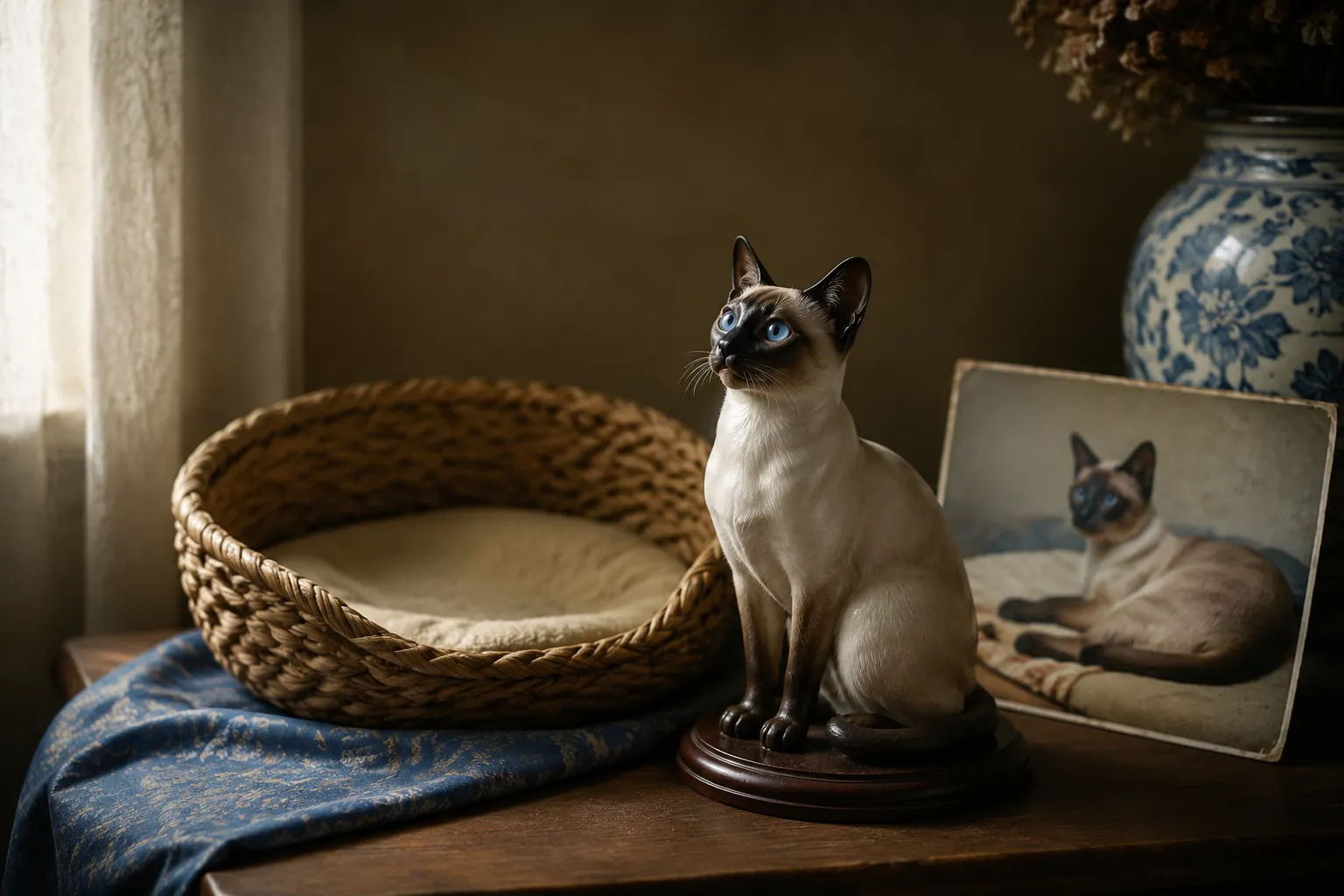
You catch the afternoon light pooling on the empty Siamese cat bed by the window, and something in your chest pulls tight. Anticipatory grief in pet loss works exactly like that—it arrives early, painting the room with absence before your cat has even gone.
Quick Takeaways
- Anticipatory grief is real grief — you can mourn a pet who's still breathing beside you, and that's normal
- Light, not the object, holds memory — train yourself to notice how your cat occupies space, not just how they look
- Consecutive pet loss compounds — grieving a second pet reopens the first wound, and that doubling needs naming
- Capturing presence beats capturing perfection — a slightly imperfect custom pet figurine often feels truer than a flawless photo
- The silence after is its own grief — the missing soundtrack of paws and purrs deserves acknowledgment, not denial
Why a Painter From 1665 Understands Your Empty Cat Bed Better Than Most Grief Guides
Here's something you won't find in the first five articles you read about losing a pet. The people who understood loss most deeply weren't grief counselors. They were painters. Specifically, they were the Dutch masters who spent their entire careers trying to do one impossible thing: hold a single moment of ordinary light before it disappeared.
Johannes Vermeer painted maybe 34 works in his whole life. Not because he was lazy. Because he was obsessed with capturing how light fell across a domestic room—the kind of room where a woman read a letter, or poured milk, or simply stood near a window. He understood that the moment was already leaving. That's what made it worth painting.
When you look at the empty bed your Siamese left behind, you're feeling the same thing Vermeer felt. Not the absence of an object. The absence of a particular quality of presence in a particular quality of light. Your cat didn't just occupy that cushion. She changed the room. She gave the afternoon light something to land on.
"You don't miss the cat-shaped space. You miss the way the whole room arranged itself around a sleeping cat."
And this is the angle most grief writing misses entirely. They treat your pet like a thing you had and now don't. But what you actually lost—what you're losing, if you're in the anticipatory phase—is closer to what an artist loses when the light shifts and the painting can't be finished. It's the loss of a way of seeing your own home.
The Siamese cat makes this loss strangely specific
If you've loved a Siamese, you know they're not background animals. They don't fade into the furniture. A Siamese cat memorial carries a particular weight because Siamese cats are particular—the points of color at the ears and paws, the way the cream body seems to glow against those dark extremities, like Vermeer deliberately lit them.
We've worked with thousands of pet families at PawSculpt, and Siamese owners describe their cats differently than other owners do. They talk about the voice first. That loud, demanding, almost-human yowl. They talk about how the cat followed them, room to room, narrating. Then they talk about the coloring, the way the seal points or blue points caught the light.
That's not a coincidence. Siamese cats are, quite literally, animals defined by light and temperature. The dark points develop where their bodies are coolest. The color is a response to light and warmth. So when you grieve a Siamese, you're grieving an animal whose very appearance was a record of how it lived in the world.
Anticipatory Grief: Mourning a Cat Who's Still Purring
Let's name the thing that makes you feel like you're losing your mind.
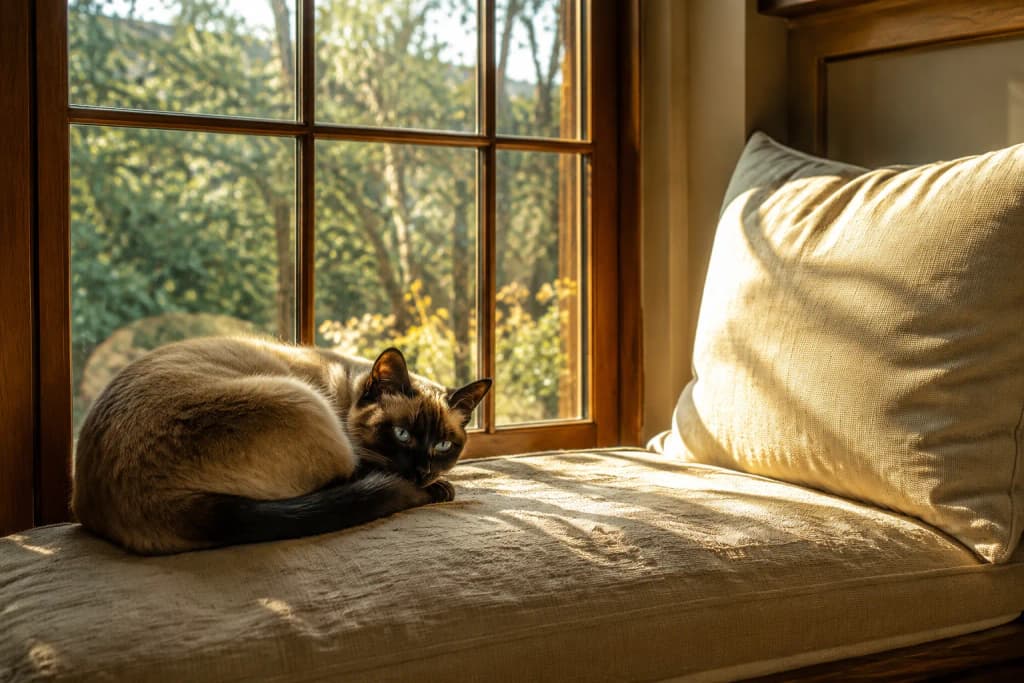
Your cat is still here. Maybe she's curled against your thigh right now, the diagnosis fresh, the vet's words still rattling around your skull. And you're already grieving. You catch yourself crying over a cat who is, at this exact moment, alive and warm and breathing.
This is anticipatory grief, and it is not a betrayal. It's one of the most documented forms of pre-loss mourning, well understood in human hospice care and increasingly recognized in veterinary settings. The Association for Pet Loss and Bereavement treats it as a legitimate, expected stage—not a sign you've given up.
Here's what nobody tells you about it though. Anticipatory grief comes with a particular guilt that's almost worse than the grief itself. You feel like you're stealing time. Like every minute you spend mourning is a minute you're not fully present with the cat who's still here. You're standing in the kitchen crying while she winds around your ankles, alive, wanting breakfast.
"Anticipatory grief isn't giving up early. It's love refusing to wait until it's allowed."
The mistake most people make during this phase
The instinct is to document everything. Suddenly you're taking 200 photos a week, filming videos, trying to capture all of it before it's gone. We get it. We've watched families do exactly this.
But here's the counterintuitive part. Frantic documentation often pulls you out of the very moments you're trying to keep. You're so busy holding the phone that you stop holding the cat. You experience the last weeks through a lens instead of through your hands.
What actually helps more: choose to be present for the ordinary, and document the specific. Instead of 200 random photos, capture three things deliberately—
- The sound. Record 30 seconds of your Siamese's particular voice. Their yowl, their chirp, the specific way they complain. This is the thing people forget first and miss most.
- The light moment. One photo, taken in the same afternoon light where they always slept. Not posed. Just them, in their spot.
- The texture. A short video of your hand moving through their fur, so you remember how it felt, not just how it looked.
The "so what" here matters. Research on memory consistently suggests that multi-sensory memories last longer and feel more real than visual ones alone. The families who cope best aren't the ones with the most photos. They're the ones who captured the right sensory anchors.
A small scene we keep thinking about
One of our customers told us about her last week with her seal point. She stopped photographing him and instead just sat on the kitchen floor every evening at 6pm, the hour the low sun came through the back door, and let him climb into her lap. No phone. She said that hour of gold light is the thing she can still close her eyes and return to. The photos, she said, feel flat next to it.
That's Vermeer's lesson in a kitchen. The light was the memory. The cat was how she learned to see it.
The Soundtrack You Don't Notice Until It Stops
Walk into your home the day after. The first thing that hits you isn't the empty bed. It's the sound. Or the lack of it.
A house with a cat has a soundtrack you stopped hearing years ago. The soft thud of a jump from counter to floor. Claws ticking across hardwood. The 5am yowl that you cursed and now would give anything to hear again. The specific creak of the cat flap. The purr that started up the second you sat down.
When it stops, the silence has a texture. It's not peaceful. It's loud. You notice the refrigerator hum for the first time in a decade because nothing is layered over it anymore.
"Grief doesn't always sound like crying. Sometimes it sounds like a kitchen that's gone too quiet."
This is why so many newly bereaved pet owners report that the sound of absence is harder than the sight of it. You can put the bed away in a closet. You can't put away the missing noise. It fills every room.
What actually helps with the auditory void
Most people try to fill the silence with distraction—TV constantly on, podcasts, anything. That works short term but it teaches your nervous system that silence is the enemy, and it delays the adjustment.
What we've seen work better: deliberately reintroduce a chosen sound into the spaces your pet used to fill. Not as a replacement. As an acknowledgment.
- Play the 30-second recording of their voice (if you made one) once, intentionally, when you need to.
- Add a small sound to their old spot—a wind chime near the window where they slept, a small fountain, anything that gives that empty corner an acoustic presence again.
- Keep one routine sound alive. If you always fed them at 6 with a specific can-opener click, you don't have to abandon the kitchen at 6.
The point isn't to mask the silence. It's to slowly let the room learn a new song instead of pretending it never had one.
When You Lose Two Pets Close Together: Consecutive Pet Loss
This one doesn't get talked about enough, and if you're living it, you already know why it's different.
Coping with consecutive pet loss—losing one pet and then another within months, or even weeks—is not just "double grief." It's a specific, compounding kind of pain that has its own cruel mechanics. And almost no one prepares you for it.
When the second pet dies while you're still raw from the first, three things happen at once:
First, the new loss reopens the old one. You're not grieving one animal. You're grieving both, simultaneously, and the second death drags the first back to the surface in full color.
Second, you start to distrust your own home. A place where two beloved animals died in quick succession can start to feel cursed, or unsafe, or simply unbearable. The walls hold too much.
Third—and this is the one people are ashamed to admit—you can become numb. The second grief doesn't always hit harder. Sometimes it hits softer, because you're already depleted, and then you feel monstrous for not crying as hard as you did the first time.
"Numbness after a second loss isn't a smaller love. It's an exhausted one."
If that's you, hear this clearly. The muted feeling is not evidence that you loved the second pet less. It's evidence that grief is a finite resource and yours is running low. That's biology, not betrayal.
The art history parallel that reframes consecutive loss
Vermeer lost children. Several of them, in an era when that was common but no less devastating. Art historians notice that his later work didn't get darker or more chaotic—it got quieter and more precise. He didn't paint his grief loudly. He poured it into getting the light exactly right.
There's a lesson buried in that. When loss compounds and you can't feel it all at once, sometimes the path through isn't more emotion. It's attention. Choosing one small, precise act of remembrance for each pet rather than trying to summon a grief big enough to hold both.
Here's a comparison of how different memorial approaches tend to land, based on what we've observed across thousands of families:
| Memorial Approach | Effort Required | Emotional Impact | Best For |
|---|---|---|---|
| Photo book or digital album | Medium | Moderate, fades over time | Visual people who revisit often |
| Memorial garden or planting | High | Strong, seasonal renewal | Those who need a living ritual |
| Paw print or clay impression | Low | Strong but static | Capturing physical trace quickly |
| Custom 3D-printed figurine | Low (you send photos) | Strong, tactile, daily presence | Recreating a pet's living posture |
| Cremation jewelry | Low | Intimate, private | Keeping the pet physically close |
Notice there's no single "best." The right one depends on whether you grieve through sight, ritual, touch, or proximity. For consecutive loss especially, we often gently suggest choosing different memorials for each pet—so they don't blur into one undifferentiated ache.
Capturing Presence, Not Perfection: The Vermeer Approach to Keepsakes
Now here's where the art history lens becomes genuinely practical, not just poetic.
When people set out to memorialize a pet, they chase accuracy. They want a perfect likeness. Every whisker, every marking, exact. And that's understandable. But it's also, often, the wrong goal—and the Dutch masters knew it.
Vermeer didn't paint photographically. Photography didn't exist, sure, but even compared to his contemporaries he simplified. He blurred. He let light dissolve detail. Because he understood that a face you love isn't a catalog of features. It's a feeling of presence. Get the light and the posture right, and the soul comes through even if the details soften.
This is exactly what we've learned creating memorial pieces. The figurines that move families to tears aren't the most technically detailed ones. They're the ones that capture how the pet held themselves. The specific tilt of a Siamese head when she was listening. The way she sat with her tail wrapped just so.
"We've learned that families don't reach for the most detailed piece. They reach for the one that sits the way their cat used to sit."
— The PawSculpt Team
How the technology actually captures a Siamese
Since Siamese coloring is all about those gradient points—the way seal or blue or chocolate fades from dark extremities into a pale body—the method of recreation matters a lot.
At PawSculpt, pieces are digitally sculpted by master 3D artists and then precision 3D printed in full color. Here's why that matters specifically for a Siamese: the color is printed directly into the resin, voxel by voxel, not layered on top. So those subtle point gradients—the smoky transition from dark face to cream body—come through as actual graduated color in the material itself, rather than as a surface coating that can chip or flatten.
The full-color resin print captures the fur patterns and color transitions directly, and the only manual step is a protective clear coat that gives it a gentle sheen and guards against fading. The result has a natural texture to it—a fine grain, an authentic quality—rather than that eerie, too-smooth plastic look. It feels like a thing that holds something, not a toy.
We're being straight with you about the process because you deserve to know what you're actually getting. It's not a hand-finished sculpture and it's not a photograph. It's a faithful, tactile, full-color reproduction of your pet's living form that you can hold in your palm. For specifics on the process, timelines, and guarantees, it's worth visiting pawsculpt.com directly, since those details get updated regularly.
What photos work best (the practical part)
If you decide a sculptural keepsake is right for you, the input matters more than people expect. Here's what we've learned helps most:
| Photo Element | What Works | What to Avoid |
|---|---|---|
| Angle | Eye-level, slightly side-on | Shot from far above looking down |
| Lighting | Soft, natural daylight | Harsh flash that flattens color |
| Posture | Their characteristic pose | Stiff, unnatural positioning |
| Focus | Sharp on the face and markings | Blurry or low-resolution |
| Quantity | 3-5 angles of the same pet | A single straight-on shot only |
The single most useful photo isn't the prettiest one. It's the one where your pet is doing the thing only they did—the head tilt, the loaf, the sprawl. That's the Vermeer photo. That's the one that captures presence.
A Counter-Point: When Memorializing Too Soon Can Hurt
We'd be doing you a disservice if we only sold you on keepsakes and rituals. So let's be honest about the other side.
Sometimes, creating a memorial too quickly is a way of skipping the grief rather than processing it. We've seen it. A family rushes to fill the void with objects—the urn, the figurine, the framed photos, the garden, all within days—and the busyness becomes a way to avoid sitting in the raw, unbearable middle of the loss.
A memorial should be a container for grief, not a lid on it.
Grief counselors generally caution against making major commemorative decisions in the first week or two, when you're in acute shock and not thinking clearly. There's no deadline. Your cat will be just as worth honoring in three months as in three days. If anything, a little distance often helps you choose a memorial that captures who they truly were, rather than one made in panic.
"A keepsake made in panic preserves your fear. A keepsake made in love preserves your cat."
There's also the opposite caution. Some people feel that any memorial object is "weird" or that they'll be judged for spending money or display space on a pet figurine. If that voice is in your head, we want to name it: feeling judged for grieving a pet is incredibly common, and it's almost always projection. People who've never bonded deeply with an animal genuinely don't understand, and their discomfort is not a verdict on your love. Honor your pet in whatever way actually comforts you. The neighbors don't get a vote.
And for some people, the healthiest choice is no physical object at all. Some grieve better by giving things away, by donating to a shelter, by writing. If that's you, that's completely valid. We're a figurine company telling you that you might not need a figurine. We mean it.
The Specific Emotional Tangles Nobody Warns You About
Let's go deeper into the feelings that the standard "grief takes time" advice completely fails to address. Because the surface emotions aren't the hard part. The complicated ones are.
Second-guessing the timing
If you made the euthanasia decision—or are facing it now—you will almost certainly torture yourself with timing. Too soon? Too late? Did I rob her of good days, or did I let her suffer one day too long?
Here's the truth from people who've sat with thousands of these stories. There is no perfect day. The "right time" is a window, not a point. If you chose with love and the information you had, you chose correctly, even if hindsight whispers otherwise. The American Veterinary Medical Association frames quality-of-life decisions as exactly that—judgment calls made in good faith, not exact sciences. (For the medical side of these decisions, your vet is the right guide; we're not vets.)
The second-guessing isn't a sign you got it wrong. It's a sign you cared enough to want to get it perfect for a creature who couldn't tell you what they wanted.
Relief, and the guilt that ambushes it
If your cat was sick for a long time, or the caregiving was exhausting, or the nights were sleepless and the medications endless—you may feel relief now. Relief that it's over. Relief that you can sleep. Relief that the daily dread has lifted.
And then comes the guilt, sharp and immediate, telling you that relief means you're glad she's gone.
It doesn't. The relief is about the end of suffering—hers and yours—not the end of her. You can be devastated that she's gone and relieved that the hard part is over at the exact same time. Both are true. Grief is fully capable of holding two opposite feelings in the same hand.
The fear of forgetting
This one creeps in around week three or four. The panic that you're already forgetting the exact sound of her voice, the precise weight of her on your chest. It feels like a second loss—losing the memory of the loss.
This is partly why the sensory anchors we mentioned earlier matter so much. But also: forgetting some details is not forgetting her. Memory naturally compresses. What remains isn't the data. It's the feeling. You won't remember every day, but you'll remember how she made the days feel. That's the part that doesn't fade.
Building a Daily Ritual That Actually Sustains You
Grand gestures fade. Small daily rituals are what carry people through. Here's what we've seen work, specifically and concretely:
- The 6pm light moment. If your pet had a spot they loved at a certain hour, go there at that hour. Sit for two minutes. Don't perform grief. Just occupy the space they occupied.
- One sentence a day. Keep a small notebook. Write one sentence about a memory as it surfaces. Not an essay. One line. Over months this becomes the truest record you have.
- The keepsake as touchstone, not shrine. If you have a figurine or photo, put it somewhere you naturally pass—not on an altar you have to make a pilgrimage to. The point is casual, daily, unforced contact.
- The transferred routine. If 5am was their wake-up yowl, let 5am stay theirs for a while. Wake, acknowledge, go back to sleep. Routines hold grief gently.
The "so what" of rituals: they give your nervous system a container. Unstructured grief floods. Ritualized grief has banks and a current. It still moves through you, but it doesn't drown you.
Frequently Asked Questions
Is it normal to grieve a pet who is still alive?
Yes, and it has a name—anticipatory grief. When you know your pet is terminally ill or nearing the end, your mind begins mourning before the actual loss. It's recognized in both human hospice and veterinary contexts. It doesn't mean you've given up. It means love is refusing to wait for permission.
How long does pet grief actually last?
There's no honest timeline anyone can give you. Acute, can't-breathe grief usually softens over weeks to a few months, but grief waves can resurface for years, often triggered by light, sound, or an anniversary. If you're dealing with consecutive pet loss, expect the process to take longer and feel more tangled—that's normal, not a malfunction.
Is it normal to feel relief when my pet dies?
Yes, and the guilt that follows it is one of grief's cruelest tricks. After a long illness or demanding caregiving, relief is a natural response to the end of suffering—theirs and yours. It is not the same as being glad they're gone. You can hold relief and devastation in the very same moment.
What photos work best for a custom pet figurine?
Eye-level, soft natural lighting, and—most importantly—your pet in their characteristic pose, not a stiff posed shot. Send three to five clear angles of the same pet. The best photo is usually the one where they're doing the thing only they did, because that's what captures presence rather than just appearance.
Should I memorialize my pet right away or wait?
There's no deadline, and rushing can sometimes be a way of avoiding the grief rather than honoring it. Many find that a little time helps them choose a memorial that captures who their pet truly was. Your pet will be just as worthy of honoring in three months as in three days.
Why does my house feel so different after losing a pet?
Because you lost a soundtrack, not just a presence. The thud of jumps, the click of claws, the purr, the yowl—your nervous system tuned them out years ago, so the silence now feels unnaturally loud. Acknowledging the auditory absence, rather than masking it, helps you adjust.
Ready to Honor Your Cat's Light?
Every pet leaves behind more than an empty bed—they leave the particular way they filled a room with presence, sound, and warmth. Whether you're walking through anticipatory grief in pet loss right now or finding your way after a Siamese cat memorial, preserving how your companion truly held themselves can become a quiet daily comfort. A custom PawSculpt figurine captures that posture, those markings, and the unmistakable shape of who they were.
Visit pawsculpt.com to explore our full-color 3D printing process, flexible revisions, and quality guarantee.