
Five Years After the Accident: How a Paw Print Became My Beagle's Secular Ceremony of Return
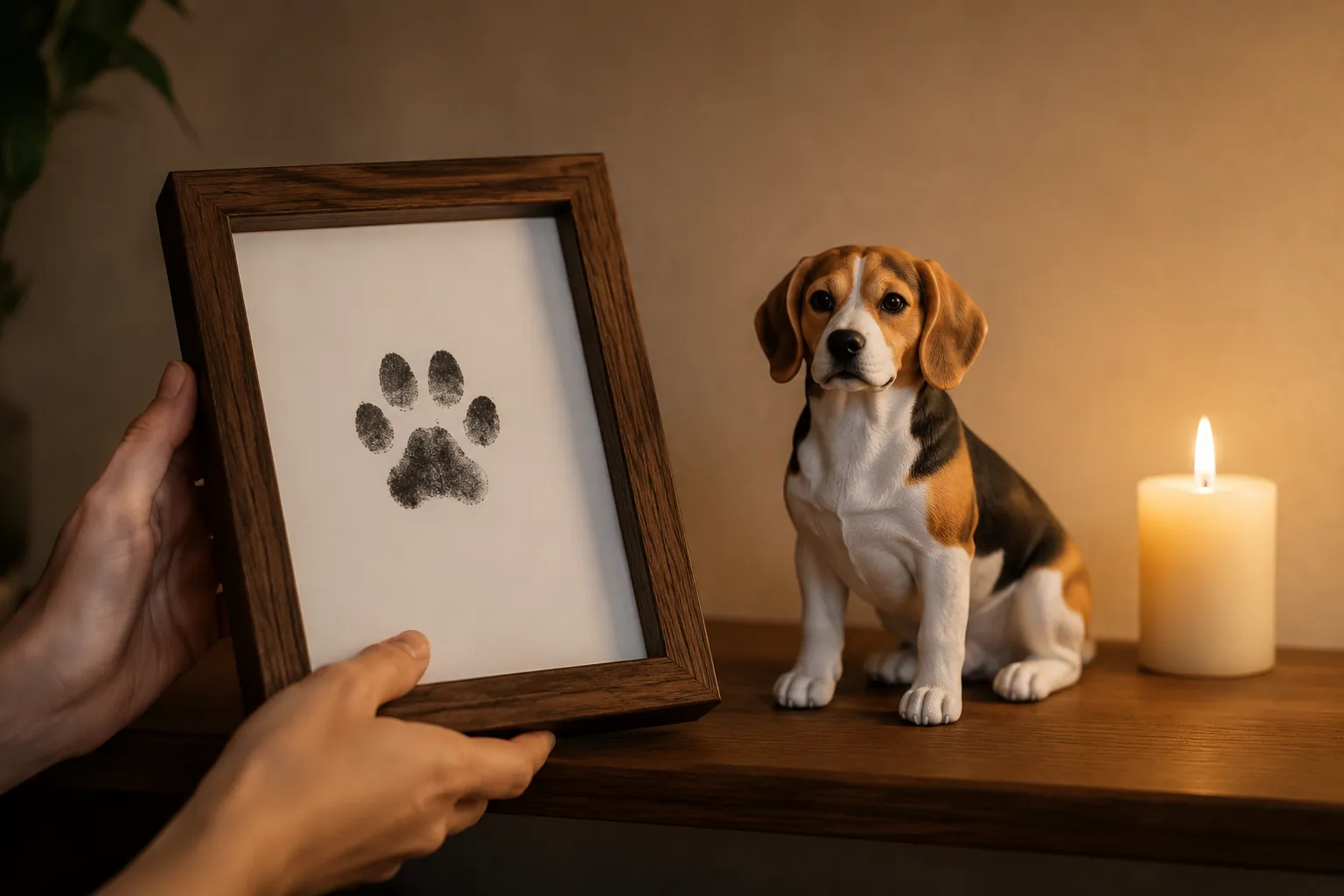
Five years ago, my home office had two monitors, a standing desk, and a beagle named Rufus curled beneath it—his copper-and-white coat catching the blue glow of the screen. Today the desk is the same, the monitors upgraded, but the floor beneath holds only a small resin figurine where warm fur used to be. This is the story of a pet loss anniversary ritual that took five years to find its shape.
Quick Takeaways
- Physical rituals outperform passive remembrance — engaging your hands and body anchors grief more effectively than thought alone
- The five-year mark isn't closure — it's often when grief finally becomes something you can use rather than just survive
- A paw print ceremony creates secular sacred space — no belief system required, just intention and repetition
- Tangible memorials like custom pet figurines serve as ritual anchors — giving grief a physical address in your home
- Post-traumatic growth after pet loss is real and measurable — but it requires active participation, not just time
The Counterintuitive Truth About Five-Year Grief
Here's what nobody tells you about the fifth anniversary of losing a pet: it's often harder than the first.
Not harder in the raw, gasping way. Harder because by year five, the world has fully moved on. Your coworkers don't remember. Your social media memories have cycled through the painful photos enough times that the algorithm stopped surfacing them. The grief has gone underground—and underground things grow strange roots.
The first anniversary carries a kind of social permission. People check in. They send the heart emoji. But by year five? You're supposed to be "over it." And if you're not—if you still feel the phantom weight of a beagle against your ankle at 2 PM when you're trying to focus on a spreadsheet—something must be wrong with you.
Nothing is wrong with you.
What's actually happening is that unritualized grief doesn't resolve. It just changes shape. And most of us, especially those who lost pets rather than people, never received permission to ritualize in the first place.
"Grief without ritual is a river without banks—it floods everything."
Why Pet Loss Lacks Ceremony
Think about it. When a human dies, there's a funeral. An obituary. A gathering. A caserole brigade. A one-year anniversary that people mark on their calendars. There are entire industries built around giving human grief a container.
When a beagle dies in an accident on a Tuesday afternoon, you get—what? A sympathy card from the vet's office. Maybe a clay paw print pressed in haste while you're still in shock. A week of people saying "I'm sorry" before the subject changes permanently.
The Association for Pet Loss and Bereavement has documented this gap for decades. Pet grief is what researchers call disenfranchised grief—loss that society doesn't fully validate. And disenfranchised grief is sneaky. It doesn't announce itself. It shows up as irritability at work, as a reluctance to walk past the park, as a flinch when someone else's beagle rounds a corner.
What I've learned—what our team at PawSculpt has witnessed through thousands of conversations with grieving pet families—is that the antidote to disenfranchised grief isn't more time. It's deliberate ceremony.

Building a Secular Ceremony of Return: The Framework
The word "ceremony" might feel heavy. Religious, even. But ceremony predates religion. At its core, a ceremony is just intentional action performed with attention. You already have secular ceremonies—birthday candles, New Year's countdowns, the way you arrange your desk before starting deep work.
A beagle memorial paw print ceremony works on the same principle. It gives grief a time, a place, and a set of actions. It says: this matters enough to mark.
Here's the framework that emerged over five years of trial and error:
The Four Elements of a Return Ceremony
| Element | Purpose | Example |
|---|---|---|
| Threshold | Signals the shift from ordinary time to sacred time | Lighting a specific candle, playing a specific song |
| Object | Anchors attention to something physical | Paw print, figurine, collar, photograph |
| Action | Engages the body, not just the mind | Tracing the paw print with a finger, speaking aloud |
| Release | Marks the return to ordinary time | Blowing out the candle, placing the object back |
The beauty of this framework is its flexibility. You don't need an altar. You don't need incense (unless you want it). You need four things that signal: I am here, paying attention to what was lost.
Why "Return" and Not "Remembrance"
Language matters. "Remembrance" implies the thing is gone and you're pulling it back through effort. "Return" implies it comes back to you—that the love, the presence, the particular weight of a beagle's head on your foot, returns when you create the conditions for it.
This isn't magical thinking. It's neuroscience. When you engage multiple senses in a ritualized pattern—the visual of the paw print, the tactile sensation of tracing it, the auditory cue of a song—you're activating the same neural networks that fired during the original experience. You're not imagining your dog. You're re-experiencing the relationship through its physical traces.
Personal Aside: We'll be real—when we first started hearing from customers about their anniversary rituals, we thought it was a niche thing. A handful of people. But over the years, we've realized it's the quiet majority. Most people who order memorial figurines from us aren't doing it for decoration. They're building anchor for a ceremony they haven't named yet. That realization changed how we think about everything we make.
The Anatomy of a Paw Print Ritual (Year by Year)
Here's what most articles about first pet loss five years later won't tell you: the ritual shouldn't stay the same. It should evolve. A static ritual becomes an obligation. An evolving ritual becomes a relationship.
Year One: Raw Contact
The first year, the ceremony is barely a ceremony. It's survival. You hold the paw print. You cry. Maybe you talk to the empty room. The "ritual" is just allowing yourself to fall apart in a contained way—giving the flood those banks.
What matters in year one: don't skip it. Don't let the anniversary pass unmarked because you're afraid of the pain. Unmarked pain doesn't disappear. It calcifies.
Year Two: Adding Structure
By year two, you can start adding intention. Light the candle. Choose the song. Set a timer if you need to—fifteen minutes of dedicated attention. This is when the threshold and release elements become important. You need to be able to enter the grief and exit it without it consuming the whole day.
Year Three: Incorporating Others
If you have a partner, a child, a friend who knew your pet—year three is often when you can invite them in. Not everyone. Just one person who gets it. Shared ritual is exponentially more powerful than solo ritual.
Year Four: Adding Creation
This is where it gets interesting. By year four, many people feel the urge to make something. Write a letter. Plant something. Commission a piece of art. The grief has composted enough to become generative.
This is often when people find their way to PawSculpt—not in the immediate aftermath of loss, but years later, when they're ready to transform grief into something they can hold. A full-color resin figurine that captures the exact copper-and-white pattern of a beagle's coat, the particular tilt of ears, the way one eye always squinted slightly in sunlight. It becomes the ritual object—the anchor that says this is where I come to return.
Year Five: Integration
By year five, the ceremony isn't about grief anymore. It's about post-traumatic growth. It's about who you became because of this love and this loss. The paw print is still there. The figurine is still there. But the tears have mostly been replaced by something warmer. Gratitude, maybe. Or just presence.
"A ritual isn't something you do to feel better. It's something you do to feel fully."
The Emotion Nobody Talks About: Relief That Became Guilt
Here's where I need to get honest about something.
Rufus died in an accident. It was sudden. And in the weeks after, buried beneath the obvious grief, there was a feeling I couldn't name for months: relief.
Not relief that he was gone. Relief that the anxiety was gone—the low-grade, constant worry about his health, his aging, the inevitable future loss that I'd been dreading for years. The accident took the dread away by making it real. And feeling relieved about that? It made me feel like a monster.
This is more common than anyone admits. Whether the loss was sudden or slow, whether it followed a long illness or came out of nowhere, many pet owners experience a flash of relief—and then immediate, crushing guilt about that relief.
Here's what I've learned: that relief isn't about wanting your pet gone. It's about the human nervous system finally releasing a tension it's been holding. If your pet was sick, you were holding the tension of caregiving. If your pet was healthy, you were holding the tension of knowing loss was coming. Either way, when the thing you feared actually happens, the body exhales. That's biology, not betrayal.
The guilt that follows is grief's cruelest trick. It takes your love—because only someone who loved deeply would dread loss so intensely—and reframes it as evidence of inadequacy.
If you're reading this and recognizing yourself: you are not a monster. You are a person whose body did what bodies do. The ceremony of return can hold this too. You can trace the paw print and say, out loud: I'm sorry I felt relieved. I know it was just my body letting go of fear. It wasn't about you.
Naming it takes its power away.
Physical Ritual vs. Mental Remembrance: Why Your Body Needs to Participate
Most grief advice focuses on the mind. Think about the good times. Remember them fondly. Keep them in your heart.
But grief lives in the body. It lives in the hand that reaches for a leash that isn't there. In the foot that steps carefully around a dog bed that's been gone for years. In the ear that still perks at the sound of tags jingling.
Physical ritual grief healing works because it meets grief where it actually lives—in muscle memory, in spatial awareness, in the sensory cortex.
| Mental Remembrance | Physical Ritual |
|---|---|
| Happens in the mind only | Engages body, senses, and space |
| Can spiral into rumination | Has a defined beginning and end |
| Often feels passive | Requires active participation |
| No external anchor | Uses objects as focal points |
| Difficult to share | Can be witnessed or joined |
| Fades over time | Strengthens with repetition |
This is why a paw print—a physical impression of a physical body—works so powerfully as a ritual object. It's not a photograph (visual only). It's not a memory (mental only). It's a topographic record of a body that existed. When you trace it with your finger, you're touching the same shape that once touched the earth.
"We've seen families heal by holding something tangible. Grief needs an anchor—something the hands can find when the mind is lost."
— The PawSculpt Team
And when the paw print is paired with a three-dimensional representation—a figurine that captures not just the shape but the color, the posture, the attitude of the animal—the ritual gains depth. You're not just touching a trace. You're looking at a presence.
The Counterintuitive Insight: Grief Rituals Work Better When They're Boring
Here's the thing nobody in the wellness industry wants to admit: the most effective rituals are slightly boring.
Not boring in a bad way. Boring in the way that brushing your teeth is boring. Boring in the way that a morning coffee routine is boring. Predictable. Low-stakes. Repeatable without emotional preparation.
The mistake most people make with grief rituals is making them too intense. They create elaborate ceremonies that require emotional readiness, perfect conditions, and significant time. And then they skip them—because who has the energy for a two-hour emotional excavation on a random Tuesday in March?
The best anniversary rituals take five to fifteen minutes. They use the same objects every time. They follow the same sequence. They don't demand catharsis. They just ask for presence.
Here's what a Tuesday-morning version looks like:
- Light the candle (10 seconds)
- Pick up the paw print or figurine (5 seconds)
- Look at it. Really look. Notice the details—the color gradients in the resin, the texture of the impression, the specific curve of a toe pad (60 seconds)
- Say one thing out loud. It can be "I miss you" or "Good morning" or just their name (5 seconds)
- Put it back. Blow out the candle (10 seconds)
Total time: under two minutes.
That's it. That's the ceremony. And it works—not because it's dramatic, but because it's consistent. The neural pathways strengthen through repetition, not intensity.
Choosing Your Ritual Object: What Actually Works
Not all memorial objects serve equally well as ritual anchors. Here's what we've observed works best, based on years of conversations with grieving pet families:
The Paw Print
Strengths: Tactile, unique, directly connected to the animal's body. Can be traced, held, pressed against skin.
Limitations: Often made in haste during a traumatic moment. May be imperfect. Can crack or degrade over time if not properly sealed.
Best for: People who process through touch. Those who find comfort in direct physical connection.
The Photograph
Strengths: Visually rich, easily accessible, can be changed or rotated.
Limitations: Two-dimensional. Can trigger rumination rather than ritual if not bounded by ceremony. Screens add layer of distance.
Best for: Visual processors. Those who want variety in their ritual.
The Custom Figurine
Strengths: Three-dimensional presence. Captures personality, not just form. Full-color resin technology means the specific markings—the exact pattern of a beagle's tricolor coat—are reproduced directly in the material, not painted on as an afterthought. Durable. Displayable.
Limitations: Requires good reference photos. Arrives after the initial shock has passed (which, counterintuitively, might be a strength—it arrives when you're ready to ritualize rather than just survive).
Best for: People who need presence in their ritual. Those whose pet's personality was inseparable from their physical appearance. Anyone building a long-term ceremony that needs an object worthy of decades of attention.
The Collar or Toy
Strengths: Carries scent (temporarily). Directly associated with daily life. Free
Limitations: Degrades. Scent fades. Can feel morbid rather than sacred if not intentionally placed.
Best for: The first year, when proximity to the animal's actual belongings matters most.
Post-Traumatic Growth: What the Research Actually Shows
Post-traumatic growth after pet loss isn't just a comforting phrase. It's a documented psychological phenomenon—the experience of positive change that emerges from the struggle with a major life crisis.
But here's what most articles get wrong: post-traumatic growth doesn't happen to you. It happens through you. It requires active engagement with the loss. Passive time-passing doesn't produce growth. It produces numbness.
The five domains of post-traumatic growth, applied to pet loss:
- New possibilities — "Because I lost Rufus, I started voluntering at the shelter. I wouldn't have done that before."
- Relating to others — "I understand other people's grief now in a way I couldn't before. I'm a better friend."
- Personal strength — "I survived the worst thing I could imagine. I know I can survive other hard things."
- Appreciation of life — "I notice small moments now. The light through the window. The warmth of a body nearby."
- Spiritual/existential change — "I think differently about what matters. About what lasts."
A ritual doesn't just mark the loss. It cultivates these domains. Each year you return to the ceremony, you're actively choosing to engage with the loss rather than avoid it. And that engagement—that willingness to feel fully—is what produces growth.
The Fear of Forgetting (And Why It's the Wrong Fear)
Let me name something else that lives in the shadows of long-term grief: the fear of forgetting.
By year five, you can't remember exactly how their bark sounded. The specific weight of their body. The way their ears felt between your fingers. These sensory memories fade, and their fading feels like a second loss—like you're losing them again, slowly, through the erosion of your own neurons.
This fear drives a lot of memorial purchases. It's why people order figurines years after the loss—not because the grief is fresh, but because the memory is fading and they need something external to hold what their brain can no longer retain.
Here's the counterintuitive comfort: you're not forgetting them. You're forgetting the details. The love isn't stored in your ability to recall the exact shade of copper on their ears. The love is stored in who you became because of them. In the way you treat animals now. In the patience you learned. In the capacity for joy you developed through years of daily, uncomplicated companionship.
The figurine on your desk—digitally sculpted by artists who studied your photographs, then precision-printed in full-color resin that captures every marking—isn't replacing your memory. It's freing you from the burden of remembering perfectly. It holds the details so you can hold the meaning.
That's what a good ritual object does. It carries the weight of accuracy so your heart can carry the weight of love.
Practical Guide: Creating Your Own Five-Year Ceremony
If you're approaching a pet loss anniversary—whether it's the first or the fifteenth—here's a practical framework for building your own secular ceremony of return.
Step 1: Choose Your Date (It Doesn't Have to Be THE Date)
Some people mark the death date. Others mark the adoption date. Others choose a completely unrelated date—the first day of spring, a birthday, a solstice. What matters isn't the calendar accuracy. What matters is that you choose it deliberately.
Step 2: Choose Your Object
Pick one thing that will serve as your ritual anchor. A paw print. A memorial figurine. A photograph in a specific frame. A stone from a meaningful place. It should be:
- Durable (this needs to last years)
- Specific to your pet (not generic)
- Pleasant to hold or look at (you'll be spending focused time with it)
- Displayable or storable with intention
Step 3: Choose Your Threshold
How will you signal the shift from ordinary time to ceremony time? Options:
- Light a candle
- Play a specific song (the same one every year)
- Move to a specific location (a chair, a spot in the garden, place where their bed used to be)
- Pour a cup of tea or coffee (the act of preparation as threshold)
Step 4: Choose Your Action
What will you do during the ceremony? This should engage your body:
- Trace the paw print
- Hold the figurine and rotate it slowly, noticing details
- Read a letter you've written (or write one fresh each year)
- Speak their name and one memory aloud
- Look through exactly five photographs (a bounded number prevents spiraling)
Step 5: Choose Your Release
How will you signal the return to ordinary time?
- Blow out the candle
- Place the object back in its designated spot
- Say a closing phrase ("Until next time" or "Thank you" or simply "Okay")
- Take three deliberate breaths
Step 6: Protect It
Put it in your calendar. Set a reminder. Tell one person about it—not for permission, but for accountability. Rituals die when they're optional. Make it non-negotiable, like a dentist appointment for your soul.
When the Ritual Isn't Enough: Knowing the Difference
Look—ceremonies are powerful. But they're not therapy. And sometimes, five years after a loss, what surfaces isn't manageable grief. It's something bigger.
Signs that you might need more than a ritual:
- The grief is intensifying rather than evolving
- You're unable to form attachments to new animals (or people) because of fear
- The anniversary triggers weeks of dysfunction, not hours of sadness
- You're experiencing intrusive thoughts about the death itself (especially if it was traumatic)
- You feel shame about the intensity of your grief—like you should be "over it" by now
That shame deserves its own paragraph. Because here's the truth: there is no timeline for grief. There is no point at which loving a beagle for ten years and losing them suddenly becomes something you should have "processed." The people who judge the intensity of pet grief—who say "it was just a dog"—have simply never loved animal the way you did. Their opinion is irrelevant to your experience.
But if the grief is interfering with your ability to function, a therapist who specializes in pet loss (yes, they exist, and they're wonderful) can help you build additional structures around the pain. The ASPCA's pet loss resources offer a starting point for finding support.
The ritual and the therapy aren't competing approaches. They're complementary. The ritual gives grief a home. The therapy helps you renovate that home when it's gotten too small or too dark.
The Light on the Figurine at 2 PM
Here's something I didn't expect.
The figurine on my desk—the one that sits where Rufus used to sleep—catches the afternoon light differently depending on the season. In winter, the low sun hits it directly, and the copper tones in the resin glow warm against the cool blue of the monitors. In summer, it's in shadow by 2 PM, just a silhouette.
I didn't plan this. I didn't position it for optimal lighting. But over five years, I've come to know these shifts the way I once knew the shifts in Rufus's breathing—deep sleep versus dreaming versus the particular sigh that meant he wanted to go outside.
The figurine doesn't replace him. Nothing could. But it gives my eyes somewhere to land when the missing hits. It gives my hands something to reach for that isn't empty air. And on the anniversary—when I light the candle and pick it up and turn it slowly in the light—it gives the ceremony its center of gravity.
That's what physical ritual grief healing actually looks like. Not dramatic. Not cinematic. Just a person in a home office, holding a small colored shape, saying a name into the quiet, and then putting it back and returning to work.
The grief doesn't end. But it finds its shape. And a shape you can hold is a shape you can live with.
Frequently Asked Questions
How long does pet grief last?
There's no expiration date. Grief after pet loss can surface for years—sometimes decades—particularly around anniversaries, seasonal changes, or unexpected sensory triggers (a bark that sounds similar, a flash of copper fur on the street). This isn't pathological. It's proportional to the love. If grief is intensifying rather than evolving, or interfering with daily life, that's when professional support becomes valuable.
Is it normal to still grieve a pet after five years?
Completely. The five-year mark often brings a specific kind of grief—quieter but deeper, mixed with the fear of forgetting. Many people find that year five is actually when they're finally ready to build intentional rituals, because the acute survival phase has passed and they can engage with the loss creatively rather than just enduring it.
What is a pet loss anniversary ritual?
It's any deliberate, repeatable ceremony you perform to honor your pet's memory on or near a significant date. It typically involves a physical object (paw print, figurine, photograph), a threshold action (lighting a candle, playing a song), a focused activity (speaking aloud, tracing the print), and a release (blowing out the candle, placing the object back). The key word is deliberate—it's chosen, not accidental.
How do I create a memorial ritual for my pet?
Start simple. Choose one object, one action, and one boundary (a time limit or a closing gesture). You can always add complexity in future years. The most sustainable rituals take under fifteen minutes and don't require emotional preparation—they meet you where you are rather than demanding you reach a certain state first.
Is it normal to feel guilty after a pet dies?
Yes—and it's one of the most universal yet least discussed aspects of pet loss. Guilt about the timing ofeuthanasia, guilt about feeling relief when suffering ended, guilt about not noticing symptoms soner. These feelings reflect the depth of your responsibility and love, not any actual failure. Naming the guilt aloud—even just to yourself—begins to dissolve its power.
What is post-traumatic growth after pet loss?
It's the documented phenomenon of positive psychological change that can emerge from actively engaging with a major loss. It doesn't happen automatically with time—it requires intentional processing, which is exactly what ritual provides. Growth shows up as deeper empathy, new life directions, greater appreciation for small moments, and a more honest relationship with mortality.
Ready to Honor Your Pet's Memory?
Five years, ten years, twenty—the love doesn't diminish, and neither should the ritual that holds it. Whether you're building your first pet loss anniversary ritual or deepening one that's evolved over years, a tangible anchor makes the ceremony real. A PawSculpt figurine captures the specific details that memory alone can't preserve—the markings, the posture, the personality printed directly into full-color resin that will outlast the decades.
Visit pawsculpt.com to learn more about our process and guarantees