
A Tabby's Face on Your Phone Can Open the Right Support in Year Two
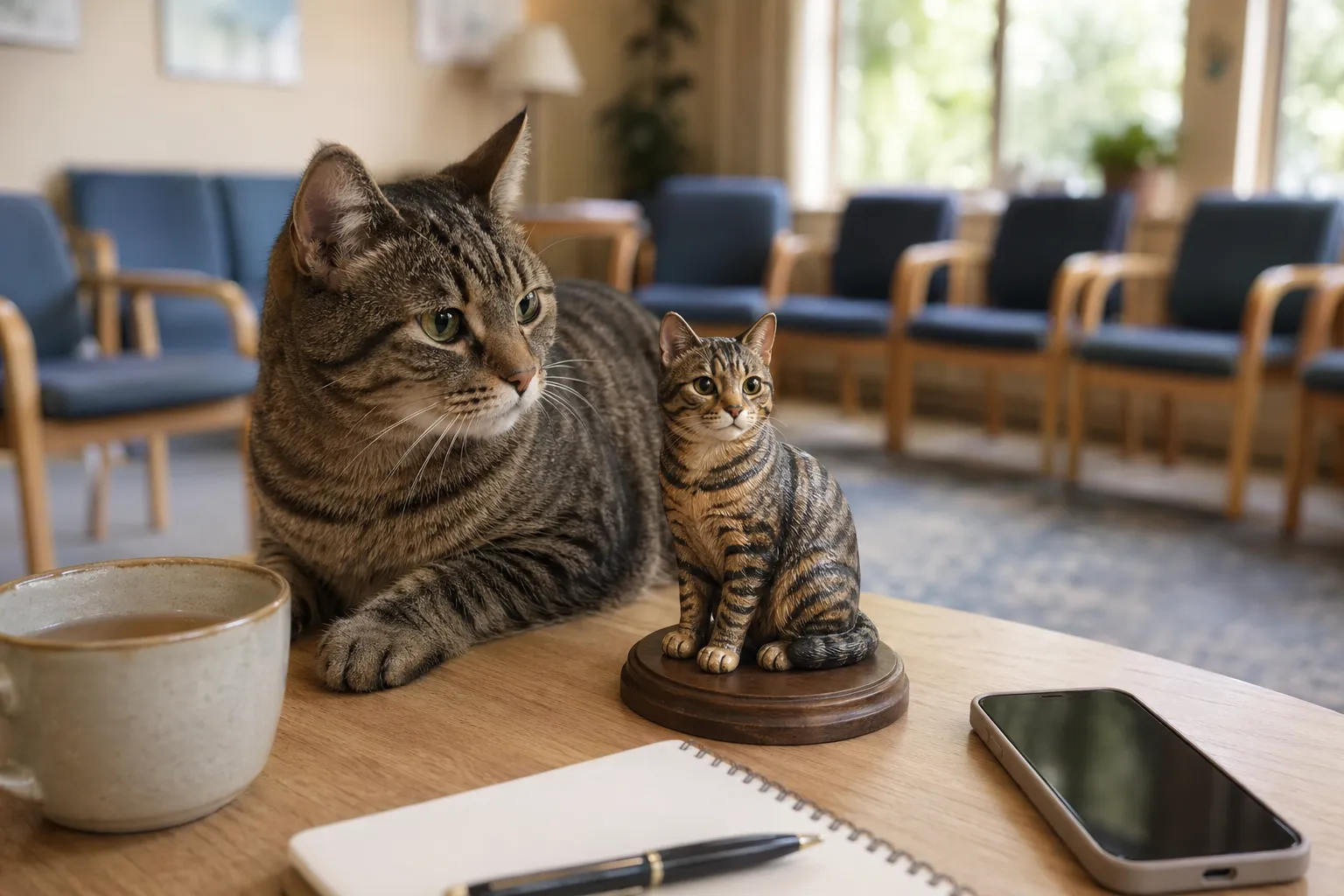
You stop at the park bench because your Tabby grief support group icon glows on your phone screen—orange face, green eyes, a square of light—and for the first time in months, year two feels heavier than year one.
Quick Takeaways
- Year two often hurts differently — plan for delayed triggers, not just anniversary dates
- Phone images can become grief tools — use your lock screen intentionally, not passively
- Mixed feelings are common — relief, guilt, envy, and numbness can coexist without meaning anything is wrong
- Tangible memorials help memory stabilize — some families explore custom pet figurines alongside support groups
- The best second year pet loss support is specific — choose groups centered on pets, routines, and memory triggers
Why the second year pet loss can feel stranger than the first
Most people prepare for the first year. They brace for the first empty holiday photo, the first birthday without the tuna treat ritual, the first spring when the patch of sun by the window looks too clean. Fewer people prepare for second year pet loss, and that gap matters.
Year one is crowded. There are sympathy texts, cards, practical tasks, vet bills to sort through, collars to decide whether to keep, food bowls to move or not move. Your nervous system is reacting in real time. Stress hormones rise. Sleep gets odd. Attention fractures. In psychology terms, grief in the first year can feel externally reinforced because your environment keeps confirming that something seismic just happened.
Year two is different. The world often stops acknowledging the absence while your attachment system still does.
That mismatch can hit hard.
You may notice it in absurdly small moments. You open your camera roll to find a recipe and there they are—your tabby caught mid-yawn, a paw lifted, whiskers white against the dark sofa. You aren’t “having a grief moment” in any ceremonial sense. You’re grocery shopping. The fluorescent light is ugly. And suddenly your chest tightens because your brain still maps comfort, routine, and safety onto that face.
This is not you “going backward.” It is memory reconsolidation at work. Every time you revisit an emotionally charged memory, your brain doesn’t pull out a neat file. It rebuilds the memory in the present. That means year two can feel unexpectedly raw because you are remembering from a new vantage point—one with more time, more distance, and sometimes more loneliness.
The overlooked part: less shock can mean more ache
This is the counterintuitive insight most generic grief articles miss: less acute pain does not always mean less grief. Sometimes the fading of crisis leaves room for the deeper ache to emerge.
In year one, your mind can protect you with a degree of emotional fog. In year two, that fog often lifts. You start seeing the shape of the loss more clearly. Not just that your pet died, but that your life has been reorganized around their absence.
That is why a Tabby grief support group can become more useful in year two than it was in the immediate aftermath. Earlier, you may not have wanted to talk. Later, when everyone assumes you’re fine, the right group offers language for feelings that finally have enough space to surface.
A micro-story we’ve seen again and again
One of our customers told us she barely cried during the first six months after losing her tabby. She handled the vet paperwork, donated the unopened food, even made a memorial shelf quickly because she thought “being productive” was helping.
Then, fourteen months later, she changed her phone wallpaper. That’s when she unraveled.
Not because the image caused pain. Because the image interrupted her efficient version of grief and exposed what was still there. The old wallpaper had become emotional camouflage.
"Year two isn't proof you're stuck. It's proof the bond outlasted the emergency."
Why tabby owners often get especially visual triggers
We’ll be real: tabbies are visually distinctive in a way that makes memory cling to surfaces. The M-shaped forehead, the striped tail curled like punctuation, the caramel-gray shimmer that changes under window light—those markings create strong visual encoding in the brain. Research on emotional memory suggests that distinctive sensory detail helps memories stick. That’s one reason a familiar image on your phone can feel like a key turning in a lock.
And because phones are not ceremonial objects, they catch grief off guard. A framed photo on a shelf asks to be approached. A lock screen appears without permission.
That difference matters.
A memorial object that appears in ordinary life can either dysregulate you or support you, depending on how you use it. The standout strategy here is not “avoid photos” or “surround yourself with photos.” It’s curate which images appear where.
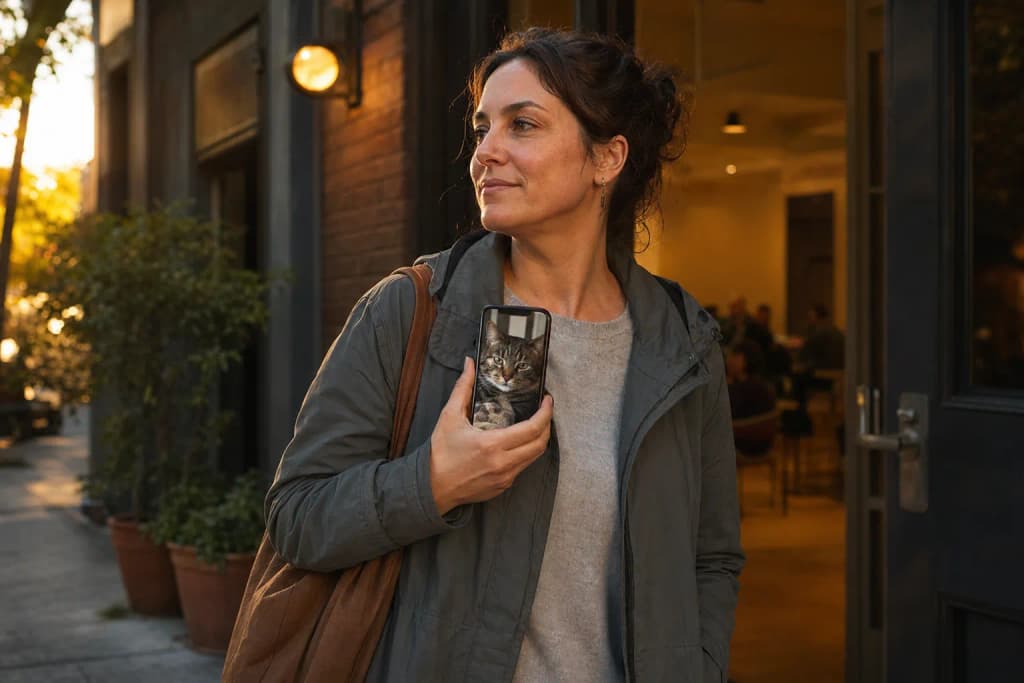
How a tabby face on your phone can open the right support
Your phone is already part of your grief architecture. Most people just haven’t named it.
You touch it first thing in the morning. It’s with you in waiting rooms, checkout lines, parking lots, late-night spirals, work breaks, and the strange five-minute windows where grief slips in because your mind finally gets quiet enough to notice something is missing. If your pet’s face lives there, it can function as more than a reminder. It can become a behavioral cue.
That’s the perspective readers rarely get: the image itself is not the intervention. What the image prompts you to do is the intervention.
Turn a passive image into an active support cue
If your tabby’s face is on your phone right now, ask one useful question: What action does this image trigger?
For many people, the honest answer is “None. I just get sad.” That doesn’t mean the image is wrong. It means it needs a job.
Try this:
- Choose one photo intentionally
- Pair it with one support behavior
- Name the ritual
This is a basic principle of habit formation and neuroplasticity. Repetition teaches the brain what to do when a trigger appears. Over time, the image may still hurt, but it hurts while also directing you toward care instead of isolation.
The best support groups for year two are not the biggest ones
Bigger isn’t always better. Our top pick is usually a group that is specific enough to feel seen but not so narrow that it becomes an echo chamber of pain.
A strong year-two group tends to have:
- Pet-specific language, not generic grief language only
- members talking about routine disruptions, not just the moment of loss
- room for ambivalent emotions like relief and guilt
- moderators who don’t rush “healing”
- archives or threads you can revisit on difficult dates
- tolerance for repetitive stories (because grief repeats itself)
What actually helps more than a massive community is a place where someone says, “I still look down before opening the dishwasher because my tabby used to sleep there in the sun,” and ten people understand immediately.
That level of specificity lowers social threat. In plain English: you stop spending energy translating your grief for people who don’t get it.
What to say when you join a tabby grief support group
Many people delay joining because they don’t know how to introduce themselves. Here’s a better script than “I lost my cat and I’m sad.”
Use this three-part format:
- Who your pet was in daily life
- What is hardest now
- What kind of support you want
For example:
- “He was the cat who waited by the shower every morning.”
- “The hardest part now is that year two feels lonelier than year one.”
- “I’m looking for people who understand delayed grief, not advice to move on.”
That level of precision tends to open more useful responses. It gives others a doorway.
Here’s a quick way to tell if your current support setup is serving you:
| Sign | Helpful Support | Unhelpful Support |
|---|---|---|
| After sharing a memory | You feel steadier, even if you cry | You feel dismissed or embarrassed |
| After reading others’ posts | You feel less alone | You spiral for hours |
| On anniversary dates | You have a plan | You’re left improvising in pain |
| When guilt comes up | People normalize it without excusing harm | People shut it down too quickly |
| When you mention year two | Others understand delayed grief | Others imply you should be “better” |
If you leave a group feeling drained every single time, that’s not noble endurance. That’s a mismatch.
The hidden emotions of year two: guilt, relief, envy, and fear of forgetting
This is where many pet owners go quiet. Not because they have nothing to say, but because the truth feels embarrassing.
Year two often strips grief of its socially acceptable script. In the beginning, people expect tears. Later, they’re less prepared for the sharp, private feelings that don’t sound tidy.
Guilt about feeling relief
If your pet was ill, elderly, or in visible discomfort, you may have felt relief mixed with grief when their suffering ended. Then came the backlash inside your own mind: How could I feel lighter if I loved them this much?
Here’s the truth. Relief after prolonged caregiving is common. It reflects nervous system downshift, not lack of love. During chronic stress, cortisol and vigilance can stay elevated for weeks or months. When the crisis ends, your body unclenches before your heart catches up.
That doesn’t make you cold. It makes you human.
We’ve heard versions of this from many families, especially after long medical declines. One woman told us the first full night of sleep she got after her tabby passed left her sobbing in the morning—not because she slept, but because she had. She felt she had betrayed him by resting.
No. Her body was exhausted. That’s all.
If this is you, try this reframing: “I am relieved the emergency ended, not relieved that they are gone.” Those are different statements. Put that sentence in your notes app. Read it when guilt starts rearranging the facts.
"Relief after caregiving isn't betrayal. It's your nervous system setting down a weight."
Second-guessing euthanasia timing
This one deserves direct language because vague comfort usually fails here.
Many pet owners replay the final decision with forensic intensity. Too soon. Too late. One more treatment. One less day of suffering. If you keep revisiting the timing, you are not unusual. You are trying to create certainty retroactively in a moment where certainty rarely existed.
That urge has a name: cognitive dissonance. You made a loving decision under impossible conditions, and now your mind keeps testing alternatives because the outcome hurt so much. The brain often assumes that if pain was this severe, there must have been one perfect choice that would have prevented it.
Usually, there wasn’t.
We’re not vets, and medical questions belong with your care team. But emotionally, what helps is writing down the facts you knew at the time, not the facts you wish you had now. Separate hindsight from reality.
Try a two-column page:
| What I knew then | What I’m adding now because I miss them |
|---|---|
| They stopped eating for two days | Maybe one more meal would have changed everything |
| They hid under the bed and avoided touch | Maybe they just needed a little more time |
| The vet discussed quality-of-life concerns | Maybe the vet was too pessimistic |
| Their breathing changed and frightened me | Maybe I panicked |
| I chose based on love and suffering | I keep grading myself against perfection |
That table won’t erase regret. It can interrupt distortion.
Feeling judged by others
A commonly overlooked wound in second year pet loss is not just missing your pet. It’s feeling judged by people who think the grief should be over.
You mention your cat’s name and someone shifts the conversation. You pass on a social event because it’s the adoption anniversary and a friend says, “Still?” The shame lands fast. You start editing yourself. You stop bringing them up.
That social editing can intensify grief because it removes one of the healthiest coping tools available: continuing bonds. Modern grief psychology doesn’t require “letting go” in the old sense. Healthy adaptation often includes an ongoing internal relationship—talking to them, keeping rituals, using their name, maintaining a place for them in your life story.
So if others make you feel dramatic, choose narrower circles. This is one reason the Association for Pet Loss and Bereavement can be such a useful resource. Their pet-specific support reflects the reality that mourning an animal companion often needs different language than general bereavement spaces.
Jealousy of people who still have their pets
Almost nobody says this out loud, but many feel it: jealousy.
You see someone at the park balancing a coffee and a striped cat in a backpack harness. Or a friend posts a lazy windowsill tabby under honey-colored light. Your immediate reaction isn’t sweetness. It’s a flash of resentment.
That doesn’t make you mean.
It means grief has sharpened your awareness of what others still get to have. The mistake most people make is trying to suppress that feeling with moral panic. What works better is naming it plainly and then reducing its heat.
A useful script: “I’m not angry at them. I’m aching for what I no longer have.”
That sentence shifts the target from other people to the real source of pain.
What actually helps in a tabby grief support group during year two
Not all support is equal. Some rituals feel profound for a week and then evaporate. Others seem almost ordinary but keep helping months later. We’ve watched enough pet families navigate memorial choices to have opinions here, and honestly, the small repeatable things usually outperform grand gestures.
Our top picks for second-year support
1. Memory specificity over memory abundance
Most people think they need more photos, more videos, more archives. Sometimes yes. But often what helps more is specific memory retrieval.
Instead of scrolling 2,000 images, write five vivid details:
- the dark outline around one eye
- the exact way the tail hooked left before a jump
- the white chin against the red blanket
- the pause before the tiny chirp at dinner time
- the look of afternoon light on striped fur
Why this works: specific sensory memory strengthens a continuing bond without overwhelming your attention. Broad image floods can spike emotion without creating a sense of closeness.
A customer once told us she stopped doom-scrolling her camera roll and started keeping “five true details” in her wallet. That small switch gave her more comfort than hours of phone scrolling.
2. Scheduled grief beats accidental grief
Here’s the standout principle: planned contact with grief usually hurts less than surprise contact with grief.
That sounds backward, but it tracks with basic nervous system regulation. Anticipation lets your brain prepare. Ambushes don’t.
Set two standing appointments each month:
- one private grief ritual (20 minutes)
- one community support touchpoint (support group, trusted friend, online thread)
You are not trying to shrink your grief into an appointment. You’re reducing the number of times it has to break through locked doors.
3. Tangible objects can stabilize memory better than digital clutter
This is where memorials matter—but not all memorials do the same job.
Digital memories are abundant and volatile. They live beside grocery lists, screenshots, work emails, and app notifications. Tangible objects ask for a different kind of attention. They hold a place. They create a boundary. They don’t vanish behind a software update.
For some families, that means a framed paw print. For others, a collar shadow box. And for readers who want something three-dimensional and visually faithful, custom figurines can be surprisingly powerful because they restore form, posture, markings, and presence—not just a flat image.
At PawSculpt, our team has seen this especially with tabbies because stripes, forehead markings, and eye color are part of the memory architecture. A piece that is digitally sculpted by master 3D artists, then precision 3D printed in full color can capture those identifying details directly in full-color resin, with the color built into the material itself. The only manual finishing step is a protective clear coat for sheen and durability.
That tactile permanence is the point. Not perfection. Presence.
And worth noting: if you’re exploring this route, choose it because you want an anchor, not because you think buying a memorial will “fix” grief. It won’t. It can, however, give grief somewhere to land.
"We've learned that the keepsakes people return to most are the ones that don't just resemble a pet—they restore a familiar presence."
— The PawSculpt Team
A comparison that may save you time
Not every memorial fits every phase. This table shows what we’ve seen work best in year two.
| Support Option | Best For | Emotional Effect | Possible Downside |
|---|---|---|---|
| Photo album on phone | Quick access, spontaneous remembering | Immediate connection | Can trigger unplanned spirals |
| In-person or online pet loss group | Feeling understood by others | Reduces isolation and shame | Quality varies widely |
| Written memory journal | Organizing thoughts | Clarifies and preserves details | Hard to start when tired |
| Memorial shelf or candle ritual | Structured remembrance | Creates calm repetition | Can feel static over time |
| Full-color 3D pet figurine | Visual/tangible presence | Stabilizes memory through form and markings | Too intense for some people early on |
Support scripts for the moments that catch you off guard
If you join a Tabby grief support group, keep a few scripts ready. They reduce the pressure to be eloquent while upset.
Use one of these:
- “Today’s trigger was small, but it hit hard.”
- “I’m in year two, and people assume I’m done grieving.”
- “I need company, not solutions.”
- “I feel guilty that I also feel relief.”
- “Can someone tell me what helped at the 18-month mark?”
Simple language works because your cognitive bandwidth is usually lower when grief is activated.
Counter-Point: when keeping your tabby on your phone may not help
We want to be honest here because this article’s main idea has limits.
A tabby face on your phone is not automatically therapeutic. For some people, especially those with traumatic final memories, a constantly visible image can keep the nervous system activated instead of soothed.
If every glance at your screen spikes panic, nausea, or intrusive replay, don’t force the ritual. That is not weakness. It is information.
Signs the phone image is becoming a stressor
Watch for these patterns over 10 to 14 days:
- you avoid using your phone because the image hurts
- you experience repeated flashbacks to the final appointment
- your sleep worsens after evening scrolling
- you feel compelled to check old photos for hours
- your baseline anxiety stays elevated after seeing the image
In those cases, we’d rank other supports higher for now.
Try these alternatives instead:
- move the image from lock screen to a hidden album you access intentionally
- use a symbolic wallpaper instead, like the color of their collar or a favorite blanket
- keep one printed photo inside a drawer you open during a chosen ritual
- use a physical memorial object in a quiet space rather than a digital image in constant circulation
This is a good place to say plainly: if your grief is colliding with daily functioning in severe ways—panic, persistent hopelessness, inability to work or sleep for extended periods—professional support matters. Pet loss grief is real grief. A support group is excellent for many people, but it is not the same as therapy.
The AVMA’s pet loss resources can also point you toward practical next steps and support frameworks grounded in veterinary care realities.
The mistake most people make with memorials
They choose based on what looks meaningful from the outside.
What actually helps is choosing based on how your body responds. Do you soften when you see the object, or brace? Do you feel accompanied, or flooded? Your answer matters more than anyone else’s idea of a proper tribute.
We’ve worked with families who were ready for a visual keepsake within weeks. Others waited much longer. Some wanted a realistic 3D piece displayed in sunlight where the markings could catch the room. Others needed something tucked into a private corner first. Both approaches were wise—because both matched the nervous system, not the trend.
Building a second-year support system that is precise, not generic
If year two has taught you anything, it’s probably this: broad advice gets old fast. “Take it one day at a time” doesn’t help much when the hard part is that the days now look normal from the outside.
You need a support system with edges and detail.
The three-layer model we recommend
After years working with pet families, we’re not huge fans of relying on one source of comfort. The strongest setups usually have three layers:
- Immediate regulation
- Relational support
- Memory preservation
Think of it as emotional architecture, not just coping.
Layer 1: Immediate regulation
This is your first response when the wave hits in a parking lot, during lunch break, or at 11:17 p.m. when you see a striped tail in a video and lose your footing emotionally.
Our top options:
- One-minute visual grounding: Look at five objects and describe color, shape, and light.
- Cold-water reset: Run cool water over wrists for 20 seconds.
- The sentence anchor: “I miss them, and I am safe right now.”
- Scheduled notes app dump: Write exactly three sentences, no more.
Why these work: they reduce physiological arousal enough to restore decision-making. You cannot process grief well while your body is acting like danger is immediate.
Layer 2: Relational support
Choose one support group and one individual if possible. More than that can become noisy.
The ideal Tabby grief support group in year two offers:
- threads about anniversaries and delayed triggers
- permission to post tiny memories, not just “big” updates
- space for morally complicated feelings
- a culture that doesn’t compare whose grief is worst
And your individual person should be able to tolerate repetition. That is a nonnegotiable. Grief is repetitive because attachment is repetitive. You didn’t love your cat once. You loved them daily. Of course the remembering arrives daily too.
Layer 3: Memory preservation
This is where fear of forgetting comes in.
Many pet owners secretly dread this more in year two than in year one. The panic isn’t just “I miss them.” It’s “What if the exact green of her eyes fades?” Or, “What if I forget the angle of his ears when he was curious?” That fear can become compulsive scrolling, which often leaves you more distressed.
What works better is creating a finite memory archive.
Try this 7-item list:
- best front-face photo
- best side profile
- one sleeping image
- one “typical attitude” image
- one written story about a routine
- one audio clip if you have it
- one physical memorial item
This is enough to preserve identity without drowning in data.
And if a physical piece feels right, some families choose memorial keepsakes that translate those photos into a three-dimensional form. PawSculpt’s approach uses advanced full-color 3D printing technology to reproduce markings directly in resin, which matters if your tabby’s facial pattern is part of what you’re afraid to lose. The result isn’t plastic-perfect—and that’s often a virtue. Fine print texture and a protective clear finish can make the piece feel more grounded, more real, less like a generic ornament.
A support map you can actually use
Here’s a simple framework for the next 30 days.
| Need | Best Tool | Time Required | Why It Helps |
|---|---|---|---|
| Sudden trigger at work | 60-second grounding + note | 1-2 minutes | Restores focus without suppressing grief |
| Late-night longing | Support group check-in | 10 minutes | Replaces isolation with witness |
| Fear of forgetting details | 7-item memory archive | 30-45 minutes once | Preserves identity in a finite way |
| Anniversary dread | Planned ritual + person on standby | 20-60 minutes | Reduces surprise and anticipatory stress |
| Ongoing visual ache | Physical memorial in chosen space | Varies | Creates stable, intentional contact |
A brief scenario that may feel familiar
Picture this. It’s late afternoon. The park path is striped with long shadows from bare trees, and a child races by with a blue scooter. You check your phone for the time and your tabby’s face appears—amber eyes, dark forehead lines, that alert little tilt. Instead of swallowing the hit and marching on, you open your grief group and type: “Year two is strange today. I saw his face and the whole path changed color.”
Someone replies within five minutes: “Mine too. You don’t have to explain.”
That’s not a miracle cure. It’s something better—a nervous system interruption through recognition.
Choosing memorials that support healing rather than perform it
Some memorial advice is too aesthetic. It focuses on what looks touching instead of what functions well in real grief. We think that’s backward.
The right memorial in year two should do at least one of these three things:
- reduce panic about forgetting
- create intentional contact instead of random ambush
- help you tell the story of who your pet was
If it does none of those, it may be decorative but not especially supportive.
What to look for in a meaningful visual memorial
If you are considering a portrait, sculpture, or figurine, prioritize:
- accurate markings
- recognizable expression
- familiar posture
- a size and placement you can live with daily
That last point is underrated. A memorial can be beautiful and still wrong for your current nervous system if it dominates a room you can’t avoid.
One family we worked with chose a smaller display area near a bookshelf rather than the entry table. Smart decision. They wanted access, not confrontation.
Why three-dimensional memorials can help with attachment
Attachment is embodied. Your relationship with your cat was not only visual. It involved shape, movement, weight, position in space. A flat image captures one plane. A three-dimensional memorial can reconnect some of the brain’s spatial memory—the sense of how they occupied a room, turned their head, held their body.
That may be one reason some people respond so strongly to figurines in memorial settings. The object doesn’t replace the pet (nothing does), but it can restore enough physical reference to calm the fear that the memory is dissolving.
We’ve seen this especially with striped cats. Their markings are part map, part signature. A carefully modeled piece can preserve that map in a way that feels immediately legible to the person who loved them.
If you’re browsing options, 3D pet sculptures are worth looking at as one lane among several—not because everyone needs one, but because some grief responds best to form.
"Memory fades at the edges first. Good memorials hold the edges."
What to expect if you choose a custom figurine
Let’s keep this practical.
- submitting clear photos from multiple angles
- review of a digital concept or preview
- revisions as needed according to current company policy
- final production in the stated material and process
With PawSculpt, the important technical point is this: the piece is hand-modeled digitally with care, then brought to life through full-color 3D printing. The color is printed into the resin voxel by voxel rather than applied as a surface layer. That distinction matters for realism, especially with tabby striping and subtle facial transitions.
For current process details, options, and guarantees, the wisest move is to visit the website directly because those specifics can change.
Photo selection tips that actually matter
If your goal is a faithful memorial, not all photos are equal. Here’s the shortlist we recommend.
| Photo Type | Why It Matters | Best Lighting | Avoid |
|---|---|---|---|
| Straight-on face shot | Captures eye shape and forehead markings | Soft window light | Heavy flash that flattens fur |
| Side profile | Shows muzzle and ear angle | Bright indirect daylight | Blurry motion shots |
| Full-body standing or sitting | Helps posture and proportions | Even natural light | Photos cropped too tightly |
| Favorite expression image | Captures personality | Any clear, high-resolution image | Filters that alter color |
| Marking close-up | Preserves unique stripes/spots | Daylight with accurate color | Yellow indoor lighting if possible |
This applies whether you’re creating a figurine, portrait, or archive.
A practical 30-day plan for the right kind of support in year two
If you want a clear next step, here’s the version we’d give a friend.
Week 1: Audit your triggers
For seven days, note:
- what triggered the grief
- what time it happened
- whether it came from a planned or unplanned reminder
- what helped within 10 minutes
Don’t overcomplicate this. A notes app log is enough.
You are looking for patterns, not poetry.
Week 2: Choose one support group and test it
Join one Tabby grief support group or pet-specific grief community. Post once. Comment twice. Then assess how your body feels after.
Helpful signs:
- shoulders drop a little
- you feel more coherent
- you save something someone said
- you feel seen instead of exposed
If you feel consistently worse, leave. Editorial judgment matters in grief too. Not all communities deserve your vulnerability.
Week 3: Build your finite memory archive
Create the 7-item archive. Print one photo if everything currently lives on your phone. Physicality matters.
If fear of forgetting is loud, this week often brings more relief than people expect.
Week 4: Add one intentional memorial point
Choose one:
- a candle ritual
- a bench visit
- a written letter
- a small shelf
- a custom memorial object
Some families stop there. Others decide they want a more enduring visual piece and explore custom pet figurines after they’ve clarified which photos and details matter most. That sequence tends to work well because it ensures the memorial grows from memory, not panic.
The quieter truth about year two
Year two is often where love becomes less public and more deliberate.
People stop asking. The casseroles are long gone. Your home may look normal again. But then your thumb pauses over a bright square on your phone and there they are—your tabby, lit from within by the screen, pulling a thread through the fabric of an ordinary day.
That moment does not have to remain a private collapse.
It can become a cue. A ritual. A route toward the right witness.
So here’s the next step: choose one image, one person or group, and one preserving action this week. Not ten things. Three. Make the support specific enough to meet the exact shape of your grief. If year one was survival, year two can be design.
And if your second year pet loss has left you afraid that the details will blur—the stripe down the nose, the way the eyes caught green in afternoon light—remember this: love does not only live in memory. It also lives in what you choose to keep, repeat, and honor.
Frequently Asked Questions
Is it normal for second year pet loss to feel worse than the first year?
Yes. In fact, it’s more common than many people realize. The first year often brings external acknowledgment and logistical tasks, while year two can expose the deeper ongoing absence once life looks “normal” again.
Can a Tabby grief support group really help in year two?
Absolutely—if the group is specific, well-moderated, and emotionally literate. The best groups help you talk about routine triggers, guilt, relief, and fear of forgetting, rather than only focusing on the immediate loss event.
Why does seeing my cat on my phone trigger such a strong reaction?
Because your phone appears in everyday life, not just memorial moments. That makes it a powerful delivery system for emotional memory, especially when your pet had distinctive visual traits like tabby striping, bright eyes, or a very recognizable expression.
Is it normal to feel relief after a pet dies?
Yes, especially after a period of caregiving, medical stress, or visible suffering. Relief is often your body releasing chronic vigilance; it does not mean you wanted less time or loved your pet any less.
What memorial helps most if I am afraid of forgetting my tabby?
The best memorial is the one your body can tolerate and return to. For some people that’s a finite photo archive or memory journal; for others it’s a physical keepsake that preserves markings, posture, and presence in a more stable form.
Ready to Celebrate Your Pet?
Every pet has a story worth preserving. Whether you're honoring a beloved companion who's crossed the rainbow bridge or celebrating your furry friend's unique personality, a custom PawSculpt figurine captures those details that make your pet one-of-a-kind.
If you're navigating a Tabby grief support group or the ache of second year pet loss, a tangible memorial can offer something digital images sometimes can't: a steady place for memory to rest.
Visit pawsculpt.com to learn more about our process and guarantees