
When the Whole House Grieves: Helping Your Other Pets After Losing a German Shepherd
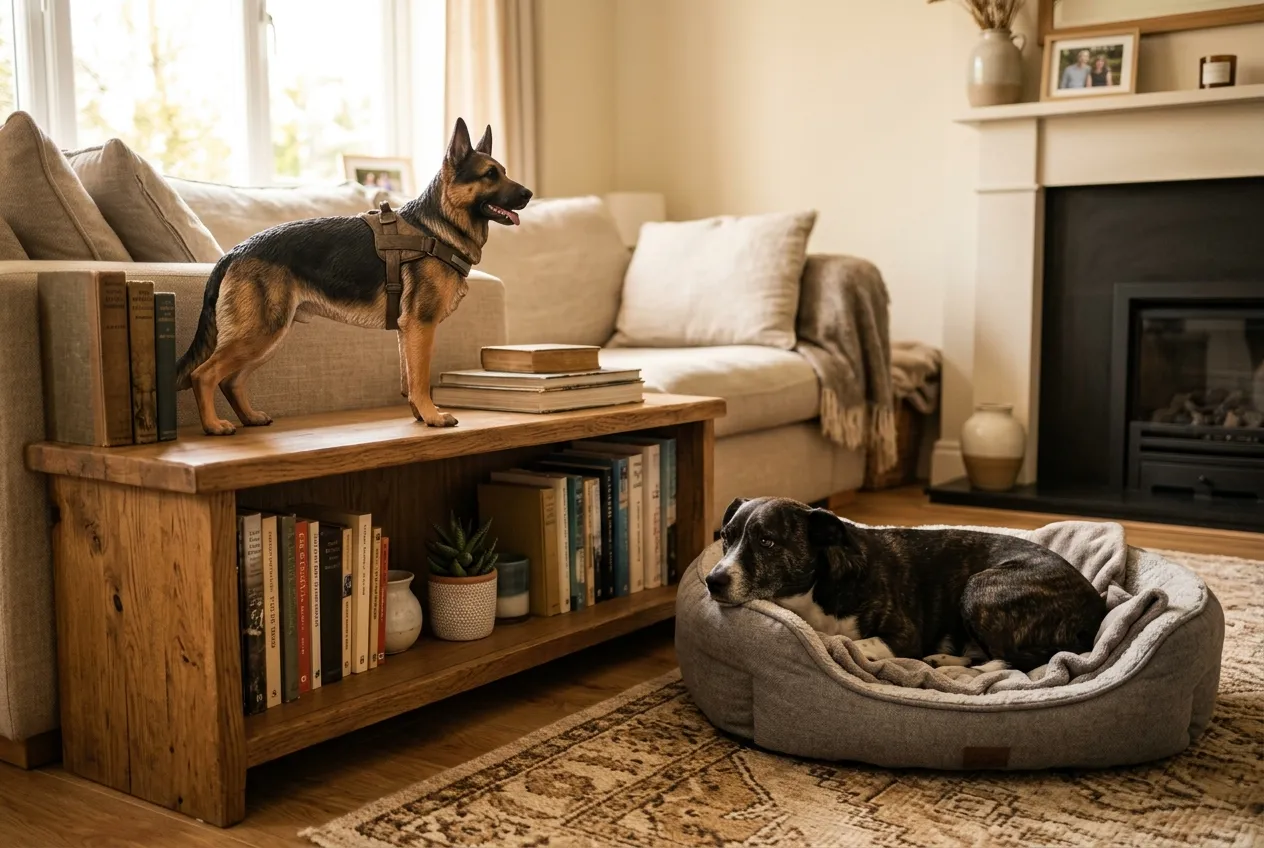
You're standing in the pet store aisle, staring at a bag of kibble you don't need anymore. Your German Shepherd is gone, but your cart still has two food bowls in it out of habit—and your other pets at home are acting like the walls of the house shifted overnight. Because in a multi-pet household grief doesn't just belong to you. It belongs to everyone under that roof.
Quick Takeaways
- Your surviving pets are grieving too — watch for appetite changes, withdrawal, and searching behavior in the first 2-4 weeks
- Routine is neurochemistry, not just comfort — maintaining schedules stabilizes cortisol levels in anxious animals
- Don't rush to "fix" the pack dynamic — let your pets renegotiate their social structure naturally over 4-8 weeks
- A physical memorial anchors healing for the whole family — a custom pet figurine can give everyone, including kids, a tangible place to direct their love
- Your guilt about your surviving pets' confusion is normal — you can't explain death to them, and that's okay
The Science Behind Why Your House Feels Wrong
Here's something most pet loss articles won't tell you: your German Shepherd wasn't just a pet in your household. From a behavioral science perspective, they were likely the social architect of your entire multi-pet dynamic.
German Shepherds, by temperament and sheer physical presence, tend to function as what animal behaviorists call the "social fulcrum" of a multi-pet home. They're the ones who set the pace of the morning routine. They decide when play starts and when it stops. Their body language—that confident, ears-forward posture—sends constant micro-signals to every other animal in the house about whether the environment is safe, exciting, or calm.
When that fulcrum disappears, the other animals aren't just sad. Their entire social reference system has collapsed.
Think of it this way. If you removed the conductor from an orchestra mid-symphony, the musicians wouldn't just feel bad about it. They'd literally not know when to come in. That's what's happening in your living room right now.
Your cat who suddenly won't eat near the kitchen? She's not being dramatic. She used to wait until your Shepherd finished eating first—a pattern so ingrained she doesn't know the meal is "safe" to approach without that cue. Your smaller dog pacing the hallway at 6 AM? He's not looking for your Shepherd exactly. He's looking for the signal that the day has started, because your Shepherd was always the one who gave it.
This is attachment theory playing out in real time, across species. And understanding it changes everything about how you help your surviving pets heal.

What Grief Actually Looks Like in Your Other Pets (It's Not What You'd Expect)
Most guides will give you a tidy list: lethargy, loss of appetite, whining. And sure, those happen. But the real signs of pet grief in a multi-pet household after German Shepherd loss are stranger, subtler, and sometimes look like the opposite of sadness.
Here's what we've learned from working with thousands of families navigating this exact situation:
| Behavior You'll See | What It Actually Means | When to Worry |
|---|---|---|
| Sudden hyperactivity or "zoomies" | Stress displacement—burning off cortisol | If it persists beyond 3 weeks |
| Guarding the deceased pet's bed or toys | Scent-based comfort seeking | Only if aggression develops |
| Increased affection toward you | Seeking replacement social anchor | This is healthy—lean into it |
| Ignoring spots they used to share | Avoidance of grief triggers (yes, animals do this) | If they stop using entire rooms for weeks |
| New destructive behavior | Anxiety from social structure collapse | If it escalates or causes self-harm |
| Sudden "boldness" in a previously shy pet | Testing new social boundaries | Usually temporary and normal |
That last one surprises people the most. We had a customer tell us her timid Beagle suddenly started sleeping on the couch—something he'd never dared to do when their Shepherd was alive. She felt guilty about it, like the Beagle was being disrespectful. But what was actually happening was a completely natural social renegotiation. The hierarchy had shifted, and the Beagle was cautiously exploring what that meant for him.
This isn't disrespect. It's biology.
"Grief in animals isn't silence. It's the whole house learning a new language without a translator."
The Counterintuitive Truth About Cats and German Shepherd Loss
Here's the thing nobody talks about: cats often grieve German Shepherds harder than other dogs do.
It sounds backwards. But if your cat and Shepherd had a long coexistence, your cat likely built her entire spatial routine around the dog's patterns. Cats are territorial creatures who map their environment obsessively. Your Shepherd was part of that map—a large, predictable, warm-bodied landmark that the cat oriented around.
Remove that landmark, and the cat's cognitive map has a hole in it. Literally. Research into animal spatial cognition suggests that cats experience environmental changes as a form of cognitive dissonance—the world doesn't match their internal model anymore, and that mismatch creates genuine distress.
So if your cat is suddenly hiding under the bed or yowling at 3 AM or refusing to walk through the hallway where your Shepherd used to sleep, she's not being difficult. She's disoriented. Her GPS is recalculating.
The First 48 Hours: What to Do (and What to Absolutely Not Do)
The first two days after losing your German Shepherd set the tone for how your entire household—human and animal—will process this loss. Here's where most people make well-meaning mistakes.
What to do immediately
- Don't wash your Shepherd's bedding right away. This is the single most important thing. Your other pets need those scent markers. Scent is how animals process presence and absence. Removing the scent abruptly is the animal equivalent of someone erasing all photos of a loved one overnight. Leave the bed, the blanket, the favorite toy in place for at least 2-3 weeks.
- Maintain feeding times to the minute. Not approximately. Not "around the same time." The exact time. Your pets' circadian rhythms are regulated by routine, and routine is regulated by cortisol cycles. Disrupting meal times right now is adding biochemical stress on top of social stress.
- Give each surviving pet 10-15 minutes of individual, undivided attention daily. Not group time. Solo time. Get on the floor with them. This isn't about comfort—it's about re-establishing you as the new social anchor. Your Shepherd held that role. Now you need to step into it consciously.
- Keep the lights on a normal schedule. This sounds oddly specific, but light cycles regulate melatonin production in all mammals. If you're grieving and spending days in a darkened room (which is completely understandable), your pets' sleep-wake cycles will destabilize, compounding their anxiety.
What NOT to do
- Don't immediately rearrange furniture or "clear out" your Shepherd's things. Your surviving pets are using spatial memory to cope. Moving everything around forces them to process two losses at once—the social loss and the environmental loss.
- Don't bring a new pet home within the first month. We know the house feels empty. We know someone at work has puppies. But your surviving pets need time to establish a new equilibrium before another variable enters the system. Most behaviorists recommend waiting at least 8-12 weeks, and honestly, longer is usually better.
- Don't punish new behavioral issues. That chewed shoe? That accident on the carpet? That's grief talking. Punishment right now will create a fear association on top of an already stressed animal. Redirect, don't reprimand.
"We've seen families heal by holding something tangible. Grief needs an anchor—for humans and for the animals who share their home."
— The PawSculpt Team
Myth vs. Reality: What Most People Get Wrong About Pets Grieving Other Pets
Let's clear up some persistent misconceptions that even well-meaning vets sometimes perpetuate.
Myth: "Animals don't really grieve—they just respond to changes in routine."
Reality: This is an outdated view rooted in 20th-century behaviorism that denied animals emotional complexity. Modern neuroscience has identified that dogs, cats, and even some birds produce oxytocin and cortisol patterns during social loss that mirror human grief responses. A 2022 study published in Scientific Reports found that dogs in homes where a companion animal died showed significant increases in attention-seeking behavior, sleep disturbance, and fearfulness—changes that persisted well beyond any routine disruption. Your pets aren't just confused. They're mourning.
Myth: "You should let your other pets see the body so they understand."
Reality: This one's complicated. For dogs, there's some evidence that brief exposure to the deceased companion can reduce searching behavior—they seem to understand, on some level, that the other animal isn't coming back. But for cats, the evidence is mixed at best. Some cats show increased stress after body exposure, possibly because the scent profile of a deceased animal is deeply wrong to them—familiar but chemically altered. If you want to try this, keep it brief (under 5 minutes) and watch for signs of distress. Don't force it.
Myth: "Getting another German Shepherd will help your other pets adjust."
Reality: This is the one that breaks our hearts the most, because it comes from such a loving place. But your other pets aren't grieving "a German Shepherd." They're grieving that specific individual—with that specific scent, those specific behavioral patterns, that specific way of lying in the doorway at exactly the angle that blocked the draft. A new dog, even the same breed, is a stranger. And introducing a stranger during active grief can actually intensify anxiety in surviving pets. Wait. Let the house settle. Let the new normal become normal first.
The Emotional Landscape You're Not Supposed to Talk About
Let's get honest about something. Really honest.
You're grieving your German Shepherd. Your other pets are grieving your German Shepherd. And somewhere in the middle of all that grief, you're probably feeling something you haven't told anyone about.
You're feeling guilty about your surviving pets.
Maybe it's guilt that you're so consumed with grief for your Shepherd that you haven't been fully present for the animals still here. Maybe it's guilt that when you look at your other dog, you feel a flash of something terrible—a thought like why couldn't it have been... before you shut it down in horror. Maybe it's guilt that your cat seems fine, and you're angry at her for not grieving the way you think she should.
Or maybe—and this is the one that really twists the knife—you feel a tiny, shameful flicker of relief that the complex dynamic of managing a multi-pet household just got simpler. One less medication schedule. One less vet bill. One less body to navigate around in the kitchen.
That relief doesn't make you a monster. It makes you a human being whose nervous system has been running on high alert, possibly for months if your Shepherd was ill, and is now experiencing the neurological downshift that follows sustained stress. Your parasympathetic nervous system is doing exactly what it's designed to do: exhale. The guilt that chases that relief is one of grief's cruelest tricks, because it takes a normal physiological response and turns it into evidence of your worst fears about yourself.
You loved your Shepherd. The relief and the love are not opposites. They're roommates in the same overwhelmed heart.
And here's the part that connects back to your other pets: they can sense this internal conflict. Dogs in particular are remarkably attuned to human cortisol levels and emotional states. If you're locked in a guilt spiral, your surviving dog is absorbing that tension without understanding its source. The most helpful thing you can do for your other pets right now might be the hardest: forgive yourself for every complicated feeling you're having.
"The grief you're ashamed of is usually the grief that most needs to be felt."
Rebuilding the Pack: Weeks 2 Through 8
The acute phase is over. The searching behavior has mostly stopped. Now comes the longer, quieter work of helping your household find its new shape.
Week 2-3: The Testing Phase
This is when your surviving pets start experimenting with new behaviors. Your smaller dog might try claiming the Shepherd's spot on the couch. Your cat might start venturing into rooms she previously avoided. You might notice brief, almost playful interactions between animals that previously only interacted through the Shepherd as intermediary.
Let this happen. Don't intervene unless there's genuine aggression. Your pets are doing the social equivalent of rearranging furniture after a roommate moves out—figuring out what the new space allows.
One practical tool that helps enormously during this phase: scent bridging. Take a cloth, rub it on one pet, then leave it near another pet's resting area. This cross-pollinates scent profiles and helps animals build new direct associations with each other, rather than relying on the absent Shepherd as the connective tissue.
Week 3-5: The Regression Phase
Just when you think everyone's adjusting, someone falls apart. The dog who seemed fine suddenly won't eat. The cat starts over-grooming. You find yourself crying in the pet store again, holding a toy your Shepherd would have loved.
This is normal. Grief—in humans and animals—isn't linear. It's recursive. Neuroscience tells us that memory consolidation happens in waves, and each wave can retrigger the stress response as the brain processes the loss at deeper levels. Your pets aren't going backwards. They're processing forward in a spiral pattern.
During this phase:
- Increase enrichment activities. Puzzle feeders, new scent trails (drag a treat along a path through the house), novel but safe objects to investigate. You're giving their brains something to do besides loop on absence.
- Consider calming supplements. Talk to your vet about L-theanine or adaptil diffusers for dogs, or Feliway for cats. These aren't magic, but they can take the edge off enough for natural coping to kick in.
- Watch for the 30-day mark. If a pet is still refusing food, showing significant weight loss, or displaying self-harming behaviors (excessive licking, pulling fur) after 30 days, it's time for a veterinary behavioral consultation. According to the ASPCA's guidelines on pet grief, prolonged behavioral changes warrant professional attention.
Week 5-8: The New Normal Emerges
Slowly, almost imperceptibly, the house starts to feel like a house again instead of a house with a hole in it. Your pets develop new routines that don't revolve around the absent Shepherd. The smaller dog finds his own rhythm for morning walks. The cat reclaims the sunny spot by the window without checking over her shoulder first.
This is also when something bittersweet happens: you start to see your surviving pets as individuals in a way you might not have before. When a German Shepherd is in the house, their personality tends to dominate the narrative. They're so big, so present, so much. Now, with that enormous presence gone, the quieter personalities in your home get room to bloom.
It doesn't replace what you lost. But it's something.
| Recovery Phase | Timeline | What You'll See | What Helps Most |
|---|---|---|---|
| Acute grief | Days 1-14 | Searching, appetite loss, vocalization | Maintain routine, preserve scent items |
| Testing | Weeks 2-3 | New behaviors, boundary exploration | Allow natural renegotiation, scent bridging |
| Regression | Weeks 3-5 | Return of grief behaviors, setbacks | Enrichment, calming aids, patience |
| New normal | Weeks 5-8 | Stabilized routines, emerging personalities | Celebrate small moments, gradual transitions |
| Integration | Months 3-6 | Settled dynamic, readiness for change | Consider (slowly) whether to expand the family |
Creating Anchors: Why Physical Memorials Matter More Than You Think
There's a concept in psychology called continuing bonds theory. For decades, the grief model told us to "let go" and "move on." Modern research has flipped that completely. Healthy grief doesn't require severing the bond—it requires transforming it. Finding new ways to maintain connection with what's gone.
For humans, this is relatively straightforward. We have language, ritual, memory. We can write about our German Shepherd. We can talk about them. We can look at photos.
But here's the angle most people miss: physical memorials serve your surviving pets too.
Not directly—your cat isn't going to contemplate a figurine and feel comforted. But indirectly, the presence of a memorial object changes your behavior in ways your pets absolutely notice. When you have a tangible place to direct your grief—a spot on the shelf where your Shepherd's likeness sits, a garden stone, a shadow box—you're less likely to project unresolved grief onto your surviving animals.
We've seen this pattern repeatedly. Families who create some form of physical memorial report that their interactions with surviving pets become healthier, faster. The memorial becomes a container for the grief, which frees you to be fully present with the animals who still need you.
Some families plant a garden. Others frame a collar. And some choose to capture their Shepherd's likeness in a way that preserves every detail—the exact tilt of the ears, the specific pattern of the saddle markings, that one spot where the fur always cowlicked. Companies like PawSculpt use advanced full-color 3D printing technology to reproduce those details directly in resin, so the color is part of the material itself rather than a surface coating. The result is something that looks like your dog, not a generic version of the breed. For families with children especially, having something they can see and touch gives the grief a home.
But whatever form your memorial takes, the principle is the same: give the love somewhere to land.
When Your Grief and Their Grief Collide
There's a particular kind of exhaustion that comes from grieving in a multi-pet household. You're processing your own loss while simultaneously monitoring everyone else's emotional state. You're trying to be the stable center of a destabilized system while your own center has been knocked sideways.
This is where compassion fatigue enters the picture—a term usually reserved for healthcare workers and caregivers, but absolutely applicable here. You are caregiving through your own crisis. That's extraordinarily hard, and it doesn't get acknowledged enough.
A few things that genuinely help (not platitudes, actual strategies):
- Tag-team with your household. If you have a partner, kids, or roommates, explicitly divide pet-monitoring duties. "You handle the evening feeding and check on the cat. I'll do the morning walk." Grief shared is grief halved, and so is the labor of shepherding other animals through it.
- Set a daily 20-minute "grief window." This sounds clinical, but it works. Give yourself a specific time each day to sit with your loss fully—look at photos, hold the collar, cry if you need to. Then close the window and focus on the living. This isn't suppression. It's containment, a legitimate psychological technique that prevents grief from flooding every hour of every day. Your surviving pets benefit too—they pick up on your emotional regulation, or lack of it.
- Create a \"transition object\" for your surviving dog. Take a piece of clothing or a blanket that carries the scent of the deceased German Shepherd and place it in the surviving dog's bed. Scent is the longest-lasting sensory memory for dogs. This doesn't replace their companion, but it eases the olfactory shock of sudden absence. Remove it gradually over 2-3 weeks as the surviving dog adjusts.
- Don't rearrange the house immediately. Your first instinct might be to remove the extra water bowl, pick up the second leash, fold the extra bed. Resist for at least two weeks. Your surviving pets navigate by spatial memory. Sudden changes to their environment compound the stress of losing their companion with the confusion of a reconfigured home.
The Hardest Part Nobody Mentions
Here's the thing nobody tells you about multi-pet household grief: you will, at some point, feel resentment toward your surviving pets. It's ugly and it's temporary, but it's real.
You'll look at your cat sleeping peacefully in a sunbeam and think, irrationally, "Why are you fine? Don't you miss her?" Or you'll watch your younger dog play with a toy and feel a flash of anger that they're acting normal when nothing feels normal.
This is grief misdirecting itself. It's looking for a target and landing on the nearest living thing. Recognize it. Name it. And then look again—because your cat isn't fine, they're sleeping more than usual because that's how cats process disruption. And your younger dog isn't being callous—they're trying to re-establish normalcy because that's their only coping mechanism.
Your whole house is grieving. It just looks different for each occupant.
Honoring Your German Shepherd While Tending to the Living
The tension of multi-pet grief is that honoring the dead and caring for the living compete for the same emotional bandwidth. You want to sit with your sadness, but the surviving dog still needs their walk. You want to look at old photos, but the cat is meowing for dinner.
This tension isn't a problem to solve—it's the shape of your life right now. The walks you take with your surviving dog can become your memorial practice. The routine you maintain for the cat can become your act of honoring, because your German Shepherd would have wanted the house to keep running.
Some families find that placing a custom figurine of their German Shepherd in a visible spot helps bridge this gap. The figurine stands watch while you tend to the living. It's there when you return from the walk, when you fill the water bowls, when you collapse on the couch at the end of a long day. It holds the space for your grief so you can hold the space for everything else.
Ready to Honor Your German Shepherd's Memory?
Your German Shepherd held the household together—their presence was the gravity that kept everyone in orbit. A custom PawSculpt figurine captures their strength, their alertness, their specific way of standing guard, rendered in full-color resin with every marking and expression preserved.
Visit pawsculpt.com to start your order—free AI preview, a 3D artist preview within 7 days, and 5 free revisions
Frequently Asked Questions
Do other dogs grieve when a companion dog dies?
Yes. Research from the ASPCA and studies published in animal behavior journals confirm that dogs display measurable grief responses—reduced appetite, increased sleeping, searching behavior, and changes in vocalization. The intensity depends on the bond between the animals, not the species involved.
How long do dogs grieve the loss of another pet?
Most dogs show noticeable behavioral changes for two to six months, though some adjust within weeks and others carry subtle shifts for a year or more. There is no standard timeline. Watch for gradual improvement rather than expecting a clean endpoint.
Should I let my surviving dog see the deceased pet's body?
Many veterinary behaviorists recommend it. Brief exposure to the body can reduce searching behavior—the surviving dog understands their companion is gone rather than simply missing. Keep the experience calm and brief, and follow your dog's lead on whether they want to approach.
How do I help a cat that is grieving a dog companion?
Cats grieve differently than dogs—they tend to withdraw rather than search. Maintain their routine strictly, offer elevated resting spots where they feel secure, and increase gentle interaction without forcing it. Some cats benefit from puzzle feeders or new environmental enrichment to redirect anxious energy.
Should I get a new pet to help my surviving dog cope?
Not immediately. Your surviving pet needs time to establish a new normal without their companion before adjusting to a stranger. Introducing a new pet too soon can add stress rather than comfort. Most behaviorists suggest waiting at least three to six months, and only if your surviving pet shows signs of wanting social companionship.