
Writing a Letter to Your Husky at the Rainbow Bridge: A Ritual That Untangles the Chaos
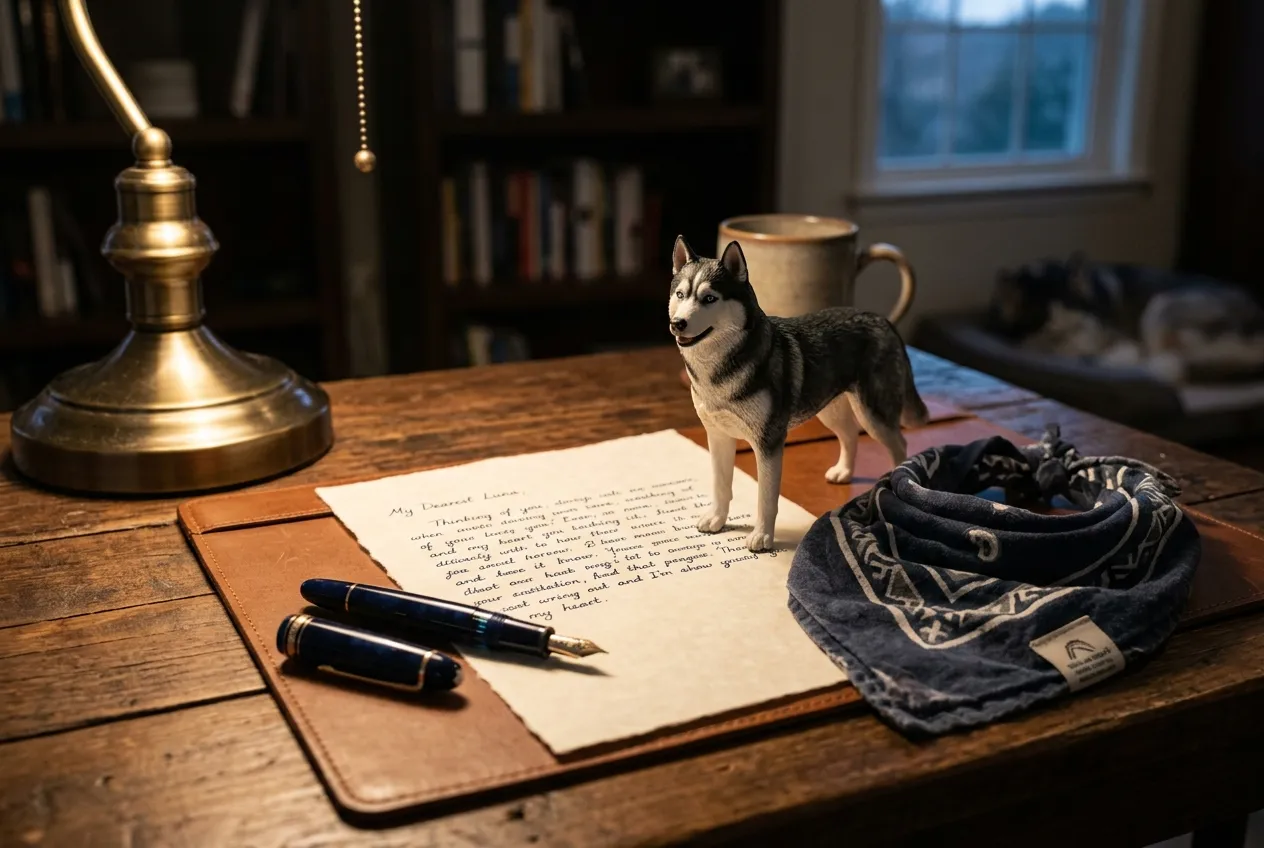
"To write is to attempt to know what we would write if we wrote," Joan Didion once observed. She was talking about grief, naturally—because grief is the one experience that resists understanding until you force it through your fingers, onto a page. The smell of your husky's fur after a rainstorm, that particular wet-earth-and-warmth scent that clung to your couch cushions for weeks after they were gone—a letter to your pet at the rainbow bridge can hold that. It can hold all of it.
Quick Takeaways
- Writing a rainbow bridge letter isn't about closure—it's about creating a container for emotions that have no other place to go
- Structure matters less than honesty—your husky doesn't need perfect prose, they need your real voice
- The ritual of writing physically changes your grief—moving pain from body to page is a neurological release, not just a metaphor
- Pair your letter with a tangible memorial like a custom pet figurine to anchor the abstract into something you can hold
- There's no expiration date on this practice—writing to your husky five years later is just as valid as writing the day after
Why a Letter and Not a Journal Entry (The Distinction Nobody Talks About)
Here's the thing most grief guides get wrong: they tell you to "journal your feelings." And look, journaling is fine. But writing a letter to your husky at the rainbow bridge is a fundamentally different act, and the difference matters more than you'd think.
A journal entry is you talking to yourself. A letter is you talking to them.
That shift in audience changes everything. When you write "Dear Koda" or "Hey, you big goofball" at the top of a page, something in your brain clicks over. You're not analyzing your grief anymore. You're in relationship with it. You're speaking to the presence that's missing, and in doing so, you're acknowledging that the relationship didn't end—it transformed.
We've worked with thousands of pet families at PawSculpt, and one pattern we see over and over is this: people who write letters to their pets describe the experience as "talking to them again." People who journal describe it as "processing." Both are valid. But only one of them smells like your husky's ear on a Sunday morning—that warm, biscuity, slightly dusty scent that was somehow always comforting.
The counterintuitive insight here? The letter doesn't need to be sent anywhere to work. The act of addressing it is the magic. You're not mailing it to heaven. You're reopening a channel of communication that grief slammed shut, and your nervous system responds to that reopening with something that feels a lot like relief.
The "Second Person" Effect
Psychologists who study expressive writing have noticed something interesting. When people write in second person—"you always did this" or "you would have loved this"—they access emotional memories more vividly than when they write in first person ("I miss when you did this"). It's a small grammatical shift with an outsized emotional payoff.
Try it. Write "You used to press your cold nose against my ankle at 6 AM" instead of "I miss when you pressed your cold nose against my ankle." Feel the difference? The first one puts your husky back in the room. The second one reminds you they're not.

The Emotions You're Allowed to Put in This Letter (Yes, Even Those)
Let's get honest for a second. Really honest.
Most husky memorial guides will tell you to write about your favorite memories, the funny moments, the love. And you should. But if that's all you write, you're leaving the heaviest stones unturned.
Many husky owners we've spoken with carry a specific guilt that rarely gets named: the guilt of relief. Huskies are intense dogs. They're escape artists, they're dramatic, they howl at 3 AM, they destroy furniture with the enthusiasm of a demolition crew. And when they get old or sick, the caregiving becomes consuming. So when they finally pass, there's sometimes this wave of relief—not that they're gone, but that the vigilance is over. That you can sleep through the night. That you don't have to check the fence line every morning.
And then the guilt crashes in like a freight train.
That wave of relief you felt? It doesn't make you a terrible person. It makes you someone who was running on fumes for months, maybe years, and whose body finally exhaled. The guilt that follows relief is one of grief's cruelest tricks—it takes evidence of your exhaustion and reframes it as evidence of insufficient love. That's a lie. Write about it in your letter. Tell your husky you're sorry you feel relieved. Tell them you know they'd understand, because they always understood.
"Grief isn't the absence of love. It's love with nowhere left to go."
Here are some of the emotions that belong in your letter, even if they feel wrong:
- Anger at the vet, at the diagnosis, at yourself for not catching it sooner, at your husky for leaving
- Jealousy when you see someone else walking their husky and you have to look away
- Regret about the last day—did you do enough? Should you have waited? Should you have acted sooner?
- Fear of forgetting—the exact shade of their eyes, the specific pitch of their howl, the weight of their head on your lap
- Shame about how much this hurts—because someone, somewhere, has said "it was just a dog" and that phrase lives rent-free in your head
Put all of it in the letter. Every ugly, complicated, contradictory feeling. Your husky handled your worst moods for years. They can handle this too.
Myth vs. Reality: What People Get Wrong About Pet Grief Writing
| Myth | Reality |
|---|---|
| You should only write positive memories to "honor" your pet | The most healing letters include the hard stuff—the complicated feelings, the arguments with family about treatment, the guilt. Sanitized grief is stalled grief. |
| Writing a letter means you haven't "moved on" | There's no moving on, only moving with. People write letters to deceased human loved ones for decades. No one calls that unhealthy. Your husky deserves the same ongoing conversation. |
| You need to be a good writer for this to work | The worse the writing, the more honest it usually is. Typos, run-on sentences, crossed-out words—these are signs you're writing from the gut, not the head. That's exactly where healing lives. |
How to Actually Write the Letter (A Framework, Not a Formula)
Okay, so you're sitting down to write. Maybe at the kitchen table, maybe on the floor in the spot where their bed used to be. You can still smell them there if you press your face close enough to the carpet—that distinct husky musk, part wolf, part popcorn, part something entirely their own.
You've got a pen. Or a laptop. Or your phone at 2 AM because the grief hit without warning. Here's a loose framework to get you started, but honestly? Break every one of these suggestions if your gut tells you to.
Step 1: Start With a Specific Moment, Not a Feeling
Don't open with "I miss you." Open with the thing that made you miss them right now. The trigger. The ambush.
"I found your whisker on my black sweater today. It was stuck in the lint roller, and I almost threw it away before I realized what it was."
"The neighbor got a husky puppy. I heard it howl for the first time yesterday and I had to close the window."
"I made salmon for dinner and automatically set aside the skin for you before I remembered."
These specific moments do more emotional work than a thousand "I miss you"s. They're the scent-memories of grief—particular, sharp, impossible to fake.
Step 2: Tell Them What You Didn't Say
This is the part that breaks people open, and it should. We spend so much time talking to our dogs—good boy, no, drop it, come here, I love you—but there are things we never say because we assume they know. Or because we didn't have the words yet.
Write those things now.
"I should have told you that you were the reason I got out of bed during that year. You know the one."
"I never said thank you for sitting with me every single time I cried. You never once left the room."
"I'm sorry I yelled at you for digging up the garden. You were just being you, and I was just being stressed, and I wish I could take every sharp word back."
Step 3: Describe Them Back to Themselves
This is the part that fights the fear of forgetting. Describe your husky in obsessive, loving detail. The way their tail curled. The exact pattern of their mask. How one ear was slightly more upright than the other. The sound they made that wasn't quite a bark and wasn't quite a howl—that weird husky talking thing that used to make strangers on walks stop and laugh.
Write it all down. Not because they need to hear it, but because you need to say it before the details start to soften at the edges, the way all memories eventually do.
"We've found that the families who describe their pet in the most specific detail are the ones who feel most at peace with their memorial. The details are the love."
— The PawSculpt Team
Step 4: Tell Them About Now
What's happened since they left? What would they think of the new couch? Would they have liked the snow last Tuesday? Did you finally take that trip you kept postponing because you couldn't find a pet sitter?
This part matters because it maintains the relationship across the gap. You're not writing to a memory. You're writing to your dog, wherever they are, and you're catching them up. It sounds irrational. It is irrational. It also works.
Step 5: Close However You Need To
There's no right way to end this letter. Some people write "I'll see you again." Some write "Wait for me." Some write "I hope you're running somewhere with no fences." Some just write "I love you" and stop because there's nothing else to say.
One thing we'd gently suggest: don't write "goodbye." Not because it's wrong, but because this doesn't have to be the last letter. You can write another one next month. Next year. On their birthday. On the anniversary. Whenever the smell of rain on warm pavement reminds you of their wet fur after a walk.
This is a practice, not a one-time event.
| Letter Element | Purpose | Example Prompt |
|---|---|---|
| The Trigger | Grounds the letter in a specific moment | "I'm writing because today I..." |
| The Unsaid | Releases words you carried too long | "I never told you that..." |
| The Description | Fights the fear of forgetting | "Your eyes were the exact color of..." |
| The Update | Maintains ongoing relationship | "Since you've been gone, I..." |
| The Close | Provides (temporary) resting point | "Until next time..." |
What to Do With the Letter After You Write It
So you've written it. Your hand is cramped or your keyboard is wet and you feel like you've been turned inside out. Now what?
This is where the pet grief writing ritual part comes in—because what you do with the letter matters almost as much as writing it. The ritual creates a container. It tells your brain: this grief has a place. It lives here. I can visit it and I can also leave.
Here are some options, and honestly, none of them is better than the others. Pick the one that makes your stomach unclench.
Keep it. Put it in a box with their collar, a tuft of fur, their favorite toy. Some families we've worked with place their letter next to a custom memorial figurine of their husky—something tangible that holds space on a shelf or mantle, a physical anchor for an invisible bond. There's something about having a three-dimensional representation of your dog, captured in full-color resin with every marking and expression preserved, sitting next to your handwritten words. The letter holds what you felt. The figurine holds what they looked like. Together, they hold the whole story.
Burn it. Not in an angry way—in a release way. Some people find that watching the paper curl and disappear feels like sending the message somewhere. The smell of smoke becomes part of the ritual, a sensory bookmark your brain will file alongside the memory.
Bury it. In the yard, at their favorite park (discreetly), in a planter on your balcony. Returning words to the earth has a poetic logic to it, especially for a husky who probably spent half their life trying to dig holes in that same earth.
Read it aloud. To their photo. To their ashes. To the empty room. Hearing your own voice say these things adds a dimension that silent reading can't touch. You might cry harder. That's the point.
Share it. With a partner, a friend, an online community of husky owners who get it. The Association for Pet Loss and Bereavement maintains support resources for exactly this kind of sharing, and sometimes reading your letter to someone who nods instead of saying "it was just a dog" is the most healing thing in the world.
The Counterintuitive Truth: Writing to Them Isn't About the Past
Here's what most people miss about writing a rainbow bridge letter, and it's the thing that transforms this from a nice grief exercise into something genuinely powerful.
The letter isn't really about the past. It's about the present.
When you write to your husky, you're not just remembering who they were. You're discovering who you are without them. You're mapping the shape of the hole they left, and in doing so, you're mapping the shape of the love that created it. Those are the same shape. They've always been the same shape.
"The size of your grief is the exact measurement of your love. Don't you dare apologize for its magnitude."
And here's the part that might surprise you: many people who start writing these letters find that the letters evolve over time. The first one is raw, desperate, soaked in pain. The second one, maybe written a few months later, is softer. More conversational. "Hey, you won't believe what happened at work today." The third one might even be funny. "Remember when you ate an entire stick of butter off the counter and then looked at me like I was the one who'd done something wrong?"
The letters become a living document of your grief transforming—not disappearing, never disappearing—but changing shape. Becoming something you carry differently. Something lighter in your hands, even though it weighs the same.
When the Letter Reveals Something You Weren't Ready For
Fair warning: sometimes the letter writes itself into territory you didn't plan to visit. You sit down to tell your husky about the funny thing the cat did, and suddenly you're writing about your marriage, or your childhood dog, or the way your mother never let you grieve properly when your first pet died.
Let it go there. The letter knows what it needs to be. Your husky was probably the safest relationship in your life—the one where you were never judged, never found lacking, never too much or not enough. It makes sense that writing to them would unlock the doors you keep locked everywhere else.
This is why a pet grief writing ritual is more than a coping mechanism. It's an excavation. And what you dig up might not all be about your dog, but your dog is the reason you finally had the courage to dig.
Timing: When Should You Write This Letter?
The honest answer? Whenever the urge hits. But let's get more specific, because "whenever" isn't always helpful when you're drowning.
| Timing | What to Expect | Who This Works For |
|---|---|---|
| Within the first week | Raw, possibly incoherent, deeply cathartic. You might not be able to read it later without falling apart. That's fine. | People who process through action, who need to DO something with their hands |
| 2-6 weeks after | The shock has faded enough to access specific memories. Details are still sharp. The smell of their bed hasn't fully faded yet. | People who need a little distance before they can approach pain directly |
| 3-6 months after | You've lived without them long enough to know what you miss most. The letter will be more reflective, less reactive. | People who process slowly, who need to understand before they express |
| On an anniversary or birthday | Ritualistic, intentional. Gives the grief a scheduled place to live instead of ambushing you randomly. | People who find comfort in structure and recurring practices |
| Years later | Surprisingly powerful. You'll discover grief you didn't know you were still carrying. The scent-memory might be fading, which makes writing it down even more urgent. | Anyone. Seriously. There's no statute of limitations on love. |
The one timing we'd gently push back on? "When you're ready." Because here's the thing—you'll never feel ready. Readiness is a myth that keeps people waiting forever. You don't need to be ready. You just need a pen and the willingness to be honest.
Making It Physical: Why Tangible Memorials Amplify the Letter
There's a reason humans have always built monuments to the dead. A letter lives in a drawer. A monument lives in the world. And grief needs both—the private and the visible, the words and the object.
Some families plant a tree. Some commission a portrait. Some get a tattoo of their husky's paw print. And increasingly, we're seeing families pair their letters with physical memorials that capture their pet in three dimensions—not a flat photo, but something with weight and presence.
At PawSculpt, we create custom figurines using advanced full-color 3D printing technology, where every detail of your husky's unique markings is reproduced directly in resin, voxel by voxel. The color isn't painted on—it's part of the material itself, which means those distinctive husky mask patterns, those ice-blue or amber eyes, that specific way their fur graduated from silver to white on their chest—it's all captured with a permanence that photos can't quite match.
But here's why we mention this in an article about letter-writing: the figurine and the letter serve the same purpose from opposite directions. The letter captures the invisible—feelings, memories, the sound of their howl echoing off the kitchen tiles. The figurine captures the visible—their stance, their expression, the physical reality of their body in space. Together, they create something close to complete.
We're not saying you need both. We're saying that grief looks for anchors, and the more anchors you give it, the less it thrashes.
A Note on Huskies Specifically (Because They Grieve Differently, and So Do Their People)
Huskies aren't like other dogs, and losing one isn't like losing other dogs. This deserves its own section because the husky-specific grief is real and rarely addressed.
Huskies are loud. Dramatically, theatrically, absurdly loud. They howl. They talk back. They make sounds that aren't quite barks and aren't quite words but land somewhere unnervingly close to language. Living with a husky means living with constant sound—a running commentary on meals, walks, the audacity of squirrels, the injustice of closed doors.
When that sound stops, the silence isn't just absence. It's a void with texture. The house doesn't just get quiet—it gets wrong. You notice it at strange moments: pouring kibble and hearing nothing, opening the front door to stillness, lying in bed without the rhythmic huff of breathing from the floor beside you.
Husky owners also grieve the loss of a specific kind of relationship. Huskies are notoriously independent, stubborn, and selectively obedient. The bond with a husky isn't one of compliance—it's one of negotiation, mutual respect, and earned trust. You didn't train your husky to love you. You convinced them, over years, that you were worth their attention. Losing that feels like losing a conversational partner, not just a pet.
Why Standard Grief Advice Falls Short for Husky People
Most pet loss resources assume a dog who was loyal, obedient, and eager to please. Huskies break that template. The grief is tangled up with admiration, exasperation, and a fierce pride in an animal who never once pretended to be anything other than exactly who they were.
That's why writing a letter to your husky works so well. You're not writing to an idealized pet. You're writing to a personality—a creature who stole food off the counter and then made eye contact while doing it, who decided which commands were worth following and which were beneath them, who loved you on their own terms and made those terms worth meeting.
Your letter can hold all of that. The frustration and the devotion. The escape attempts and the moments of startling gentleness. The contradictions that made your husky your husky.
The Ink Dries, but the Letter Doesn't End
You don't have to write the perfect letter. You don't have to write it all at once. You can write a paragraph on a Tuesday when the grief hits, fold it into an envelope, and add another paragraph six months later. The letter grows with you.
Some families pair their letters with a physical ritual—placing the sealed envelope beneath a custom figurine, or reading it aloud once a year on the anniversary. The point isn't the format. The point is that you gave your grief a voice, a shape, a place to live that isn't just inside your chest.
Write messily. Write honestly. Write the things you were too busy to say when they were alive. Your husky never judged you for imperfection—your letter shouldn't either.
Ready to Give Your Husky's Memory a Physical Presence?
A letter holds the invisible—your feelings, your memories, the sound of their howl at 6am. A custom PawSculpt figurine holds the visible—their stance, their markings, the tilt of their head when they decided you were being unreasonable. Together, they create something close to whole.
Visit pawsculpt.com to start your order—free AI preview, a 3D artist preview within 7 days, and 5 free revisions
Frequently Asked Questions
How do I start writing a letter to my pet at the rainbow bridge?
Start by writing as if your pet is sitting right beside you. Use their name, reference specific memories—a favorite walk route, the way they greeted you—and let yourself write without editing. The goal isn't perfection; it's connection.
Is writing to a deceased pet a healthy way to grieve?
Yes. Grief therapists and bereavement counselors frequently recommend expressive writing as a coping tool. Writing a letter to your husky helps externalize emotions that might otherwise cycle silently, and research suggests it can reduce anxiety and promote emotional processing.
What should I include in a rainbow bridge letter to my husky?
Include specific sensory memories—how their fur felt, the sound of their paws on hardwood, their particular howl. Mention things you're grateful for, things you regret, and what you wish you could tell them. Authenticity matters more than structure.
How often should I write to my pet after they pass?
There's no schedule. Some people write once and feel complete. Others write on anniversaries, holidays, or whenever the grief resurfaces unexpectedly. Write when you feel the pull—whether that's daily for a week or once a year.
Can writing a letter to my husky help with guilt after euthanasia?
It often does. Putting the guilt into words—naming the specific doubts and second-guesses—takes them out of the endless mental loop. Many pet owners find that once they write down their reasoning, they can start to see the compassion in their decision more clearly.