
The 10-Minute Grooming Checklist for Your Senior Dachshund (Busy-Owner Edition)
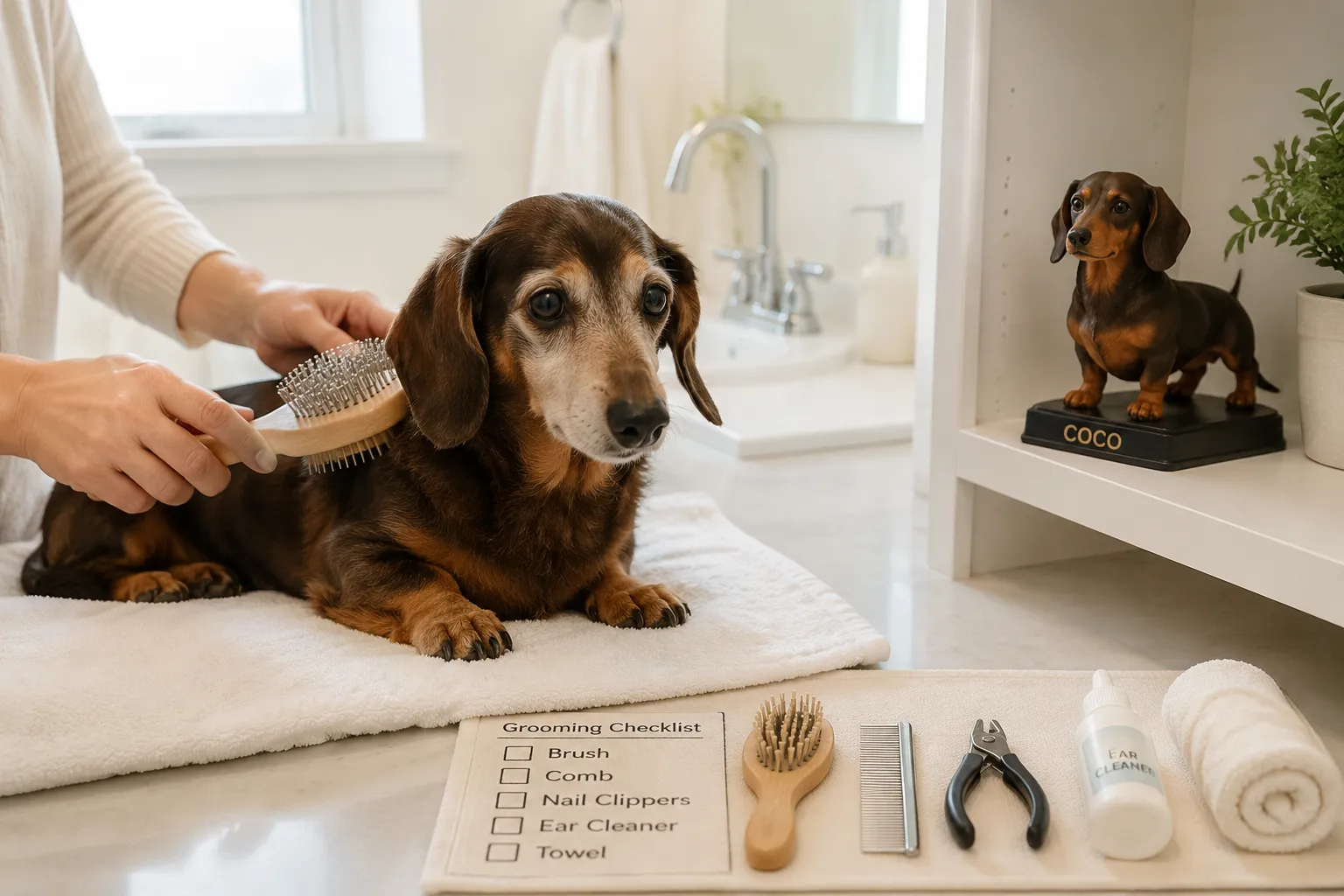
Your senior dachshund is stretched across the living room rug, one paw twitching mid-dream, and you spot it again—the small mat tucked behind her ear, the dull sheen along her spine. Senior dachshund grooming has lived on your to-do list for a week now. You have ten minutes before the next thing. Good. Ten minutes is enough.
Quick Takeaways
- Groom in a low, supported position — never dangle a senior doxie's long spine mid-air during brushing.
- Treat the 10-minute groom as a body scan — your hands find lumps, sore spots, and skin changes before your eyes do.
- Senior coats change texture — drier, thinner, more tangle-prone, so adjust tools and pressure accordingly.
- Capture their markings while you can — many families preserve their dog's coat and personality with custom pet figurines made from a single good photo.
- Consistency beats duration — three short weekly sessions outperform one stressful monthly marathon.
The Real Reason Senior Dachshund Grooming Feels Harder Than It Used To
Here's the thing nobody tells you. Grooming an older dachshund isn't harder because the dog got difficult. It's harder because you started noticing more.
The cloudy patch near the elbow. The way she flinches when your hand passes over her lower back. The little skin tag that wasn't there last spring. Grooming a senior dog turns you into an accidental diagnostician, and that's exactly why those ten minutes matter more now than they did when she was two and bouncing off the couch.
Most quick-grooming guides treat the senior dachshund like a smaller, slower version of a young dog. That's the mistake. A senior dachshund is a different animal with a different body, and the single most important factor isn't the brush you choose—it's the position you put her in.
"The ten-minute groom isn't about a cleaner coat. It's the most thorough health check most dogs ever get."
Let's get specific, because vague advice helps no one at 7 a.m. on a Tuesday.
Why the Spine Changes Everything
Dachshunds carry a famously long back, and that elongated spine is the whole reason this breed needs a grooming approach all its own. The breed is prone to Intervertebral Disc Disease (IVDD)—a condition where the cushioning discs between vertebrae bulge or rupture. According to the American Kennel Club's breed information, spinal issues are among the most common health concerns for the breed, and the risk climbs with age.
So the way you hold your senior dachshund during grooming isn't a comfort preference. It's spinal protection.
Picture the common mistake: owner lifts the dog under the front legs, back end dangling, spine stretched and unsupported, then balances her on a slippery counter. For a young dog, annoying. For a senior doxie with disc degeneration, that's a position that can genuinely hurt.
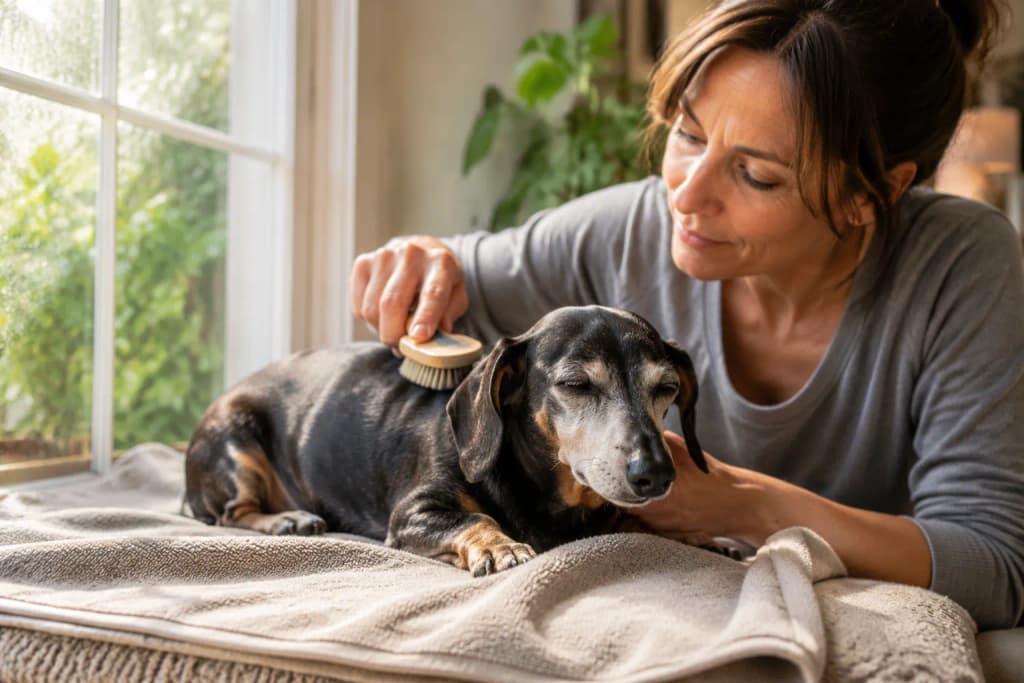
What actually works: groom on a flat, non-slip surface at or near floor level, with her body fully supported and her spine kept in a neutral, horizontal line. A yoga mat on the floor beats a bathroom counter every single time for this breed. Your back will complain. Her back will thank you.
The 10-Minute Senior Dachshund Grooming Checklist
This is the part you came for. A real, minute-by-minute structure you can run on autopilot. The goal isn't a show-ring finish. The goal is a clean, comfortable, monitored dog—and a relaxed one.
We've built this sequence around how senior dachshunds actually behave: short attention, sensitive joints, and a strong preference for predictable routine. Run the steps in the same order every time. Familiarity lowers their stress, and a calm dog makes ten minutes feel like five.
Here's the full breakdown at a glance, then we'll walk through the tricky parts.
| Minute | Task | What You're Really Doing |
|---|---|---|
| 0:00–1:00 | Settle and scan | Hands-on calm-down, first lump/tenderness check |
| 1:00–4:00 | Brush coat | Detangle, distribute oils, monitor skin and shedding |
| 4:00–5:30 | Face, ears, eyes | Wipe folds, check for discharge, odor, redness |
| 5:30–7:00 | Paws and nails | Check pads, trim or file tips, clear debris |
| 7:00–8:30 | Rear and sanitary area | Clean under tail, check for matting and irritation |
| 8:30–10:00 | Full-body finish + reward | Smoothing pass, final check, treat and praise |
Minute 0:00–1:00 — Settle and Scan
Before a single brush stroke, you put both hands on her.
Start at the head and run your palms slowly down her body—neck, shoulders, along the ribs, down each leg. This isn't petting (though she'll take it as such). You're feeling for anything new: a lump under the skin, a warm swollen joint, a patch that makes her tense or pull away.
So what? Senior dogs hide pain instinctively. Your hands often catch a problem weeks before it's visible. One of our customers told us she found an early mast cell tumor on her twelve-year-old doxie during a routine brush-out. The vet caught it early. That minute matters.
Keep your touch firm but slow. Sudden, light, fluttery touches can startle an older dog whose hearing or vision has faded.
Minute 1:00–4:00 — Brush the Coat (Adjust for Their Type)
Dachshunds come in three coat types, and your senior's coat almost certainly behaves differently than it did five years ago. Older coats tend to grow drier, thinner, and more prone to tangling, especially in long-haired and wire-haired dogs.
Here's the quick guide by coat type:
| Coat Type | Best Tool | Senior-Specific Tip |
|---|---|---|
| Smooth | Soft rubber curry brush or grooming glove | Gentle pressure—thinning skin bruises easier |
| Long-haired | Slicker brush + wide-tooth comb | Watch armpits, ears, and behind knees for mats |
| Wire-haired | Pin brush + comb (skip hand-stripping on seniors) | Aging skin makes stripping uncomfortable—just tidy |
Brush in the direction of hair growth, using shorter, lighter strokes than you would on a young dog. The pressure that felt good at age three can feel sharp on thinning senior skin.
Pay special attention to the friction zones: behind the ears, the armpits, the groin, and the backs of the legs. That's where mats form, and a mat on a senior dog isn't cosmetic—it pulls the skin, traps moisture, and can hide a sore underneath.
"Mats aren't a grooming failure. They're a message. Where the fur tangles, the skin is asking for attention."
If you hit a mat, do not yank. Work a little cornstarch or detangling spray into it and tease it apart with your fingers first, then the comb. If it's tight to the skin, leave it for a groomer with proper clippers. A nicked senior is a vet visit you didn't need.
Minute 4:00–5:30 — Face, Ears, and Eyes
Dachshund ears hang, and hanging ears trap warmth and moisture—a setup for infection that gets more common with age.
You're not deep-cleaning here. You're checking and wiping. Lift each ear flap, take a quick look and a quick sniff. A yeasty, sour smell or visible brown gunk means it's time to call the vet, not to dig in with a cotton swab. Never insert anything into the ear canal. Wipe only the visible flap with a soft, damp cloth or a vet-approved wipe.
For the eyes, gently clear any crust from the corners with a separate clean cloth. Cloudiness in the eye itself isn't yours to treat—note it and mention it at the next checkup. Many senior dachshunds develop a normal age-related haze called nuclear sclerosis, but cataracts look similar to the untrained eye, so let the vet make that call.
Wipe any facial folds dry. Moisture sitting in a skin fold breeds irritation fast.
Minute 5:30–7:00 — Paws and Nails
Flip into a paw check. Press gently between each toe and across the pad. You're feeling for cracks, foreign objects, overgrown fur, or that tell-tale flinch.
Senior dogs move less, which means nails wear down less, which means they overgrow faster than you'd expect. Long nails on a dachshund change how the foot strikes the ground, which throws off posture, which strains—you guessed it—that long back.
If you hear clicking on the hardwood, the nails are too long. Take just the tips. A few seconds per nail with a clipper or a rotary file is plenty. If your senior has dark nails and you can't see the quick, file rather than cut, and stop the moment you see a chalky gray center.
Pro tip from years of watching nervous owners: trim one or two nails per session instead of all at once. Spread across your weekly grooms, every nail gets done without a single stressful standoff.
Minute 7:00–8:30 — The Rear and Sanitary Area
Not glamorous. Genuinely important. Older dogs, especially those with reduced mobility or longer coats, can struggle to keep their rear clean on their own.
Check under the tail for matting, stuck debris, or redness. A quick wipe with a warm damp cloth handles most of it. If you notice scooting, persistent licking, or a strong odor, that points toward the anal glands, and that's a conversation for your vet or groomer.
Keep the fur around this area trimmed short with blunt-nosed scissors—it prevents most of the mess before it starts.
Minute 8:30–10:00 — Finish and Reward
One last smoothing pass with a soft brush or glove to settle the coat and distribute natural oils—this is what gives a healthy coat that low, warm sheen. Run your hands over her one more time. Confirm nothing got missed.
Then the most important step: the reward. A treat, a soft "good girl," a few seconds of the chin scratch she loves. You're building an association. Grooming equals good things. Skip this and every future session gets a little harder.
What Most Busy Owners Get Wrong About Senior Dog Care
The biggest myth in quick dog grooming checklists is that frequency equals love. People feel guilty, then over-correct with a marathon spa day that exhausts an arthritic dog and teaches her to dread the brush.
The counterintuitive truth: short and frequent beats long and rare, especially for geriatric dog care. Three relaxed ten-minute sessions a week keep mats from forming in the first place, build a tolerance to handling, and give you three weekly health scans instead of one.
Think of it like this. A monthly two-hour groom is a stressful event. A ten-minute Tuesday-Thursday-Sunday rhythm is just life. Dogs thrive on the second one.
"A dog who trusts the routine sits still. A dog who dreads the event squirms. Calm is something you build, not something you're given."
— The PawSculpt Team
Here's another one owners miss. Bathing too often strips the coat. Senior skin already produces less oil, so a weekly bath leaves them dry, itchy, and flaky. Unless your vet says otherwise for a skin condition, most senior dachshunds need a full bath only every four to eight weeks. Spot-clean with a damp cloth in between. Your ten-minute routine handles the rest.
A Quick Word on Anxiety and Cognitive Decline
Some senior dachshunds develop canine cognitive dysfunction—essentially doggy dementia—which can make handling confusing or frightening for them. If your dog has started seeming disoriented, pacing, or reacting oddly to familiar routines, the grooming approach shifts.
Go slower. Narrate softly so your voice anchors her. Keep the environment identical each time: same mat, same spot in the living room, same order of steps. Predictability is medicine for an anxious senior brain. And loop in your vet, because some of this is manageable.
We're not vets, and nothing here replaces one. For any lump, limp, smell, or behavior change you find during these grooms, the checklist's real job is simply to get you to the professional sooner.
What We Wish We Knew Sooner
We work with thousands of pet families a year, and the same regrets surface again and again—especially from people whose senior dogs have since passed. We'll be honest about them, because they might save you a small heartbreak.
- The coat changes faster than you think. The soft puppy-like texture of a young dachshund gives way to something coarser or thinner in their senior years. Owners are often surprised when they look back at photos. Whatever your dog's coat feels like right now—run your hand through it today. That exact texture won't last forever.
- Photos of the living dog are gold. So many families come to us after a loss with only blurry or distant pictures. The bright-eyed, healthy, mid-tail-wag shots taken during ordinary moments—like right after a groom when the coat is glossy—are the ones worth having.
- The grooming ritual becomes the memory. People assume they'll remember the big trips and birthdays. What they actually ache for later is the small stuff. The weight of her settling against your leg. The specific sound of her sigh when she finally relaxed under the brush.
That last point is why a surprising number of pet parents tell us they decided to commemorate their dog while she was still healthy and around. Some keep a "good coat day" photo on the fridge. Others create lasting 3D pet sculptures that capture the exact markings and posture that make their dog unmistakably theirs.
Capturing Who They Are, Not Just How They Look
There's a moment, post-groom, when a senior dachshund looks especially herself—coat smoothed, eyes soft, that signature long silhouette stretched out in a sunbeam. That's the version of her you want to hold onto.
PawSculpt grew out of exactly this instinct. Our team digitally sculpts each pet by hand using advanced modeling tools, then brings the figure to life through full-color 3D printing. The color isn't applied on top—it's printed directly into the resin itself, voxel by voxel, so your dog's specific brindle, dapple, or red-and-tan markings come through in full color. The only manual finishing step is a protective clear coat that gives the piece its gentle sheen and guards against fading.
What surprises people is the texture. A full-color resin print carries a fine natural grain—you can feel the subtle layering when you hold it, a little weight in the palm, smooth under the clear coat but never that hollow, mass-produced plastic feel. It reads as real because it isn't pretending to be flawless.
We won't pretend a figurine replaces a living dog. Nothing does. But for families who want something tangible that captures a personality—the proud chest, the slightly crooked sit, the ears at exactly the right tilt—it gives the memory a shape you can hold. If you're curious how it works or what photos suit it best, the details live at pawsculpt.com.
"You don't preserve a pet by freezing time. You preserve them by keeping the details that made you smile."
Building the Routine Into a Busy Life
Knowing the checklist and doing it are different problems. Let's solve the second one, because intention without a system fails every time.
Anchor it to something you already do. Don't schedule grooming as its own event—it'll get bumped. Attach it to an existing habit. Ten minutes during the evening news. Right after her dinner, before yours. The post-walk wind-down. Stacking the new habit onto an old one is how it actually sticks.
Keep the kit in one grab-and-go spot. Half the friction is hunting for the brush. Stash a small basket in the living room: brush, comb, wipes, nail file, treats. When the tools live where the grooming happens, the ten minutes start themselves.
Here's a realistic weekly rhythm that keeps a senior dachshund comfortable without overwhelming either of you:
| Day | Focus | Time |
|---|---|---|
| Sunday | Full 10-minute checklist | 10 min |
| Tuesday | Brush + paw/nail check | 6 min |
| Thursday | Brush + ear and eye wipe | 6 min |
| As needed | Sanitary trim, spot clean | 3 min |
| Every 4–8 weeks | Full bath | 20 min |
Adjust freely. A long-haired senior in shedding season needs more brushing; a smooth-coated dog needs less. The structure matters more than the exact minutes.
Watch for the days to skip. If your dog is having a painful flare-up, a bad mobility day, or seems unusually withdrawn, do the gentle hands-on scan and skip the rest. Grooming should never be forced onto a hurting dog. For more on recognizing pain and comfort needs in older dogs, PetMD's senior dog care resources are a solid, vet-reviewed starting point.
The point of all this isn't a perfectly groomed dog. It's a comfortable one, monitored closely, who associates your hands with safety. Everything else is a bonus.
Frequently Asked Questions
How often should I groom my senior dachshund?
Short and frequent wins. Three brief ten-minute sessions a week beat one long monthly groom for a senior dog. Frequent handling keeps mats from forming, builds your dog's tolerance, and gives you regular chances to scan for lumps, sore spots, or skin changes early.
Is it safe to groom a dachshund with back problems?
It is, as long as you protect the spine. Always groom on a flat, non-slip surface at or near floor level, keeping the back horizontal and fully supported. Never lift a dachshund under the front legs with the rear dangling, since that stretches an already-vulnerable spine. When in doubt with a dog who has diagnosed IVDD, ask your vet about safe handling positions.
Why is my senior dachshund's coat getting thinner and drier?
Aging is the usual culprit—older skin makes less oil and hair naturally thins. Adjust by brushing more gently, bathing less often, and using a soft brush that distributes natural oils. That said, sudden coat changes can signal thyroid issues or other conditions, so it's worth mentioning to your vet at the next visit.
How do I know if a lump I found is serious?
You don't, and that's fine—your job during grooming is just to find it and report it. Note the size, location, and feel, then have your vet evaluate anything new, growing, or that bothers your dog. Catching lumps early during routine grooming is one of the quiet superpowers of a consistent checklist.
Can I groom my senior dachshund myself or should I use a professional?
Most of the ten-minute routine is easily done at home, and the regular contact is good for your dog. Leave the trickier jobs—tight mats close to the skin, full clip-downs, anal gland expression—to a professional groomer or your vet, especially for a fragile or anxious senior.
Ready to Celebrate Your Pet?
Every pet has a story worth preserving. Whether you're honoring a beloved companion who's crossed the rainbow bridge or celebrating your furry friend's unique personality, a custom PawSculpt figurine captures those details that make your pet one-of-a-kind. The same care you put into senior dachshund grooming—noticing every marking, every quirk of posture—is exactly what we capture in full-color 3D printed resin.
Visit pawsculpt.com to learn more about our process, preview turnaround, flexible revisions, and quality guarantee.