
Stop Assuming Your Senior Cat Can't Learn: What Vets Wish Multi-Cat Households Knew About Older Russian Blues
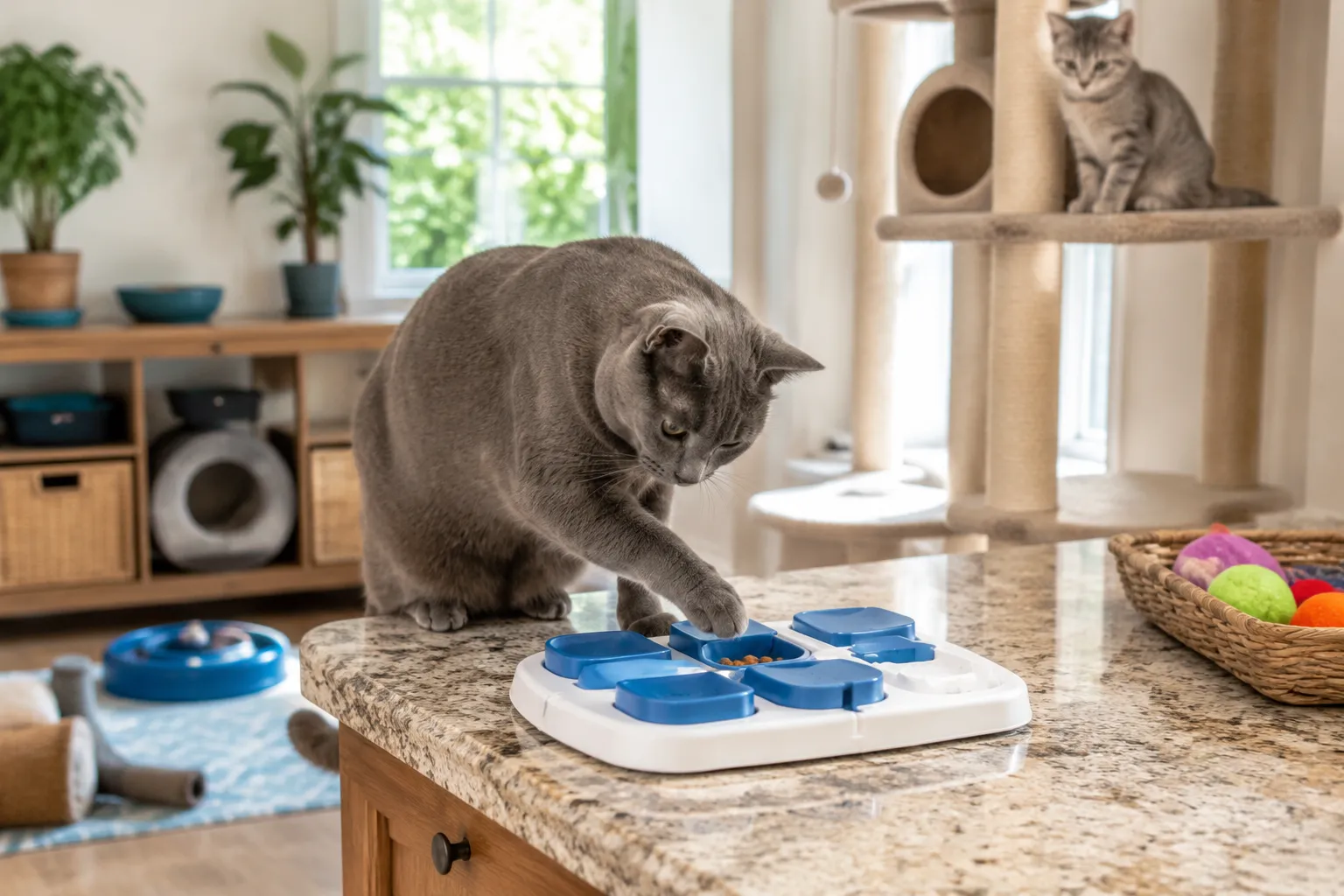
You're halfway down the hallway, dragging a feather wand behind you, when your fourteen-year-old Russian Blue does the thing every book swore she couldn't. She watches the pattern, waits, and anticipates. That's senior cat behavior training happening in real time, on a Tuesday, in a hallway that smells faintly of the radiator warming up.
Quick Takeaways
- Senior cats keep learning their whole lives — the aging brain rewires slower, not never, with the right cues.
- Russian Blues respond to ritual, not repetition — predictable timing matters more than treat volume for this breed.
- Multi-cat tension is usually spatial, not personal — vertical territory solves what scolding never will.
- Capture the personality before it fades — many families preserve their senior cat's presence through custom pet figurines built from a single great photo.
- Five minutes beats fifty — short, sacred training sessions outperform long ones for older cats every time.
The Lie We Tell Ourselves About Old Cats
Here's the assumption baked into almost every conversation about senior cats: that learning is a young animal's game. That a cat past ten is a finished product. A creature of locked-in habits you simply manage until the end.
It's a comforting lie. It lets us off the hook.
Because if the old cat can't learn, then we don't have to try. We don't have to sit on the cold floor at 9pm with a clicker and a patience we're not sure we have. We get to call it kindness — "she's too old for that" — when really it's surrender dressed up as mercy.
We've worked with thousands of pet families over the years, many of them in the bittersweet final chapters with senior animals. And the single most common regret we hear isn't about money or vet bills. It's this: I wish I'd kept engaging with her. I treated her like she was already gone.
"We mistake a slower brain for a closed one. The old cat is still asking to be met."
The science is quietly on the cat's side. Feline cognition research suggests that while older cats process new information more slowly and tire faster, neuroplasticity doesn't switch off with age. The pathways are still there. They just need a gentler on-ramp. According to PetMD's overview of senior cat care, mental stimulation in older cats is linked to slower cognitive decline — the feline equivalent of doing crosswords at ninety.
So the real question was never can she learn. It's whether we'll show up to teach her.
Why this matters more for the bond than the behavior
Think about what training actually is, stripped of the jargon. It's a conversation. A back-and-forth where two different species agree on a shared language — a sound means a reward, a gesture means come here, a ritual means we're about to do this together.
When you stop training a senior cat, you don't just lose a few tricks. You go quiet. The conversation thins out. And cats, especially the sensitive breeds, feel that withdrawal as a kind of absence even while you're still in the room.
This is the part the care guides miss. Training a senior cat isn't about the behavior. It's about keeping the line open. About refusing to let the relationship calcify into mere caretaking — feed, clean, repeat — in the years when the connection matters most.
Why Russian Blues Break the Senior Cat Rulebook
Most senior cat advice is written for the average cat. The Russian Blue is not an average cat.
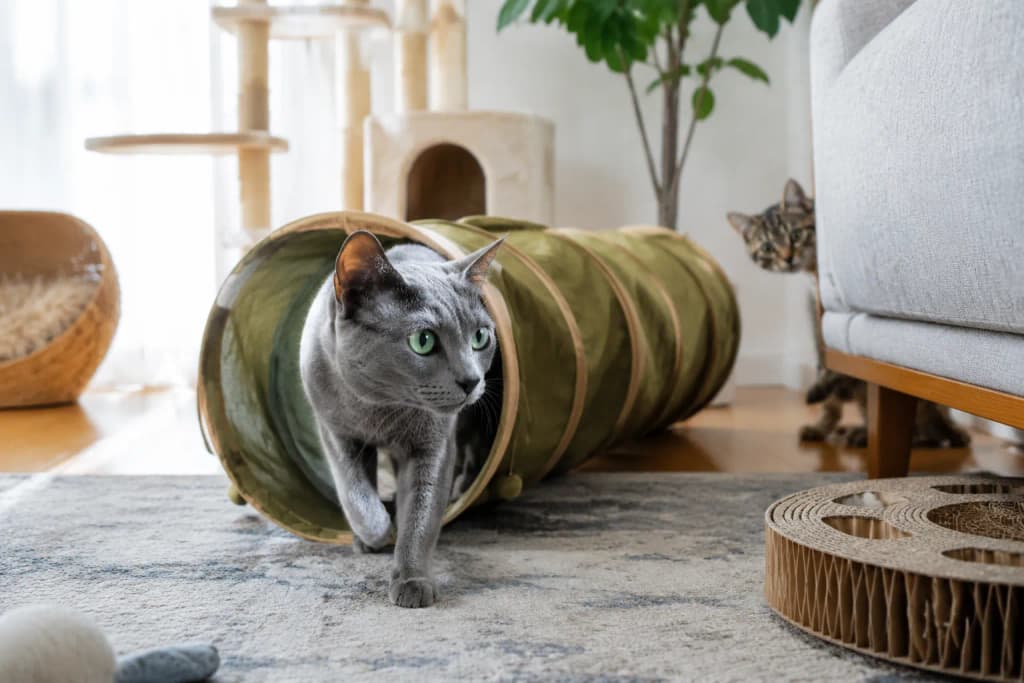
If you live with one, you already know this in your hands. There's the famous double coat — that dense, plush, almost synthetic-feeling fur that springs back when you press it, the texture somewhere between rabbit and velvet. There's the way they pick one or two humans and quietly devote themselves, watching from the top of the bookshelf like a small gray accountant auditing your day.
And there's the intelligence. This is a breed that gets bored. A Russian Blue who isn't being engaged doesn't just nap more — she develops opinions. She starts editorializing about the closed door, the late dinner, the cat who took her sunbeam.
"A bored Russian Blue isn't lazy. She's a sharp mind with nowhere to go."
Here's the counterintuitive part. Most people assume the senior Russian Blue is harder to train than she was at three. The opposite is often true. The frantic, distractible energy of youth has burned off. What's left is a focused, deliberate animal who — if you respect her rhythm — can actually concentrate better than her younger self ever could.
The catch is the rhythm. Russian Blues are creatures of ritual to an almost spiritual degree. They don't want novelty. They want the same good thing, at the same time, in the same sacred spot. Violate the pattern and they shut the conversation down. Honor it, and they'll meet you there every single evening like clockwork.
Reading the Russian Blue specifically
A few breed-specific tells that change how you should train an older one:
- They're noise-sensitive. A loud clicker can backfire. Many respond better to a soft tongue-click or a quiet verbal marker.
- They hoard trust slowly. A senior Blue who's been ignored for a year won't re-engage in a day. Budget three to four weeks of consistent, low-pressure invitation.
- They read your body, not just your hands. Tension in your shoulders, a rushed energy — they clock it and withdraw. Calm is a prerequisite, not a bonus.
- They prefer earning to begging. Free-feeding a Russian Blue dulls one of your best motivational tools. A senior Blue often works harder for a meal she helped "earn."
Personal Aside: We'll be honest — Russian Blues are quietly our team's favorite breed to recreate in resin. That coat does something unusual under full-color 3D printing. The dense gray reads almost silver when the clear coat catches the light, and the natural print grain gives it a texture that flat photos never capture. There's a reason Blue owners tend to be the ones who tear up when the preview lands.
What Vets Wish Multi-Cat Households Knew
We're not vets, and for anything medical you should absolutely loop in your own. But over years of talking with veterinary behaviorists and the families they refer to us, certain themes come up so often they've become a kind of quiet consensus. Here's what vets wish multi-cat households understood — the stuff that rarely makes the cheerful pamphlets.
The tension is almost never about dominance
A scenario we hear constantly: two cats who "used to be fine" start hissing, blocking the litter box, ambushing each other in the hallway. The owner assumes a power struggle. They try to referee. They scold the "aggressor."
And it gets worse.
Because here's what's actually happening most of the time. The conflict isn't about who's boss. It's about resources and space — specifically, the senior cat's shrinking comfort zone. As cats age, arthritis makes jumping painful. A senior Russian Blue who once owned the high shelf may now be marooned at floor level, suddenly forced to share the vulnerable ground with a younger cat. That's not a dominance dispute. That's a frightened elder who lost her escape routes.
"Most cat conflict isn't a fight for the throne. It's a scramble for somewhere safe to stand."
The mistake most people make is treating it as a behavior problem to be corrected in the cats. What actually helps is treating it as an architecture problem to be solved in the home. Give the senior cat low, easy, exclusive perches — a wide windowsill, a sturdy ottoman, a cat shelf mounted at a reachable height with a ramp. Restore her vertical options at a body she can actually use, and the "aggression" often evaporates within two to three weeks.
Senior cats need separated everything
The old rule is "one litter box per cat, plus one." For a multi-cat home with a senior, go further. Vets routinely push for spatial separation of resources — not just enough boxes, but boxes in genuinely different zones so an anxious elder never has to run a gauntlet past a younger cat to relieve herself.
The "so what" here is medical, not just behavioral. A senior cat who avoids a contested litter box doesn't just have an accident. She holds it, which invites UTIs and kidney stress in the exact life stage already prone to kidney trouble. The behavior issue and the health issue are the same issue.
Here's a quick reference for resource spacing in a senior multi-cat home:
| Resource | Common Mistake | What Vets Recommend |
|---|---|---|
| Litter boxes | Lined up in one room | Spread across separate zones, one low-entry box for the senior |
| Food bowls | Shared feeding station | Individual stations, senior fed somewhere quiet and reachable |
| Water | Single bowl near food | Multiple sources, away from food and litter |
| Resting spots | First-come-first-served | Dedicated low perch reserved for the senior cat |
| Escape routes | One path in/out of rooms | Always two exits so no cat gets cornered |
Slow introductions don't end at "introduction"
Most guides treat cat introductions as a one-time event. You bring the new cat home, do the scent-swapping, the gradual reveals, and after a few weeks you declare victory.
But in households with a senior cat, the relationship needs ongoing maintenance — especially as the older cat's health shifts. A senior who develops vision loss, hearing decline, or pain may suddenly stop reading the younger cat's social signals correctly. Misread signals breed conflict. So the "introduction" you finished two years ago may quietly need redoing.
Watch for sudden changes. A previously peaceful pair that erupts overnight is often telling you something is medically wrong with one of them. The behavior change is the smoke. Get to the vet to find the fire.
How Senior Cats Actually Learn (The Real Mechanics)
Let's get specific, because vague advice helps no one. "Be patient" is not a method.
Here's how to run an effective senior cat training session, built around the way an older feline brain genuinely works.
Keep it short and sacred
Young cats can grind through ten-minute sessions. A senior cat's attention and energy fade faster — often within three to five minutes. Past that, you're not teaching, you're irritating.
So shrink the session and raise its status. Same time each day. Same quiet corner. A small ritual of arrival — sitting down on the floor, the specific sound of the treat pouch, the way you say her name. Russian Blues especially anchor to these cues. The ritual itself becomes part of the learning, a signal that says the conversation is open now.
Five focused minutes, done daily, beats a sprawling weekend session every time. Consistency is the active ingredient. Duration is almost irrelevant.
Use food strategically, not abundantly
The single biggest lever you have is timing the session before a meal, not after. A senior cat who just ate has no reason to work. A senior cat who's pleasantly hungry is a student.
This is where free-feeding hurts you. If kibble is always available, you've removed your best currency. Many vets recommend scheduled meals for senior cats anyway — it helps you monitor appetite, an early warning system for illness. Training and meal scheduling reinforce each other.
For high-value rewards with older cats, lean toward soft, smelly options. Aging cats lose smell sensitivity and may have dental issues. A crunchy treat she can't smell or comfortably chew isn't a reward. A tiny smear of churu-style paste, lickable and pungent, almost always lands.
Mark the moment precisely
The gap between the good behavior and the reward is where learning lives or dies. Too slow, and the cat can't connect the dots — especially a senior whose processing has slowed.
Use a consistent marker the instant she does the right thing. A clicker works, but for noise-sensitive Russian Blues, a soft, repeatable word ("yes") or a quiet tongue-click is often gentler. Mark, then reward within two seconds. The marker becomes a bridge that buys you time and clarity.
Here's a realistic timeline for what to expect teaching a senior cat a simple new behavior, like targeting a stick or coming to a sound:
| Phase | Typical Timeframe | What's Happening |
|---|---|---|
| Curiosity | Days 1–4 | She investigates the ritual, no real learning yet |
| First connection | Week 1–2 | She links the marker to the reward |
| Repeatable response | Week 2–4 | She performs on cue, slowly, when motivated |
| Reliable habit | Week 4–8 | The behavior becomes part of her routine |
Notice this is slower than a kitten's curve — and that's fine. You're not behind. You're on the senior timeline. Comparing her to a young cat is the fastest way to quit too early.
Train with the multi-cat dynamic, not against it
In a multi-cat home, training the senior cat separately is non-negotiable. A younger cat will hijack the session, steal the treats, and intimidate the elder into checking out. The senior needs a closed door and undivided attention — a literal sacred space where, for five minutes, she is the only cat in the world.
There's an unexpected bonus here. That solo time isn't just training. For a senior cat in a crowded house, it may be the only stretch of the day she has her person entirely to herself. The behavior is almost secondary. The undivided presence is the gift.
"Every whisker holds a story, and the old ones hold the most. Our job is to keep those stories where you can still reach them."
— The PawSculpt Team
The Part Nobody Wants to Say Out Loud
We need to talk about why this matters with more honesty than most articles will offer.
You're training a senior cat. Which means, somewhere underneath the clicker and the treats, you know what "senior" is shorthand for. You're investing in a relationship with a deadline you can feel but can't see.
That's a strange, heavy thing to carry. And it's exactly why so many people quietly stop engaging — not from laziness, but from a kind of protective flinch. If I don't get closer, it'll hurt less when she goes. So they manage instead of connect. They feed and clean and let the conversation go quiet, and they call it acceptance.
We'd gently push back on that.
The Japanese have a concept worth borrowing here, ichigo ichie — roughly, "one time, one meeting." The idea that each encounter is unrepeatable and therefore sacred precisely because it won't come again. That's not a reason to pull back from your old cat. It's the strongest possible reason to lean in.
"The deadline isn't a reason to hold back. It's the whole reason to show up."
Every five-minute session in that hallway is one of a finite number you'll get. That's not morbid. That's clarifying. It turns a chore into a small daily ceremony, a way of saying I'm still here, and so are you, and that's enough.
Where the keepsake fits — honestly
This is usually the point where a company like ours would hard-sell you. We won't.
But we will say this, because it's true and because families tell us constantly that they wish they'd known sooner. The version of your cat you have right now — the specific gray of that coat, the particular set of her ears, the exact texture of that double-thick fur — is changing. Senior cats thin out. Postures shift. The face you're looking at today is not permanent.
A lot of families wait until after a cat is gone to think about preserving her, working from blurry old photos and fading memory. The ones who do it while their cat is still here, still themselves, almost always tell us they're glad. Our team builds 3D printed pet sculptures that are digitally modeled by master artists from your photos, then printed in full color resin — the markings and that signature Russian Blue silver captured directly in the material, sealed under a protective clear coat.
It's not for everyone, and it's not the point of this article. We mention it only because "I waited too long" is a regret we hear far more than we'd like. Whatever form it takes — a figurine, a photo book, a painting — capturing your senior cat as she is now is one of the few things you genuinely can't do later.
Building the Daily Ritual: A Practical Framework
Let's pull it together into something you can actually run, starting tonight.
- Pick the time. Right before her evening meal, when she's alert and a little hungry. Same time every day.
- Pick the place. A quiet room you can close off from other cats. Floor level. Comfortable for old joints.
- Open the ritual. Sit down. Make your consistent sound — the treat pouch, her name, a soft greeting. Let her arrive in her own time.
- Work one tiny thing. Targeting a stick, coming to a sound, stepping onto a low platform. One behavior. Five minutes max.
- Mark and reward fast. Soft marker word, then a lickable treat within two seconds.
- Close the ritual. End on a small win, before she's tired. A few gentle strokes through that plush coat. Done.
The "so what" of doing it as a ritual rather than random practice: predictability lowers a senior cat's baseline anxiety. The nervous system of an older animal craves pattern. You're not just teaching a behavior — you're handing her a reliable, safe fixture in her day. That structure itself is therapeutic.
What success actually looks like
Lower your bar, and you'll both win more often. Success with a senior cat is not a circus act. It's:
- She comes to the spot when she hears the cue.
- She holds attention for the full five minutes.
- She tries the behavior even when she's slow.
- She seeks you out for the session rather than waiting to be fetched.
That last one is the real prize. When your old cat starts initiating the ritual — appearing in the doorway at 8:55 because she knows what 9:00 means — you've done it. You've kept the conversation open. That's the whole thing.
When to Pull Back (Because Sometimes You Should)
Honesty requires the other side of this. Training a senior cat is not always the right call, and pushing through the wrong moment does harm.
Stop the session, and check with your vet, if you see:
- Sudden disinterest in food or play that lasts more than a day or two.
- Signs of pain — reluctance to move, flinching when touched, hiding.
- Disorientation — staring at walls, getting "stuck" in corners, nighttime yowling, which can signal feline cognitive dysfunction.
- Labored breathing or lethargy of any kind.
A cat who suddenly "won't learn" anymore may not be stubborn. She may be sick, or in pain, or slipping into cognitive decline — all of which need a vet, not a clicker. The American Veterinary Medical Association emphasizes that behavioral changes in senior pets are frequently the first visible sign of underlying medical issues. Trust that. When a reliable old cat goes off her routine, the routine isn't the problem.
The skill isn't just knowing how to engage. It's knowing when engagement has become pressure, and having the grace to set the clicker down and just sit with her instead.
Frequently Asked Questions
Can senior cats really learn new behaviors?
Yes, genuinely. The aging feline brain processes new information more slowly and fatigues faster, but neuroplasticity doesn't shut off with age. The trick is matching the method to the cat: short three-to-five-minute sessions, consistent cues, and rewards she can actually smell and chew. Mental stimulation is also linked to slower cognitive decline, so it's good for her in more ways than one.
How do I train an older Russian Blue specifically?
Lean into ritual. This breed anchors hard to predictable timing and quiet, low-stress cues, so train at the same time and place each day and skip the loud clicker in favor of a soft marker word. Budget three to four weeks of patient, low-pressure invitation if she's been disengaged, and time sessions just before a meal when she's motivated.
Why are my cats suddenly fighting after years of peace?
Sudden conflict is rarely about dominance. It's usually a resource or space problem — often a senior cat who can no longer reach her safe high perches due to arthritis and feels cornered at floor level. Restore low, exclusive perches and separate the food, water, and litter zones. Just as important, see your vet, because an abrupt behavior change frequently signals an underlying medical issue.
How long should a senior cat training session last?
Three to five minutes, every day, beats one long weekly session by a wide margin. Older cats lose focus and energy quickly, and pushing past that point teaches frustration instead of behavior. End on a small win before she's tired, and treat the session as a daily ritual rather than a marathon.
Should I keep training a cat that seems to be declining?
Engage gently, but read her closely. If you see sudden loss of appetite, signs of pain, disorientation, or lethargy, set the training aside and call your vet — those can be early signs of illness or cognitive dysfunction, not stubbornness. Sometimes the right move isn't a clicker at all, but simply sitting quietly with her.
Ready to Celebrate Your Pet?
Every pet has a story worth preserving. The years you spend on senior cat behavior training with an older Russian Blue build a bond that deserves to be held onto — and a custom PawSculpt figurine captures the details that make your companion unmistakably herself, from that signature silver-gray coat to the exact tilt of her ears.
Visit pawsculpt.com to learn more about our process, preview turnaround, revisions, and quality guarantee.