
Stop Punishing Your Young Boxer for 'Misbehaving' — 5 Myths First-Time Owners Still Believe
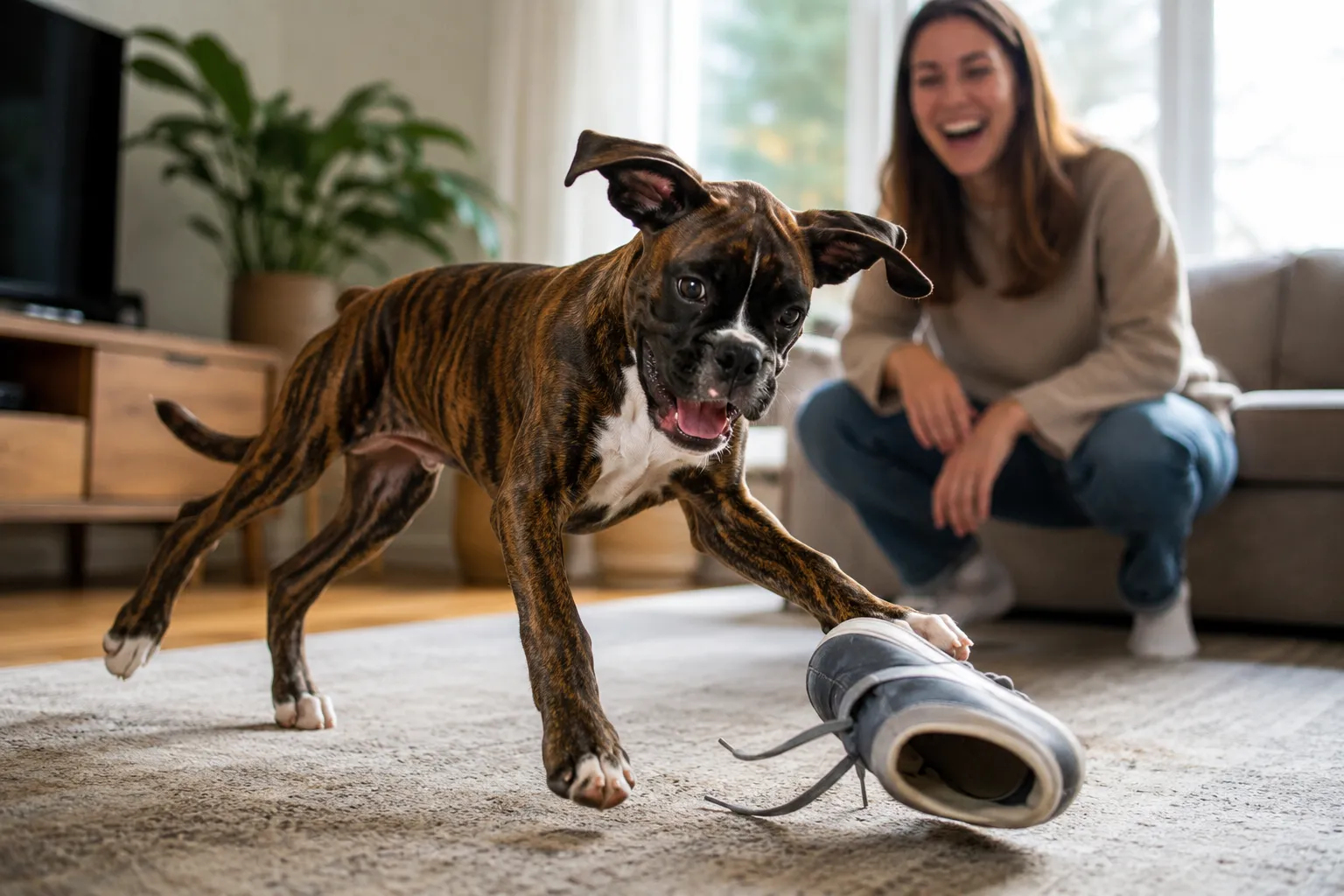
Six months ago, your kitchen tile was a war zone of shredded paper towels and a chewed table leg, the teeth marks still rough under your thumb when you ran your hand along the edge. Today that same dog rests his chin on your foot. The shift didn't come from punishment. It came from unlearning the Boxer puppy behavior myths that first-time owners keep getting fed.
Quick Takeaways
- A "stubborn" young Boxer is usually a still-developing one — their brains aren't fully wired until age two to three.
- Punishment suppresses behavior, it doesn't teach it — and with Boxers it quietly erodes the trust you need most.
- More exercise often makes the wildness worse, not better — decompression and mental work do the heavy lifting.
- Jumping and mouthing are conversation, not defiance — your Boxer is talking, you just haven't learned the language yet.
- Capturing this goofy, chaotic phase matters — many families preserve it with a custom pet figurine before the puppy face is gone for good.
Why First-Time Boxer Owners Get the Worst Advice
Here's something the training world doesn't say out loud: most generic puppy advice was never written with Boxers in mind. It was written for the "average dog," and a Boxer is not an average dog. They're a working breed wearing a clown suit. They mature on a slower clock, they feel everything loudly, and they bond hard.
We work with thousands of pet families a year, and a pattern shows up again and again. Someone brings home a Boxer, follows the advice they found in the first five search results, and three months later they're frustrated, the dog is anxious, and both of them feel like failures. Not because the owner did anything cruel. Because the advice was built for a different animal.
Take one couple we got to know through their order. They'd adopted a brindle Boxer named Rosie at ten weeks. By month four they were convinced she was "dominant" and "spiteful" — words a trainer friend had used. Rosie counter-surfed, mouthed their wrists, and blew off the recall they'd drilled a hundred times. They were exhausted. They were also, it turned out, completely wrong about what was happening. We'll come back to Rosie.
The thing is, young Boxer misbehaving isn't a character flaw — it's a developmental stage colliding with bad information. Once you can spot the myths, the whole picture changes. Let's pull them apart one at a time.
"A young Boxer isn't giving you a hard time. He's having a hard time. Learn the difference and everything gets easier."
Myth #1: "My Boxer Is Stubborn and Knows Better"
This is the big one. The one that does the most damage.
You ask for a sit. Your Boxer stares at you, tail going, and does nothing. Yesterday she nailed it ten times in a row. So obviously she's being stubborn, right? She knows the command. She's choosing to ignore you.
Almost never true.
What's actually happening in that head
Boxers are slow maturers. While a Border Collie might have the emotional regulation of a teenager by ten months, a Boxer is still very much a toddler. Physically they're not considered fully mature until around two to three years old, and the brain regions that handle impulse control and focus lag behind the body. So you've got a 50-pound dog with the muscle of an athlete and the self-control of a kindergartner who skipped naptime.
When your Boxer "ignores" a known cue, one of a few things is usually going on. She's over-aroused and physically cannot access the thinking part of her brain. Or the environment changed (you practiced in the kitchen, now you're at the park with squirrels), and to a young dog "sit at the park" is a completely different command than "sit in the kitchen." Dogs don't generalize the way we assume. They learn in context, brick by brick.
So what?
If you label this stubbornness and escalate — repeat the command louder, push her rear down, get frustrated — you teach her that your cues are unpredictable and a little scary. You're not building obedience. You're building hesitation.
What actually works:
- Lower the difficulty before you lower the boom. If she fails twice, the exercise is too hard, not her attitude.
- Re-teach known cues in five new locations. A "sit" isn't reliable until it works in the yard, the driveway, the vet lobby, and the chaos of the kitchen at dinnertime.
- Watch her body, not just her ears. A Boxer who's panting hard, whining, or whipping around isn't defiant. She's flooded. Give her ninety seconds to settle before you ask for anything.
The American Kennel Club's Boxer breed profile describes them as bright but "energetic and playful into adulthood." Read between the lines: that prolonged puppy energy is the breed, not a behavior problem you forgot to fix.
Myth #2: "Punishment Will Stop the Bad Behavior"
Let's be real about this one, because it's where a lot of good-hearted owners go sideways.
Punishment can absolutely make a behavior stop in the moment. Yell, snap a leash, pin the dog — yes, the jumping stops. That's exactly why people believe in it. They see the immediate result and conclude it worked.
Here's what they don't see.
The hidden cost nobody mentions
Punishment suppresses the surface behavior without touching the cause underneath. Your Boxer jumped because he was thrilled to see you. Punish the jump and you might stop the jump — but the excitement, the need, the lack of a better option, all of that is still there. It just leaks out somewhere else. As barking. As pacing. As mouthing. As a flinch every time your hand moves too fast.
And Boxers are sensitive. This breed reads human emotion like a book. We've heard from more owners than we can count who describe the same heartbreak: they used heavy corrections for a few weeks, and their bouncy, confident puppy got "weird." Quieter. Slower to greet them. That's not a calmer dog. That's a dog who's learned that being near you is a gamble.
"Suppressing a behavior isn't the same as solving it. The need doesn't disappear — it just changes its address."
What to do instead
The research consensus here is genuinely settled, and we're not vets but the behavioral literature is one-directional: reward-based training produces better results and fewer side effects than aversive methods. PetMD's overview of positive reinforcement dog training lays out the why in plain language.
The practical version:
- Decide what you want him to do instead. "Stop jumping" is a vacuum. "Four feet on the floor gets attention" is a plan.
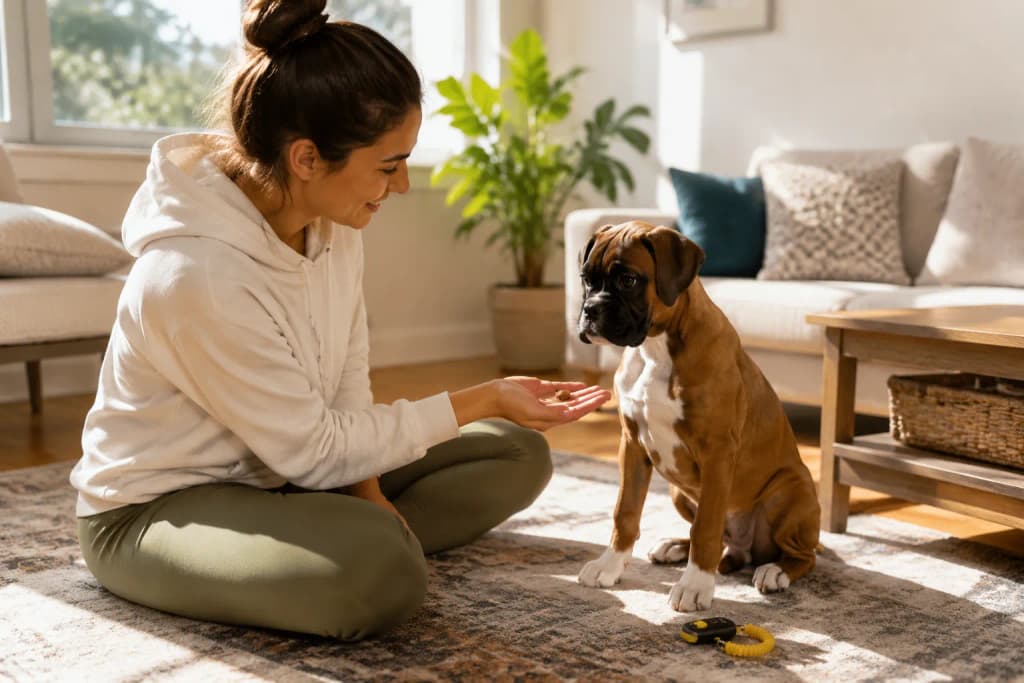
- Reward the alternative the instant it happens. Boxer sits instead of jumps? Mark it ("yes!") and pay it. Every single time, at first.
- Manage the environment so he can't rehearse the bad version. A leash on at the door, a baby gate, a stuffed toy ready. Every jump he doesn't get to practice is a jump you don't have to untrain.
- Ignore what you can, redirect what you can't. Boring is a consequence. For an attention-seeking Boxer, your turned back is more effective than any scolding.
The mistake most people make is waiting to react until the dog is already wrong. Flip it. Catch him being right, and pay generously. Boxers are food-motivated goofballs — use it.
Myth #3: "I Have to Be the Alpha"
Ah, the dominance myth. It refuses to die.
You've heard it. Don't let him walk through the door first. Eat before he does. Never let him "win" tug. Pin him if he gets mouthy, because that's what the pack leader would do. It sounds authoritative. It sounds like ancient dog wisdom.
It's based on a study of captive wolves from the 1940s that the original researcher himself later spent years trying to retract.
Why this matters for Boxers specifically
The whole "alpha" framework assumes your dog is running a constant campaign to overthrow you. He isn't. He's trying to figure out how to get the things he wants — food, play, your attention, the squirrel — in a confusing human world. That's it. There's no coup.
For a Boxer, the alpha approach is especially counterproductive because the breed thrives on partnership. They were bred to work with people, close and collaborative. Treat a Boxer like a subordinate you have to constantly dominate and you get one of two outcomes: a shut-down dog who's lost his spark, or a defensive dog who's learned that hands and confrontation mean trouble. Neither is the buddy you signed up for.
Rosie's family — remember them — had fallen into exactly this trap. The "dominant" label led them to start pinning her when she mouthed. The mouthing got worse, and she started growling, something she'd never done. They weren't bad owners. They were good owners following bad advice that framed a baby dog as an adversary.
The reframe that fixes it
Stop thinking leadership through force and start thinking leadership through resources. You already control everything that matters to your Boxer. The trick is to make good behavior the currency that buys it.
- Want to go outside? Sit at the door first.
- Want the food bowl down? Four on the floor.
- Want the ball thrown? Bring it back and drop it.
This is called "nothing in life is free," and it builds genuine respect — the kind rooted in clarity, not fear. Your Boxer learns you're the reliable source of all good things, and that you're predictable. Predictability is the foundation of trust, and trust is the foundation of every cue you'll ever teach.
When Rosie's people dropped the dominance stuff and switched to this, the growling stopped within two weeks. Not because they'd "won." Because she finally understood the rules.
Myth #4: "A Tired Boxer Is a Good Boxer — Just Exercise Her More"
This one's sneaky, because it's half true, and the half that's wrong creates monsters.
Yes, Boxers need exercise. A lot of it. An under-exercised Boxer is a renovation project waiting to happen. So owners hear "a tired dog is a good dog," and they ramp up the mileage. Longer runs. More fetch. Two hours at the dog park. And they're baffled when the dog comes home and then somehow has more energy, ricocheting off the furniture at 9 p.m.
The counterintuitive truth about exercise
Here's what almost no first-time owner is told: you cannot physically exhaust a young Boxer into calmness, and trying to will backfire.
Two reasons. First, intense repetitive exercise — especially fetch, which is basically a dopamine slot machine — floods the dog with adrenaline and cortisol. You're not draining the tank. You're revving the engine. Over time you build an athlete who needs that hit and gets more wound up, not less. Owners accidentally create a dog that requires three hours of hard exercise just to function. That's not sustainable, and it's not the goal.
Second, there's a physical risk. Boxer growth plates don't close until well past a year. Pounding pavement, forced jogging, and repetitive high-impact jumping on a young Boxer can damage developing joints. More isn't better. Appropriate is better.
What actually calms a Boxer down
The answer is mental work and decompression, not more cardio.
- Sniffing. A 20-minute "sniffari" where she sets the pace and investigates everything tires a dog more than a 45-minute march. Scent work lights up the brain and lowers arousal. This one surprises people every time.
- Chewing and licking. A frozen stuffed Kong, a snuffle mat, a lick mat with something tasty. These are self-soothing activities that actually downshift the nervous system.
- Training games. Ten minutes of learning a new trick is more tiring than a mile of walking. Thinking is exhausting — for dogs too.
- Genuine rest. Puppies and young dogs need 16 to 18 hours of sleep a day. A cranky, over-the-top Boxer is very often an overtired one, exactly like a toddler who skipped a nap and is now bouncing off the walls at full volume.
Here's a rough framework we share with families who ask about structuring a young Boxer's day.
| Activity Type | Frequency | Duration | Why It Matters |
|---|---|---|---|
| Sniff-led walk | Daily | 20–30 min | Lowers arousal, mentally tiring, joint-safe |
| Structured training games | 2–3x daily | 5–10 min each | Builds focus, burns mental energy |
| Free play / social | Daily | 15–30 min | Healthy outlet for excitement |
| Chew / lick decompression | Daily | 15–20 min | Self-soothing, downshifts nervous system |
| Protected nap time | Multiple | Aim 16–18 hrs total sleep | Prevents overtired meltdowns |
Notice what's not on there: hour-long forced runs. The goal is a satisfied dog, not a depleted one.
Myth #5: "He'll Grow Out of It"
The flip side of "he's being stubborn" is the wishful one: he's just a puppy, he'll grow out of it.
Some things, sure. The needle teeth go away. The worst of the puppy zoomies mellow. But behaviors that get rehearsed daily don't evaporate with age — they get stronger and more automatic. A nine-month-old who's been counter-surfing successfully for four months isn't going to wake up at two years old and decide the counter isn't worth checking. He's got a four-month winning streak. Why would he quit?
The window people waste
There's a developmental window in young dogs — the socialization and learning period running through roughly the first year and beyond — where habits form fast and stick hard. What your Boxer practices now is what he's installing for life. That cuts both ways. Bad habits cement. So do good ones.
This is the part that should light a fire under you, in a good way. The chaos of the young Boxer phase is also the most fertile training ground you'll ever have. The dog in front of you is learning who he's going to be. Three months of consistent, kind work right now saves you years of management later.
A micro-example: a family told us their Boxer "would never" stop bolting out the front door. We've heard it a hundred times. They spent ten days rewarding a sit-and-wait at the threshold, every single exit, no exceptions. By day eleven the dog was planting his butt at the door on his own. He didn't grow out of bolting. They trained in an alternative — during the window when his brain was wide open.
"What your young Boxer practices today is the dog you'll live with for the next decade. Choose what gets rehearsed."
Don't wait for adulthood to fix it
If something's bugging you now, address it now, gently and consistently. Waiting hands the problem more time to root. The good news is Boxers are smart and want to work with you — the raw material is excellent. You just have to give the clay a shape before it sets.
The Behind-the-Scenes Truth: This Phase Is Shorter Than It Feels
When you're in the thick of it — wrist bruises, chewed shoes, a dog that loses his mind at the doorbell — the young Boxer stage feels endless. It isn't. Most of the intense stuff softens noticeably somewhere between 18 months and three years. One morning you'll realize the doorbell didn't trigger a meltdown, and you won't even remember when that changed.
That's the part that catches people off guard. They spend so long surviving the wild puppy that they forget to witness it. And then it's gone. The square puppy head lengthens. The clumsy oversized paws turn into a sleek adult gait. The brindle deepens. You blink and the goofball who couldn't sit still is a dignified 70-pound shadow who sleeps at your feet.
This is honestly why so many of the families we work with reach out during the puppy stage, not after. They want to hold onto the specific dog they have right now — the slightly-too-big ears, the perpetual play-bow, the exact pattern of white on the chest. At PawSculpt we digitally sculpt each pet with master 3D artists and then bring it to life through full-color 3D printing, so the markings and proportions are captured in the resin itself rather than added on top. You can explore how that works through our custom pet figurines and see why people choose to freeze a moment of the puppy phase before it's over.
"We see it constantly — owners wish they'd captured the puppy stage instead of just surviving it. The goofy years go fast. Hold onto them."
— The PawSculpt Team
Rosie's family was one of those. Once the training clicked and the stress lifted, they wanted to remember her exactly as she was that first wild year — brindle, big-eared, mid-play-bow. They didn't want to forget the dog who taught them how wrong the myths were.
Here's a quick reference of the myths against what's actually true, so you can screenshot it for the next time someone offers you "advice" at the dog park.
| The Myth | The Reality | What To Do Instead |
|---|---|---|
| She's stubborn and knows better | Slow maturation, can't generalize yet | Lower difficulty, re-teach in new places |
| Punishment stops bad behavior | Suppresses surface, erodes trust | Reward the alternative, manage the setup |
| You must be the alpha | Dominance theory is debunked | Lead through resources, build predictability |
| More exercise equals calm | Over-arousal makes it worse | Sniffing, chewing, training, real rest |
| He'll grow out of it | Rehearsed habits stick and strengthen | Train alternatives during the open window |
How to Build a Realistic Daily Structure (The No-Nonsense Version)
Theory is nice. Here's the part you can actually run with starting tomorrow.
Morning. Potty break first thing, then a short sniff-led walk before breakfast burns off the early-morning buzz. Feed using a puzzle feeder or scatter the kibble in the yard — making him work for food adds ten minutes of mental tiring for free.
Midday. A training game or two, five minutes each. Practice one known cue and introduce one new thing. Then enforce a nap. If your young Boxer is getting wild and bratty at this hour, the answer is almost always sleep, not stimulation. Crate or quiet room, lights low.
Evening. This is your golden window for connection — 15 minutes of undivided floor-time play where you're fully present, no phone. Tug, find-it games, gentle wrestling with clear rules. Follow it with a frozen chew to bring the arousal back down before bed.
Throughout. Reward the behavior you want the moment you see it. Keep a jar of treats on the counter and in your pocket. The owners who succeed aren't the ones with the most willpower — they're the ones who made the right thing easy and convenient to reinforce.
A few hard truths most articles skip:
- Consistency between humans matters more than any single technique. If you allow couch-jumping and your partner doesn't, you've taught your Boxer to gamble. Get everyone on the same page first.
- Progress isn't linear. Adolescent dogs regress around 6–12 months. The dog who "knew" recall suddenly doesn't. This is normal brain remodeling, not failure. Keep going.
- You will have bad days. You'll lose your patience. It happens. One frustrated moment won't undo your relationship — a pattern of them will. Repair, reset, move on.
When It's Not a Myth: Knowing What's Actually a Problem
We'd be doing you a disservice if we pretended every behavior is just a misunderstood developmental stage. Some things warrant real help.
If your Boxer shows stiff, frozen body language and hard staring before a growl, if there's resource guarding that's escalating, if there's genuine fear that isn't improving, or if any behavior is getting worse despite consistent kind handling — that's a flag. We're not vets or certified behaviorists, so for anything involving aggression, sudden behavior changes, or possible pain, loop in a professional. A vet visit rules out medical causes (pain makes dogs grumpy, and Boxers are stoic about hurting). A certified behavior consultant can build you a real plan.
The ASPCA keeps a solid plain-English library on common dog behavior issues if you want to sanity-check what's normal versus what needs eyes on it. Most of what scares first-time Boxer owners turns out to be normal. But "most" isn't "all," and there's no prize for white-knuckling something that needs help.
Bringing It Back to Rosie
That couple who thought their brindle puppy was spiteful and dominant? Here's where they landed.
They stopped punishing. They led through resources instead of force. They traded an hour of frantic fetch for sniff walks and frozen chews. They drilled the boring fundamentals during the messy adolescent window instead of waiting for her to "grow out of it." None of it was a secret technique. It was just the opposite of the five myths.
Rosie is three now. Calm, confident, still ridiculous in the best way. The growling never came back. And on their wall sits a full-color 3D printed figurine of her at eight months — square-headed, big-eared, frozen mid-play-bow, the exact brindle striping she had that first chaotic year. They told us they almost didn't make it through that phase. Now it's the phase they're most glad they captured.
The teeth marks in your table leg, rough under your thumb? In two years they'll be the thing you smile about. The myths cost you the relationship. The truth gives it back. First-time Boxer owner training isn't about controlling a tiny rebel — it's about guiding a slow-growing partner who was never misbehaving on purpose in the first place. Get that one idea right and everything downstream gets easier.
Go put a treat jar on the counter. Catch your Boxer doing one thing right tonight, and pay him like it mattered. Because it does — you're not fixing a bad dog, you're building a great one, one rewarded moment at a time.
Frequently Asked Questions
Why is my young Boxer ignoring commands he already knows?
It's almost never stubbornness. Boxers mature slowly and learn in context, so a cue that's solid in your kitchen may genuinely not transfer to the park yet. When he "ignores" you, he's usually over-aroused or confused by a new environment. Lower the difficulty, re-teach the cue in several locations, and give him a moment to settle before asking again.
Is punishment effective for training a Boxer puppy?
Punishment can stop a behavior in the moment, but it doesn't teach what to do instead, and Boxers are sensitive enough that heavy corrections often damage the bond. You'll see the jump stop and the trust quietly fade. Reward-based training that pays the alternative behavior is more effective and won't cost you the relationship.
Do I really need to be the "alpha" with my Boxer?
No. The dominance model comes from outdated wolf research the original author later walked back. Your Boxer isn't plotting to overthrow you — he's trying to get what he wants in a human world. Lead by controlling resources and being predictable, and you'll build the kind of trust that force never can.
Will more exercise calm my hyper young Boxer down?
Often it does the opposite. Intense repetitive exercise like endless fetch floods a dog with adrenaline and can build an athlete who needs more and more to function — plus it risks young joints. Sniff walks, chew sessions, short training games, and protected nap time calm a Boxer far more reliably than extra miles.
When do Boxers finally calm down?
Most of the wild stuff softens between about 18 months and three years, though Boxers stay playful and goofy into adulthood by design. That long puppyhood is the breed, not a problem. The behaviors you guide now are the ones that stick, so use the window rather than waiting it out.
Is it normal for my Boxer to regress during adolescence?
Completely. Somewhere around 6 to 12 months, many dogs seem to "forget" cues they knew cold. It's normal brain remodeling, not a sign you failed. Stay consistent, keep rewarding the behavior you want, and it comes back stronger.
Ready to Celebrate Your Pet?
Every pet has a story worth preserving, and the wild, goofy young Boxer years go faster than any first-time owner expects. Once you've moved past the Boxer puppy behavior myths and built real trust with your dog, it's worth capturing who they were in this exact season — the big ears, the play-bow, the brindle you'll want to remember. A custom PawSculpt figurine reproduces those details directly in full-color resin so they last.
Visit pawsculpt.com to learn more about our process, preview turnaround, flexible revisions, and quality guarantee.