
8 First Aid Steps Every First-Time Geriatric Guinea Pig Owner Should Print and Post on the Fridge
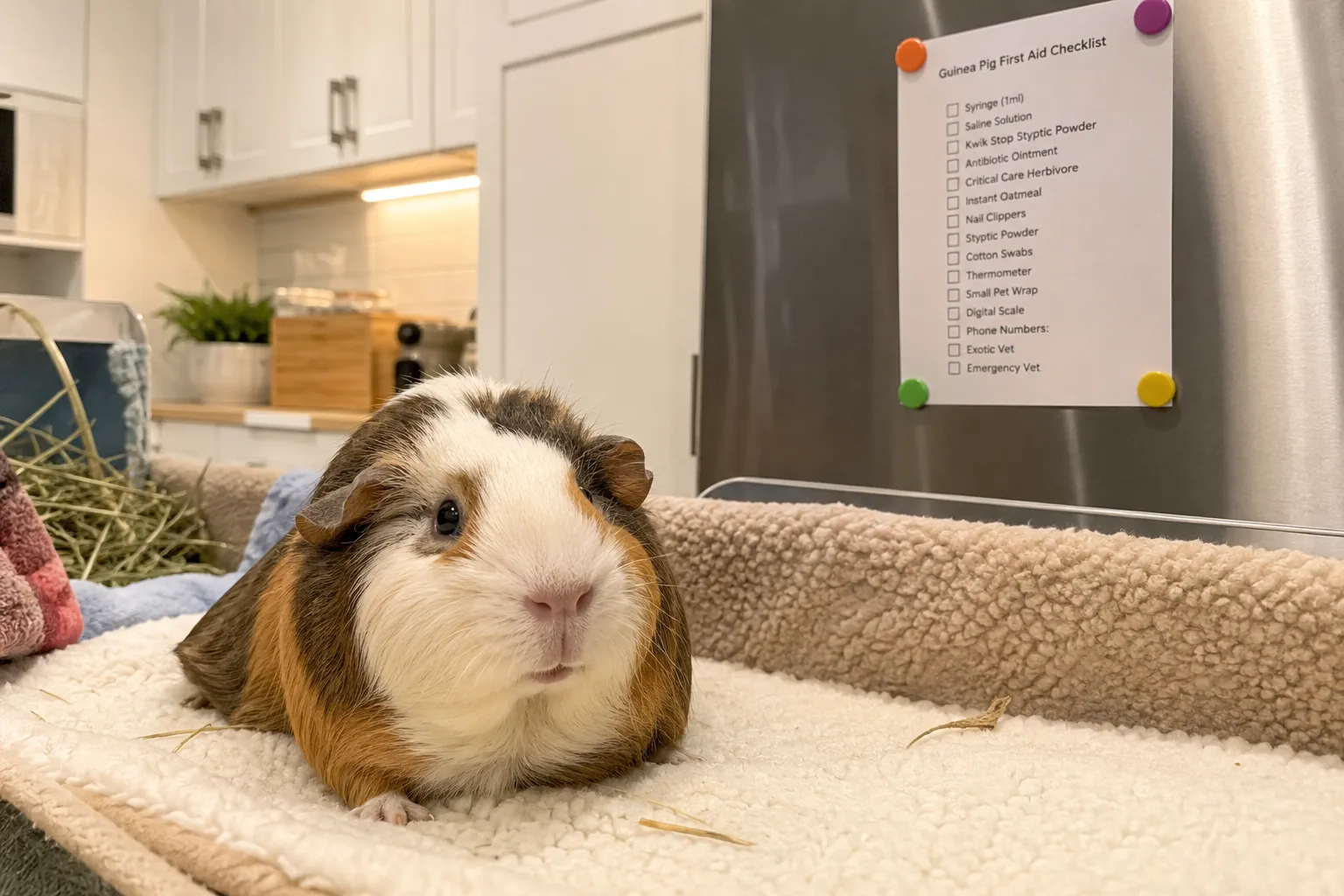
Guinea pigs are wired to hide pain—prey animals conceal weakness right up until they can't, so a sick cavy can look almost normal hours before a crisis. That instinct is exactly why geriatric guinea pig first aid has to start before the emergency, in the quiet corner of the attic where her cage catches the late afternoon light.
Quick Takeaways
- Weight loss is the first alarm — a kitchen scale catches trouble days before symptoms show.
- A guinea pig that stops eating or pooping is an emergency — gut stasis can turn fatal within hours.
- Never fast a senior guinea pig before a vet visit — unlike dogs and cats, they must keep eating.
- Build the kit now, not during the panic — keep recovery formula, a syringe, and a heat source ready.
- Memory deserves a plan too — many families preserve a senior pet's likeness through custom pet figurines while there's still time to capture them.
Here's the thing nobody tells first-time owners when they bring home that fuzzy little potato: guinea pigs age fast, and they age quietly. By four or five, your piggy is officially a senior. The popcorning slows. The wheeks get a little raspier. And one Tuesday you'll glance over at the cage and notice she's tucked into the back corner instead of bossing you around at feeding time.
That corner. The back corner of the cage becomes a place you learn to watch.
Most articles about old guinea pig emergency care want to hand you a dramatic checklist of catastrophes—seizures, bloat, collapse. And sure, we'll get there. But the real secret of caring for a geriatric guinea pig isn't heroics. It's the boring, beautiful discipline of noticing small things early. First aid for a senior cavy is less about the ambulance and more about the smoke detector.
So let's walk through the eight steps that actually belong on your fridge. Print them. Magnet them up next to the grocery list. Because when something goes sideways at 9 p.m. on a Sunday, you won't want to be Googling—you'll want to be doing.
Step 1: Weigh Her Every Single Day (Yes, Really)
Picture this. It's morning, the coffee's brewing, and before you even sit down you scoop her up, set her on the kitchen scale in a little bowl, and watch the number settle. Ten seconds. That's the whole ritual.
That ten seconds is the most powerful diagnostic tool you own.
Here's why it matters so much for seniors: a guinea pig can lose 10 to 15 percent of her body weight before you'd ever notice by looking. Their fur hides everything. By the time a piggy looks thin to the naked eye, she's often been declining for a week or more. The scale sees what your eyes can't.
"A guinea pig doesn't tell you she's sick. She shows you, in grams, if you're watching."
Get a digital kitchen scale that reads in grams—the kind you'd use for baking. Weigh at the same time each day, ideally before breakfast. Write it down. A notebook taped to the cage works fine. You're looking for trends, not single numbers.
A 30-gram dip overnight? Watch closely, recheck in the morning. A steady slide of 30 grams a day across two or three days? That's a vet call. A senior guinea pig who drops 50-plus grams in 24 hours is telling you something is wrong right now.
The mistake most first-timers make is weighing "when something seems off." But the whole point is that with prey animals, by the time something seems off, you've lost your head start. The daily weigh-in is your guinea pig health checklist in its purest, simplest form.
Step 2: Learn the "Fade" Before You Ever See It
There's a posture senior guinea pigs get when they feel bad. Owners who've been through it call it different things—the loaf, the hunch, the puff. The body rounds up, the fur fluffs out, the eyes go a little squinty and half-lidded. She'll sit very still in one spot, often that back corner, ignoring food she'd normally mug you for.
We call it the fade. And learning to spot it is a skill, not an instinct.
The counterintuitive part? A guinea pig sitting quietly is not "resting"—it's often the loudest distress signal she can give. Healthy cavies, even old ones, are nosy. They investigate. They complain. A piggy who's gone silent and still has usually crossed from "a little off" into "actively unwell."
Run through this quick visual scan once a day, and it takes maybe a minute:
- Posture — Upright and curious, or hunched and puffed?
- Eyes — Bright and open, or dull and squinting?
- Breathing — Smooth and quiet, or fast, with little side-to-side rocking?
- Engagement — Coming to the bars at your voice, or hanging back in the corner?
So what? Because catching the fade 24 hours earlier can be the difference between a treatable problem and a goodbye. Senior guinea pigs have almost no reserve. They go from "fine" to "fragile" with very little runway, and that runway is the entire game.
Step 3: Treat "Not Eating" and "Not Pooping" as a Five-Alarm Fire
Okay, this is the one we'd tattoo on your arm if we could.
For dogs and cats, a skipped meal is usually no big deal—annoying, worth watching, rarely an emergency. For guinea pigs, it's the opposite. Their digestive system has to keep moving constantly. When a guinea pig stops eating, the gut slows, then stalls completely. This is gastrointestinal stasis (GI stasis), and in a senior cavy it can become life-threatening shockingly fast.
The gut and the appetite feed each other in a vicious loop. She feels bad, so she eats less. She eats less, so the gut slows. The slow gut makes her feel worse, so she eats even less. Round and round, downhill.
"The gut is the engine. When a guinea pig stops eating, the engine doesn't idle—it seizes."
Your two non-negotiable daily checks: Is she eating? Is she pooping?
Fecal pellets are a beautiful early-warning system. Healthy poops are plump, oval, and plentiful. When you start seeing smaller, drier, or fewer droppings—or a sudden change to teardrop shapes or string-of-pearls clumping—the gut is already slowing. That's your window. Act in it.
Here's the timeline that should live in your head:
| Sign | Window | What to Do |
|---|---|---|
| Eating less, smaller poops | Same day | Offer favorites, start hand-feeding, call vet for advice |
| Refusing food entirely | 4–6 hours | Begin syringe feeding now, get a vet appointment |
| No poop in 12+ hours | Urgent | Emergency exotic vet visit |
| Bloated, hard belly, in pain | Immediate | Emergency vet—do not wait for morning |
The "wait and see until tomorrow" instinct kills more guinea pigs than almost anything else. With a senior, tomorrow is sometimes too late.
Step 4: Build the Kit Before the Crisis (A Day-in-the-Life Reality Check)
It's 11 p.m. She hasn't touched her hay since dinner. You finally notice because the cage in the corner is too quiet. Now imagine ransacking the bathroom for a syringe while she fades—versus reaching into one labeled box where everything's already waiting.
Build the box now. Tonight, if you can.
A proper senior guinea pig first aid kit isn't fancy. It's a shoebox of small, specific things that turn panic into a plan:
- Critical Care (or a recovery formula) — A powdered food you mix with water and syringe-feed when she won't eat on her own. This is the single most important item. Ask your exotic vet to keep a bag on hand, or order one to store.
- Feeding syringes — 1 mL for medication, 10 mL for food. The wide-tip ones designed for piggies are easiest.
- A digital gram scale — From Step 1. It lives here too.
- A snuggle-safe heat disc or microwavable pad — For warmth, used carefully (more on that next).
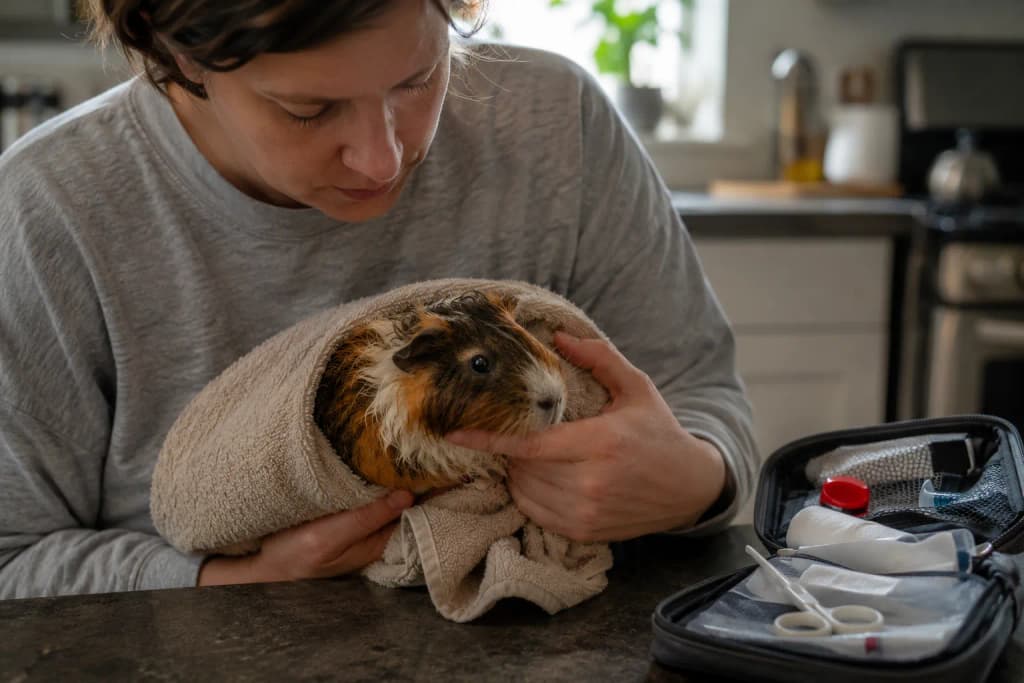
- A soft towel — For burritoing during feeds and exams.
- Your exotic vet's number AND the nearest 24-hour exotic emergency clinic — Written down. Phones die. Memory fails at midnight.
- A small notebook — Weight log, poop count, medication times.
So what's the payoff? A family we worked with told us the difference between losing their nine-year-old piggy and getting two more good months came down to having Critical Care in the cupboard at midnight. Not a heroic vet visit. A box on a shelf and the calm to use it.
The kit is the difference between reacting and responding. One of those is panic. The other is care.
Step 5: Get the Warmth Right (Because Wrong Warmth Hurts)
Senior guinea pigs lose the ability to regulate body temperature well. A sick or aging cavy chills easily, and a cold guinea pig spirals faster. So warmth is genuinely first aid.
But here's the counterintuitive trap most caring owners fall into: they overheat their sick piggy, or burn her, trying to help. A heating pad set directly under a guinea pig who's too weak to move away is dangerous. Heat lamps dry them out. A microwaved sock that's too hot does damage in seconds.
The rule: gentle, indirect, escapable warmth.
- Warm one half of the enclosure, never the whole thing, so she can crawl toward heat or away from it.
- Use a towel-wrapped heat disc, not bare metal or plastic.
- Always test it against your own inner wrist first—comfortably warm, never hot.
- Watch for the flip side: a piggy stretched out long and flat, breathing hard, may be too hot.
The texture of good care here is subtlety. You're aiming for the warmth of a sunny windowsill, not a sauna. When in doubt, cooler-but-stable beats too-hot. And if she's collapsed and cold to the touch, gentle warmth on the way to the emergency vet can buy precious time.
Step 6: The Weekly Hands-On Exam (Teeth, Feet, Eyes, Skin)
Once a week, do a slower, full-body check. Set her on a towel on your lap in good light—near a window in the afternoon works beautifully, and honestly it's a sweet little ritual once you settle into it.
You're feeling and looking for the things that creep up silently in old age.
Teeth. Guinea pig teeth grow continuously, and seniors are prone to malocclusion—misaligned teeth that prevent eating. Drooling, a wet chin ("slobbers"), dropping food, or sudden weight loss can all point here. You can't always see the back molars, but a wet chin is a flag for the vet.
Feet. Check the soles for bumblefoot (pododermatitis)—red, swollen, or scabbed footpads. Older, heavier, less mobile piggies on hard or dirty surfaces are at higher risk. Soft, clean bedding is the prevention.
Eyes and nose. Crusty eyes, cloudiness, or discharge from the nose deserve attention. A milky eye discharge can sometimes just be normal grooming fluid, but anything persistent or colored is worth a look.
Skin and coat. Part the fur and look for flaky skin, bald patches, scabs, or lumps. Senior guinea pigs can develop ovarian cysts, fatty lumps, or tumors, and the earlier a lump is found, the more options you have. Run your hands over her whole body like you're reading her in braille.
This weekly exam is where you stop treating "the cage in the corner" as a piece of furniture and start truly seeing the animal in it. Veterinary resources like PetMD's guinea pig health guides are a solid place to learn what's normal versus what's not—just remember they supplement, never replace, an actual exotic vet.
"Healthy pets make the best subjects—we love seeing the spark in their photos. But the quiet seniors? Those faces hold the whole story."
— The PawSculpt Team
Step 7: Syringe-Feeding 101 (The Skill That Saves Lives)
If there's one hands-on technique every owner of an aging cavy should practice before they need it, it's syringe-feeding. When a senior guinea pig stops eating, this is the bridge that keeps her gut moving until the vet and the medicine catch up.
Let's walk through it like you're learning over my shoulder.
- Mix the recovery formula to a smooth, soft-pudding consistency—thin enough to pass the syringe, thick enough to be food.
- Wrap her gently in a towel, burrito-style, with her head free. This calms her and keeps things tidy.
- Slide the syringe into the side of her mouth, behind the front teeth, aiming toward the cheek—never straight down the throat.
- Give small amounts (about 0.5 mL at a time), and wait for her to chew and swallow before the next. Patience here prevents aspiration, which is dangerous.
- Aim for the amount your vet recommends across the day, usually split into many small feeds every few hours.
The mistake people make is rushing—pushing too much, too fast, out of fear. Slow and steady actually delivers more food and far less risk. A frightened, choking piggy eats nothing.
And here's a tip you won't find in most beginner guides: warm the formula slightly and offer it on a spoon or your fingertip first. Some seniors who refuse the syringe will lick from a spoon, and any voluntary eating is a win. You're not just delivering calories—you're keeping the will to eat alive.
This is the kind of first time guinea pig owner senior care skill that feels intimidating until you've done it twice. Then it's just part of the routine, like the morning weigh-in.
Step 8: Know the Goodbye Plan—and Capture Her While You Can
Nobody puts this step on a fridge checklist. We think they should.
Geriatric first aid is partly about extending good days. But part of caring for a senior is being honest that the road has an end, and that comfort care matters as much as cure. Knowing your vet's stance on palliative options, pain management, and humane euthanasia before the night you need it spares you from making the hardest decision of your life in a panic.
Watch for the line between "treatable old age" and "suffering": persistent refusal to eat despite support, labored breathing, inability to move, a piggy who no longer responds to your voice or her favorite food. Quality of life is the measure. Your exotic vet can help you read it honestly.
"Old age isn't an illness. It's just a season that asks for softer hands and closer eyes."
And here's the part we've learned from thousands of pet families: the time to preserve a senior pet is while they're still here. Photos are wonderful, but they flatten. Many families find deep comfort in something they can actually hold—a likeness that keeps the curve of those ears, the specific swirl of those markings, the exact set of that face.
That's the corner of this work we sit in at PawSculpt. We digitally sculpt your guinea pig from your photos, then bring her to life through full-color resin 3D printing that reproduces her real markings and coloring directly in the material—not painted on top, but printed into it, then sealed with a protective clear coat. The result has a warm, authentic texture, not a glossy plastic fakeness. For a beloved senior, having that piece made now—while she's dozing in her sunny corner—means you capture her, not a memory of her. You can see how the process works at pawsculpt.com.
It's not for everyone, and that's genuinely okay. Some families plant a little garden. Some keep the favorite hay rack. But if you're the kind of person who wants to hold onto the physical shape of someone you loved, this is one path among many.
Your At-a-Glance Senior Care Schedule
To make all of this stick, here's the rhythm of caring for a geriatric guinea pig boiled down. This is the part worth copying onto the fridge card.
| Task | How Often | What You're Watching For |
|---|---|---|
| Weigh on gram scale | Daily | Loss of 30g+ over a few days |
| Check eating & pooping | Daily | Reduced food intake, fewer/smaller droppings |
| Visual "fade" scan | Daily | Hunching, puffed fur, hiding, dull eyes |
| Full hands-on exam | Weekly | Teeth, feet, lumps, skin, eyes |
| Refresh first aid kit | Monthly | Expired formula, working syringes |
| Vet wellness check | Every 6 months | Bloodwork, dental, weight trends |
The truth most beginner guides skip? A senior guinea pig's care isn't harder than a young one's—it's just more attentive. Same food, same love, slightly closer eyes. The American Veterinary Medical Association's guidance on finding qualified exotic and small-mammal vets is worth bookmarking now, because the night you need one is not the night to start searching.
You don't have to become a tiny veterinarian. You just have to become the person who notices. The person who knows the back corner of the cage, who reads the scale, who keeps the box ready. That person saves lives. Quietly. On ordinary Tuesdays.
When to Call the Vet Immediately vs. Monitor at Home
One more tool for the fridge, because in the moment, clarity is everything. Use this to sort "watch closely" from "go now."
| Symptom | Monitor at Home | Emergency—Call Now |
|---|---|---|
| Appetite | Slightly less, still eating | Refusing all food 4–6+ hrs |
| Droppings | Slightly fewer | None in 12+ hours |
| Breathing | Normal, quiet | Fast, labored, open-mouth |
| Energy | A bit quieter | Collapsed, unresponsive |
| Belly | Soft, normal | Bloated, hard, painful |
| Temperature | Normal to touch | Cold or limp |
When you're unsure, err toward calling. Exotic vets would always rather hear from you early about a senior cavy than too late. And remember our golden rule from Step 3: never withhold food before a guinea pig's vet visit. Bring her hay and her recovery formula right along with her.
Frequently Asked Questions
At what age is a guinea pig considered geriatric?
Most guinea pigs are considered seniors around 4 to 5 years old, though many live well into 5 to 8 years with good care. The shift isn't a switch that flips—it's gradual. You'll notice slower movement, more sleeping, and a little less of that explosive popcorning. That's your cue to tighten up the daily monitoring routine.
How do I know if my old guinea pig is having a true emergency?
The clearest red flags are refusing all food for more than a few hours, no droppings in 12 or more hours, labored or open-mouth breathing, a hard or bloated belly, and sudden collapse or unresponsiveness. Any of these means call an exotic vet right away—don't wait for morning. With seniors especially, the early hours matter enormously.
Should I stop feeding my guinea pig before a vet visit?
No, and this trips up a lot of new owners. Guinea pigs must never be fasted the way we fast dogs or cats before procedures. Their digestive system needs to keep moving constantly, and an empty gut can trigger dangerous stasis. Bring her hay and recovery formula to the appointment and keep offering food.
How often should I weigh my senior guinea pig?
Every day, ideally at the same time, on a digital scale that reads in grams. You're tracking the trend, not a single number. A drop of 30 to 50 grams over a few days is often the earliest sign of illness—long before anything's visible to the eye. It's the most reliable line on your guinea pig health checklist.
My senior guinea pig is sleeping more and playing less. Is that normal?
Some slowing down is a normal part of aging—more naps, less zooming around. But "quiet" and "hunched and hiding" are different things. Increased rest is usually fine if she's still eating, pooping, and coming to greet you. Withdrawal, puffed fur, and ignoring favorite foods are not normal aging and warrant a vet check.
Can I prevent gut stasis in an aging guinea pig?
You can lower the risk significantly. Unlimited grass hay, fresh water, daily vitamin C, gentle encouragement to move, and prompt action at the first sign of reduced eating all help keep the gut running. Stress and pain also slow digestion, so keeping a senior comfortable and warm is part of prevention too.
Ready to Celebrate Your Pet?
Every pet has a story worth preserving. Whether you're caring for a beloved senior in the gentle final season or celebrating a piggy who's still bossing you around at breakfast, the same truth holds: those tiny details—the markings, the ears, the exact tilt of that nosy little face—deserve to be kept. As you put your geriatric guinea pig first aid routine into practice, consider capturing her likeness while she's here, so the shape of her stays with you long after.
Visit pawsculpt.com to learn more about our full-color 3D printing process, preview turnaround, revision options, and quality guarantee.