
No Answers, Only Absence: How Year Two With Your Abyssinian Becomes a Ritual
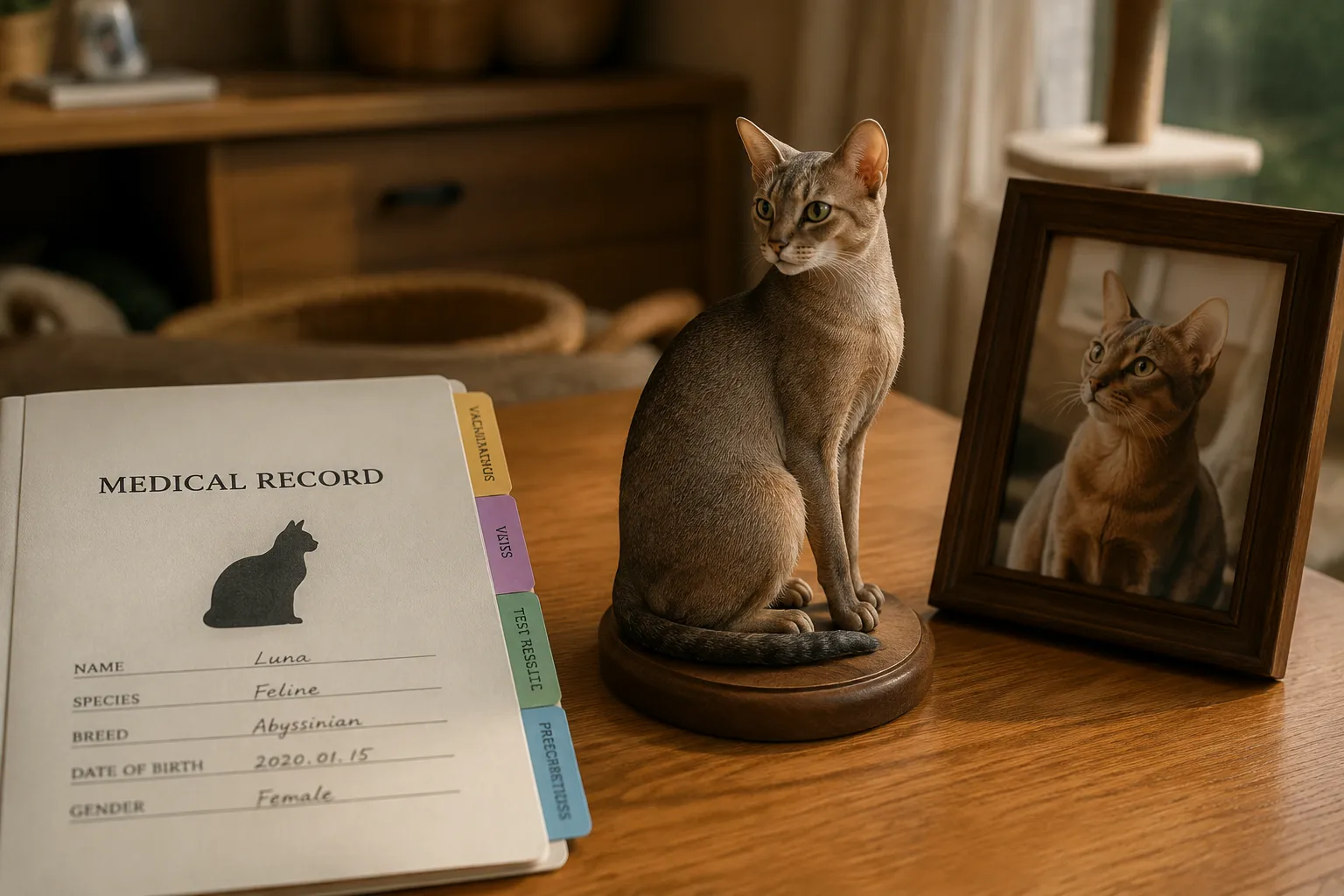
The passenger seat still holds the shape of her. That faint ticking-clock sound of Abyssinian claws on the dashboard is gone, and building an Abyssinian cat memorial in year two means sitting with that empty curve in the upholstery, no answers riding shotgun anymore.
Quick Takeaways
- Year two grief shifts from shock to ritual — the sharp pain becomes a quieter, structural absence you build around.
- "Grief without answers" is its own category — sudden loss or unexplained illness leaves no closure to chase, so you make meaning instead.
- Anniversary spikes are neurological, not weakness — your brain files dates, smells, and spaces as triggers you can plan for.
- A tangible anchor helps year-two grief settle — many families find comfort in custom pet figurines that hold a specific memory in the hand.
- Rituals beat "moving on" — small repeated acts do more for long-term grief than trying to close the chapter.
Why Year Two Hits Different Than Everyone Warned You
Here's the thing nobody tells you at the vet's office or in those first sympathy cards: year one is survival, and year two is where the real relationship with the loss begins.
Year one, you're numb. You're running on adrenaline and casseroles and the strange social permission to fall apart. People check in. They remember. The absence is loud because it's new.
Then the calendar flips. The check-ins stop. And you're left in a house that has quietly reorganized itself around a cat who isn't there.
That corner by the radiator where your Abyssinian used to fold into a loaf on cold mornings? It's just a corner now. Except it isn't. It's a coordinate on a map only you can read.
We've talked with hundreds of families through our work at PawSculpt, and the same phrase comes up again and again around the 14 to 18 month mark: "I thought I was supposed to be better by now."
You're not broken. You're entering a normal, well-documented phase.
"Year two isn't a relapse. It's the moment grief stops being a storm and becomes a landscape you have to live in."
Psychologists who study continuing bonds theory — a model that replaced the old "stages of grief, then closure" thinking — found something counterintuitive. Healthy grievers don't sever the connection to who they lost. They relocate it. They find a new, durable place for it in their ongoing life.
Year two is when that relocation actually happens. Year one you're too busy bleeding to build anything.
The Abyssinian-Specific Absence
Abyssinians aren't background cats. If you shared your life with one, you know they're less "cat in the house" and more "small orange coach reviewing your every decision from the top of the doorframe."
They follow. They supervise. They insert themselves into the exact center of whatever you're doing, especially if it's a laptop or a warm plate.
So the absence of an Abyssinian is spatial in a way that hits harder than most breeds. You didn't lose a pet who slept in one spot. You lost a presence that occupied the whole square footage of your day.
That's why year two feels like the walls got farther apart.
Grief Without Answers: The Loss You Can't File Away
Some losses come with a story. A long illness, a clear diagnosis, a decision made with a vet holding your hand. There's a narrative, even a terrible one.
And then there's the other kind.
The cat who was fine on Tuesday and gone by Thursday. The necropsy that said "inconclusive." The heart condition nobody could have caught. The open door, the coyote, the question that never got a period at the end of the sentence.
Grief without answers is a different animal entirely, and most memorial content completely ignores it.
Here's what the psychology actually says: your brain is a prediction machine. It's constantly building cause-and-effect models to keep you safe. When a death has no explanation, that machine can't complete the loop. So it keeps running the same query. What did I miss. What was the sign. What if.
This isn't obsession. It's cognitive dissonance — the mental discomfort of holding a reality your brain refuses to accept as complete.
"Closure is a myth we sell to people who've never needed it. Meaning is the thing that actually holds."
Why "Finding Peace" Is Bad Advice Here
Most grief articles will tell you to "find peace with not knowing." We think that's a little cruel, honestly, because it treats acceptance like a switch you flip.
What actually works for grief without answers isn't acceptance. It's substitution. You cannot fill the answer-shaped hole, so you build something in the space next to it.
One family we worked with lost their Abyssinian to a sudden seizure with no known cause. The husband told us he spent a full year rehearsing the morning it happened, looking for the thing he should have seen. What finally quieted it wasn't an answer. It was a ritual — a specific candle, lit on the 9th of every month, for exactly the length of one cup of coffee.
The question didn't go away. It just stopped being the loudest thing in the room.
The "So what?" here matters: when you stop chasing an answer that doesn't exist and start building a repeatable act of remembrance, you give your prediction-machine brain a new loop to complete. One it can actually finish.
The Ritual Framework: Turning Year Two Into a Practice
This is where we get practical, because "just grieve" is not a plan.
A ritual works differently in the brain than a memory. Memories are passive and unpredictable — they ambush you in the cereal aisle. Rituals are active and scheduled. You're the one choosing the moment, which hands a piece of control back to a person who lost control the day their cat died.
Think of it as the difference between weather and gardening. You can't control the weather of grief. You can absolutely tend a garden.
Below is the framework we've seen work best for year-two rituals, organized by how much they ask of you and what they give back.
| Ritual Type | Effort Level | Best For | What It Anchors |
|---|---|---|---|
| Monthly candle or moment | Low | Grief without answers | A recurring, contained pause |
| Anniversary-day tradition | Medium | Sudden loss, guilt | The hardest calendar dates |
| Physical keepsake or figurine | Medium | Fear of forgetting details | The specific look and posture |
| Memorial garden or planting | High | Long, gradual goodbyes | A living, growing marker |
| Story-keeping journal | Low-Medium | Complicated relationships | The full, honest truth |
Notice that not one of these is "get over it." Every single one is a way of staying in relationship with the loss on terms you set.
Start With the Spaces, Not the Objects
Here's insider knowledge from doing this work: most people start their memorial ritual with a thing. A photo, an urn, a paw print. And that's fine.
But the more powerful move is to start with a space.
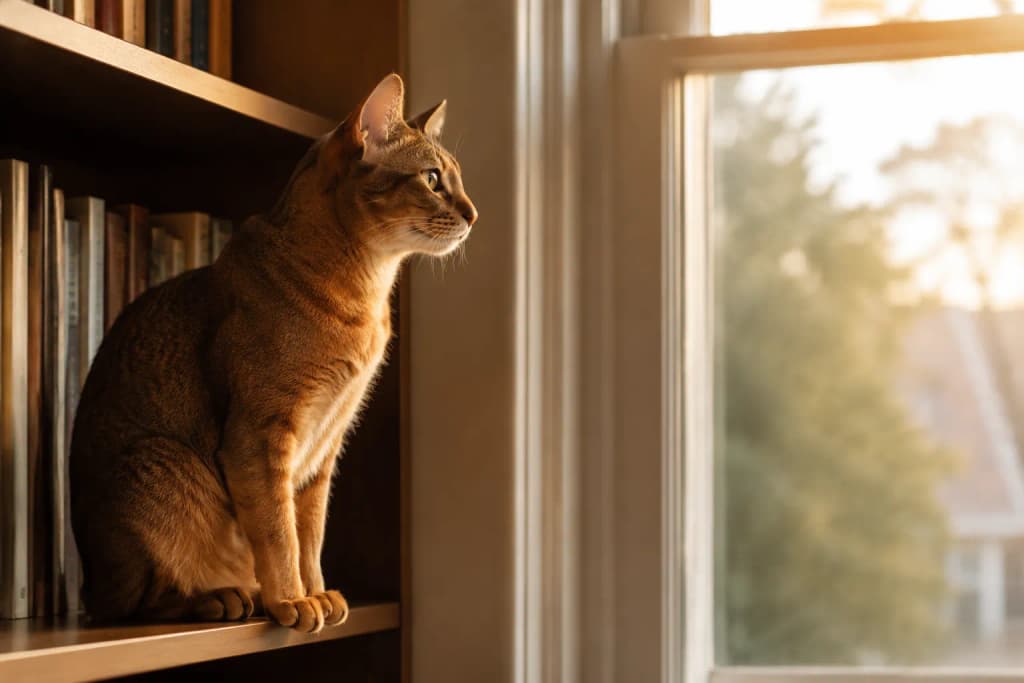
Walk your home and notice the coordinates. The chair no one sits in the same way anymore. The windowsill at the exact height an Abyssinian likes for bird-watching. The foot of the bed that stays too smooth.
These spaces are already doing grief work whether you acknowledge them or not. Naming one of them as your ritual space transforms a source of ambush into a place of choice.
One customer turned the empty windowsill into a tiny rotating display — a seasonal thing, a small figurine, a fresh sprig of catnip. She told us the sill went from "the thing I avoid" to "the thing I visit." Same square inches. Completely different emotional weight.
The Feelings Nobody Puts on a Sympathy Card
Let's talk about the emotions that don't make it into the pretty grief graphics. Because year two is when these surface, and their timing makes people feel like they're losing it.
The Guilt That Comes Without a Reason
You'd think guilt requires a mistake. It doesn't.
Guilt in grief without answers is almost universal, and it's not logical — it's biological. When your brain can't find an external cause for a loss, it turns the search inward. If there's no answer out there, maybe the answer is me. Maybe I did something. Maybe I didn't do something.
This is your mind choosing self-blame over chaos, because self-blame at least implies you had control.
If you're carrying guilt for a death you could not have prevented and could not have predicted, hear this clearly: that guilt is a symptom of love with nowhere to go, not evidence that you failed.
The Association for Pet Loss and Bereavement has resources specifically for this kind of complicated guilt, and if it's consuming you, the APLB's support services are worth a look. We're not grief counselors — for guilt that's affecting your daily function, a professional is the right call.
The Anger You're Embarrassed About
Some of you are angry. At the vet who didn't catch it. At yourself. At the universe. At the cat, even, for leaving without explanation.
Anger is grief with its teeth out, and it's especially common in sudden loss because there's no one to direct it at. So it sloshes around and lands wherever it can — sometimes on the people trying to help you.
This is normal. It burns off. Naming it ("I'm not just sad, I'm furious") tends to loosen its grip faster than pretending it isn't there.
The Quiet Fear of Forgetting
This one shows up right around year two, and it terrifies people.
You start to forget things. The exact pitch of the meow. The specific weight of them on your chest. The precise pattern of the ticked Abyssinian coat, those bands of color on each individual hair.
And then comes the second wave of guilt — guilt about the forgetting itself, like it's a betrayal.
It isn't. Memory fades because your brain is healthy and reallocating resources, a process rooted in normal neuroplasticity. The vividness dims not because you loved them less, but because your mind is rewiring around a life that has to keep going.
This particular fear is exactly why tangible keepsakes matter more in year two than year one.
"You're not forgetting because you loved them less. You're forgetting because your brain is trying to help you live."
The Team's Honest Take
"We've watched year-two families relax the moment they hold something real. Grief needs a place to land, and a screen full of photos isn't it."
— The PawSculpt Team
What We Wish We Knew Sooner
A candid sidebar from our team, because we've learned some of this the hard way alongside the families we serve.
We wish we'd known that "how are you doing?" stops around month three — and that's when the real work starts. People assume silence means you're fine. It usually means you've just gotten quieter about it.
We wish we'd known that grief without answers doesn't need solving. For the longest time our instinct was to help people "make sense" of a loss. The families who healed fastest weren't the ones who found sense. They were the ones who stopped requiring it.
We wish we'd known how physical the fear of forgetting is. It's not sentimental. It's people frantically watching old videos at 2 a.m. because they can't remember which side their cat's white patch was on. A physical object solves a physical problem.
We wish we'd known that the "empty chair" phenomenon is real and lasts longer than a year. The spatial absence — the specific unoccupied places — is one of the most under-discussed parts of pet grief. It deserves more attention than it gets.
We wish we'd known that celebrating the pet works better than mourning them. The families who make a ritual joyful, even a little, tend to carry the loss more lightly than those who keep it strictly solemn.
Building an Abyssinian Cat Memorial That Actually Holds
Okay. Practical territory. If you want a physical anchor for your ritual, here's how to think about it without wasting money or ending up with something that gathers dust.
We've seen every kind of memorial keepsake, and honestly, most of them fail the same test: they're generic. A paw print in clay could be any cat. A rainbow-bridge poem in a frame says nothing about your specific, opinionated, dashboard-walking Abyssinian.
The keepsakes that hold up over years are the specific ones. The ones that capture a posture, a marking, a personality — not "a cat" but that cat.
Why Specificity Beats Sentiment
Here's the counterintuitive part. The more specific a memorial, the more it comforts.
A generic angel-cat statue lets your brain fill in the blanks, and after a while it stops registering at all — that's habituation, the neurological process where repeated identical stimuli fade into background noise.
But an object that captures your cat's exact loaf posture, the particular tilt of the head, the ruddy ticked coat? Your brain keeps finding new detail in it. It stays alive to you because it keeps giving your memory something to grab.
This is where technology has genuinely changed what's possible. Companies like PawSculpt digitally sculpt your pet with master 3D artists, then produce the piece through full-color resin 3D printing — the color is part of the material itself, printed voxel by voxel, so an Abyssinian's complex ticked banding actually reads as theirs rather than a generic tabby wash.
The finish carries a natural, fine-grained texture protected by a clear coat, so it looks authentic in the hand rather than plastic-perfect. If you want the specifics on their process, PawSculpt's custom figurine service lays it all out.
What Photos Actually Work Best
Since so much depends on the source images, here's what we've learned makes or breaks a good figurine — Abyssinian or otherwise.
| Photo Element | What Works | What to Avoid |
|---|---|---|
| Lighting | Soft, natural daylight | Harsh flash, deep shadow |
| Angle | Eye-level, side and 3/4 views | Straight-down phone shots |
| Pose | A signature posture they actually did | Stiff, unnatural setups |
| Detail | Clear shot of unique markings | Blurry or low-resolution |
| Quantity | 3-5 angles of the same cat | A single distant photo |
For a breed with intricate coat detail like the Abyssinian, that clear shot of the ticked pattern matters most. The banding on each hair is what makes them unmistakable.
Pro tip: if your best photos are low-res because they're old, that's okay — send them anyway and describe the details in words. The color and the markings you remember can guide the digital sculpting even when a pixel count can't.
A Note on Timing and Cost
We won't quote you numbers, because prices and turnaround for custom work shift and we'd rather you get current, accurate info straight from the source. What we'll say is this: for a piece meant to anchor a year-two ritual, the specifics of process and guarantees matter, so it's worth reading them directly on the PawSculpt site before you order.
The Remaining Pets Are Grieving Too (And Year Two Is When You'll Notice)
If you have other animals, here's something under-discussed. Surviving pets grieve on their own timeline, and it doesn't always match yours.
Sometimes the surviving cat or dog searches, calls, or goes off food in the first weeks. But sometimes — and this is the part that surprises people — the behavior shifts show up later, especially if you're still grieving hard yourself. Animals read your cortisol levels, your body language, the change in the home's rhythm. Your year-two low can register with them.
Watch for these, and know what's typical versus what warrants a vet visit:
| Sign in Surviving Pet | Often Normal If... | Call the Vet If... |
|---|---|---|
| Searching or vocalizing | Fades within weeks | Persists or worsens for months |
| Appetite change | Brief, then recovers | Refuses food beyond 24-48 hrs |
| Clinginess | Comforting for both of you | Escalates to separation panic |
| Sleeping more | Gradual return to normal | Combined with other symptoms |
| Seeking the lost pet's spots | Gentle, occasional | Obsessive or distressed |
Including your surviving pet in the ritual can help both of you. Some families do a shared quiet time in the memorial space. We're not vets, though — for behavior that concerns you, PetMD's guidance on pets and grief is a solid starting point, and a real vet is better still.
The Anxiety About Loving Again
Year two is often when the question surfaces: another cat?
And with it comes a very specific anxiety — not just "am I ready," but "would getting another cat be a betrayal, and what if I can't love it the same, and what if it also leaves without warning?"
This fear is loyalty misfiring as self-protection. After grief without answers, your brain has learned that love can end with no explanation, so it flinches at the prospect of doing it again.
Here's the reframe we offer: a new pet is not a replacement, and it's not a betrayal. It's proof that the first one taught you how to love an animal that thoroughly. You're not moving on. You're moving forward while carrying them with you.
There's no correct timeline. Some people are ready at eight months, some at four years, some never, and every one of those is fine. Just know that the anxiety itself is not a sign you shouldn't. It's a sign you loved well.
"A new pet doesn't erase the last. It's the clearest evidence of how deeply that love rewired you."
Frequently Asked Questions
Is it normal to grieve a pet harder in the second year?
Absolutely, and it catches almost everyone off guard. Year one runs on shock and social support. When both fade, the quiet, permanent nature of the absence sets in. This isn't a relapse — it's a normal phase where grief shifts from acute pain to a landscape you learn to live in.
How do I cope with pet loss when there are no answers?
Stop chasing an explanation that may not exist, and build meaning instead. Grief without answers keeps your brain running the same unanswerable question on a loop. A small, repeatable ritual — a monthly candle, a memorial space, a specific tradition — gives your mind something it can actually complete.
Why do I feel guilty when my pet's death wasn't my fault?
Because guilt in grief is often biological, not logical. When your brain can't locate an external cause, it turns inward, since blaming yourself at least implies you had some control. That guilt is love with nowhere to go. If it's overwhelming, a grief professional can genuinely help.
What is the best way to memorialize an Abyssinian cat?
Choose specificity over sentiment. Generic keepsakes fade into background noise through habituation, but an object that captures your cat's exact ticked coat, posture, and personality keeps your memory engaged. Full-color 3D printed figurines can reproduce an Abyssinian's distinctive banding in a way generic statues can't.
Is it a betrayal to get another cat after losing one?
Not at all. A new pet doesn't replace the one you lost — it proves how thoroughly that love shaped you. The anxiety you feel is loyalty misfiring as self-protection after a loss with no explanation. There's no right timeline, so trust your own.
Ready to Celebrate Your Pet?
Every pet has a story worth preserving. Whether you're honoring a beloved companion who's crossed the rainbow bridge or celebrating your furry friend's unique personality, a custom PawSculpt figurine captures those details that make your pet one-of-a-kind. For a year-two ritual, that specificity is everything — an Abyssinian cat memorial that holds the exact ticked coat and signature posture gives your grief a real place to land.
Visit pawsculpt.com to learn more about our process, revision options, and quality guarantee