
Stop Believing Your Adult Husky Can't Learn Calm: The Myth Holding Back Experienced Owners
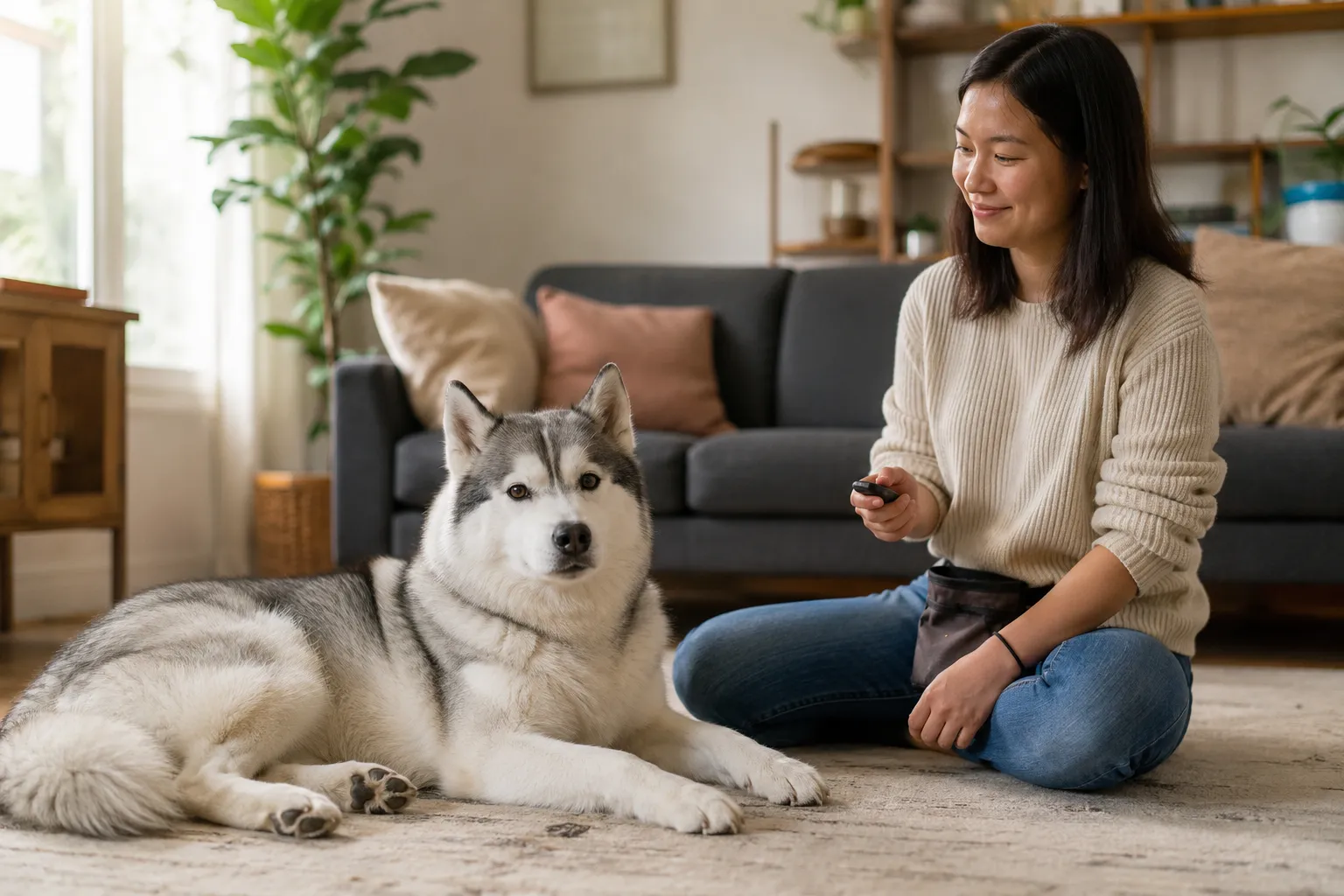
What does your hallway look like at6:45 a.m. when your adult Husky decides that calm is a concept invented for lesser breeds—leash jangling against the hook, nails scrabling on hardwood, seventy pounds of coiled momentum ricocheting between the door and your shins? That chaos, that daily texture of friction and fur, is precisely where most experienced owners make a quiet, devastating assumption: adult Husky training for calm behavior is a lost cause.
It isn't.
Quick Takeaways
- Your Husky's brain remains plastic well into adulthood — neurological research confirms dogs can form new behavioral pathways at any age
- "Calm" isn't the absence of energy; it's a trained skill — treat it like a behavior you shape, not a personality trait you wait for
- The biggest barrier is owner identity, not dog capability — experienced owners often confuse management with training
- Capturing calm (rewarding stillness unprompted) works faster than suppressing excitement — start with 3-second windows of quiet
- Celebrate your Husky's unique presence — whether through training milestones or a custom 3D-printed figurine that captures their personality in full-color resin, honor who they are right now
The Myth That Experience Built
Here's the counterintuitive problem: the more Huskies you've owned, the more likely you are to believe calm can't be taught to an adult. This isn't ignorance—it's pattern recognition gone wrong.
Experienced owners have watched puppies grow into adolescents, adolescents into adults, and they've catalogued what changed and what didn't. They've read the breed profiles. They know Huskies were built for sustained effort across frozen distances, that their arousal threshold sits lower than a Labrador's, that their vocal range rivals a small orchestra. All of this is true. And none of it means what most people think it means.
The myth isn't "Huskies are energetic." The myth is: "An adult Husky who hasn't learned calm by now never will."
This belief persists because it feels like wisdom. It sounds like acceptance. But it's actually a category error—confusing temperament (the raw material) with behavior (the shaped output). A Husky's temperament doesn't change. Their behavior absolutely can.
"We've worked with thousands of pet families, and the ones who surprise themselves most are the experienced owners who finally try something different."
— The PawSculpt Team
Why Experienced Owners Are Especially Vulnerable
New dog owners Google everything. They take classes. They ask questions without embarrassment. But if you've raised three Huskies, you've built an identity around knowing this breed. Admitting that your current approach isn't working feels like admitting you don't know your own dog.
This is the deeper issue—not training methodology, but owner identity. The experienced owner's ego becomes the invisible fence around their dog's potential.
Consider this morning scenario: You wake up. Your Husky, Atlas, is already pacing. You clip the leash, brace yourself, and muscle through the door. You manage the walk with familiar tension in your forearms, familiar commands barked over your shoulder. You return home, Atlas still buzing, and you think: That's just how he is. You've confused management with acceptance. And acceptance with truth.

The Neuroscience That Demolishes the "Too Old" Argument
Let's get precise. The concept at work here is behavioral plasticity—the brain's capacity to form new neural pathways in response to consistent environmental input. In dogs, this capacity doesn't vanish at twelve months, or two years, or five.
A 2020 study published in Scientific Reports examined cognitive flexibility in dogs across age groups and found that while older dogs took slightly longer to acquire new associations, they retained them with equal or greater reliability once learned. The American Kennel Club's training resources consistently emphasize that adult dogs can learn new behaviors—the timeline shifts, but the ceiling doesn't lower.
What does change with age:
| Factor | Pupy (Under 1 Year) | Adult (1-7 Years) | Senior (7+ Years) |
|---|---|---|---|
| Learning Speed | Fast acquisition, poor retention | Moderate acquisition, strong retention | Slower acquisition, strong retention |
| Impulse Control Capacity | Low (prefrontal cortex still developing) | High (full neurological maturity) | High (habitual patterns dominate) |
| Motivation Flexibility | Broad (everything is novel) | Narrow (established preferences) | Narrow (comfort-seeking) |
| Calm Training Advantage | Can build early habits | Can leverage existing impulse control | Can redirect established routines |
Notice something? Your adult Husky actually has a neurological advantage for learning calm that puppies lack. Their prefrontal cortex—the brain region governing impulse control—is fully developed. They have the hardware. They just haven't been given the software update.
The "Hardwired" Fallacy
When someone says a Husky is "hardwired" for intensity, they're conflating drive with destiny. Yes, Huskies have high prey drive, high arousal sensitivity, and high social motivation. These are drives—raw energetic tendencies. But drive doesn't dictate behavior any more than having a powerful engine dictates how fast you drive on a residential street.
The engine is fixed. The driving is learned.
This distinction matters because it shifts the question from "Can my Husky be calm?" (yes, obviously) to "What specific conditions allow my Husky to access calm?" That second question is actionable. The first one just generates despair.
Redefining "Calm" for the Husky Brain
Most owners picture calm as a Golden Retriever draped across a living room floor, breathing slowly, eyes half-closed. That's one version of calm. It's not the only version, and it's probably not the version your Husky will offer you—at least not initially.
Calm Husky behavior exists on a spectrum, and recognizing the early stages is critical:
- Level 1: Voluntary stillness — Four paws on the floor for 3+ seconds without being asked
- Level 2: Reduced scanning — Eyes soft, not tracking every movement in the room
- Level 3: Muscle release — Jaw unclenched, shoulders dropped, weight shifted to one hip
- Level 4: Sustained settle — Lying down with relaxed body posture for 2+ minutes
- Level 5: Environmental calm — Maintaining composure despite moderate triggers (doorbell, leash visible, another dog passing)
Most owners only recognize Level 4 or 5 as "calm." They miss Levels 1 through 3 entirely—which means they miss hundreds of daily opportunities to reinforce the behavior they want.
"Calm isn't silence. It's the moment between notes that gives the music its shape."
The Texture of Stillness
Here's where the artistic eye matters. Learning to see calm in your Husky requires the same attention a sculptor gives to negative space—the areas between forms that define the whole.
Watch your Husky right now. Not during a walk or feeding time. Just... watch. You'll notice micro-moments of stillness: the half-second pause before they shift position, the brief softening of their brow when they process a sound and dismiss it, the weight settling into their haunches before they decide whether to stand.
These moments have a physical texture. The fur along their spine lies flat instead of slightly raised. Their tail drops from its characteristic curl to a neutral hang. The pads of their feet press fully into the floor rather than hovering on tiptoe readiness.
These are your training opportunities. And you've been walking past them for years.
The Protocol: Capturing Calm in Adult Huskies
Forget everything you know about teaching "down-stay." That's a commanded behavior—useful, but fundamentally different from what we're building here. We're not teaching your Husky to obey a calm instruction. We're teaching them to choose calm independently.
The method is called Capturing, and it's embarrassingly simple in concept, profoundly difficult in execution for experienced owners (because it requires you to do less, not more).
Step 1: Become a Calm Detective (Days 1-7)
Your only job for the first week: notice when your Husky is calm. That's it. Don't reward yet. Don't intervene. Just observe and mentally catalogue.
You're training your own eyes before you train your dog.
What you'll discover: your Husky is calm more often than you thought. You just never noticed because calm doesn't demand attention. Chaos does. Your nervous system is calibrated to respond to arousal, not stillness. This week recalibrates you.
Step 2: Mark and Reward Micro-Calm (Days 8-21)
Now you act. When you catch your Husky in any level of calm (even Level 1—four paws still for three seconds), you:
- Mark it — A quiet "yes" or a soft click. Not enthusiastic. Calm marking for calm behavior.
- Deliver a reward — Walk slowly to your dog. Place (don't toss) a treat between their front paws. The placement matters: it rewards the position they're already in rather than creating movement toward you.
- Leave — Don't linger. Don't pet. Don't praise effusively. Just mark, reward, depart.
The critical error most experienced owners make here: they reward too enthusiastically, which spikes arousal and destroys the calm state they're trying to reinforce. Your energy must match the behavior you're building.
| Common Mistake | Why It Fails | Better Approach |
|---|---|---|
| Excited verbal praise ("GOOD BOY!") | Spikes arousal, breaks calm state | Quiet, low-pitched "yes" |
| Tossing treats | Creates movement and anticipation | Place treat between front paws |
| Petting vigorously | Physical stimulation triggers excitement | Brief, slow stroke along shoulder or skip entirely |
| Rewarding only perfect stillness | Mises early-stage calm, slows progress | Reward any reduction in arousal |
| Training in dedicated "sessions" | Calm isn't a session behavior—it's a lifestyle | Capture throughout the day, unpredictably |
Step 3: Raise Criteria Gradually (Weeks 3-8)
Once your Husky is offering calm more frequently (you'll notice—they'll start settling and glancing at you expectantly), you can begin requiring slightly longer duration before marking.
- Week 3-4: Wait for 5-second stillness before marking
- Week 5-6: Wait for 10-second stillness, or a visible muscle release
- Week 7-8: Wait for a full lie-down with relaxed posture
The timeline above is approximate. Some adult Huskies progress faster; some need longer at each stage. The principle is: never jump more than one level ahead of where your dog is succeding 80% of the time.
Step 4: Add Context (Weeks 6-12)
Once your Husky can offer calm in a quiet room, begin practicing in progressively more challenging environments:
- Calm in the hallway (where arousal typically spikes before walks)
- Calm with another person present
- Calm with the leash visible but not being used
- Calm near the front door
- Calm in the yard
- Calm at a distance from other dogs
Each new context resets your criteria slightly. Expect Level 1-2 calm in new environments even if your Husky is offering Level 4-5 at home. This isn't regression—it's normal generalization lag.
The Commonly Overlooked Factor: Your Breathing Pattern
Here's something you won't find in the first five Google results for dog training myths: your respiratory rate directly influences your Husky's arousal level.
Dogs are exquisitely sensitive to human physiological states. Research on interspecies emotional contagion shows that dogs' cortisol levels correlate with their owners' cortisol levels—not just in stressful situations, but chronically, over months and years.
Your Husky isn't just reading your commands. They're reading your nervous system. And if your breathing is shallow and rapid (as it often is when you're bracing for chaos), you're broadcasting a signal that says: Something is about to happen. Be ready.
The fix is almost absurdly simple: before any interaction with your Husky where you want calm, take four slow breaths. Inhale for four counts, exhale for six. Let your shoulders drop. Soften your jaw.
You're not doing this for yourself (though it helps). You're doing it because your Husky's mirror neurons are watching, and they will match what they detect.
This is the insight that separates experienced owners who struggle from experienced owners who succeed: the dog's calm begins in your body, not theirs.
"The leash is a conversation. Most of us are shouting through it without realizing."
What "Experienced" Actually Means (And Why It Can Trap You)
Let's sit with an uncomfortable truth. Experience, in dog training, can mean two things:
- Ten years of learning — progressive skill development, updated methods, refined observation
- One year of experience repeated ten times — the same approaches, the same assumptions, the same results
Most experienced Husky owners fall into category two without realizing it. They've managed the same behaviors for years. They've developed workarounds (exercising the dog into exhaustion, crating during high-arousal periods, avoiding triggers). These workarounds function. But they don't teach.
The difference between management and training:
- Management prevents the unwanted behavior from occurring
- Training teaches the dog an alternative behavior they can choose independently
If your Husky is only calm when exhausted, crated, or removed from stimulation, they haven't learned calm. They've been managed into a state that resembles calm. The moment the management structure fails—you're sick, the weather prevents a long run, guests arrive unexpectedly—the illusion colapses.
True calm Husky behavior persists even when the management scaffolding is removed. That's the test. And that's the goal.
The Identity Shift Required
Training an adult Husky to be calm requires you to become a different kind of owner. Not a more permissive one. Not a less structured one. A more observant one.
The experienced owner's superpower is pattern recognition. You already know your dog's body language better than most trainers could learn in a consultation. You know the ear position that precedes a howl, the weight shift that precedes a bolt, the specific quality of attention that means prey drive has engaged.
Now redirect that observational skill toward calm. Use the same precision you've developed for reading arousal to read relaxation. The ear position that signals processing rather than alerting. The weight shift that signals settling rather than launching. The quality of attention that means your Husky is present but not activated.
You already have the eyes. You just need to point them at a different target.
The Role of Physical Environment in Calm Training
Your home's physical texture matters more than most training guides acknowledge. Huskies are tactile animals—they respond to surfaces, temperatures, and spatial configurations in ways that either support or undermine calm.
Consider your hallway—that narrow corridor where arousal peaks every single day. What's the floor surface? If it's hardwood or tile, your Husky's nails can't grip. They slide. Sliding creates instability. Instability creates tension. Tension creates arousal. You've been fighting physics.
Practical environmental modifications:
- Place a textured runner or mat in the hallway (the grip under their pads reduces physical anxiety)
- Create a designated "calm station" near the door—a specific mat or bed where calm behavior is heavily reinforced
- Remove visual triggers from the immediate door area (leash hooks, treat bags, shoes associated with walks)
- Consider temperature: Huskies calm more readily in cooler spaces. A fan near their settle spot can help.
The feel of the surface beneath your Husky's body communicates safety or alertness. A soft, slightly warm bed with textured fabric says settle. A cold, slick floor says be ready to move. These aren't conscious decisions your dog makes—they're physiological responses to tactile input.
One family we worked with had spent two years trying to teach their five-year-old Husky, Koda, to settle near the front door. Nothing worked until they placed a shepskin-textured mat at the threshold. Within a week, Koda was voluntarily lying on it before walks. The texture—that specific combination of warmth and softness against his belly—was the missing piece. Not a command. Not a treat protocol. A surface.
The Timeline Nobody Talks About
How long does it take to teach an adult Husky calm behavior? The honest answer is uncomfortable: 3-6 months for reliable indoor calm, 6-12 months for generalized calm across contexts.
That timeline scares people. It shouldn't. Here's why:
You're not waiting 3-6 months for any improvement. You'll see changes within the first two weeks—small ones, but real. Your Husky will offer slightly more stillness. They'll glance at you during quiet moments (checking if a reward is coming). They'll choose to lie down in spaces where they previously paced.
The 3-6 month timeline is for the behavior to become default—for calm to be your Husky's go-to response rather than a trained trick they perform for treats. That's a fundamentally different goal than "my dog can hold a down-stay for thirty seconds." You're reshaping a behavioral default. That takes time. But it's permanent once established.
| Timeline | What You'll See | What's Happening Neurologically |
|---|---|---|
| Week 1-2 | Slightly more frequent stillness, occasional eye contact during quiet moments | Initial association forming between stillness and reward |
| Week 3-4 | Dog begins offering calm deliberately, settling faster after arousal | Neural pathway strengthening, behavior becoming more efficient |
| Month 2-3 | Calm in familiar environments without treats every time | Behavior shifting from reward-dependent to habitual |
| Month 4-6 | Calm maintained during moderate triggers at home | Generalization beginning, emotional regulation improving |
| Month 6-12 | Calm as default state in most familiar contexts | Full neural pathway establishment, behavior is now "personality" |
The counterintuitive insight: the longer your Husky has practiced arousal as a default, the more durable their calm will be once established. Adult dogs who learn calm later in life often maintain it more reliably than dogs who learned it young—because the adult brain commits more fully to behaviors it adopts deliberately.
Celebrating the Dog in Front of You
There's a philosophical dimension to this work that most experienced dog owner tips articles ignore entirely. Teaching your adult Husky calm isn't just about behavior modification. It's about seeing your dog clearly—perhaps for the first time in years.
When you've lived with a Husky for five or seven years, you stop seeing them. You see your expectations of them. You see the pattern. You see "my crazy Husky" because that's the story you've told yourself and others. The dog becomes a character in your narrative rather than a living, changing being.
Calm training forces you to look again. Really look. To notice the moments of stillness you've been blind to. To recognize that your dog has been offering you calm all along—you just weren't paying attention because it didn't fit the story.
This is, honestly, one of the most beautiful things about working with adult dogs. You get to fall in love again. Not with a pupy's potential, but with the actual, specific, fully-formed animal sharing your home. The particular weight of their head when it drops onto their paws. The specific texture of their coat when their muscles finally release. The sound of their breathing when it slows.
Some owners mark this shift—this moment of truly seeing their dog again—by creating something tangible. A photograph. A journal entry. A custom pet figurine that captures their Husky's specific posture and markings in full-color resin, preserving not the chaos but the calm. The version of their dog they finally learned to see.
Whatever form it takes, the impulse is the same: I want to remember this. I want to hold onto the moment I stopped fighting my dog and started understanding them.
Common Mistakes That Experienced Owners Make (That Beginers Don't)
Paradoxically, experience creates specific blind spots. Here are the errors we see most often in owners who've had multiple Huskies:
Mistake 1: Over-Exercising as a Calm Strategy
The logic seems sound: tire them out, and they'll be calm. But research on canine arousal shows that high-intensity exercise actually lowers the arousal threshold over time. Your Husky becomes fitter, requires more exercise to reach exhaustion, and develops a nervous system calibrated for high-output activity.
You're not building calm. You're building an athlete who needs increasingly intense workouts to achieve temporary stillness.
Better approach: Replace30 minutes of high-intensity exercise with 15 minutes of moderate exercise plus 15 minutes of mental enrichment (sniff walks, puzzle feeders, training games). The mental work produces genuine fatigue without raising the arousal baseline.
Mistake 2: Assuming Breed Means Destiny
"That's just how Huskies are." This sentence has ended more training efforts than any other. It sounds like breed knowledge. It functions as learned helplessness.
Yes, Huskies have breed-specific tendencies. So do Border Collies, Belgian Malinois, and Jack Russell Terriers—all breeds whose owners successfully teach calm behavior every day. Breed tendencies set the starting point, not the ceiling.
Mistake 3: Comparing to Previous Dogs
"My last Husky was never this intense." Maybe. Or maybe your memory has softened the edges. Either way, the dog in front of you is the dog in front of you. Comparison is the enemy of observation.
Mistake 4: Waiting for the "Right Moment" to Start
"I'll work on calm training once we get through this busy season / move to a bigger house / finish the fence." There is no right moment. The right moment was years ago. The second-best moment is today. Your Husky's brain is forming associations right now, whether you're intentionally shaping them or not.
Mistake 5: Confusing Suppression with Calm
Yelling "QUIET" until your Husky stops moving isn't calm training. It's suppression. The dog hasn't learned to be calm—they've learned to freeze under pressure. The internal arousal state remains high. The behavior will resurface the moment pressure is removed.
True calm is visible in the body: soft eyes, relaxed jaw, weight distributed evenly or shifted to one hip, slow breathing. If your Husky is still but rigid—ears pined, muscles taut, breathing shallow—that's not calm. That's a dog waiting for permission to explode.
Building a Calm Protocol Into Daily Life
Theory means nothing without implementation. Here's how calm training integrates into an actual day:
6:30 AM — You wake up. Before going to your Husky, take four slow breaths. Walk to them with relaxed shoulders. If they're still lying down (even if their tail is wagging), mark and reward before they stand up. You've just reinforced the first calm moment of the day.
7:00 AM — Pre-walk routine. Instead of clipping the leash immediately, wait. Stand near the door with leash in hand. The moment your Husky offers any stillness—even a brief pause in their excitement—mark and reward. Then wait again. Repeat 3-5 times. The walk doesn't start until four paws are on the floor. This adds2-3 minutes to your routine. It's worth months of progress.
12:00 PM — You're working. Your Husky is somewhere in the house. Get up, find them. If they're lying down calmly, quietly place a treat between their paws and walk away. No fanfare. You've just reinforced calm during the lowest-arousal period of the day—building the habit when it's easiest.
5:30 PM — Evening arousal spike (common in Huskies). Instead of trying to suppress the energy, redirect it into a10-minute structured activity (training session, puzzle feeder, sniff game). Then wait. The post-activity settle is a prime capturing opportunity. Mark and reward the moment they lie down afterward.
9:00 PM — Your Husky is on their bed, breathing slowly. You walk past. You place a treat gently near their paw without stopping. They barely lift their head. Perfect. That's Level 5 calm being reinforced without disruption.
Total additional time investment: approximately 8-12 minutes spread across the day. Not a training session. A lifestyle shift.
When to Seek Professional Help
We'll be real: some adult Huskies have arousal levels that indicate underlying anxiety, not just breed-typical energy. If your dog:
- Cannot settle even in a completely quiet, familiar room after adequate exercise
- Shows physical stress signals (excessive panting, drooling, pacing) during calm attempts
- Has sudden behavioral changes (new-onset inability to settle)
- Becomes aggressive when arousal is high
...then you're dealing with something beyond normal training scope. Consult a veterinary behaviorist (not just a trainer—a board-certified veterinary behaviorist, or DACVB). There may be a physiological component that training alone won't address.
This isn't failure. This is precision. Knowing when a problem exceds your tools is the most experienced thing an owner can do.
The Deeper Why: What Calm Training Really Teaches
At its core, teaching your adult Husky calm isn't about having a quieter house or easier walks (though you'll get both). It's about something more fundamental: giving your dog the ability to feel safe without constant motion.
A Husky who can't settle is a Husky whose nervous system is perpetually scanning for the next thing. That's not joy—it's vigilance. It's exhausting for them, even if it looks like enthusiasm to us.
When you teach calm, you're teaching your dog that nothing bad happens during stillness. That the world doesn't require their constant readiness. That they can release the weight of alertness and simply... be.
That's a gift. Not just a behavior.
And when you see it happen—when your Husky exhales fully, drops their head onto their paws, and lets their eyes go soft—you'll feel something shift in your own chest too. Because you've been carrying the tension of their tension for years. And now, finally, you can both put it down.
The weight of a Husky's head on your foot when they've chosen to settle there. The warmth of their body against the cool floor. The specific rhythm of their breathing when it finally slows. These are the textures of a relationship transformed—not by force, but by attention.
Some moments deserve to be preserved. The first time your Husky settles voluntarily in the hallway where chaos used to reign. The afternoon you realize you haven't braced yourself before opening the front door. The quiet evening when you look over and see your dog simply resting—not exhausted, not suppressed, just calm. PawSculpt's full-color 3D printing process can capture your Husky exactly as they are in these moments—every marking, every color variation in their coat reproduced directly in resin, a tangible reminder of the calm you both worked to build.
But the real memorial isn't on a shelf. It's in the daily practice. In the breath you take before reaching for the leash. In the treat you place silently between sleeping paws. In the story you stop telling—the one about your "crazy Husky"—and the truer story you begin to live.
Your dog has been waiting for you to see them clearly. Start today.
Frequently Asked Questions
Can you really teach an adult Husky to be calm?
Absolutely. The idea that adult dogs can't learn new behavioral defaults is a myth unsupported by neuroscience. Adult dogs have fully developed prefrontal cortices—the brain region responsible for impulse control—which actually gives them an advantage over puppies when learning self-regulation. The timeline is longer than teaching a puppy, but the results are often more durable.
How long does it take to train calm behavior in an adult Husky?
You'll see small improvements within the first two weeks of consistent capturing practice. Reliable indoor calm typically develops over 3-6 months, while generalized calm across different environments and trigger levels takes 6-12 months. These aren't rigid timelines—every dog progresses differently based on their history, environment, and the consistency of your practice.
Is it true that more exercise makes Huskies calmer?
This is one of the most persistent and counterproductive myths in Husky ownership. While adequate exercise is important for overall health, relying on exhaustion as your calm strategy actually raises your dog's fitness level and arousal baseline over time. A better approach combines moderate physical exercise with mental enrichment activities like sniff walks, puzzle feeders, and structured training games.
What is the "capturing" method for dog training?
Capturing is a positive reinforcement technique where you mark and reward behaviors that your dog offers naturally, without being commanded. For calm training, this means quietly rewarding moments of voluntary stillness—even brief ones—to increase their frequency. It's different from teaching a "down-stay" because you're reinforcing a choice, not compliance with a command.
Why doesn't my years of Husky experience help with calm training?
Experience can actually create specific blind spots. Seasoned owners often develop effective management strategies (exhausting the dog, crating during high-arousal periods, avoiding triggers) that prevent chaos but don't teach calm. They also build an identity around "knowing" the breed, which can make it harder to try fundamentally different approaches. The shift required isn't more knowledge—it's different observation.
When should I consult a professional about my Husky's inability to settle?
If your Husky cannot settle even in a completely quiet, familiar room after adequate exercise and mental stimulation, shows physical stress signals like excessive panting or drooling during calm attempts, or has experienced sudden behavioral changes, consult a board-certified veterinary behaviorist (DACVB). These signs may indicate underlying anxiety that requires professional intervention beyond standard training protocols.
Ready to Celebrate Your Calm Husky?
Every breakthrough deserves to be remembered. Whether your Husky just offered their first voluntary settle in the hallway or you're months into a calm training journey that's transformed your daily life together, these moments matter. A custom PawSculpt figurine captures your Husky's unique coat patterns, distinctive markings, and personality—printed voxel-by-voxel in full-color resin—so you can hold onto the version of your dog you worked so hard to see clearly. Because adult Husky training for calm behavior isn't just about a quieter home. It's about a deeper relationship worth preserving.
Visit pawsculpt.com to explore the full process, materials, and service details