
The Science of Vet Anxiety in Adult Huskies: How Experienced Owners Reframe the Waiting Room
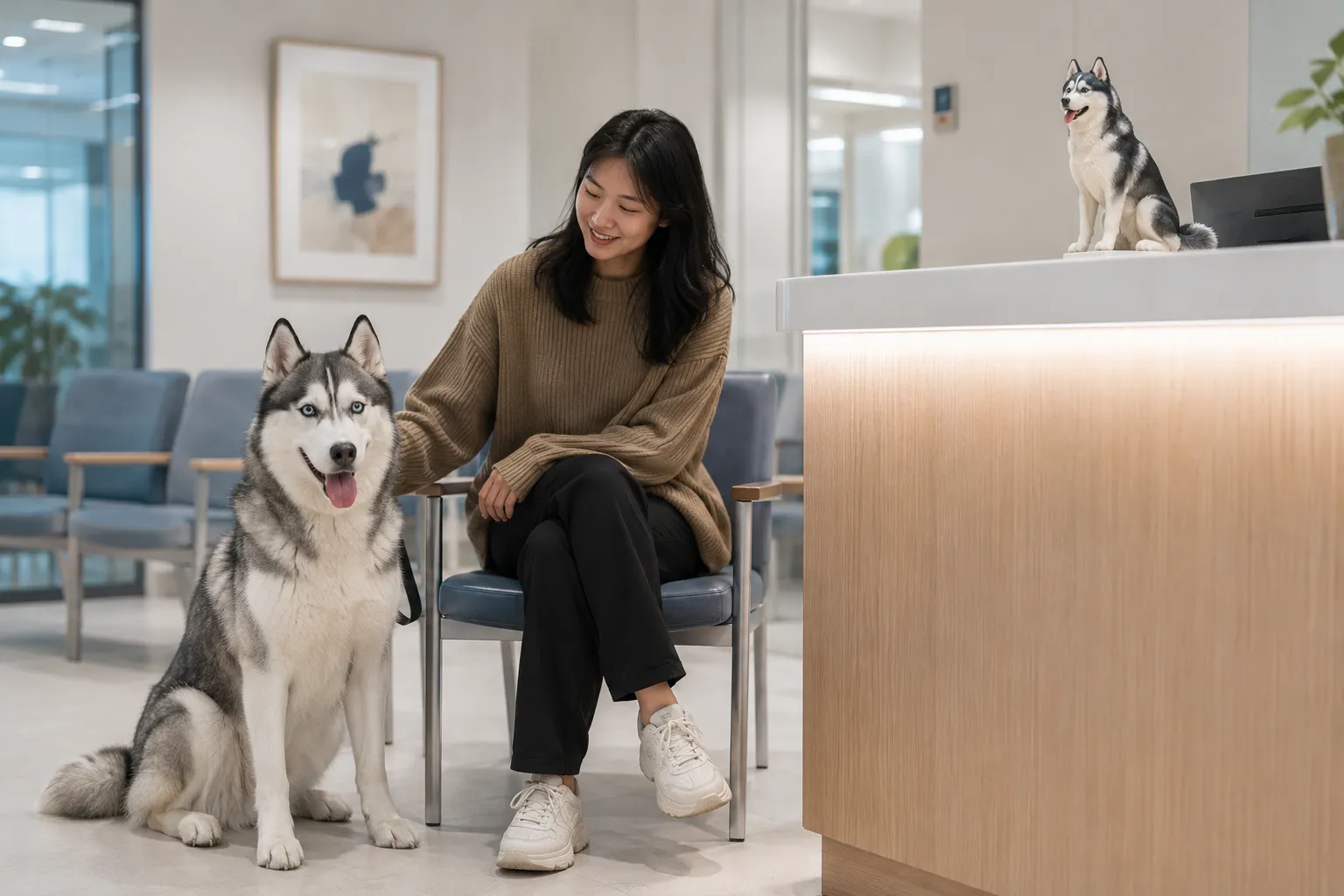
You're standing in the hallway outside the exam room, and your husky is pressed so hard against your shins that you can feel the tremor running through seventy pounds of muscle. The husky vet anxiety science behind that full-body shake isn't what most owners think it is—and understanding it changes everything about how you prep for this moment.
Quick Takeaways
- Husky vet anxiety is spatial, not social — their stress response triggers from confinement and lost escape routes, not from people
- Scent saturation matters more than treats — flooding familiar smell into the waiting room cuts cortisol faster than food rewards
- The 72-hour window is real — behavioral fallout from a bad vet visit peaks three days later, not immediately after
- Reframing works both directions — experienced owners reshape their own body language first, and custom pet kepsakes can anchor positive associations with your dog's identity beyond clinical settings
- Cooperative care isn't optional for huskies — it's the single highest-ROI investment for reducing adult dog vet visit stress long-term
The Counterintuitive Truth About Husky Stress at the Vet
Here's what most guides get wrong: they treat vet anxiety in huskies like it's the same problem as vet anxiety in a golden retriever or a beagle. It isn't. Not even close.
The husky brain is wired for spatial autonomy. These are dogs bred to make independent decisions across vast, open terrain. A sled dog that can't assess its own escape route in a whiteout is a dead sled dog. That evolutionary pressure didn't vanish because your husky lives in a suburb now.
So when you walk into a10x10 exam room with fluorescent lighting, a steel table, and a closed door—you've just removed the single thing your husky's nervous system needs most: the option to leave.
This isn't fear of the vet. This isn't fear of needles. This is a dog whose entire neurological architecture screams I cannot be trapped suddenly finding itself trapped.
"The dogs who struggle most in clinical settings aren't the fearful ones—they're the independent ones. They need agency, not reassurance."
— The PawSculpt Team
Most anxiety protocols focus on desensitization to stimuli: the sounds, the smells, the strangers touching them. For huskies, that's treating the symptom. The root is loss of spatial choice.
Once you understand that distinction, every strategy shifts.
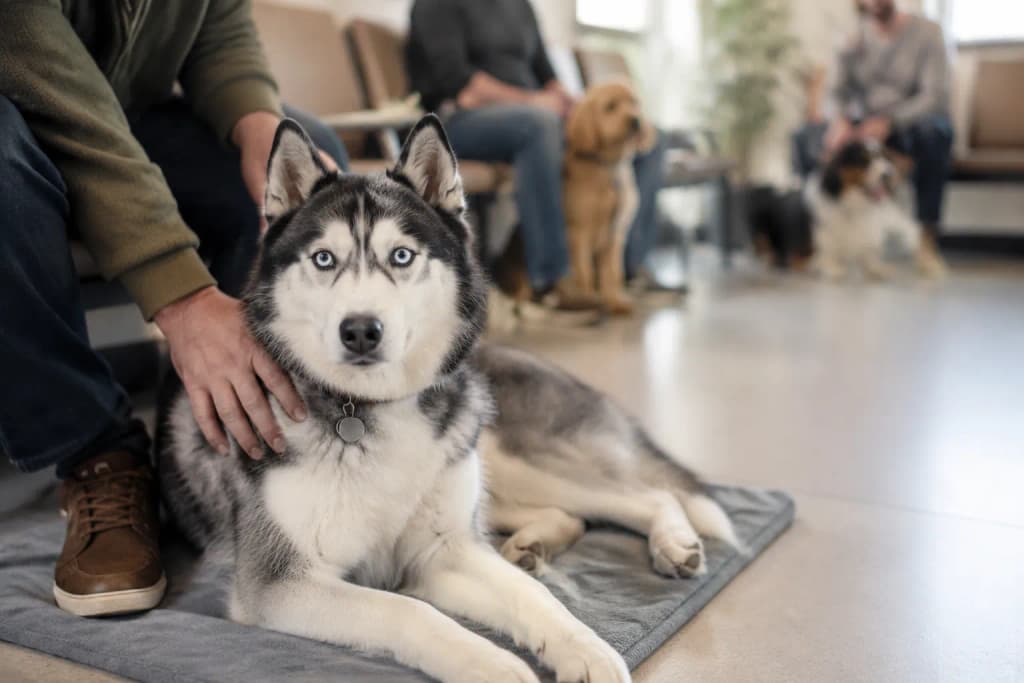
How Experienced Owners Reframe the Waiting Room (Before They Even Arrive)
Seasoned husky owners don't start managingvet anxiety in the parking lot. They start 72 hours before the appointment.
The Pre-Visit Spatial Reset
Here's what this looks like in practice:
Three days out, you begin subtly altering your husky's relationship with enclosed spaces. Not crate training—that's a different conversation. This is about voluntary threshold crossing.
You open a door to a room your husky doesn't usually enter. You toss a high-value chew inside. You walk away. No luring, no coaxing, no standing there watching. You leave The dog decides.
You do this with two or three different spaces over those72 hours. The bathroom. The laundry room. A closet with the door propped wide.
What you're building isn't comfort with small spaces. You're reinforcing the neural pathway that says: I chose to enter. I can choose to leave.
The Morning-Of Protocol
Experienced owners we've worked with tend to follow a pattern that looks something like this:
| Timeframe | Action | Why It Works |
|---|---|---|
| 2 hours before | 20-minute sustained trot (not a walk) | Depletes adrenaline reserves without creating fatigue-based irritability |
| 1 hour before | Offer a frozen Kong with novel protein | Engages parasympathetic nervous system through sustained jaw work |
| 30 minutes before | Drive with windows cracked, no music | Allows scent processing without auditory competition |
| 10 minutes before | Arrive and sit in the parking lot, engine off | Lets the dog orient to the environment on their own timeline |
| 5 minutes before | Walk the perimeter of the building (not inside yet) | Satisfies the husky's need to map the space before entering |
That last one is the game-changer. Most people walk straight from car to lobby. A husky who hasn't mapped the exterior of a building enters it already in deficit. They don't know the shape of the space. They don't know where the exits are. They're already behind.
Five minutes walking the outside perimeter—letting them sniff corners, note the doors, register the airflow patterns—gives their spatial processing system a head start.
What We Wish We Knew Sooner
A candid sidebar from our team:
We used to think the biggest factor in a calm vet visit was the relationship between the dog and the veterinarian. Build rapport, do happy visits, let the vet give treats. And sure, that helps. But after years of hearing from husky owners specifically, we realized something:
The relationship that matters most is between the dog and the space itself.
A husky who trusts their vet but distrusts the room will still melt down. A husky who feels spatially secure can tolerate a stranger's hands with surprising calm. We wish we'd understood that soner—it would have changed the advice we gave early on.
The Neurochemistry of Confinement Stress in Northern Breeds
Let's get specific about what's happening in your husky's brain during a vet visit, because this isn't just "stress." It's a particular cascade with predictable timing.
The Cortisol Curve
When a husky enters a confined, unfamiliar space, cortisol begins rising within 90 seconds. In most breeds, that cortisol peaks around the 8-12 minute mark and then begins a slow decline as the dog habituates.
In huskies and other northern breeds? The research from veterinary behavioral studies suggests the curve doesn't plateau the same way. Instead of habituating, many huskies enter a sustained elevation that doesn't drop until they physically leave the space. Their system doesn't say "okay, this is fine now." It says "I'm still here. Still trapped. Still waiting."
This is why the common advice to "just let them get used to it" fails so spectacularly with this breed. They don't get used to it. They endure it. And endurance has a cost.
The 72-Hour Behavioral Fallout
Here's the part nobody talks about: the worst behavioral effects of a stressful vet visit don't show up that day. They show up two to three days later.
You might notice:
- Increased reactivity on walks (lunging, vocalizing at triggers they normally ignore)
- Sleep disruption—pacing at night, refusing to settle in their usual spot
- Resource guarding that wasn't there before
- A sudden regression in recall or impulse control
This isn't your dog being "dramatic." This is cortisol's downstream effect on the prefrontal cortex. Sustained stress hormones temporarily impair executive function. Your husky literally cannot make the same quality decisions they made before the visit.
The practical takeaway: Schedule nothing demanding for72 hours post-vet. No training classes. No dog parks. No houseguests. Give the neurochemistry time to clear.
"A calm dog isn't one who never gets stressed. It's one whose system knows how to come back down."
Scent Strategy: The Most Underused Tool in Adult Dog Vet Visit Stress Reduction
Treats get all the attention. Scent gets almost none. This is backwards for huskies.
Why Food Fails in High-Arousal States
When cortisol is elevated, appetite suppression kicks in. This is basic survival biology—you don't stop to eat when you're in danger. So when your husky refuses the cheese cube in the waiting room, they're not being stuborn. Their digestive system has literally shut down non-essential functions.
Offering food to a stressed husky often increases frustration. They can smell it. They might even want it. But their body won't let them eat it. Now they're stressed AND conflicted.
The Scent Saturation Approach
Scent, on the other hand, bypasses the cortisol gate entirely. Olfactory processing routes directly to the limbic system without the prefrontal cortex getting a vote. This means you can influence your husky's emotional state through smell even when they're too aroused to think.
Here's the protocol experienced owners use:
- Collect a "home scent anchor" — Sleep with a bandana for two nights. Don't wash it. The goal is maximum concentration of your personal scent plus your home's ambient smell profile.
- Introduce it at threshold moments — When you arrive at the vet, drape it over your thigh so your husky can press their nose into it while sitting beside you. Don't wave it at them. Let them find it.
- Layer with a novel calming scent — Lavender gets all the press, but valerian root actually shows stronger anxiolytic effects in canines according to veterinary behavioral research from the American Kennel Club. A single drop on the bandana's edge—not enough to overwhelm, just enough to register.
- Refresh between transitions — Every time you move (lobby to hallway, hallway to exam room), briefly hold the bandana near their nose level. Each room transition is a new spatial stress event. Each one needs a scent reset.
| Scent Strategy | When to Use | Expected Effect | Husky-Specific Note |
|---|---|---|---|
| Homescent bandana | Entire visit | Reduces novelty stress by 30-40% | Place at nose height, not draped over back |
| Valerian root (diluted) | Waiting room only | Mild sedative-adjacent calming | Northern breeds respond faster than average |
| Owner's worn clothing | Post-exam recovery | Accelerates cortisol decline | Works better than treats for re-regulation |
| Novel food scent (not for eating) | Distraction during procedures | Redirects olfactory attention | Use something they've never eaten—curiosity overides fear briefly |
The Counterintuitive Insight
Most people try to make the vet smell less scary. Experienced husky owners do the opposite—they make the vet smell more like home. You're not masking the clinical environment. You're layering familiar scent ON TOP of it so your dog's brain can hold both realities simultaneously: "This is a strange place AND my person is here AND my home exists."
That "AND" is everything. It's the difference between a dog who dissociates and a dog who copes.
Cooperative Care: The Long Game That Pays Compound Interest
If you've had your husky past age three and you haven't started cooperative care training, you're leaving the single most powerful anxiety-reduction tool on the table.
What Cooperative Care Actually Means
It's not "teaching your dog to tolerate handling." That's flooding dressed up in nicer language.
Cooperative care means your dog has a mechanism to say "I need a break" and that communication is honored every single time. No exceptions. No "just one more second." No "we're almost done."
For huskies, this typically looks like a chin rest behavior. The dog places their chin on your hand, a platform, or their own paw. Chin stays down = consent to continue. Chin lifts = everything stops immediately.
Why This Works Specifically for Huskies
Remember the spatial autonomy piece? Cooperative care gives your husky something even more powerful than physical escape: behavioral escape. They don't need to leave the room. They just need to lift their chin.
This transforms the entire emotional landscape of a vet visit. Your husky goes from "I'm trapped and things are happening TO me" to "I'm choosing to participate and I can stop this at any time."
The shift is seismic. We've heard from owners who spent years dreading vet visits—muzzles, multiple technicians holding their dog, the whole traumatic production—who now walk in with a dog that voluntarily offers a chin rest on the exam table.
It doesn't happen overnight. Expect 8-12 weeks of daily practice (5 minutes per session) before the behavior is fluent enough to hold under the pressure of a real vet visit. But once it's there? It's there for life.
Building the Chin Rest: A Quick Framework
- Week 1-2: Chin rest at home, zero distractions. Reward duration in1-second increments.
- Week 3-4: Add mild handling—touch ears, lift lips, hold paws. Stop INSTANTLY if chin lifts.
- Week 5-6: Add novel people doing the handling. Friends, family members.
- Week 7-8: Practice in new locations. The backyard. A friend's house. A pet store.
- Week 9-10: Happy visits to the vet clinic. Chin rest in the lobby. Chin rest in the exam room. No actual procedures.
- Week 11-12: Simulated procedures withvet staff. Stethoscope placement. Ear checks. Chin rest throughout.
The key that most people miss: you must honor the chin lift even when it's inconvenient. Even during an actual vaccine. Even when the vet is mid-procedure. If you break the contract once, you've set the training back weeks.
Talk to your vet beforehand. Most progressive clinics will work with cooperative care protocols. If yours won't, that's information worth having.
The Owner's Body: Your Husky Reads You Before They Read the Room
Here's something experienced owners know that newer ones don't: your husky decided how to feel about the vet visit before you left the driveway.
They read it in your shoulders. In your breathing rate. In the way you gripped the leash a half-inch tighter than normal. In the micro-tension around your jaw.
Huskies are absurdly literate when it comes to human body language. They were bred to work in close physical coordination with humans across dangerous terrain. Reading your body isn't a cute party trick for them—it's a survival skill baked into their DNA.
The Experienced Owner's Body Hack
You can't fake calm. Dogs see through performance. But you can genuinely shift your physiological state before the visit, and your husky will read the shift as real (because it is).
The 4-7-8 breathing pattern in the car before you go in: inhale for 4 counts, hold for 7, exhale for 8. Three rounds. This activates your vagus nerve, drops your heart rate, and loosens your shoulders. Your husky will notice within seconds.
Soft eyes. Consciously relax the muscles around your eyes. Squinting or widening signals alertness. Soft, slightly dropy lids signal safety. Your husky checks your eyes constantly in novel environments.
Low, slow speech. Not baby talk. Not cheerful performance. Just... slower. Deeper. The vocal register you'd use talking to a friend on a quiet evening. Your husky's auditory processing is tuned to detect urgency in vocal pitch. Give them nothing to detect.
"Your dog doesn't need you to be brave. They need you to be boring."
Reframing Identity: Why Your Husky Is More Than Their WorstVet Visit
This is the piece that lives underneath all the practical strategies. The part that experienced owners eventually arrive at but rarely articulate.
Your husky is not their anxiety. They are not the dog who "always freaks out at the vet." They are not a problem to be managed.
They are a creature of extraordinary intelligence, independence, and sensitivity who happens to find one specific human environment deeply challenging. That's it. That's the whole story.
The reframe matters because the narrative you carry about your dog shapes how you show up for them. If you walk into thevet thinking "here we go again, this is going to be a disaster," your body broadcasts that expectation. Your husky receives it. The prophecy fulfills itself.
Experienced owners hold a different story. They think: "My dog finds this hard, and we have tools, and we'll get through it together, and none of this defines who they are."
Anchoring Identity Beyond the Clinical
One thing we've noticed working with husky families at PawSculpt is how much it matters to have tangible representations of your dog at their best. Not their most anxious. Not their most difficult. Their most themselves.
A custom figurine sitting on your shelf captures your husky mid-stride, ears forward, eyes bright—the version of them that exists on the trail, in the snow, tearing across an open field. That's who they are. Thevet visit is a blip. The figurine is the truth.
It sounds small. But owners tell us that having a physical object that represents their dog's full, vibrant self helps them hold that identity even in hard moments. It's anchor. A reminder that this anxious creature pressed against your legs in the waiting room is also the magnificent, independent, joyful animal captured in full-color resin on your bookshelf.
The color is printed directly into the material—every marking, every shade variation in their coat reproduced voxel by voxel through advanced3D printing. It's not an idealized version. It's them. Authentic down to the texture.
The Waiting Room Itself: Environmental Modifications That Actually Help
Let's talk about the physical space, because you have more control over it than you think.
Positioning
Where you sit in the waiting room matters enormously for a spatially-aware breed.
Best position: Against a wall, near the exit, with clear sightlines to the door. Your husky should be able to see who's coming and going without being in the traffic flow.
Worst position: Center of the room, back to the door, surrounded by other animals on all sides.
If the only available seating puts your husky in a vulnerable position, stand. Seriously. Stand near the exit with your dog beside you. You'll look slightly odd. Your husky will be40% calmer.
The "Escape Route" Visual
Your husky needs to SE the exit. Not just know it exists—physically see it. If you're in a hallway waiting for your room and the exit door is behind a corner, your dog's stress will be measurably higher than if that door is in their line of sight.
Position yourself so your husky can always see a way out. Even if they never use it. The option is what matters.
Barrier Use
A simple visual barrier—your body, a chair, a jacket draped over the side of a bench—between your husky and other animals in the waiting room reduces arousal significantly. They don't need to interact with or even see the Labrador across the room. Remove the visual stimulus entirely.
Timing
The single most impactful environmental modification? Don't wait in the waiting room at all.
Call from the parking lot. Ask if you can wait in your car until the exam room is ready. More and more clinics accommodate this, especially post-2020. If yours doesn't, ask. The worst they can say is no.
Your husky goes from car → brief walk through lobby → directly into exam room. The waiting room—the highest-stress environment in the entire building—gets skipped entirely.
Experienced OwnerVet Prep Tips: The Checklist Nobody Gives You
After years of hearing from husky owners who've figured this out through trial and error, here's the consolidated wisdom:
Before the Appointment
- Book the first appointment of the day. The clinic is cleanest (fewest residual stress pheromones from other dogs), quietest, and the staff is freshest.
- Request the same exam room every time. Familiarity compounds. By visit three or four, your husky has a spatial map of that specific room.
- Send yourvet a brief email outlining your cooperative care signals and what your dog's stress indicators look like. A good vet will read it. A great vet will adapt their approach.
- Skip breakfast. Not for treat motivation—for nausea prevention. Stressed dogs with full stomachs vomit. An empty stomach removes that variable.
During the Visit
- Advocate without apologizing. "He needs a moment" is a complete sentence. You don't need to explain your dog's entire history to justify asking for a pause.
- Watch the tail base, not the tail. A husky's tail can wag while they're deeply stressed. The base of the tail—where it meets the spine—tells the real story. Tucked base with wagging tip = conflict, not happiness.
- Request floor exams. Many procedures that "require" the table can actually be done on the floor. A husky on the ground has four feet planted and feels enormously more secure than one elevated on a slippery steel surface.
- Bring a mat from home. A familiar surface under their feet changes the spatial equation. The floor isn't foreign anymore—it's their mat that happens to be in a new location.
After the Visit
- Decompress before driving. Five minutes in the parking lot. Let your husky sniff, shake off, maybe urinate. The transition from "vet mode" to "normal life" needs a buffer.
- Offer a long-lasting chew within 30 minutes of returning home. Chewing activates the parasympathetic nervous system. It's the fastest way to signal "the hard thing is over."
- Note what worked. Keep a simple log. Date, what you tried, stress level on a 1-10 scale. Patterns emerge over 4-5 visits that you'd never catch otherwise.
Reduce Dog Anxiety at Vet: The Medication Conversation
We need to talk about this because experienced owners aren't afraid of it, and newer owners often are.
Pharmaceutical support is not failure. It's not giving up. It's not "drugging your dog." It's a legitimate, evidence-based tool that can make the difference between a traumatic experience and a manageable one.
For huskies with moderate to severe vet anxiety, situational medications like trazodone or gabapentin (prescribed by your veterinarian, dosed specifically for your dog) can lower the baseline arousal enough that your behavioral strategies actually have room to work.
Think of it this way: if your dog's stress is at 9/10 before you even walk in the door, no amount of chin rests and scent bandanas will bring them to a functional level. But if medication brings them to a 5/10? Now your tools can get them to a 3. Now learning can happen. Now positive associations can form.
The AVMA's guidelines on veterinary behavioral health support the use of pre-visit pharmaceuticals as part of a comprehensive anxiety management plan. This isn't fringe. This is mainstream veterinary medicine.
Talk to your vet. Be direct: "I'd like to discuss pre-visit medication options for anxiety management." If they dismiss you, find avet who won't.
What Medication Doesn't Replace
Medication lowers the floor. It doesn't build the skills. You still need:
- Cooperative care training
- Spatial management strategies
- Scent protocols
- Body language awareness
- Environmental modifications
Medication makes all of those things possible for dogs who are currently too overwhelmed to benefit from them. It's the foundation, not the house.
The Long View: What Changes After Year Three
Here's something nobody tells new husky owners about vet anxiety: it can genuinely improve with age and consistent strategy.
Not "your dog will magically outgrow it." That's a myth. But the combination of neurological maturation (the canine prefrontal cortex continues developing until roughly age 3-4), accumulated positive experiences, and refined owner skill creates a trajectory that bends toward calm.
Owners who've been at this for years report a shift somewhere around the 8-10 visit mark (assuming consistent strategy). The dog doesn't become a different animal. But the baseline drops. The recovery time shortens. The behavioral fallout window narows from 72 hours to 24, then to same-day.
It's not linear. You'll have setbacks. A bad experience with a substitute vet. A painful procedure that undoes months of progress. That's normal. The trend line still moves in the right direction if you stay consistent.
Celebrating the Wins
This is where identity anchoring comes back. When your husky has a good vet visit—even a slightly-less-terrible one—that matters. Mark it. Celebrate it. Not with a party, but with recognition.
Some owners we've worked with at PawSculpt have told us they ordered a custom figurine after breakthroughvet visit. Not as a reward for the dog (dogs don't understand commemorative objects). As a marker for themselves. A physical timestamp that says: "This is the version of our life together where things got easier."
The figurine sits on the shelf and holds that moment. Digitally sculpted by artists who study the specific proportions of your dog's face, then precision-printed in full color so every detail of their coat is preserved in the material itself. It becomes a small monument to progress.
Frequently Asked Questions
Why is my adult husky suddenly anxious at the vet?
Adult huskies often develop vet anxiety after a single negative experience—sometimes one you didn't even register as traumatic. It can also emerge when their spatial awareness matures (around age 2-3) and they become more sensitive to confinement. It's not always a gradual build. Sometimes it switches on like a light.
How long does it take to reduce husky vet anxiety?
With consistent cooperative care training (5 minutes daily) and environmental management strategies, most owners report measurable improvement within 8-12 weeks. The real shift usually becomes apparent after 4-5 vet visits using the new approach. It's not fast, but it compounds.
Should I use medication for my husky's vet anxiety?
If your husky's anxiety is moderate to severe (unable to take treats, panting heavily, trying to escape, or shuting down completely), pre-visit medication is worth discussing with your vet. It's not a crutch—it's a tool that creates the neurochemical space for behavioral strategies to work.
Do calming treats actually work for huskies at the vet?
Honestly? In our experience hearing from owners, most over-the-counter calming treats have minimal impact on huskies in high-arousal states. The cortisol response suppresses digestion, so anything that needs to be metabolized works too slowly or not at all. Scent-based and spatial strategies tend to outperform ingestible calmatives for this breed.
Is it normal for my husky to act out days after a vet visit?
Completely normal. The behavioral fallout—reactivity, sleep disruption, regression in training—peaks 48-72 hours post-visit due to cortisol's downstream effects on brain function. Plan low-demand days after appointments and don't introduce new challenges during that recovery window.
What is cooperative care training for dogs?
Cooperative care gives your dog a way to say "pause" during handling. Typically through a chin rest behavior: chin stays down means "I consent to continue," chin lifts means "stop everything immediately." The critical piece is that you ALWAYS honor the signal. No exceptions. This gives your husky the behavioral escape route their nervous system craves.
Ready to Celebrate Your Pet?
Your husky is so much more than their hardest moments. They're the dog who races through fresh snow with abandon, who howls at the moon with zero self-consciousness, who looks at you with those ice-blue eyes like you're the entire world. That's the version worth capturing.
A custom PawSculpt figurine preserves your husky exactly as they are—every marking, every expression, every detail that makes them irreplaceable—rendered in full-color resin through precision3D printing. For owners navigating husky vet anxiety science and all the challenges that come with loving an independent breed, it's a reminder on your shelf of who your dog truly is. Not their worst day. Their whole self.
Visit pawsculpt.com to explore the full process, preview options, and service details