
Forget the Waiting Room Dread: The Science Behind Stress-Free Vet Visits for Your Multi-Cat Household's Siamese
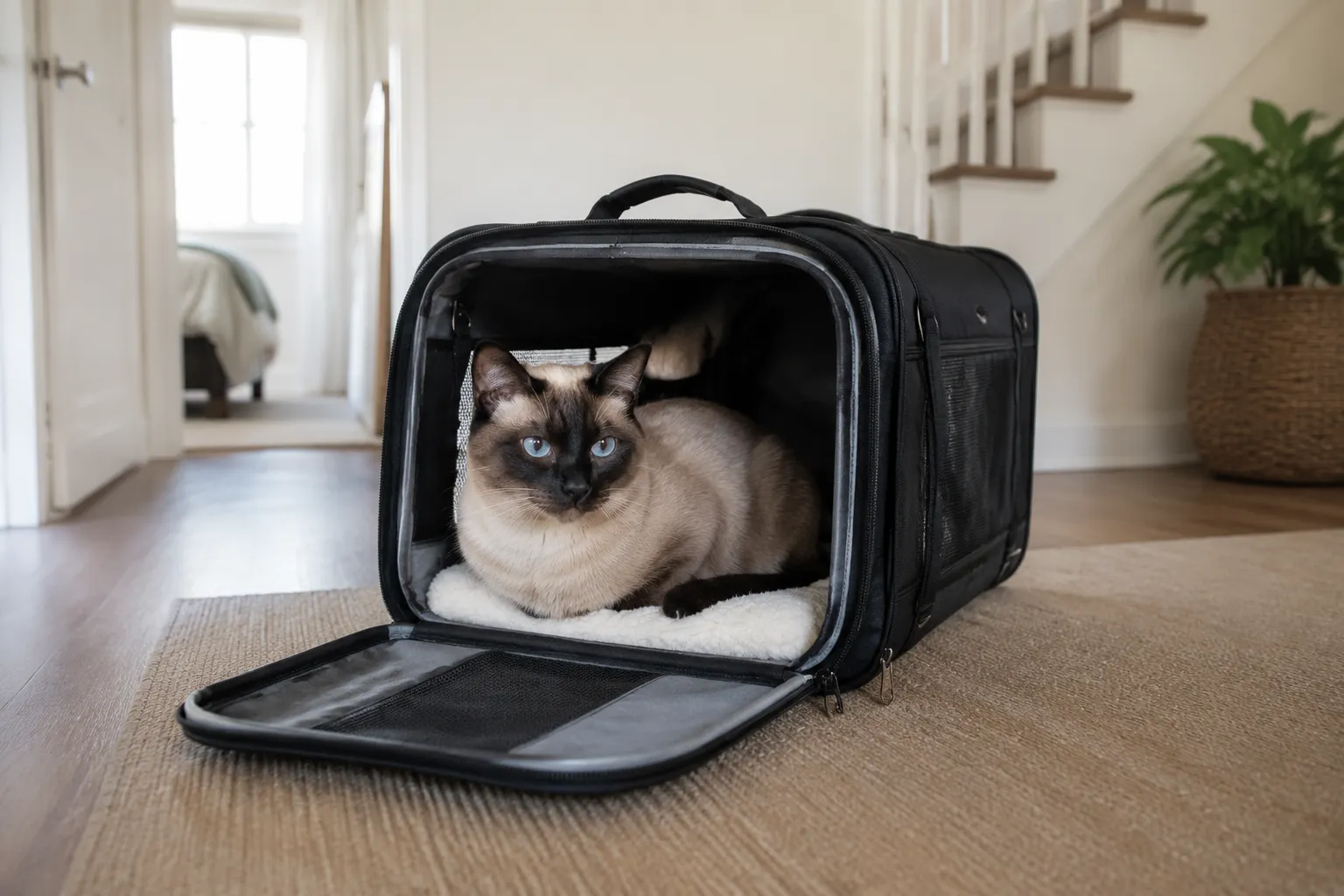
A 2022 survey published in the Journal of Feline Medicine and Surgery found that 78% of cat owners delay or skip veterinary appointments entirely because of the stress involved in getting their cat into a carrier—and in multi-cat households with Siamese, that number climbs higher. Picture the scene: three carriers lined up by the front door like lugage for a trip nobody wants to take, and one blue-eyed Siamese already vocalizing from two rooms away because she's mapped the pattern. Siamese cat vet visit stress isn't just an inconvenience—it's a cascade event that disrupts every cat in the household for hours, sometimes days.
Quick Takeaways
- Siamese stress responses are neurologically distinct — their vocal reactivity triggers cortisol spikes in housemates, not just themselves
- Carrier anxiety is spatial, not object-based — cats fear the loss of territory control, and the fix starts3 weeks before the appointment
- The "single cat extraction" method backfires — isolating one cat for transport destabilizes the entire group's scent map
- Scent-anchoring your carrier reduces loading time by up to 60% when done consistently over 14 days
- Celebrate your cat's personality between visits with a custom 3D-printed figurine that captures the exact expression you love most
The Counterintuitive Problem: Your Siamese Isn't the Difficult One
Here's what most multi-cat household guides get wrong. They frame the Siamese as the "problem cat"—the loud one, the dramatic one, the one who makesvet day a nightmare. But if you trace the stress cascade backward, the Siamese is usually the indicator, not the source.
Think of it spatially. Your home is a territory map with invisible boundaries negotiated daily between every cat in the household. Each cat owns certain perches, certain pathways, certain times of day when specific rooms belong to them. When you pull out carriers—even one carrier—you've just announced that the spatial contract is about to be violated.
Your Siamese screams about it. Your other cats internalize it. But the disruption hits everyone simultaneously.
"The loudest cat in the room isn't always the most stressed—they're just the one telling you what every cat is feeling."
The real science behind stress-free vet visits for multi-cat households starts with understanding that you're not managing one cat's anxiety. You're managing an ecosystem.
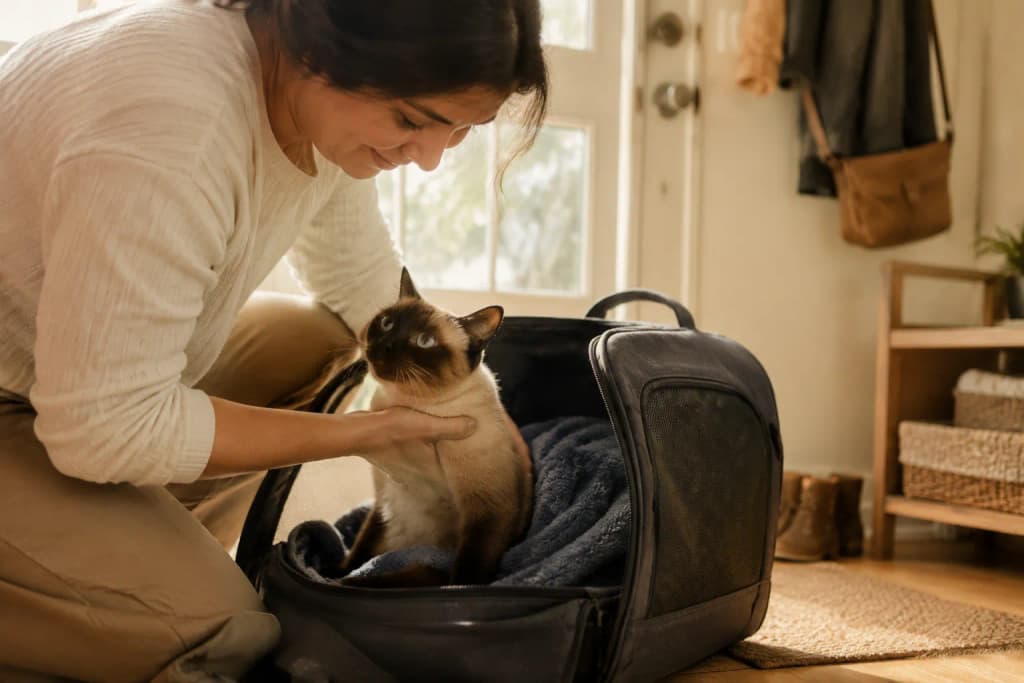
The Neurochemistry of Siamese Vocal Stress (And Why It's Contagious)
Siamese cats carry a genetic predisposition toward vocal reactivity that's linked to their temperature-sensitive albinism gene. The same genetic pathway that gives them their pointed coloring also influences neural development in ways that make them more communicative under stress. This isn't personality—it's hardware.
When a Siamese vocalizes in distress, the sound frequency (typically between 500-800 Hz in an agitated Siamese) falls within a range that triggers alertness responses in other cats. In a multi-cat household, one Siamese yowling in a carrier creates a sympathetic cortisol response in every cat within earshot.
Here's the cause-and-effect chain:
- You bring out the carrier → Siamese recognizes the pattern
- Siamese begins vocalizing → other cats' cortisol rises within 90 seconds
- Elevated cortisol in housemates → territorial anxiety increases
- Territorial anxiety → cats begin guarding resources (food bowls, litter boxes, hiding spots)
- Resource guarding → inter-cat tension that can persist24-72 hours after the vet visit
This is why "just get through it" isn't a strategy. Thevet visit stress doesn't end when you get home. It echoes through the household's social structure for days.
What the Research Actually Shows About Carrier Anxiety
The ASPCA's behavioral resources confirm that carrier aversion in cats is a learned spatial fear, not an innate one. Kittens exposed to carriers as neutral objects before12 weeks of age rarely develop carrier anxiety. But for adult cats—especially Siamese who've already had negative carrier associations—the fix requires understanding what they're actually afraid of.
It's not the box. It's the loss of spatial agency.
A cat in a carrier cannot:
- Choose their distance from threats
- Access escape routes
- Maintain visual control of their environment
- Regulate their own temperature through movement
For a Siamese—a breed that relies heavily on vocal communication to manage social space—being confined means losing their primary coping tool. They vocalize harder because it's the only agency they have left.
| Stress Factor | What Owners Think | What's Actually Happening |
|---|---|---|
| Carrier resistance | "My cat hates the carrier" | Cat is losing spatial control and escape options |
| Loud vocalization | "She's being dramatic" | Vocal attempt to re-establish social agency |
| Post-vet aggression | "He's mad at me" | Scent profile disruption causing non-recognition |
| Hiding after return | "She needs alone time" | Attempting to re-establish territorial boundaries |
| Litter box avoidance | "Stress behavior" | Scent-marking territory that feels compromised |
Preparing Your Multi-Cat Household: The21-Day Protocol
Most guides tell you to "leave the carrier out" so your cat gets used to it. That's step one of a twelve-step process, and on its own, it accomplishes almost nothing for an adult Siamese with established carrier aversion.
Here's the protocol that actually works, broken into three phases. The timeline matters—start this 21 days before your scheduled appointment.
Phase 1: Spatial Neutralization (Days 1-7)
The goal isn't to make your cat like the carrier. It's to make the carrier invisible within the territory map.
Day 1-3: Place the carrier (door removed entirely, not just open) in a location your Siamese already claims. Not a hallway. Not by the front door. In their spot—near their preferred sleeping area or beside the window perch they use most.
Day 4-5: Place a worn t-shirt of yours inside the carrier. Not a blanket that smells like thevet's office from last time. Something that smells like the household's primary human.
Day 6-7: Begin feeding treats within a 3-foot radius of the carrier. Not inside it yet. Just near it. You're shrinking the "threat zone" gradually.
Personal Aside: We've talked to dozens of multi-cat household owners through our work at PawSculpt, and the number one thing they tell us is that they tried the "leave the carrier out" advice for exactly one day before giving up. Seven days feels long. It isn't. Your Siamese has been building carrier associations for years—a week of counter-conditioning is the minimum investment.
Phase 2: Voluntary Entry Conditioning (Days 8-14)
Now you're building positive spatial associations with the interior of the carrier.
The critical rule: Your Siamese must enter voluntarily every single time during this phase. Zero exceptions. If you place them inside, you've reset the clock.
- Scatter high-value treats (freeze-dried chicken, not kible) just inside the carrier entrance
- Move the treat placement2 inches deeper every2 days
- If your Siamese reaches in with one paw but won't enter, that's progress—don't push
- For multi-cat households: let other cats investigate the carrier too. This is important. If only the Siamese interacts with the carrier, it becomes "their problem" in the group dynamic
The scent-anchoring technique: Take a soft cloth, rub it along your Siamese's cheeks (where facial pheromones concentrate), then place it inside the carrier. This marks the carrier as "claimed territory" rather than "foreign space."
By day 14, most Siamese will voluntarily nap in or near the carrier if you've been consistent. If yours won't enter fully, extend this phase another week rather than forcing Phase 3.
Phase 3: Movement Desensitization (Days 15-21)
This is where most people fail because they skip straight to "put cat in carrier, go to car."
The sequence:
- Day 15-16: Close the carrier door with your Siamese inside for 30 seconds. Open immediately. Treat heavily.
- Day 17-18: Close door for 2-3 minutes. Stay in the same room. Talk normally.
- Day 19: Lift the carrier 6 inches off the ground. Set it back down. Open door.
- Day 20: Carry the carrier to another room. Return. Open door.
- Day 21: Carry to the car. Sit in the car for 5 minutes (engine off). Return inside. Open door.
Each step must be completed without significant distress vocalization before moving to the next. For Siamese, "significant" means sustained yowling (more than 3-4 consecutive vocalizations). Brief meows of confusion are normal and acceptable.
"A carrier should feel like a portable territory, not a trap. The difference is whether your cat chose to be there."
The Multi-Cat Extraction Problem Nobody Talks About
Here's the counterintuitive insight that changes everything for multi-cat households: taking one cat to the vet disrupts the group more than taking all of them.
The logic seems backward. You'd think removing one cat would be less stressful for the others. But here's what actually happens neurochemically:
When Cat A leaves the household, Cats B and C experience a territory vacuum. Spaces that Cat A occupied are suddenly unclaimed. This triggers exploratory behavior, scent-marking, and sometimes redirected aggression as the remaining cats renegotiate boundaries.
Then Cat A returns smelling like the veterinary clinic—alcohol, other animals, latex fear pheromones from the waiting room. Cats B and C don't recognize Cat A's scent profile. In approximately 40% of multi-cat households, this triggers non-recognition aggression that can take days to resolve.
For Siamese specifically, the problem compounds because they rely on vocal recognition as much as scent. A stressed Siamese returning from the vet vocalizes differently—higher pitch, more rapid cadence—which other cats interpret as an unfamiliar or threatening presence.
The Group Transport Solution
If your multi-cat household has 2-3 cats, consider transporting all of them simultaneously, even if only one has an appointment. The benefits:
- No territory vacuum forms at home
- All cats maintain their scent group
- The returning cat doesn't smell "foreign" relative to housemates
- Siamese vocal stress is lower when familiar cats are nearby (even in separate carriers)
This isn't always practical, obviously. If you can't transport everyone, use the scent buffer protocol instead:
| Step | Timing | Action Purpose | |
|---|---|---|---|
| 1 | Before departure | Rub a cloth on ALL cats, place in traveling cat's carrier | Maintains group scent |
| 2 | During absence | Don't clean or disturb the absent cat's sleeping spots | Preserves territorial markers |
| 3 | Upon return | Place carrier in a closed room for 30 minutes | Allows stress hormones to dissipate |
| 4 | After 30 min | Rub returning cat with the group scent cloth | Restores familiar scent profile |
| 5 | Reintroduction | Open the door but don't force interaction | Lets cats re-establish on their terms |
The Waiting Room Problem: Why Your Prep Work Unravels in 10 Minutes
You've done the 21-day protocol. Your Siamese entered the carrier calmly. The car ride was quiet. And then you walk into the veterinary waiting room and everything falls apart.
The waiting room is an olfactory assault for any cat, but especially for Siamese. Their heightened neural reactivity means they process environmental stressors faster and more intensely. A typical veterinary waiting room contains:
- Fear pheromones from dozens of previous patients (cats release these from their paw pads)
- Dog vocalizations at frequencies that trigger prey-alertness responses
- Chemical cleaning agents that mask but don't eliminate stress scent markers
- Other cats' distress vocalizations
The spatial problem is acute: your cat is confined in a carrier, in an unfamiliar room, surrounded by threat signals, with zero escape options. Every survival instinct fires simultaneously.
Science-Backed Waiting Room Strategies
1. Skip the waiting room entirely. Many veterinary practices now offer "cat-friendly" scheduling or will let you wait in your car and text when the exam room is ready. Ask If yourvet doesn't offer this, it's worth finding one who does—the American Association of Feline Practitioners maintains a directory of Cat Friendly Practices.
2. Carrier positioning matters. Place the carrier on a raised surface (chair or counter), not on the floor. Cats feel more vulnerable at ground level. Face the carrier toward a wall, not toward the room. Reducing visual input reduces cortisol production.
3. The towel drape technique. Cover the carrier with a towel that carries your home scent. This creates a visual barrier and a scent cocoon simultaneously. For Siamese, this also muffles incoming sounds slightly, which reduces vocal reactivity.
4. Synthetic pheromone application. Apply a feline facial pheromone spray (like Feliway) to the carrier towel 15 minutes before arrival. The timing matters—applying it immediately before use means the alcohol carrier hasn't evaporated yet, which cats find aversive.
5. Your own calm matters more than you think. Cats read human tension through grip pressure, breathing rate, and voice pitch. If you're anxious about the visit, your Siamese knows. Practice carrying the carrier with relaxed shoulders and normal breathing. It sounds trivial. It isn't.
"We've noticed that the pet owners who handlevet visits most gracefully are the ones who've built rituals around their cat's identity—they know their cat so well that they can predict and prevent the stress spiral before it starts."
— The PawSculpt Team
The Post-Visit Recovery Window Most Owners Ignore
The appointment is over. You're home. Your Siamese is out of the carrier and hiding under the bed. Most owners consider this the end of the process.
It's actually the beginning of the most critical phase.
The 48-hour post-visit window determines whether your next vet visit will be easier or harder. What happens in this window either reinforces the negative association or begins building resilience.
The First 2 Hours
Don't pursue your Siamese. Don't try to comfort them. Don't offer treats immediately. Here's why: a stressed cat's cortisol levels remain elevated for approximately90-120 minutes after the stressor ends. During this window, any interaction—even positive interaction—gets encoded alongside the stress response.
Let your Siamese choose when to emerge. When they do, act completely normal. Not overly affectionate. Not apologetic. Normal. You're communicating that nothing in the household has changed.
Hours 2-24: Scent Restoration
This is when you actively rebuild the territorial scent map:
- Don't wash beding that your Siamese used before the visit. They need to find their own scent markers intact.
- Rub a soft cloth along your Siamese's cheeks and then along furniture, doorframes, and other cats. You're manually distributing facial pheromones that say "this is home, this is safe."
- Monitor inter-cat interactions closely. If housemates are hissing at the returning cat, separate them with a closed door and use the scent buffer protocol from the table above.
Hours 24-48: Positive Overlay
Now you can begin creating positive associations to overlay thevet experience:
- Offer a novel high-value food (something they don't get regularly)
- Initiate play with their preferred toy—for Siamese, this is often interactive wand toys that satisfy their high prey drive
- If your Siamese is food-motivated, scatter treats inside the carrier (door removed again). You're immediately beginning the next cycle of carrier neutralization.
The goal across these48 hours is simple: make the ratio of positive-to-negative carrier associations as lopsided as possible before the next visit.
Building Long-Term Resilience: The Monthly Maintenance Protocol
One21-day prep cycle before each vet visit isn't sustainable. What works better is a monthly maintenance routine that keeps carrier associations neutral year-round.
Here's what that looks like in practice:
Weekly (5 minutes):
- Scatter 2-3 treats inside the carrier
- Leave the carrier in its "home position" (wherever your Siamese claimed it during Phase 1)
Bi-weekly (10 minutes):
- Close your Siamese in the carrier for 2-3 minutes while you're in the same room
- Carry the carrier to another room and back
- Open, treat, done
Monthly (20 minutes):
- Full car simulation: carrier to car, 5-minute drive around the block, return home
- This is the single most effective long-term desensitization tool, and almost nobody does it
The monthly car ride is the game-changer. It breaks the association between "car = vet." When90% of car rides end with returning home and getting treats, the car stops being a reliable predictor of veterinary stress.
| Frequency | Activity | Duration | What It Prevents |
|---|---|---|---|
| Weekly | Treats in carrier | 5 min | Carrier re-aversion |
| Bi-weekly | Brief confinement + carry | 10 min | Door-closing panic |
| Monthly | Car ride (no destination) | 20 min | Car-tovet association |
| Quarterly | "Happy visit" to vet (no exam) | 30 min | Clinic-specific fear |
That last row—the quarterly "happy visit"—is worth explaining. Many cat-friendly veterinary practices will let you bring your cat in just to sit in the exam room, get treats from staff, and leave. No poking, no prodding. Just positive exposure. Call your vet and ask if they offer this. If they look at you like you're strange, consider finding a practice that understands feline behavioral science.
The Overlooked Connection Between Daily Life and Vet Day Success
Here's something that won't appear in any standard "how to prepare Siamese for vet" article: the cats who handle vet visits best are the ones whose owners maintain rich environmental engagement every single day.
The logic is straightforward. A cat with high environmental confidence—one who regularly encounters novel stimuli, solves problems, and exercises agency over their space—has a larger "window of tolerance" for stressful events. Their baseline cortisol is lower. Their recovery time is faster. Their threshold for panic is higher.
For Siamese specifically, this means:
- Daily interactive play (minimum 15 minutes of wand-toy or chase play)
- Puzzle feeders that engage their above-average problem-solving drive
- Vertical space — cat trees, shelves, window perches that let them survey their territory from height
- Novel scent enrichment — bringing in a leaf from outside, a pinecone, a stick. Something that smells like "not home" in a safe context.
Each of these builds what behaviorists call frustration tolerance—the ability to encounter something unexpected without immediately escalating to panic. A Siamese who regularly encounters safe novelty is a Siamese who can tolerate the carrier, the car, and the clinic with less cortisol flooding.
This is also, honestly, where celebrating your cat's personality becomes part of the health equation. Owners who deeply observe their cats—who notice the specific head tilt, the particular way their Siamese wraps their tail when curious versus anxious—are better equipped to read early stress signals and intervene before the cascade begins.
We see this at PawSculpt constantly. The customers who send us the most detailed photos for their custom pet figurines—noting the exact angle of an ear, the specific pattern of a facial marking—are invariably the owners who know their cats deeply enough to manage stress proactively. That level of observation isn't just sentimental. It's functional.
When the Science Isn't Enough: Pharmaceutical Options
Let's be direct: some Siamese cats have anxiety levels that behavioral protocols alone cannot adequately address. If your cat experiences:
- Urination or defecation in the carrier despite full desensitization protocol
- Self-injurious behavior (excessive groming to the point of hair loss before vet visits)
- Aggression toward owners during carrier loading that risks human injury
- Refusal to eat for 24+ hours after vet visits
...then it's time to discuss pharmaceutical support with your veterinarian. This isn't failure. It's appropriate medical intervention.
The most commonly prescribed options for situational feline anxiety include:
- Gabapentin (most widely recommended forvet visit anxiety—given 90 minutes before the appointment)
- Trazodone (sometimes used in combination with gabapentin for severe cases)
- Alprazolam (less commonly prescribed but effective for some cats)
We're not vets, and dosing decisions belong entirely to your veterinary team. But we'll say this: the stigma around "medicating your cat for a vet visit" is outdated. A cat who arrives at the clinic calm enough to be examined properly gets better medical care. Period. The exam is more thorough. The vet can palpate without resistance. Blood pressure readings are more accurate. Everyone—cat, owner, veterinary staff—benefits.
If your veterinarian isn't open to discussing pre-visit pharmaceuticals for a demonstrably anxious Siamese, that's worth a conversation about whether this practice is the right fit for your cat's needs.
Choosing a Vet Practice That Works With Feline Neurology, Not Against It
Not all veterinary practices are created equal when it comes to cat stress management. Here's what to look for:
Spatial design:
- Separate waiting areas for cats and dogs (or at minimum, visual barriers)
- Exam rooms with elevated surfaces where carriers can be placed
- Quiet rooms without barking audible through walls
Scheduling practices:
- Cat-only appointment blocks
- Longer appointment slots (rushed exams increase stress for everyone)
- Option to wait in car until room is ready
Handling philosophy:
- Fear-free or low-stress handling certification
- Willingness to let cats aclimate to the exam room before handling
- Towel-wrapping techniques rather than scruffing
- Acceptance of pre-visit pharmaceuticals without judgment
Staff training:
- Understanding that a hissing cat is a scared cat, not an aggressive cat
- Patience with Siamese vocalization (not interpreting volume as aggression)
- Willingness to pause or reschedule if a cat is too stressed for a productive exam
The right practice makes your21-day prep protocol actually pay off. The wrong practice canundo months of desensitization work in a single visit.
The Bigger Picture: Stress-Free Vet Visits as a Quality of Life Investment
Let's zoom out. The average indoor cat lives 12-18 years. If they visit the vet twice annually (the minimum recommended for adult cats, more for seniors), that's 24-36 vet visits in a lifetime. For a multi-cat household with three cats, you're looking at 72-108 total veterinary transport events over the life of your household.
Each one of those events either builds resilience or builds aversion. There's no neutral. Every vet visit is either making the next one easier or harder.
The investment in proper preparation—the 21-day protocol, the monthly maintenance, the right veterinary practice—pays compound interest over your cat's entire life. A Siamese who learns at age 2 that carriers and cars are neutral experiences is a Siamese who can receive proper geriatric care at age 15 without the owner having to choose between "skip the vet" and "traumatize my elderly cat."
That's not a small thing. Preventive veterinary care catches kidney disease, hyperthyroidism, dental disease, and cancer earlier. Earlier detection means more treatment options, less suffering, and often more time together.
The work you do now—the boring, repetitive, treat-scattering, carrier-normalizing, car-ride-practicing work—is quite literally an investment in your Siamese's longevity.
And look, between vet visits, there's something to be said for simply appreciating the cat in front of you. The specific way your Siamese tilts their head. The exact shade of their seal point markings. The particular chirp they make when birds appear at the window. These details matter—not just emotionally, but practically. Knowing your cat this intimately is what makes you capable of detecting the subtle behavioral shifts that signal illness early.
Whether you capture those details in photographs, in journal entries, or in a full-color 3D-printed figurine that sits on your desk as a daily reminder of who you're doing all this work for—the observation itself is the point.
Frequently Asked Questions
How do I reduce Siamese cat vet visit stress in a multi-cat home?
Start the desensitization protocol 21 days before your appointment. Use scent-anchoring (rubbing facial pheromones onto carrier surfaces), transport all cats together when possible, and implement the 48-hour post-visit recovery protocol to prevent inter-cat aggression. The combination of spatial neutralization, voluntary entry conditioning, and movement desensitization addresses the root causes rather than just the symptoms.
Why does my Siamese scream in the carrier but my other cats stay quiet?
Siamese cats have a genetic predisposition toward vocal reactivity that's linked to the same gene responsible for their pointed coloring. When confined, vocalization is their primary tool for re-establishing social agency. Your other cats may be equally stressed but express it through freezing, hiding, or subtle body language changes rather than sound.
Should I take all my cats to the vet even if only one has an appointment?
In many cases, yes. Removing one cat creates a territory vacuum that destabilizes the remaining cats' spatial agreements. When the vet-scented cat returns, approximately 40% of multi-cat households experience non-recognition aggression. Transporting the group together maintains scent cohesion and reduces this risk significantly.
How long does it take to desensitize a Siamese cat to a carrier?
The minimum effective protocol is 21 days, divided into spatial neutralization (days 1-7), voluntary entry conditioning (days 8-14), and movement desensitization (days 15-21). However, monthly maintenance—weekly treats in the carrier, bi-weekly brief confinement, monthly car rides—is essential to prevent regression between appointments.
Is it okay to give my cat medication before vet visits?
Absolutely. Pre-visit pharmaceuticals like gabapentin (administered 90 minutes before the appointment) are widely endorsed by veterinary behaviorists for cats with significant anxiety. A calmer cat receives better medical care—more accurate vitals, more thorough physical exams, and less risk of injury to cat and staff alike.
How do I prevent my cats from fighting after one returns from the vet?
Use the scent buffer protocol: isolate the returning cat in a closed room for 30 minutes, rub them with a cloth that carries the household group scent, then open the door without forcing interaction. Don't wash the absent cat's bedding during their absence, and monitor interactions closely for48 hours.
Ready to Celebrate Your Pet?
Managing Siamese cat vet visit stress in a multi-cat household is ongoing work—work that comes from knowing your cat deeply, observing them closely, and respecting the complexity of their inner world. That same deep observation is what makes a truly meaningful kepsake. A custom PawSculpt figurine captures the exact details that make your Siamese uniquely themselves—the specific ear set, the precise point coloring, the expression that only you recognize.
Visit pawsculpt.com to explore the full process, preview options, and service details