
13 Memorial Garden Ideas for Your Husky (And 5 Plants That Won't Survive Your Climate)
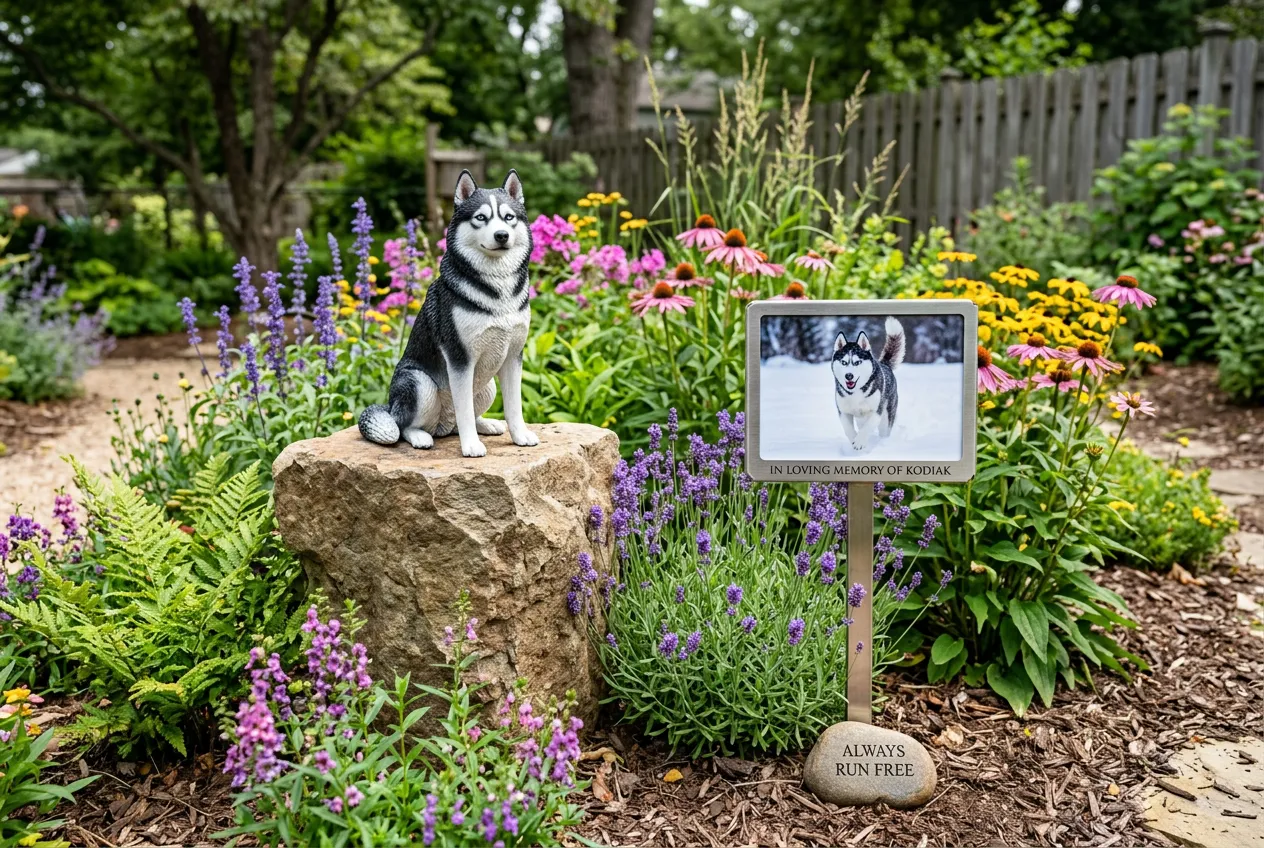
A 2019 survey by the Human Animal Bond Research Institute found that 94% of pet owners consider their pet part of the family—yet fewer than 12% have a dedicated space at home to honor a pet who's passed. If you've been walking a familiar trail lately, the one your husky used to pull you down with that absurd, joyful force, and you've started imagining what a husky memorial garden might look like in your own backyard, you're already further along than you think.
Quick Takeaways
- Match plants to your USDA hardiness zone first — a gorgeous memorial garden means nothing if everything dies by October
- Design for all four senses, not just sight — sound, texture, and movement honor a husky's restless spirit best
- Skip the generic stepping stones — personal, weather-resistant elements like custom pet figurines create focal points that actually last
- Plan for your climate's worst season, not its best — a garden that only looks alive in June isn't a memorial, it's a seasonal display
- Include at least one interactive element — something you touch, turn, or tend, because grief needs somewhere to put your hands
Why a Husky Memorial Garden Is Different From Any Other Pet Garden
Here's what most "pet memorial garden" articles won't tell you: designing a memorial space for a husky is fundamentally different from designing one for, say, a golden retriever or a cat. And no, it's not just about the wolf aesthetic (though we'll get there).
Huskies are movement. They're sound. They're the scratch of nails on hardwood at 5 AM, the low conversational "woo-woo" that wasn't quite a bark, wasn't quite a howl. They're the sound of your back door slamming because they figured out the latch again.
A static garden with a stone angel and some hostas? That's not your husky. Your husky was wind and chaos and fur tumbleweeds the size of small animals rolling across your patio.
So the outdoor pet memorial you build needs to move. It needs texture. It needs elements that catch the breeze and make noise and remind you of that specific, glorious brand of mayhem.
Most guides will hand you a list of pretty flowers and a link to a garden center. We're going to do something different. We're going to build a memorial that actually feels like your dog lived there.
The 13 Memorial Garden Ideas (Ranked by Emotional Impact, Not Pinterest Appeal)
1. A Wind Garden Anchor Point
Forget wind chimes for a second—think bigger. A wind garden uses ornamental grasses, tall perennials, and strategically placed kinetic sculptures to create constant, visible movement. For a husky, this is everything.
Plant Karl Foerster feather reed grass (hardy in zones 3–9) as your backbone. It sways in the slightest breeze, catches light like fur, and makes a soft rustling sound that's eerily close to the whisper of a double coat brushing past your leg. Pair it with a single kinetic wind spinner—copper or stainless steel—placed where your husky's favorite outdoor resting spot was.
Why it matters: Stillness is the cruelest part of loss. A wind garden never stops moving.
2. A Howling Post
This one's counterintuitive, and we've never seen it in another guide. Find a weathered wooden post—cedar or locust, something that won't rot—and install it vertically in your garden, about 4 feet tall. Wrap the base with river stones. That's it.
The post represents the spot. Every husky owner knows about the spot—the place in the yard where your dog would plant themselves and howl at sirens, at the moon, at absolutely nothing. Mark it. Let it stand there, unapologetic and a little weird, the way your husky was.
You can attach a small weather-resistant memorial plaque at the top, or leave it bare. Either way, you'll know what it means.
3. A Dig Zone Memorial Bed
Your husky dug holes. Probably a lot of them. Probably in places that made you want to scream. Here's your chance to turn that memory into something beautiful.
Create a sunken garden bed—literally dig a shallow depression (8–12 inches deep, 3–4 feet across) and line it with gravel for drainage. Fill it with low-growing, hardy ground covers like creeping thyme (zones 4–9) or woolly thyme (zones 5–8). The sunken shape is the tribute. The fact that something beautiful now grows in a "hole" is the whole point.
"The things that drove you crazy become the things you miss first. Build your garden around those."
4. A Zoomie Path
If you had a husky, you had a zoomie track—that worn-down oval or figure-eight in your yard where your dog ran full-tilt for no reason at all. Formalize it.
Lay a narrow path of stepping stones or pea gravel in the exact route your husky used to run. Plant low borders of blue star creeper (zones 6–9) or creeping phlox (zones 3–9) along the edges. The path doesn't need to go anywhere. That's the point. Your husky's zoomie track never went anywhere either.
Walk it sometimes. Slowly, the way your husky never did.
5. A Seasonal Color Wheel Garden
This is where climate matters enormously, and where most memorial garden guides fail you. A seasonal color wheel ensures something is always blooming or showing color in your memorial space—but only if you choose plants rated for your zone.
Here's a planning table for common husky-owner climates:
| Season | Zones 3–5 (Northern/Cold) | Zones 6–7 (Mid-Range) | Zones 8–9 (Southern/Warm) |
|---|---|---|---|
| Spring | Siberian iris, crocus | Bleeding heart, tulips | Azalea, ranunculus |
| Summer | Black-eyed Susan, daylily | Coneflower, lavender | Lantana, salvia |
| Fall | Aster, sedum 'Autumn Joy' | Japanese anemone, mums | Mexican sage, firebush |
| Winter | Red twig dogwood (stems) | Winterberry holly | Camellia, cyclamen |
The goal is zero dead months. Your memorial space should never look abandoned.
6. A Fur-Colored Planting Scheme
Match your plantings to your husky's coat. This sounds precious, but it's devastatingly effective.
- Black and white husky: Silver-leafed plants (lamb's ear, dusty miller) paired with dark foliage (black mondo grass, 'Diabolo' ninebark)
- Red/copper husky: Coral bells in amber tones, copper sedge grass, orange coneflower
- Agouti/wolf gray: Russian sage (silvery-blue), blue fescue grass, 'Moonshine' yarrow
- All white: White garden concept—white phlox, Shasta daisies, 'Annabelle' hydrangea, white bleeding heart
When someone asks why you chose those specific colors, you get to say your dog's name. That matters more than you'd think.
7. A Sound Stone Fountain
Not a big, splashy fountain. A sound stone—a single boulder with a drilled core that recirculates water over its surface. The sound is quiet, constant, a soft gurgle that fills the space where your husky's breathing used to be.
Place it near a seating area. The sound gives your brain something to rest on when you sit out there and the quiet gets too heavy.
Budget reality: Sound stones range from $150–$600 depending on size and stone type. A basic recirculating pump kit runs another $30–$60. This is a one-time investment that requires minimal maintenance—just keep the reservoir filled.
8. A Snow Shadow Garden (For Cold Climates)
This one's specifically for those of you in zones 3–6 who watched your husky come alive in winter. Design a section of your memorial garden to look its best under snow.
Use structural plants—ornamental grasses left uncut through winter, red or yellow twig dogwood for stem color, and evergreen dwarf conifers for shape. When snow falls, these elements create shadows, color contrasts, and silhouettes that transform your garden into exactly the kind of landscape your husky loved most.
Your husky didn't care about your July roses. They cared about snow. Honor that.
9. A Weatherproof Figurine as the Garden's Centerpiece
Here's where we'll be honest about something most memorial garden guides gloss over: living plants die. They go dormant. They get eaten by deer. They succumb to drought or an unexpected late frost. A garden built entirely around plants will, at some point, look bare and sad—and that bare, sad moment will hit you harder than you expect.
That's why the most resilient memorial gardens include at least one permanent, non-living focal point. Something that looks the same in January as it does in July.
A custom 3D-printed pet figurine works exceptionally well here. PawSculpt's figurines are produced using full-color resin 3D printing, where the color is embedded directly into the material—not applied on top—which means UV exposure and rain don't strip the detail the way paint would fade on a traditional statue. The figurine captures your husky's actual markings, the specific pattern of their mask, the exact shade of their eyes.
Place it on a flat stone pedestal within your garden, perhaps at the center of the zoomie path or beside the sound stone. It becomes the anchor—the thing that's always there, always recognizable, always them, even when the garden sleeps.
"A memorial garden needs a heart that doesn't go dormant. Something permanent that holds the space when the flowers can't."
— The PawSculpt Team
10. A Husky-Height Seating Area
Build or place a bench, chair, or even a flat-topped boulder at a height where, if you sat down, a husky's head would be level with your hand. For most huskies, that's about 20–24 inches from the ground to the seat surface.
This is the kind of detail that sounds strange until you sit there and your hand falls to your side and lands at exactly the right height. Your muscle memory knows. Let it.
11. A Nighttime Memorial Element
Most gardens are designed for daylight. But if you're grieving, you know that nighttime is when it's loudest inside your head. Give yourself a reason to go outside after dark.
Options:
- Solar path lights along the zoomie path (warm white, not blue-white)
- A single solar spotlight on the figurine or howling post
- Glow-in-the-dark garden stones scattered through a ground cover bed
- A fire pit area adjacent to the memorial space (because your husky probably loved lying near outdoor fires)
The nighttime version of your garden should feel like a different, quieter conversation with the same dog.
12. A Scent Border
Huskies live through their noses. Plant a border of fragrant, hardy plants that release scent when you brush past them:
- Lavender (zones 5–9) — releases scent on contact
- Catmint (zones 3–8) — incredibly hardy, fragrant when brushed
- Creeping thyme (zones 4–9) — releases scent when stepped on
- Russian sage (zones 4–9) — aromatic foliage, silvery-blue color
Plant these along the edges of paths so you physically interact with them every time you walk through. The scent becomes part of the ritual.
13. A "Last Walk" Entrance
Design a deliberate entrance to your memorial garden—even if it's just two tall plants flanking a gap in a border, or a small arbor. The entrance marks a transition. You're stepping from your regular yard into their space.
If your husky had a favorite walking trail, consider mimicking elements of that trail at the entrance. Pine bark mulch if it was a forest trail. River stones if it was near water. Sand and beach grass if you walked the coast.
The entrance says: I'm here. I came to visit you.
5 Plants That Won't Survive Your Climate (And What to Plant Instead)
This is the section that will save you real money and real heartbreak. Nothing compounds grief like watching a memorial plant die because you bought it based on a Pinterest photo instead of your USDA hardiness zone.
If you don't know your zone, the USDA Plant Hardiness Zone Map takes 10 seconds to check. Do it now. Seriously.
| The "Pinterest Plant" | Zones Where It Dies | Why It Fails | Climate-Appropriate Alternative |
|---|---|---|---|
| Japanese maple | Zones 3–4 (too cold) | Can't survive below -30°F | Amur maple or staghorn sumac |
| Lavender (English) | Zones 2–4 (too cold), 9–10 (too humid) | Needs dry winters, moderate summers | Catmint (zones 3–8) or rosemary (zones 8–10) |
| Hydrangea macrophylla | Zones 3–4 (dies back completely) | Flower buds freeze on old wood | 'Annabelle' hydrangea (blooms on new wood, zones 3–9) |
| Crepe myrtle | Zones 3–6 (too cold) | Needs long, hot summers | Ninebark or viburnum for similar structure |
| Gardenia | Zones 3–7 (too cold) | Needs consistent warmth, acidic soil | Mock orange (zones 4–8) for fragrance |
The Counterintuitive Truth About "Hardy" Plants
Here's something garden centers won't volunteer: a plant labeled "hardy to zone 5" might survive in zone 5, but it won't thrive. It'll look stressed, produce fewer blooms, and be the first thing to die in an unusual cold snap.
The real move is to plant one full zone hardier than your actual zone. If you're in zone 6, choose plants rated for zone 5. You'll get healthier plants, more blooms, and far less replacement heartbreak.
A memorial garden you have to constantly replant isn't a memorial. It's a chore. And chores don't heal anything.
The Emotions Nobody Warns You About When Building a Memorial Garden
You'll start this project thinking it's about plants and stones and design. It's not. It's about spending extended time in a space that used to belong to your dog, making deliberate decisions about how to remember them, and sitting with feelings that don't have clean edges.
The Fear of Forgetting
Here's the one that wakes you up at 3 AM: What if I forget what they sounded like?
Not the howl—you'll remember the howl. But the small sounds. The sigh when they finally lay down after circling four times. The specific pitch of their whine when they wanted your attention. The click-click-click of nails on tile that you can almost hear in the kitchen if the house is quiet enough.
This fear is extraordinarily common, and it's one of grief's sharpest edges. You're not losing your mind. You're not being dramatic. The terror of forgetting sensory details—the specific sound of your dog existing in your space—is something almost every pet owner experiences but rarely says out loud.
A memorial garden helps because it gives those memories a physical address. When you sit in that space, the memories come easier. They have somewhere to land.
"You don't build a memorial garden to remember. You build it because you're terrified you'll forget—and the garden becomes proof that you won't."
The Guilt That Follows Relief
Some of you are carrying something heavier than sadness. Your husky was old. Or sick. Maybe the last months were brutal—the medications, the midnight accidents, the slow disappearance of the dog you knew. And when it was finally over, you felt something you weren't prepared for.
Relief.
And then, immediately, crushing guilt for feeling relieved.
That wave of relief doesn't make you a monster. It makes you someone who watched their best friend suffer and carried that weight every single day. The guilt that chases the relief is one of grief's cruelest tricks—it takes the most compassionate thing you felt and turns it into evidence against you.
You are not guilty. You are exhausted. There's a difference.
Building something in their honor—something that requires your time, your attention, your care—can help quiet that guilt. Not because you owe them a garden. But because the act of building gives your hands something to do besides wring themselves.
The Judgment You Feel From Others
"It was just a dog."
If someone has said this to you—or if you've felt them thinking it—you already know the specific, burning isolation of having your grief minimized. The AVMA recognizes pet loss grief as a legitimate and significant emotional experience, but that doesn't always help when your coworker raises an eyebrow at your red eyes on a Monday morning.
A memorial garden is, among other things, a declaration. It says: This mattered. This was real. I will take up space with my grief, and I will make it beautiful.
You don't owe anyone an explanation for that.
A Counter-Point: When a Memorial Garden Isn't the Right Move (Yet)
We'd be dishonest if we didn't say this: not everyone should build a memorial garden right away.
If you're in the first few weeks of loss and every time you look at the backyard you feel like you've been punched, forcing yourself into a landscaping project isn't healing—it's avoidance dressed up as productivity.
Some signs you might want to wait:
- You can't walk past their food bowl without breaking down (the raw phase needs space, not projects)
- You're making the garden to prove something to someone else
- The idea of choosing "the wrong plant" sends you into a spiral of anxiety
- You're rushing because you're afraid that waiting means you don't care enough
There's no deadline on this. Your husky doesn't need you to build a garden by spring. They need you to take care of yourself first.
When you're ready—and you'll know when you're ready because the idea will start to feel like comfort instead of obligation—the garden will be there waiting. The ground isn't going anywhere.
Practical Build Guide: Putting It All Together
Step 1: Choose Your Zone and Footprint
You don't need a huge space. A climate-appropriate memorial garden can work in as little as a 6×6-foot area. Larger is fine, but don't let a small yard stop you.
Decide on sun exposure (most flowering perennials need 6+ hours of direct sun), drainage (avoid low spots that collect standing water), and visibility (do you want to see it from inside the house, or do you want it to be a destination you walk to?).
Step 2: Pick Your Anchor Element
Choose ONE non-living focal point that will remain constant year-round:
- A figurine (like a custom PawSculpt memorial piece that captures your husky's exact coloring and stance)
- A large natural stone with an engraved plaque
- The howling post
- A sound stone fountain
This anchor is what your eye goes to first. Everything else supports it.
Step 3: Build Outward in Layers
- Inner ring: Your anchor element, surrounded by low ground cover or gravel
- Middle ring: Your primary memorial plantings (the fur-colored scheme, the scent border, or the seasonal color wheel)
- Outer ring: Structural plants for year-round interest (ornamental grasses, evergreen shrubs, twig dogwood)
- Pathway: The zoomie path or a simple stepping-stone approach
Step 4: Add the Sensory Layers
Once the bones are in place, add:
- Sound (wind features, water feature, grasses that rustle)
- Night elements (solar lights, spotlight on anchor)
- Scent (fragrant border plants along paths)
- Touch (a bench at husky-head height, textured stones)
Step 5: Maintain With Intention
This is the part nobody talks about. Maintaining a memorial garden is itself a form of ongoing connection. Pulling weeds, watering, trimming back—these are acts of care directed toward a space that holds your dog's memory. Don't outsource it unless you have to. The tending is part of the healing.
Budget Reality Check
Let's be straightforward about costs, because sticker shock on top of grief is a terrible combination.
| Element | Budget Option | Mid-Range | Premium |
|---|---|---|---|
| Anchor focal point | Painted river stone ($5) | Engraved plaque ($40–$80) | Custom 3D figurine or sound stone ($150–$600) |
| Plants (full garden) | Seed packets + divisions from friends ($20–$50) | 1-gallon nursery plants ($80–$200) | Mature specimens ($300+) |
| Pathway | Mulch ($15–$30) | Stepping stones ($40–$100) | Flagstone or pea gravel ($150–$400) |
| Lighting | Solar stake lights ($15–$30) | Solar spotlight set ($40–$80) | Low-voltage landscape lighting ($200+) |
| Seating | Flat boulder (free if you can find/move one) | Simple wooden bench ($60–$150) | Custom cedar bench ($300+) |
Total realistic range: $75 for a simple, heartfelt garden to $1,500+ for a fully designed memorial space. Most people land somewhere around $200–$500, built over several weekends.
You don't have to do it all at once. Start with the anchor and one ring of plants. Add layers over months, over seasons. Let the garden grow the way grief does—not all at once, but persistently, in its own time.
What Your Remaining Pets Might Tell You
If you have other dogs or pets at home, watch their behavior around the memorial space. This isn't mystical thinking—it's observation.
Dogs often revisit spots where a companion spent time. They sniff longer. They sometimes lie down in those areas more than they used to. If your remaining dog gravitates toward the memorial garden, let them. They're processing too, in whatever way dogs process absence.
Don't be surprised if you find comfort in watching another animal exist peacefully in the space you built for the one who's gone. That's not a betrayal. That's life continuing to move through a space you made sacred, and there's something genuinely healing about it.
The Trail You'll Walk Again
Remember that walking trail from the beginning? The one that feels wrong without a leash pulling your shoulder half out of its socket?
You'll walk it again. Maybe not tomorrow. Maybe not the same way. But one day you'll be out there and you'll pass the spot where your husky used to lose their mind over a squirrel, and instead of the gutting absence, you'll feel something warmer. Something closer to gratitude.
Your pet memorial garden will be waiting when you get home from that walk. The grasses will be moving. The water will be running over the sound stone. The figurine will be standing right where you put it, catching the late afternoon light, looking exactly like the dog who made your life louder and messier and infinitely better.
You built that. You built a place where love lives outside your body, where it has roots and stones and a path that goes in circles for no reason at all.
That's not just a garden. That's your husky, still taking up space in the world. Still here. Still home.
Frequently Asked Questions
How do I choose plants for a pet memorial garden in my climate?
Start by checking your USDA hardiness zone at planthardiness.ars.usda.gov. Then select plants rated one full zone hardier than your actual zone. This buffer ensures your memorial plants survive unusual weather events and thrive rather than merely survive. A memorial garden you're constantly replanting adds frustration to grief, and you don't need that.
How much does a pet memorial garden cost to build?
A heartfelt memorial garden can start as low as $75 with a painted stone, seed packets, and mulch pathways. Most pet owners spend between $200 and $500, building gradually over several weekends. Premium designs with custom figurines, sound stone fountains, and mature plantings can reach $1,500 or more. The key is starting with one anchor element and expanding over time.
Is it normal to feel guilty after putting my dog down?
Incredibly normal—and far more common than people admit. The guilt often follows a wave of relief that your pet's suffering ended, and that combination can feel unbearable. But relief born from compassion is not something to be ashamed of. If guilt is interfering with your daily life for an extended period, speaking with a grief counselor who specializes in pet loss can help.
What is the best type of memorial for a husky specifically?
Huskies were defined by movement, sound, and energy—so static memorials often feel incomplete. The most effective husky memorials incorporate dynamic elements like wind gardens with ornamental grasses, water features for ambient sound, and pathway designs that echo their zoomie tracks. Pair these with a permanent, weather-resistant focal point like an engraved stone or custom figurine to anchor the space year-round.
Can I build a pet memorial garden in a small yard?
A meaningful climate-appropriate memorial garden works beautifully in spaces as small as 6×6 feet. Focus on vertical interest (a tall ornamental grass, a howling post) and a single anchor element rather than trying to fit every idea into a limited footprint. Container gardens on a patio or balcony can also serve as powerful memorial spaces if you don't have yard access at all.
How long should I wait to build a memorial garden after losing my pet?
There's no correct timeline. Some people find comfort in starting within weeks; others need months or even a year. The best indicator is your emotional response to the idea: if planning feels like comfort and purpose, you're ready. If it feels like pressure or obligation, give yourself more time. The ground will wait for you.
Ready to Honor Your Husky's Memory?
Your husky was one of a kind—from the pattern of their mask to the tilt of their head when they heard something interesting three blocks away. A custom PawSculpt figurine captures those exact details in durable, full-color resin, creating a husky memorial garden centerpiece that stands through every season, every storm, and every quiet evening when you need them most.
Visit pawsculpt.com to explore the process, see examples, and learn about current service details and guarantees.